Masayoshi Son's fuse is about to blow.
Masayoshi Son is still betting wildly on AI, while Wall Street has started buying "default insurance" for SoftBank.
On October 20, according to foreign media reports, the price of SoftBank's 5-year credit default swap (CDS) rose to 432 basis points, hitting the highest level since November 2022.
The so-called CDS can be simply understood as default insurance for debt — the higher the price, the greater the cost investors have to pay to guard against default risks.
At present, the market's concern over SoftBank's credit risk has reached the highest level in nearly four years.
Yet Masayoshi Son has not stopped his pace of spending money at all.
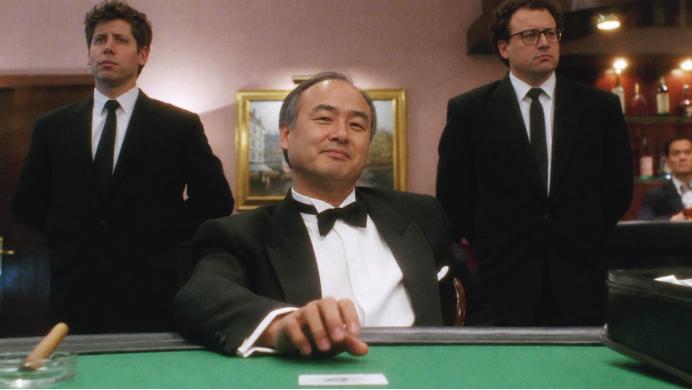
Image generated by AI
Earlier this month, SoftBank just completed a new $10 billion investment in OpenAI, bringing its total cumulative investment to $64.6 billion. Not long ago, a new batch of bonds it issued had a maximum coupon rate of 9.75%.
In addition, according to foreign media reports, OpenAI is seeking to complete a new round of financing before Anthropic's expected mid-November listing. However, as some investors are hesitant about its high valuation, the target valuation of this round has been cut from $1.4 trillion to $1.25 trillion, a shrinkage of $150 billion. As an existing investor, SoftBank was also previously exposed to be in talks to continue participating in this round of investment.
Going forward, SoftBank also plans to continue investing in AI infrastructure, and is even considering acquiring a US security giant worth tens of billions of dollars.
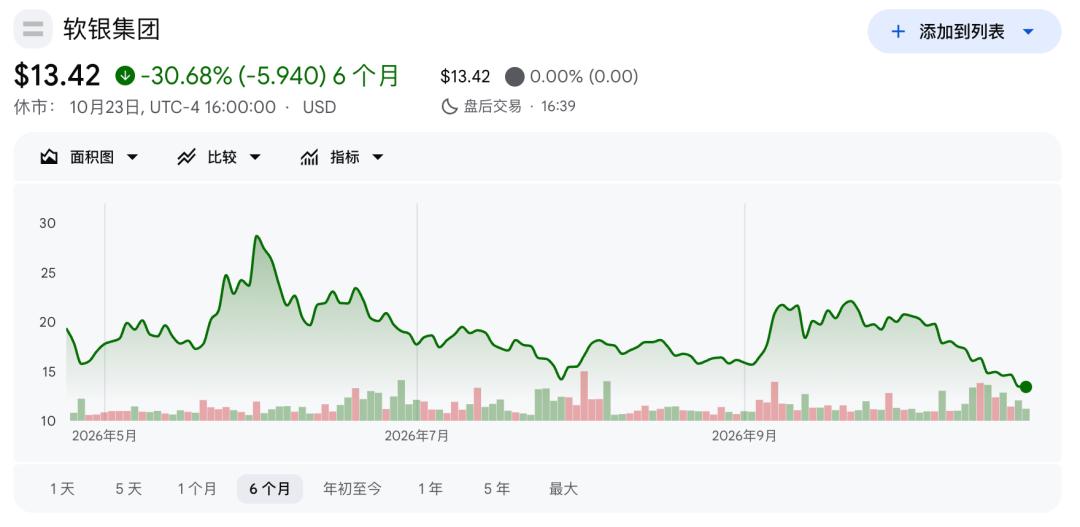
Meanwhile, SoftBank's share price has fallen by more than half from its high point in June.
A
Among major Japanese enterprises, SoftBank's default insurance price now ranks first, more than 130 basis points higher than Nissan Motor, which ranks second.
Some analysts who have long followed SoftBank have expressed concerns about Masayoshi Son's investment strategy.
On October 14, David Gibson, an analyst at MST Financial, said in an interview with the media that he directly compared SoftBank to a game of roulette. He said that in the past, SoftBank bet on many numbers at the roulette table. Now it only bets on red or black, either losing all or winning all. In Gibson's view, SoftBank is concentrating more and more bets on a small number of AI assets.
However, for investors who really need to consider whether to buy SoftBank bonds, such risks are not easy to accept.
James Athey, fixed income portfolio manager at UK asset management firm Marlborough, said SoftBank's investment strategy is too aggressive and its investment is too concentrated, with almost all bets placed on a single track. Even when considering high-yield bonds for investment, he would not choose SoftBank as his first option.
Another analyst Amir Anvarzadeh believes that Masayoshi Son's bet this time is larger than ever before, and directly advises investors to short SoftBank's stock.
Masayoshi Son still believes that AI will create amazing wealth, but in the bond and stock markets, some people have begun to make alternative preparations for his high-stakes gamble.
However, Masayoshi Son should be no stranger to such a situation.
Four years ago, SoftBank also went through a similar crisis.
In 2022, global tech stocks were hit by sell-offs, the valuations of a batch of tech companies that Masayoshi Son held heavy positions in shrank sharply, and the Vision Fund suffered consecutive huge losses. The financial report released in November that year showed that the Vision Fund lost about $7.2 billion in the July-September quarter, and it had just lost about $17 billion in the previous quarter.
It lost more than $24 billion in just half a year, which would make anyone break out in a cold sweat.
Masayoshi Son, who used to look for investment opportunities everywhere, had to put away his offensive posture. SoftBank drastically cut new investments, sold a large number of Alibaba shares to improve its financial position, and launched layoffs in September that year, cutting about 150 jobs in total across the Vision Fund and the group's international business.
At the financial report press conference on November 11, Masayoshi Son announced that he would no longer attend SoftBank's quarterly earnings briefings for a period of time in the future, and devote more energy to Arm, its chip design subsidiary.
Masayoshi Son once said that he was born to be an aggressive person. But that time, he chose to retreat and defend.
SoftBank started to retain cash, reduce investments, and wait for the market to improve. It was not until 2023 that Masayoshi Son gradually regained his offensive rhythm.
Now, four years later, SoftBank's credit risk indicators have returned to a similar level.
However, this time, Masayoshi Son does not seem to plan to stop.
B
In February this year, SoftBank announced that it would make an additional $30 billion investment in OpenAI, which was planned to be paid in three installments in April, July and October respectively. Adding the previous investment, SoftBank's total capital invested in OpenAI has reached $64.6 billion (equivalent to about 4.315 trillion RMB), holding about 13% of the shares.
Obviously, such a huge sum of money cannot all come from the cash on hand.
In March, SoftBank signed a $40 billion bridge loan agreement with banks, mainly to support its investment in OpenAI — the so-called bridge loan refers to borrowing a sum of short-term funds for emergency use first, and then repaying it through other financing methods later.
SoftBank successively withdrew $30 billion from the agreement. On September 15 this year, it repaid the remaining $25.9 billion loan in advance, and canceled the unused $10 billion quota at the end of the month. So far, this $40 billion bridge financing agreement has been settled.
However, paying off the bridge loan does not mean that SoftBank has got rid of the corresponding financing burden, and part of the capital demand is met through long-term bonds, other financing and asset realization.
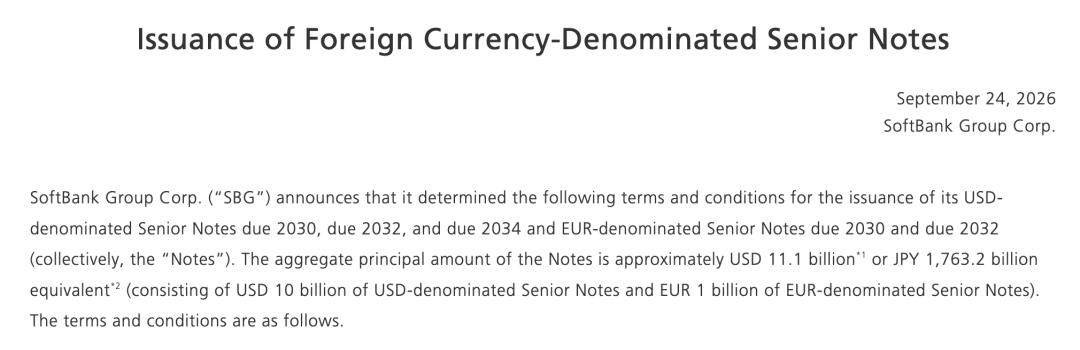
On September 24, SoftBank announced the issuance of US dollar and euro bonds with a total amount of about $11.1 billion, including a $4.5 billion US dollar bond maturing in 2034 with an annual coupon rate as high as 9.75%.
This is the highest coupon rate for any bond SoftBank has ever issued. In contrast, a batch of bonds issued by Alphabet, Google's parent company, in August this year that matures in 2033 has a coupon rate of only 5.2%.
Wall Street has begun to ask Masayoshi Son to pay a higher price for his high-stakes gamble.
However, SoftBank's management does not seem to think that the borrowed money is too expensive. On October 14, Alex Clavel, head of SoftBank Vision Fund Management, explained in a media interview why SoftBank would rather bear high interest rates than sell the assets in its hands.
He said: "The reason why we borrow money is largely because we don't want to sell assets that we believe will continue to appreciate."
In the view of SoftBank's management, OpenAI has enough room for appreciation in the future, and even if the current borrowing cost is close to 10%, it is still worth continuing to hold.
Moreover, Masayoshi Son is not satisfied with the $64.6 billion he has already invested. According to foreign media reports, OpenAI is accelerating to raise a new round of financing, and SoftBank is also in talks to participate in the investment. It is not yet clear how much capital SoftBank plans to put in, but if it continues to follow up the investment, it will be a new capital demand.
In addition to OpenAI, SoftBank has also spent a lot of money elsewhere.
At the end of September, it just completed the acquisition of DigitalBridge, a data center investment management company, for about $3.1 billion. Earlier, SoftBank had agreed to acquire ABB's robotics business for about $5.375 billion, with the transaction scheduled to be completed in the second half of this year.
Recently, Masayoshi Son has set his sights on Allied Universal, a US security giant. According to foreign media reports, SoftBank is in initial talks to acquire this company, with a potential equity valuation of up to about $18 billion, and if debt is included, the total transaction value may reach $30 billion.
OpenAI is still raising financing, data center and robotics businesses are still expanding, and new acquisition plans have emerged.
However, at least according to the previously disclosed financial data, SoftBank still has a certain capital margin and is not at the end of its tether.
As of the end of June this year, the value of SoftBank's held investment assets was about 83.11 trillion yen, and the net debt on a group-wide basis was 10.81 trillion yen, corresponding to an LTV (loan-to-value ratio) of 13%.
This indicator measures the ratio of net debt to the value of held assets. The management standard SoftBank set for itself is not to exceed 25% under normal market conditions, and even in extreme cases, it must be controlled within 35%.
13% still has a certain space away from the upper limit of 25%.
But these are all data as of the end of June. Since then, SoftBank has continued to complete huge investments and acquisitions, and the market price of its held assets has also fluctuated significantly. Especially for unlisted companies like OpenAI, even if the equity valuation keeps rising, it does not mean that SoftBank can convert them into cash at any time.
Sharon Chen, a credit analyst at Bloomberg Intelligence, estimates that SoftBank's net cash outflow will reach at least $6 billion in the fiscal year ending March 31, 2027. If it continues to expand AI investment or complete the Allied Universal acquisition, SoftBank will need to raise more capital, and the LTV may gradually approach the 25% management upper limit.
Masayoshi Son does hold a large number of valuable assets, but valuable assets cannot be directly used to pay bond interest after all. What's more, the prices of these assets are not stable.
If core investments such as OpenAI continue to appreciate, SoftBank can use the growing asset value to support the next round of financing and investment.
But if the valuation of the AI market starts to decline, the situation will reverse: assets shrink, financing space narrows, while the debts that have been borrowed and the interest that needs to be paid will not decrease accordingly.
C
SoftBank's creditors are not the only group of people who feel nervous.
On October 20 US time, according to foreign media reports, Wall Street is seeing a boom in buying default insurance for AI-related enterprises.
According to statistics from Morgan Stanley, in July this year, the average weekly transaction volume of CDS of companies including Oracle, SpaceX, Alphabet, Amazon, Meta, Broadcom and NVIDIA was less than $2 billion; by September, this figure had exceeded $9 billion.
At the same time, the AI industry is borrowing more and more money. According to statistics, since 2026, AI-related enterprises have raised a total of about $466 billion through bond issuance, private credit and other methods, while the figure in the same period last year was only $101 billion.
Not all investors who buy default insurance do so to protect the bonds in their hands. Some equity funds and multi-asset funds have begun to use CDS to hedge the risk of potential declines in AI stocks.
More and more people are starting to prepare in advance for possible troubles in AI investment.
This concern does have a realistic basis. On the same day, The Wall Street Journal disclosed the latest draft of Anthropic's IPO prospectus.
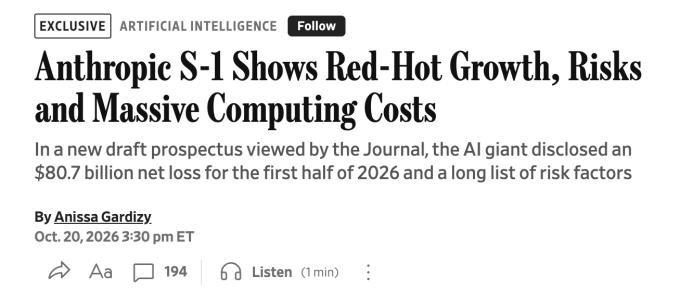
In the first half of this year, Anthropic recorded a book net loss of $80.7 billion, a sharp expansion from $13 billion in the same period last year. However, $72 billion of this came from accounting expenses generated by changes in the value of financing instruments such as convertible notes, which does not mean that the company has actually burned such a huge amount of cash.
What deserves more attention is the computing power expenditure. Anthropic spent nearly $9 billion on computing power and infrastructure in the first half of this year, which has exceeded the $7.3 billion for the whole of last year. According to the draft prospectus, counting the transactions still under negotiation, the scale of computing power expenditure in the coming years may reach $7500 billion, of which more than $6000 billion involves signed agreements.
Although Anthropic's revenue in the first half of the year has grown to $16.3 billion, such a huge long-term computing power commitment will still test its cash flow in the future.
For AI infrastructure companies, this problem is even more realistic.
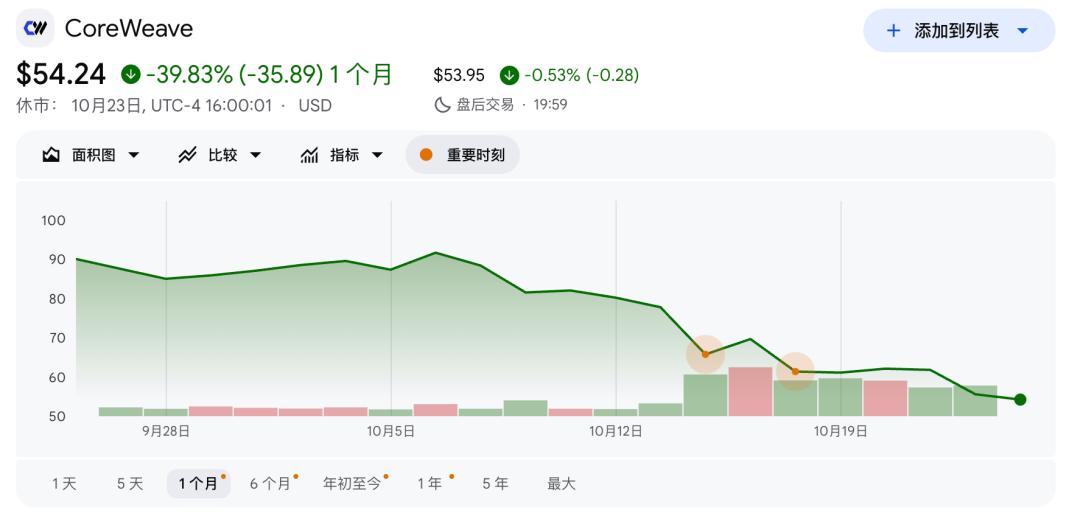
Take CoreWeave, a cloud computing company invested by NVIDIA, as an example. It borrows heavily to buy GPUs and build data centers, and then rents out computing power to customers such as Microsoft.
As market concerns about AI debt risks heat up, CoreWeave's share price has plummeted throughout October. As of October 23, its cumulative decline has been close to 40%. The credit market has also issued a warning: its 5-year CDS quote has broken through 1100 basis points, and the yield of some of its bonds has risen to around 16%.
AI companies need computing power, data centers need capital, and chip companies need these customers to keep buying GPUs.
Several companies seem to be running their own respective businesses, but the capital demands behind them are increasingly closely linked.
On