Turning veteran pre-sales experience into corporate assets: Solution Agent empowers new hires to write proposals at the level of seasoned experts.

"Intelligent Solution Editor" for SMEs: A product knowledge base that matches solutions for different customer scenarios
For SMEs such as system integrators, equipment manufacturers and agency service providers, "obtaining business opportunities — submitting solutions" is the first hurdle in sales: customer scenarios are varied, solution requirements differ from each other, and there are only a few people in the company who can write solutions. One day of delay in submitting the solution will reduce the deal closing probability by one point. A more common dilemma is that customers often find it difficult to describe the specific difficulties and current situation they are facing in detail, while the solution must be fast and targeted. Every time a new requirement is received, the pre-sales team has to spend time communicating with the sales staff, and even piece together the solution by imagination. The solution formed in this way is difficult to impress customers, and it is easy to make customers question the professionalism of the company, thus reducing the deal closing rate.
"Intelligent Solution Agent" is an agent workstation for documents: Enterprises deposit their own product materials and solution paradigms into solution templates and writing knowledge bases, then upload the customer's background materials. The agent generates articles chapter by chapter according to the template, automatically formats the layout, and directly outputs a Word solution that can be delivered to customers.
High Demands and Difficult Response: The Solution Delivery Dilemma Faced by SMEs
Unlike large enterprises that have dedicated solution departments, the solution work of SMEs is often handled by one person for multiple sales demands, and even the salesperson himself is the solution writer. Customers' demands are mixed with real and fake ones: some are long-standing pain points that need to be solved practically, while others are just casual ideas to see if you can realize them. The authenticity of demands can be judged by the salesperson's experience, but whether the deal is closed does not entirely depend on the authenticity of the demands — real demands may fail due to competitors snatching orders, and seemingly casual questions may lead to a closed deal due to the attention of a certain leader. Therefore, for SMEs, every customer communication and every business opportunity clue must be paid enough attention to, which is the hope for the development of the enterprise. Logically, the salesperson should deliver a high-quality solution to the customer that fits the actual situation, can solve the customer's problems, and can reflect the advantages of the company's products. But this is precisely contradictory to the situation of SMEs with few staff and insufficient energy.
At present, most general AI tools have obvious shortcomings in assisting solution production: the dialogue model only outputs a piece of bare text, and the format and tables need to be adjusted by the user; the model will even "fabricate" parameters — the model generated last time does not match the one generated this time; for long solutions generated in segments, the consistency of the content before and after is more difficult to unify. As an official document to be submitted to customers, these problems will directly affect customers' judgment on the company's professionalism, which is by no means a trivial issue.
Precipitate "what to sell" into a knowledge base, upload "what customers want" as materials
The approach of "Intelligent Solution Agent" is to split the solution production into "one-time precipitation and repeated invocation". On the enterprise side, through the knowledge base workstation, product parameters, quotation system, successful cases, solution paradigms and verification rules are entered one by one to form a proprietary knowledge base — it determines what to write in the solution, where to get the parameters, and which expressions are not allowed to appear. This is equivalent to turning the experience in the minds of senior pre-sales staff into the company's assets: the experience will not be taken away by personnel changes, and new employees can also write solutions at the level of experienced veterans after taking over the work; modifying the knowledge base will change the generation behavior, and the caliber of the solution will always follow the company's strategy.
On the customer side, after the bidding documents, requirement descriptions and background materials are uploaded, they are automatically parsed and stored in the database. The writing readiness check before the agent starts writing will prompt what is missing. During the writing process, materials are automatically retrieved and the source of references is indicated. The generation is not "generated through chatting paragraph by paragraph": 12 structured document tools allow the agent to directly write by section, insert tables, illustrations and modify paragraphs on the document. Five-level headings, automatic table of contents, cover, header, page number and caption tables are all completed at one time. The exported file is a Word document that can be directly submitted to customers. All the values in the full text have only one source — the project parameter table and the list of business objects. The consistency check strictly ensures that the model, quantity and amount are consistent before and after. All modifications are automatically backed up and can be rolled back at any time.
Compared with general language models such as Doubao, the differences are mainly in two points: first, the output — not a paragraph of text, but a well-formatted, deliverable official document; second, controllability — the parameters, quotations and expression calibers are determined by the enterprise's own knowledge base, not by the model's ad-hoc performance.
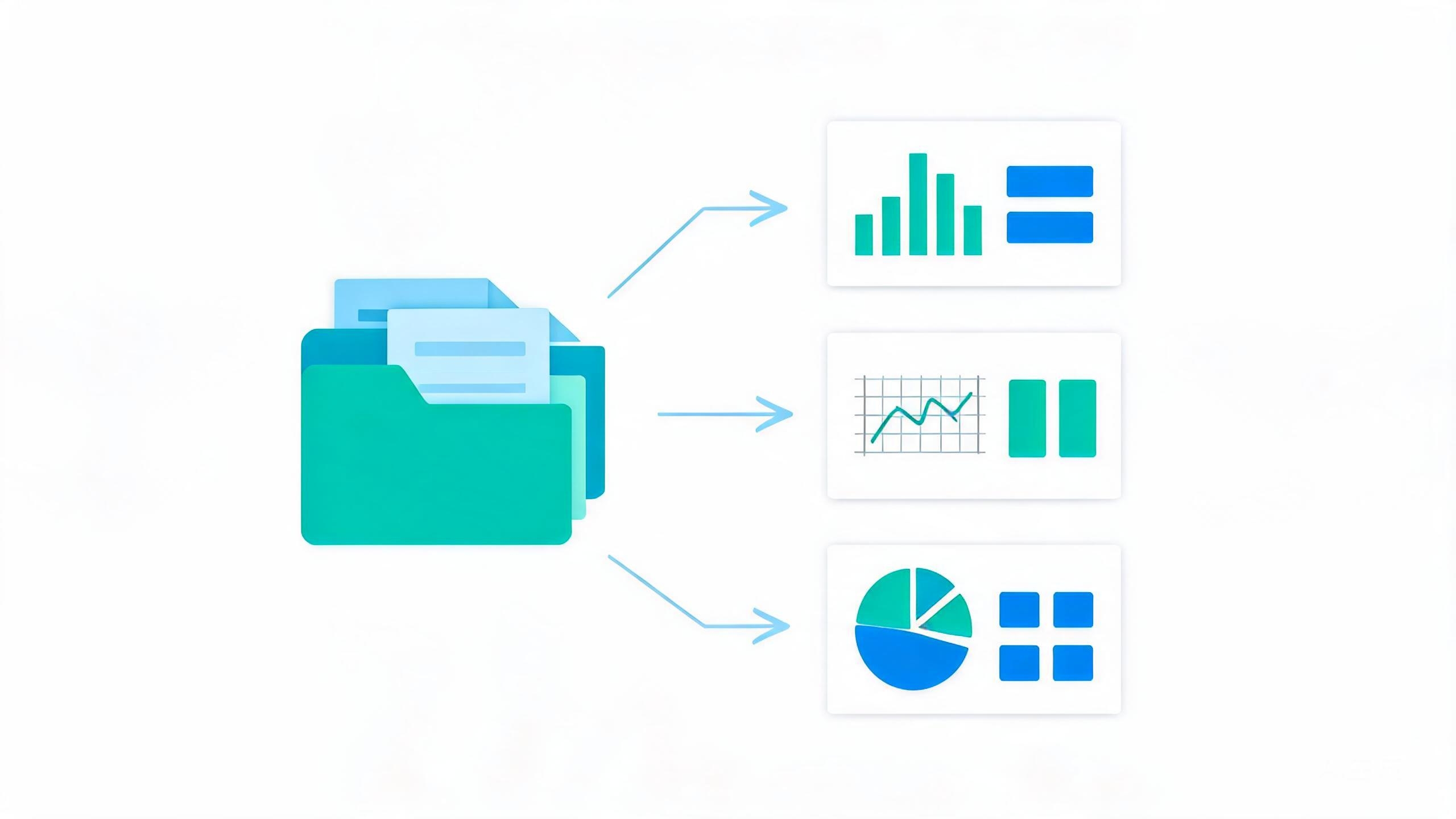
Schematic diagram of solution generation with a proprietary knowledge base matching different customer scenarios
From a single solution to a full set of sales arsenal
For a small and medium-sized enterprise, the usage of this mechanism can be very specific: Step 1, import product brochures, parameter tables and several historical winning solutions into the knowledge base, and select the solution template commonly used by the company; Step 2, when receiving new business opportunities, upload the customer's bidding requirements or requirement descriptions; Step 3, clarify the key points in the dialogue, and a Word solution that matches the customer scenario and contains the company's own products and quotation system is formed, and the details can be further fine-tuned in the dialogue. The solution production has changed from "writing from scratch for each customer" to "one-time precipitation and reuse each time", and new employees can also independently undertake solution writing tasks.
The applicable user portrait is also very clear: system integrators and engineering service providers that need to respond to customer demands repeatedly; product and equipment manufacturers with fixed product lines whose solutions change with customer scenarios; agents and service providers that represent multiple brands and need to configure solutions according to customer combinations; as well as consulting and service teams that undertake various document demands. For enterprises with complex solution systems, the team can also provide customized knowledge base services to directly embed industry practices into the knowledge base.
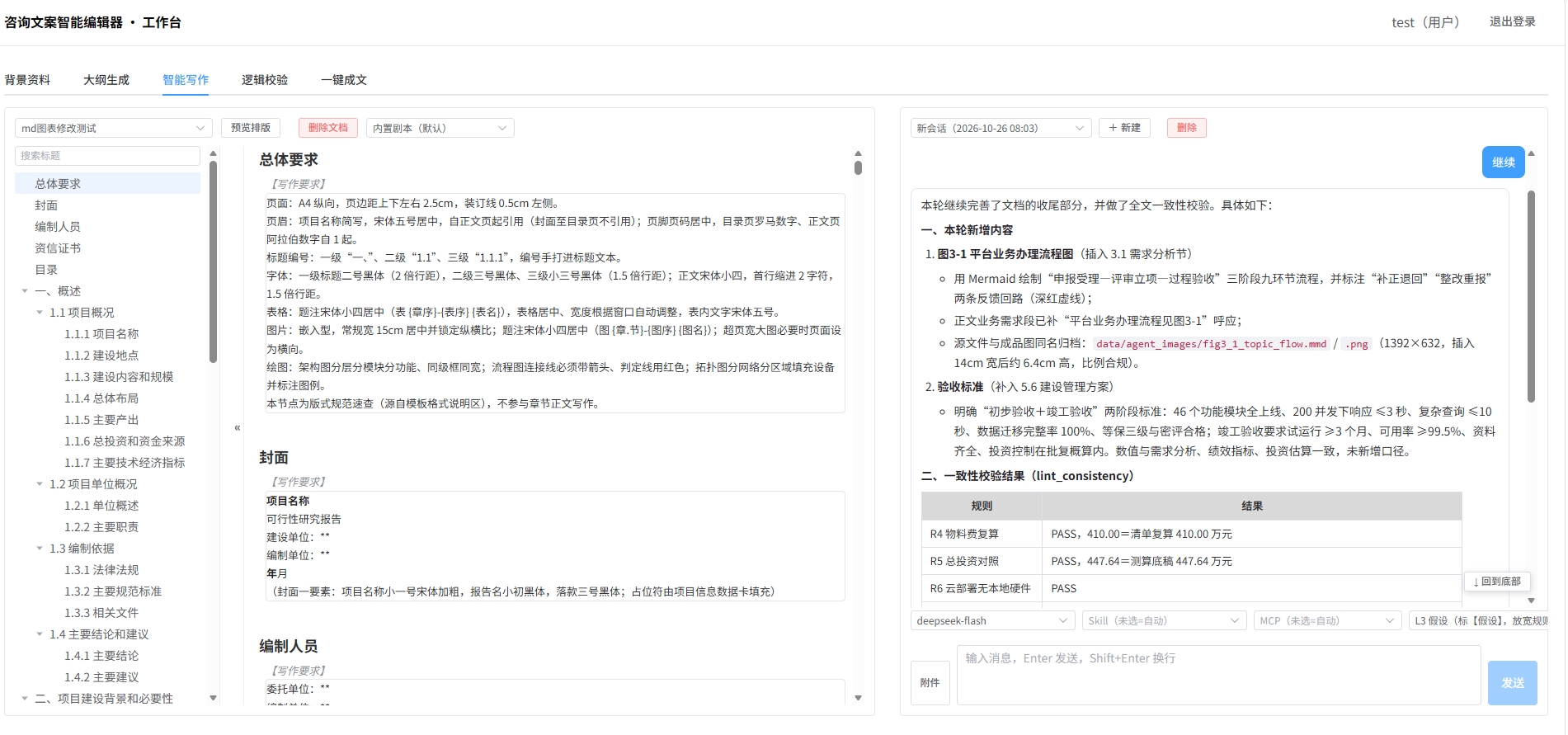
The currently operable and experiential page of the Intelligent Solution Agent
In terms of progress, the core product links have all been implemented: 12 structured document tools, the system of templates and writing instruction cards, knowledge base and consistency check, and deterministic export process have all been realized. The full-process verification from template parsing, chapter-by-chapter writing, consistency check to typesetting and export has been completed with a set of real feasibility study materials for government investment informatization projects.
In the team's view, the solution writing for SMEs is a scenario where "the content is mostly fixed and the combination changes at any time", which is naturally suitable for the production method of "knowledge base + template + structured generation". The team's goal is to enable every small and medium-sized enterprise to have a set of sales arsenal that grows with its business: as customers change and scenarios change, the solutions are always professional, timely and consistent in caliber.
Project Contact: Chen Zhe