"Green Bubble" VS "Red Fruit": With a 100% revenue incentive policy implemented, Tencent's counteroffensive in the short drama sector has officially kicked off.
The competition among internet platforms for users' attention has entered a new phase.
According to data from Nomura Securities, in August 2026, among the top 50 apps in China by monthly usage duration, the total usage duration share of ByteDance's product ecosystem reached 41.8%, representing a 0.9% month-on-month increase. During the same period, Tencent's product ecosystem accounted for 28.6% of the total usage duration, down 0.5% month-on-month.
Short dramas have become the key growth driver for ByteDance amid the widening gap. Data from QuestMobile shows that in the third quarter of 2026, users of Hongguo Short Drama spent an average of about 151 minutes per day on the app, ranking first among all national-level apps with over 100 million monthly active users, including WeChat, Douyin, Kuaishou and Xiaohongshu.
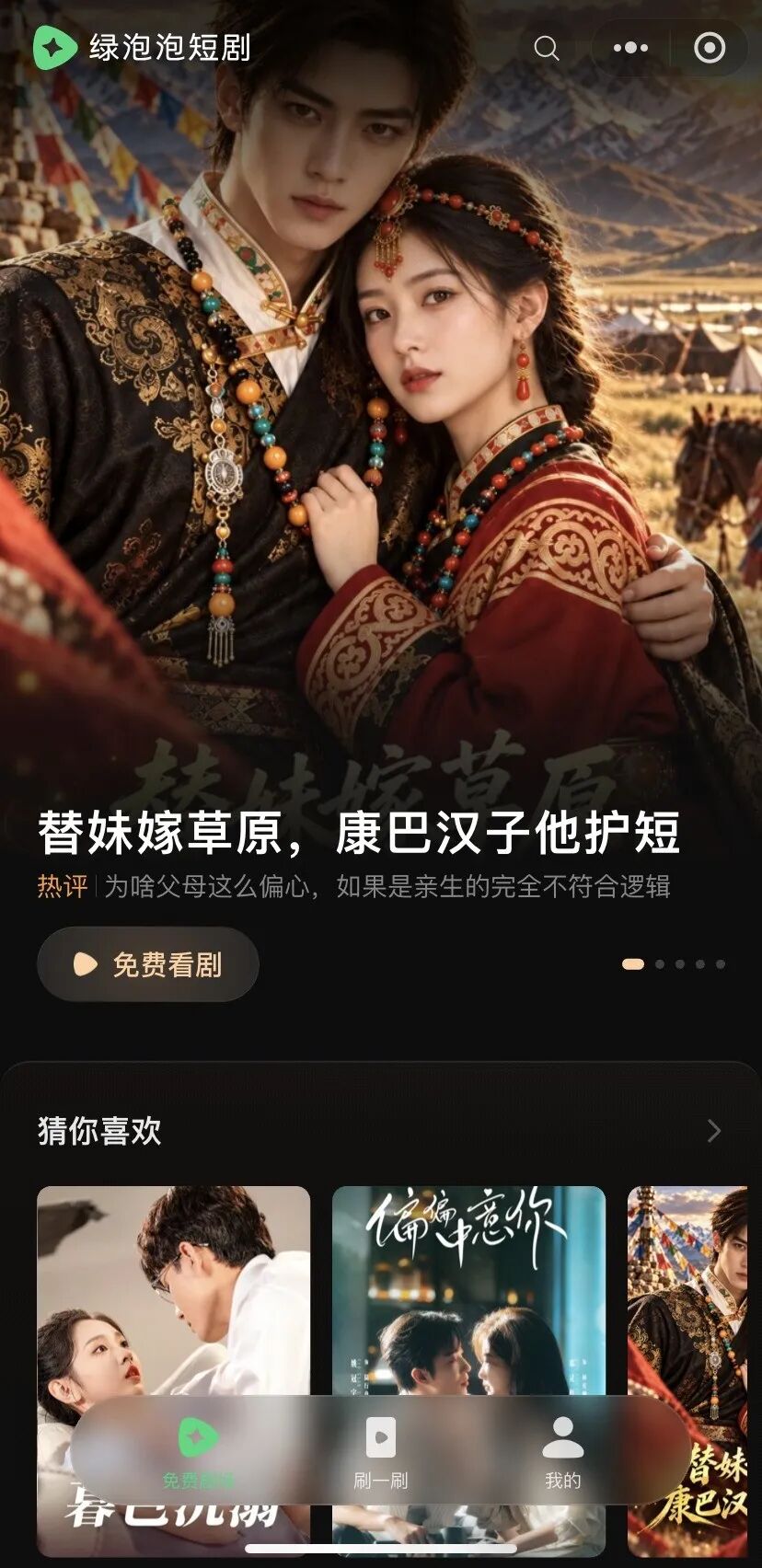
Against this development trend, Tencent recently officially launched "Green Bubble", a product directly competing with Hongguo Short Drama. However, this is not an independent short drama app, but a mini-program embedded in the WeChat ecosystem. Its internal interface features a simple overall design, and it follows the existing user habits of WeChat Channels. Leveraging WeChat's massive national user base and acquaintance social network, Tencent's entry into this track is widely regarded as a key move that will shape the future of the short drama industry.
Back to the "Original Starting Point"
Tencent Launches Its Counterattack
From the perspective of industry development, the short drama business first gained public attention on WeChat Mini Programs.
At that time, the rapid development of short videos sparked a new round of marketing transformation. In the online literature sector, some practitioners tried to convert novel plots into simple short videos. Some content even simply read the original text of novels and paired it with various decompression videos, with the sole purpose of diverting traffic to online novels or online literature platforms.
However, this unintended move generated massive traffic. Soon, such videos gradually evolved into short drama series with coherent plots, and the traffic diversion destination shifted to WeChat Mini Programs that support full playback of entire episodes. This was because the business model of mini-program game distribution was already very mature at that time, where merchants paid for traffic acquisition to convert users into paying customers. Meanwhile, the widespread adoption of WeChat Pay provided a highly accessible payment channel. These short videos quickly realized monetization along this path, marking the predecessor of paid short dramas.
From 2022 to 2023, paid short dramas hosted on WeChat Mini Programs ushered in an explosive period, with countless wealth-building myths such as "10 million RMB in top-up revenue within 24 hours, 100 million RMB in transaction volume in 8 days" still fresh in the public memory.
However, the highlight moment of the paid model did not last long. From a commercial perspective, the production cost of a single short drama is only tens of thousands to hundreds of thousands of RMB, and at the price of 9.9 RMB to unlock each subsequent episode, viewers need to spend over 100 RMB to finish a whole series, making it an extremely lucrative business. But for content creators, the business carries huge gambling risks: every drama requires heavy investment in traffic acquisition, which goes to waste if the work fails to go viral, while a hit can bring extremely high returns. As more similar content flooded the market, traffic acquisition costs kept rising. According to data from that period, traffic acquisition costs could account for 70% to 80% of the total cost for a single short drama.
At this stage, WeChat only earned a small "toll fee" from user payments and a portion of the traffic acquisition revenue. In an industry environment where long-form dramas still dominated content operations, Tencent's ecosystem had not yet prioritized short dramas as a key development direction. Users diverted by drama producers from various platforms were scattered across different third-party short drama mini-programs.
ByteDance reacted much faster. In mid-2023, Hongguo Short Drama was launched, bringing the free content model that had already been proven successful by Fanqie Novel, and quickly rewrote the rules of the entire industry. The subsequent explosive growth of the short drama industry speaks for itself, and Hongguo has since become an unshakable industry leader.
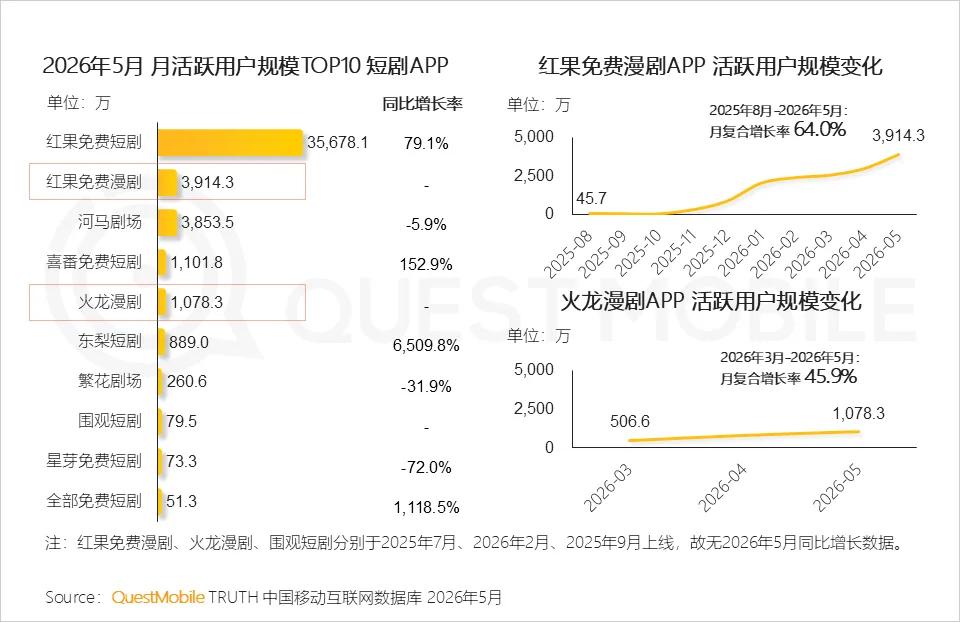
Data from QuestMobile shows that in May this year, Hongguo Short Drama reached 356 million monthly active users, taking an absolute leading position in the industry. In terms of daily active users, according to the latest monitoring data from QuestMobile, Hongguo's daily active users hit 168 million in July this year, representing a 107% year-on-year increase. For comparison, the total daily active users of the four major long video platforms iQiyi, Tencent Video, Youku and Mango TV amounted to 155 million in the same period, and the gap between the two sides keeps widening.
Now, after multiple rounds of trials, Tencent has chosen to return to WeChat Mini Programs, launching its counterattack at the very place where short dramas first exploded. Developed by the WeChat Short Drama Content Center, Green Bubble aims to integrate previously scattered short drama mini-programs, acting as a platform-level short drama distribution entry to gather scattered users into one single pool. On the commercial front, Green Bubble also adopts the "free content + ad monetization" model, which is clearly designed to directly compete with Hongguo Short Drama.
The Confidence Behind Green Bubble
Over 500 Million Users on Short Drama Mini Programs
With Hongguo occupying the vast majority of the short drama market share, Green Bubble backed by Tencent is currently the only platform that has the potential to reshape the industry landscape.
The reason lies in the fact that the declining influence of the paid short drama model does not mean that users who watch short dramas on WeChat Mini Programs have left the ecosystem.
According to data from QuestMobile, in May this year, the user scale of independent short drama apps reached 402 million, while the user scale of WeChat short drama mini-programs grew to 508 million. There are a large number of active users among them: in February this year, the monthly active users of WeChat short drama mini-programs already hit 427 million, with 54 mini-programs recording over 1 million monthly active users. The top platforms, Zhang Yang Drama and Jiuxi Theater, each have monthly active users exceeding 50 million.
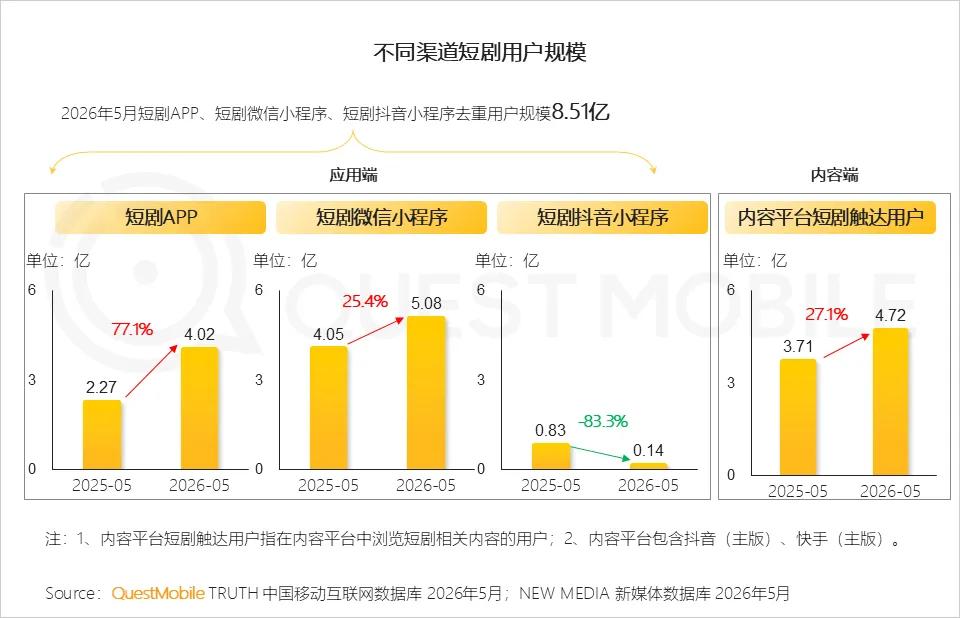
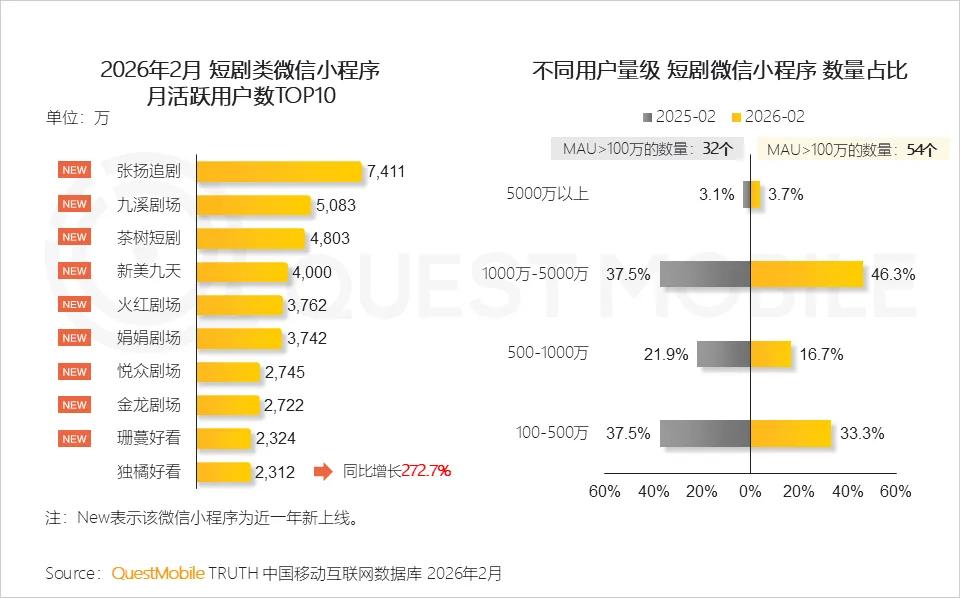
Clearly, compared with other latecomers, users have already formed the habit of watching short dramas on WeChat, which is the core factor why Green Bubble is widely expected to succeed. In terms of user portraits, the users of the two channels are not completely overlapping: independent short drama apps are more favored by young people, while WeChat short drama mini-programs have a distinct advantage among the silver-haired population, with users aged 51 and above accounting for 31.2% of the total. If these users are integrated into a unified platform, its influence will be too significant to ignore.
Apart from the advantage of the massive user base, the operation strategy adopted by Green Bubble has already been proven effective by Tencent in the short video sector.
Previously, facing the rapid rise of Douyin, Tencent tried to restart Weishi in 2018, announcing 3 billion RMB in cash subsidies and full traffic support across all its product lines, but the attempt ended in failure. However, in 2020, when the short video market was already firmly divided by Douyin and Kuaishou, Tencent successfully broke through the mature market with WeChat Channels. The key to its success is that WeChat Channels is built on top of the WeChat ecosystem and social network, and its national-level social entry forms a barrier that other platforms can hardly overcome. According to data disclosed by multiple institutions, the daily active users of WeChat Channels have exceeded 600 million in the third quarter of this year.
Today, the logic of Green Bubble in the short drama track is exactly the same as that of WeChat Channels in the short video track.
Tencent has been constantly adjusting its exploration direction in the short drama sector. Apart from setting up dedicated short drama sections within Tencent Video and launching corresponding support policies, the platform also incubated an independent short drama app called "Mars Short Drama Club" (later renamed Mars Drama View) in 2025. However, under the dominant position of Hongguo Short Drama, it is very difficult to persuade users to migrate to a new independent app. This time Tencent did not waste resources on independent products, but quickly adjusted its strategy, incubated Green Bubble within the WeChat ecosystem, and tried to leverage its social network to reshape the foundation of the entire short drama industry.
Based on WeChat's strong social attributes, the content distribution logic of Green Bubble is very different from the algorithm-driven logic adopted by ByteDance's ecosystem. Typical prompts such as "Your friend is watching" and "Your friend has watched" are equivalent to acquaintance recommendation, which can more easily drive users to click on the content.
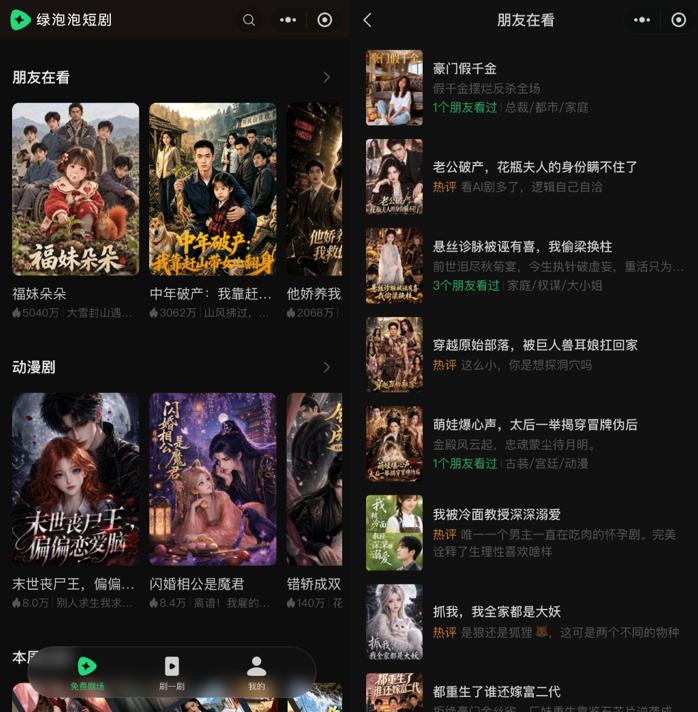
However, this function is still controversial to some extent now: exposing the behavior of chasing short dramas to the acquaintance social circle has become a psychological burden for some users. But for now, this does not change the positive industry judgment, as WeChat Channels also faced similar controversies in its early development stage. WeChat does not plan to set short dramas as a first-level entry, and it is up to users to decide whether to open the mini-program according to their own consumption habits. The scenario of casually watching short dramas in the app that users open every day is the most imaginative growth prospect for Green Bubble at present.
Revenue Incentive Reaches 100%
Core Goal Is to Retain More User Usage Duration
What is more convincing is that hit cases have already emerged.
Not long ago, the AI-simulated real-person short drama "Movie Star Yaya" launched on Green Bubble recorded over 100 million views within 3 days, with the peak number of concurrent online viewers exceeding 2 million. The average viewing duration per user on both the mini-program and WeChat Channels exceeded 30 minutes, reaching over 10 million users in total, and generating millions of RMB in advertising revenue across the two platforms.
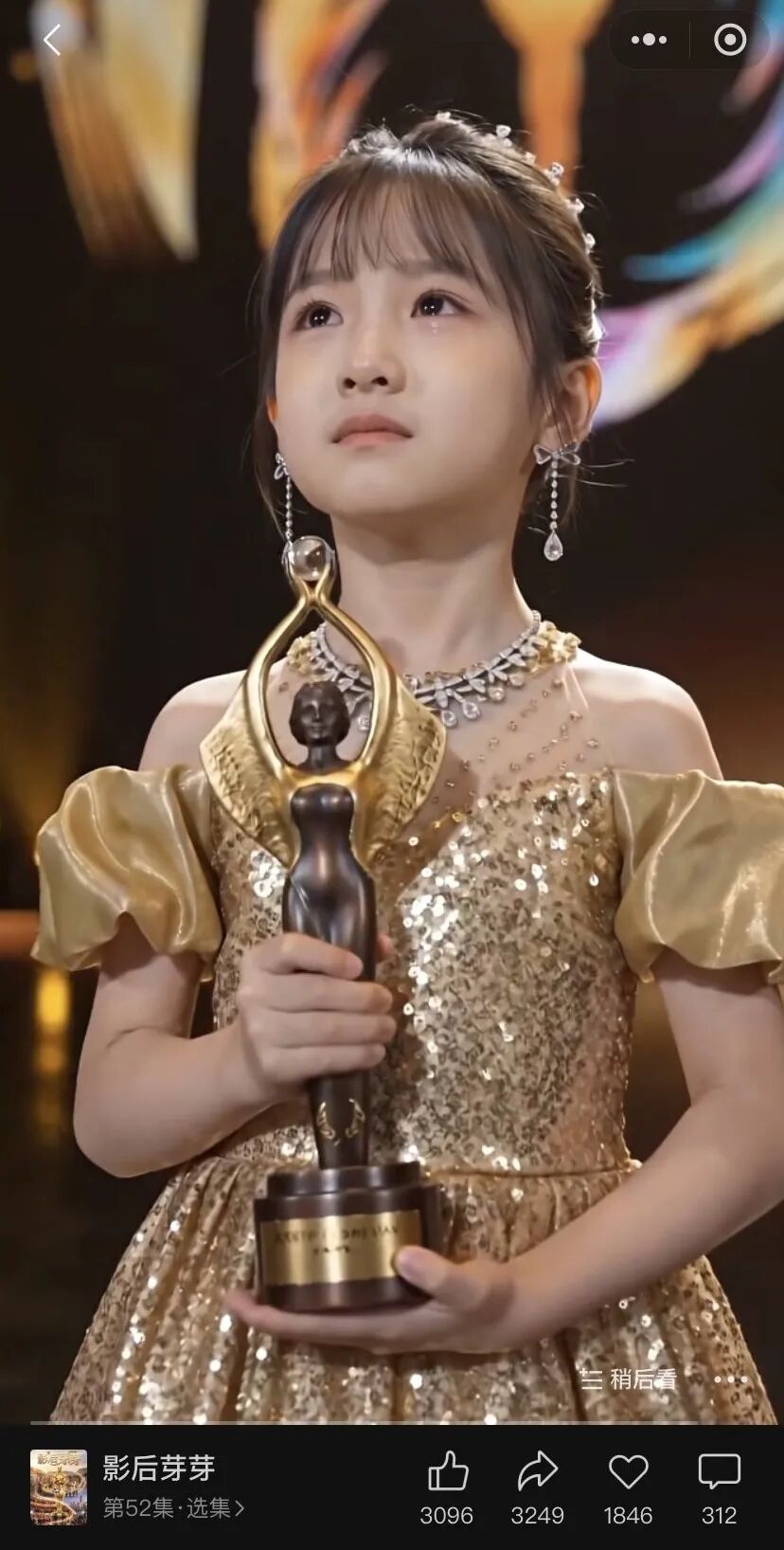
The outstanding performance in a short period of time not only proves once again that WeChat Mini Programs are still fertile ground for short drama growth, but also reflects that Tencent's relevant support policies have achieved initial results.
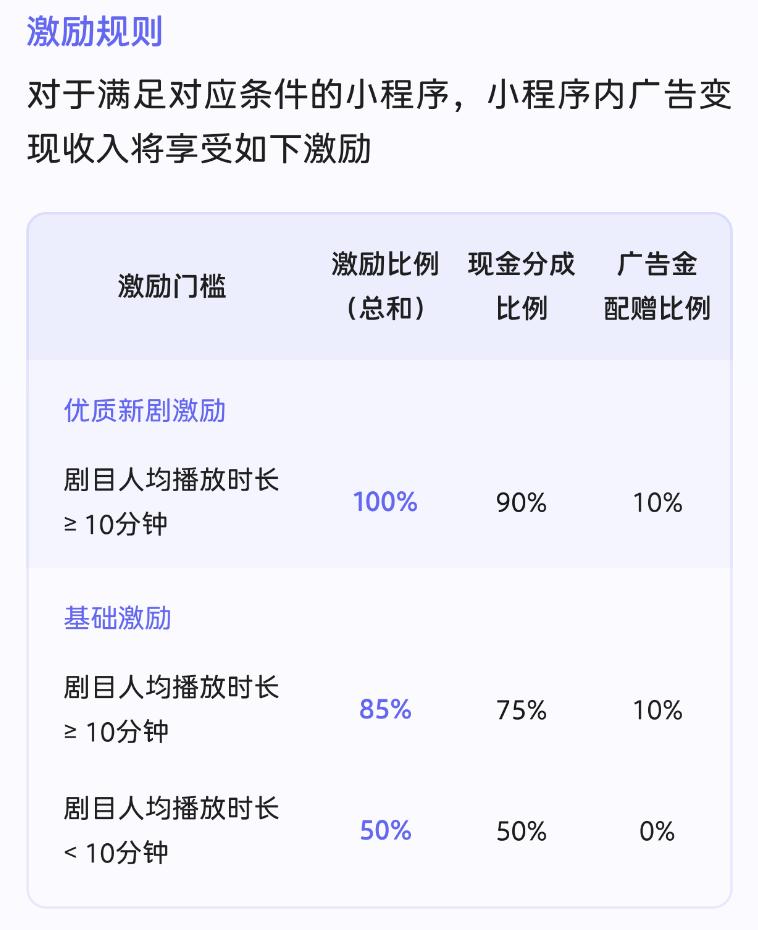
According to the latest incentive policy disclosed by WeChat, in the fourth quarter of this year, high-quality new short dramas that are jointly distributed via Green Bubble, launched within 7 days and achieve an average viewing duration of 10 minutes per user can enjoy 100% revenue incentive for 7 consecutive days, including 90% cash share and 10% advertising credit. In addition, the platform recently launched an incentive campaign for micro short dramas adapted from official account novels, with Green Bubble short drama mini-program and native short dramas on WeChat Channels as the distribution carriers.
In addition, Tencent skipped the window of explosion for live-action short dramas and took this key step at the stage of AI comic drama explosion, which is also quite thought-provoking from the perspective of timeline. On the one hand, this is a rare opportunity for curve overtaking: AI comic dramas with shorter production cycles and lower costs have further raised the growth ceiling of the short drama industry. Under the exponential growth trend, the industry is in urgent need of more distribution channels. At the 2026 WeChat Open Class PRO event, Tencent announced that the number of comic dramas launched on the WeChat ecosystem in 2025 increased by 3380% year-on-year.
On the other hand, Tencent's core purpose of shifting the short drama focus back to WeChat Mini Programs is not to pursue short-term commercial growth, but to retain more user usage duration. As mentioned at the beginning of the article, against the background that the gap in user usage duration share between Tencent's product ecosystem and ByteDance's product ecosystem keeps widening, free short drama is a track that has been rapidly absorbing user duration in recent years, and Tencent can no longer stand by. The data disclosed by the official Green Bubble team also focuses on this dimension: the average user duration on the platform is about 5 times the industry average, and the user retention rate is more than 2.5 times the industry average.
From this perspective, Tencent's launch of Green Bubble is more of a defensive counterattack, and the product is still in the early testing stage. It is reported that the Green Bubble team currently has only about 10 members, and Tencent has not yet fully rolled out resource support. Whether it will increase investment in the future depends on whether the performance of Green Bubble can meet the expectations of the platform and the market.
This article is from the WeChat Official Account "Mirror Entertainment", written by Banzhan Cha, and published by 36Kr with authorization.