Do the occasional mistakes made by Manner's employees point to the "extreme compression" operating model that the brand is forced to pursue?
Manner, which follows the "two people per one store" model, locks most of its business volume in the morning hours.
For a period of time, Manner has seen a number of controversial incidents that are interesting and worthy of in-depth reflection and summary.
A customer in Guiyang bought a 473ml extra-large cup of Manner coffee, and after finishing the drink, found that a 355ml small cup was nested inside, and the product names marked on the two cups were different. The Manner store staff explained that they were too busy in the morning and did not notice the nested cups, and they had apologized and offered a full refund or a free replacement drink.
A consumer in Beijing with milk allergy placed 7 orders at the same Manner store in two months, paying extra to replace regular milk with oat milk each time, but the store mistakenly put regular milk in the drinks for all 7 consecutive orders.
The frequent occurrence of such controversies also exposes the problems in Manner's operation model. The nested cups incident is hardly an accidental slip of hand, and the wrong milk added is probably not a deliberate "prank". These are likely the inevitable employee operation error rates generated by extreme operation under Manner's model that compresses the manpower efficiency ratio to the maximum.
Just like most coffee shops, the majority of Manner's orders are concentrated in the morning, and Manner stores are usually staffed by only one or two people all year round, so omissions in details are unavoidable.
The affordable premium coffee track Manner has chosen is caught between the low-price shocks from Luckin Coffee and Cotti Coffee, and the "third space" experience positioning of Starbucks, so its fault tolerance margin is not wide in the first place.
The controversies may only be superficial. What is really worth paying attention to is how Manner's model compresses the whole day's business into two or three hours, how it realizes the operation of one store with only one or two employees, and how it finds its own position in the "extreme" price range that divides the domestic coffee market into two at present.
I
Morning peak congestion and the limit of one-to-two person stores: Are controversies the "inevitable result" of the model?
For Manner's employees, the period from 7 a.m. to 9 a.m. may be the real "battlefield".
To understand the busyness of frontline staff in offline Manner stores, Xinshi Research Institute conducted on-site experience in multiple Manner stores in different time slots of the morning and afternoon.
At 9 a.m. on a workday, the peak commuting hour, we visited a Manner store near an office building, and saw two shop assistants making coffee nonstop. Some customers were sitting waiting for their drinks, and multiple delivery riders were waiting at the front desk to pick up orders. The number of people on site did not seem very large, but queuing for placing orders was very common.
During our stay in the store, the order notification tone from the Manner workbench kept ringing from time to time.
When we scanned the code of the store's mini-program to place an order, we found that there were 12 pending orders before ours, with a total of 26 cups being made, and the estimated waiting time for picking up the drinks was about 20 minutes. Logically, this time point should be the clock-in time for most companies, or even earlier for some, but the order volume was still very high.
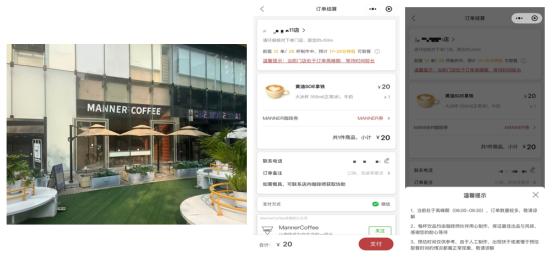
(Manner offline store in the morning hours)
The reason is very simple: apart from the immediate orders placed on the same morning, there are also pre-orders.
A Manner staff member named Paopao (pseudonym) in Shanghai told Xinshi Research Institute: "Almost all pre-orders are placed the night before."
Regarding the question of whether working at Manner is busy, Paopao said frankly that "the peak hours vary for different stores, depending on the specific location of the store."
From Paopao's perspective, the reason why Manner shop assistants are so busy in the morning is that when customers come to buy drinks very early in the morning, the drinks cannot be made immediately. There are a huge number of required procedures specified by the company in the morning. "You cannot start making orders just because the machine is ready, because the machine still needs to be adjusted, and you have to take photos to record after the adjustment."
After Paopao opens the coffee store every day, "there are a lot of things that need to be checked and photographed every morning, and all these records have to be uploaded before the deadline, so the morning is extremely rushed. There are also a large number of delivery orders, because the delivery order channel opens earlier than the in-store service."
In Manner's management system, there is a set of standardized processes and inspection procedures for employees. These processes usually come with certain operation specifications and recording requirements, which are necessary, so that employees need to prepare even earlier, which may lead to the "crowding" of working hours.
Paopao confessed to Xinshi Research Institute that some stores are extremely busy, just like her store. She has no time to stop and rest from the morning to after 11 a.m., because there are continuous delivery orders. Although there are not many in-store customers ordering for dine-in, the delivery orders never stop, especially when there are promotional activities, the store will be even busier.
In the afternoon, our survey found that many Manner stores are relatively deserted, with very few or even no consumers sitting in the store. Some stores show on the food delivery platforms that they close at 6 p.m., and customers can only make reservations for orders placed after that time.
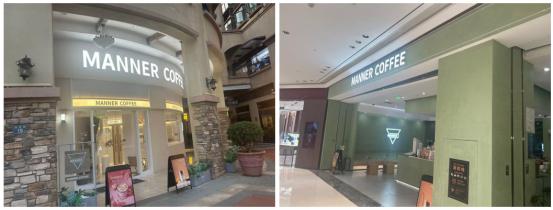
(Some Manner offline stores in the afternoon hours)
Paopao thinks this phenomenon is very normal, "Some stores close at 5:30 or 6 p.m., while some stores stay open until 10 p.m."
A large part of Manner's business is compressed into the two or three hours in the morning, and this extreme concentration of time directly determines its manpower allocation strategy.
Previously, Jiemian News reported that Manner allocates manpower according to store performance. Stores with daily turnover below 5,000 yuan are usually assigned only one full-time employee, and stores with daily turnover over 6,000 yuan are equipped with two employees. Calculated based on Manner's average unit price of about 15 yuan per cup, one employee needs to make nearly 333 cups of coffee a day, while also being responsible for order taking, cash register, stock arrangement and store cleaning.
Semi-automatic coffee machines are not very fast in making cups by nature. When superimposed with double peak orders, once the work rhythm is disrupted, the probability of making mistakes will rise significantly.
From the company's perspective, this is far more than just "saving manpower". It is probably a precise calculation of input-output ratio.
Most Manner stores are small window-type or compact stores with relatively controllable rent, but manpower is the most difficult cost item to compress and the most likely to get out of control in coffee retail.
Dynamic manpower allocation based on performance essentially takes labor force as a flexible variable: low-performance stores use 1 person to maintain basic operation, and high-performance stores use 2 people to sprint through peak hours, so as to avoid full-time fixed high manpower input.
The fact that two or three hours in the morning contribute most of the revenue means that the manpower efficiency per unit time is pushed to the extreme. The standardized process further reduces the dependence on personal skills, allowing new employees to take up the post quickly, but at the same time reduces the space for handling "exceptional situations".
This model also implies Manner's precise prediction of the time distribution of passenger flow. First of all, the coffee demand of office workers is highly concentrated in the morning commuting period. Manner actively caters to and strengthens this rule, locks part of the demand in advance through the pre-order mechanism, expands the service radius through food delivery, and minimizes the idle operation cost in off-peak hours through the minimalist store design.
The result is that the stores no longer pursue balanced operation throughout the day, but actively choose the strategy of "extreme operation at peak time, contraction at off-peak time". This model is financially efficient because the variable cost highly matches the revenue, but it pushes the fault tolerance rate in operation to the limit.
Manner's employees have to complete the standardized checks and cope with the sudden high order volume within limited time. The system gives priority to ensuring "the speed and quantity of coffee output" rather than "zero-error service".
The occasional omissions and mistakes may be the direct feedback of trade-offs under Manner's business model.
II
While balancing efficiency and revenue, is Manner also "testing" consumers' tolerance for errors?
The extreme compression management model adopted by Manner brings not only clear positive benefits, but also unavoidable negative costs, and directly shapes consumers' daily experience.
Consumers' product experience is not simply "good" or "bad", but the overall feeling of efficiency, price and quality.
Manner also has its own positive feedback in speed and predictability. For example, waiting is very common during the morning peak, but once the production process starts, the rhythm of making coffee is relatively compact. The semi-automatic machine plus relatively fixed formula ensures that the basic quality is stable in most cases. The carefully selected coffee beans and unified extraction standards are one of the core selling points that distinguish Manner from pure low-price players.
For many office workers, being able to get a cup of coffee with acceptable quality quickly in the morning is of great practical value. More importantly, this "fast enough and stable enough" experience reduces decision-making cost, so consumers do not need to compare repeatedly among numerous options, forming the path dependence of "just go to Manner".
Another detail is that Manner's 5-yuan discount for customers bringing their own cups further strengthens users' habits and stickiness, whose effect is far more than a simple discount.
When we placed orders and picked up drinks in multiple offline Manner stores, the staff would softly remind us: "Next time if you bring your own cup, you can get a 5-yuan discount." According to the sharing of netizens on social platforms, this discount is only applicable to in-store orders, and does not seem to apply to takeout and online orders.
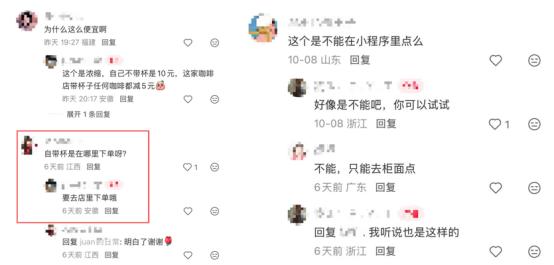
(Source: social platforms)
Therefore, many people will deliberately bring their own cups when going out in the morning, say "I bring my own cup" at the counter, and then get a 5-yuan reduction.
Over time, this has almost become a habit.
The brand gives up 5-yuan profit in exchange for relatively stable high-frequency repeat customers and predictable morning orders, and reduces the cost of disposable paper cups at the same time.
Manner's bring-your-own-cup policy has gradually changed from a "money-saving behavior" to a form of "self-expression", because it implies that consumers are pragmatic and quality-focused, environmentally friendly and shrewd. This subtle identity value allows Manner to build emotional connection among price-sensitive office workers, making it much harder to be poached by competitors than brands that only rely on price war.
Of course, the negative effect of Manner's business model is also obvious.
The error rate of Manner is easy to rise significantly during peak hours. For example, nested cups, repeated wrong addition of oat milk, and ignored special demands are all the results of details being squeezed under high pressure.
Service is almost compressed to the limit. With two people per store or even one person per store, shop assistants are too busy making coffee to have spare energy to deal with complex communication or abnormal situations, so the service quality naturally cannot keep up.
While enjoying the efficiency, consumers are forced to accept the implicit rule that "occasional errors are the norm".
The deserted Manner stores in the afternoon and the early closing of some stores mean that the consumption scenarios are highly single, lacking space for stay and experience extension, which further strengthens the positioning of "pure functional coffee".
The success of Manner's model lies in that it designs positive experiences to be frequent and predictable enough, and controls negative experiences within the range of "complaints are allowed but will not lead to user churn". But this is also a fragile balance, and any large-scale negative incident may break consumers' affection for the brand.
III
Not competing for the 9.9-yuan low-price track, nor building the third space,
Is Manner's "stuck" position in the middle affordable premium coffee a comfort zone, or a forced choice?
China's coffee market is roughly pulled by two forces. On one side are players like Luckin Coffee and Cotti Coffee, who impact the market with lower prices, turn coffee into high-frequency fast-moving consumer goods, and seize market share by subsidies, food delivery and scale expansion.
Cotti once expanded rapidly to tens of thousands of stores across the country with the strategy of 9.9 yuan for all products, forcing Luckin to follow up the coupon war. Although both sides began to reduce low-price campaigns in early 2026, the low-price mindset has been formed, and the per capita consumption of most consumers is below 15 yuan.
On the other side is Starbucks, which continues to stick to its high-end positioning and "third space" experience. As of September 2026, Starbucks has about 8,238 stores in Chinese mainland, covering thousands of county-level markets, and more than half of its stores are located in shopping malls. It attracts consumers who are willing to pay for staying by providing seats, comfortable atmosphere and brand premium, but its expansion pace has slowed down significantly in recent years, and its customer unit price is still significantly higher than that of the mass market.
Manner does not stand on either side. It chooses the middle track of affordable premium coffee, with the price ranging from 15 to 25 yuan. According to data from Zhaimen Canyan and other platforms, Manner has more than 2,400 directly-operated stores across China this year, leading the scale in the affordable premium coffee segment, and about 60% of its stores are concentrated in Jiangsu, Zhejiang and Shanghai regions.
Compared with the extreme low price of Luckin and Cotti, Manner retains a higher pricing space and higher quality control standard, which can meet the demand of commuters who have been educated by the low-price market but still pursue "acceptable quality and affordable price". Its self-owned roasting system and relatively stable raw material supply chain make the consistency of basic flavor significantly higher than most 9.9-yuan coffee players.
Although Manner's all-direct-operation model sacrifices expansion speed, it also avoids the common quality control and service decline in the franchise system, forming strong local recognition in core cities.
Compared with mid-end brands such as M Stand and Seesaw, Manner has more prominent scale effect and more obvious supply chain cost advantage, so it can still maintain a steady net increase of hundreds of stores per year during the most intense price war from 2024 to 2025, without large-scale contraction.
Compared with leading coffee brands, Manner has a huge gap in scale: Luckin has more than 30,000 stores, which is more than 13 times of Manner's number; Cotti has 16,700 stores, about 6 times of Manner's number; Starbucks has more than 8,000 stores, about 3 times of Manner's number.
Manner's stores are highly concentrated in Jiangsu, Zhejiang, Shanghai and core areas of first-tier cities, and its sinking market expansion capability is far weaker than Luck