Tencent, Alibaba and Hengke pull back: the market starts to price AI investments based on returns
On October 22, the Hang Seng Tech Index fell 5.03% to close at 3793.93 points. The index's trading volume reached HK$72.599 billion, up 55.9% from HK$46.56 billion in the previous trading day, marking the highest single-day level since October.
Tencent Holdings (0700.HK) fell 2.89% to close at HK$382.40; Alibaba (09988.HK) dropped 6.12% to close at HK$97.35, falling below the HK$100 threshold.
Just two days ago, the Hang Seng Tech Index was still above the 4000-point mark. Calculated from the intraday high of 6715.46 points on October 2, 2025, the Hang Seng Tech Index has retraced 43.5%. Since the beginning of this year, the Hang Seng Tech Index has fallen 31.2%, Tencent has dropped 35.4%, and Alibaba has decreased 31.2%.
In terms of capital flows, in August, Alibaba placed new shares to raise approximately HK$80 billion, which will be invested in AI capabilities and infrastructure. Tencent announced a new round of USD and RMB bond issuances in October — both companies are expanding their AI investment, however, the market has begun to "press for answers" on how previous investments can be converted into cash flow and profits at a faster pace.
At the macro level, the yield on the 10-year U.S. Treasury note remains above 5%, and the scale of Hong Kong IPO financing has also increased significantly since the start of this year. Interest rates, corporate expenditures and stock supply are jointly changing the price that buyers are willing to pay.
The share price adjustments of Tencent and Alibaba reflect that the market has begun to recalculate the returns on AI investments. In the past, increasing investment in computing power and models was enough to support growth expectations; now, investors are more concerned about how much revenue, profit and per-share cash return new investments can bring. The Hang Seng Tech Index has fallen in tandem, and this return verification has expanded from the two companies to the entire sector.
01
Fact: Valuation Correction of Tencent, Alibaba and Hang Seng Tech Index
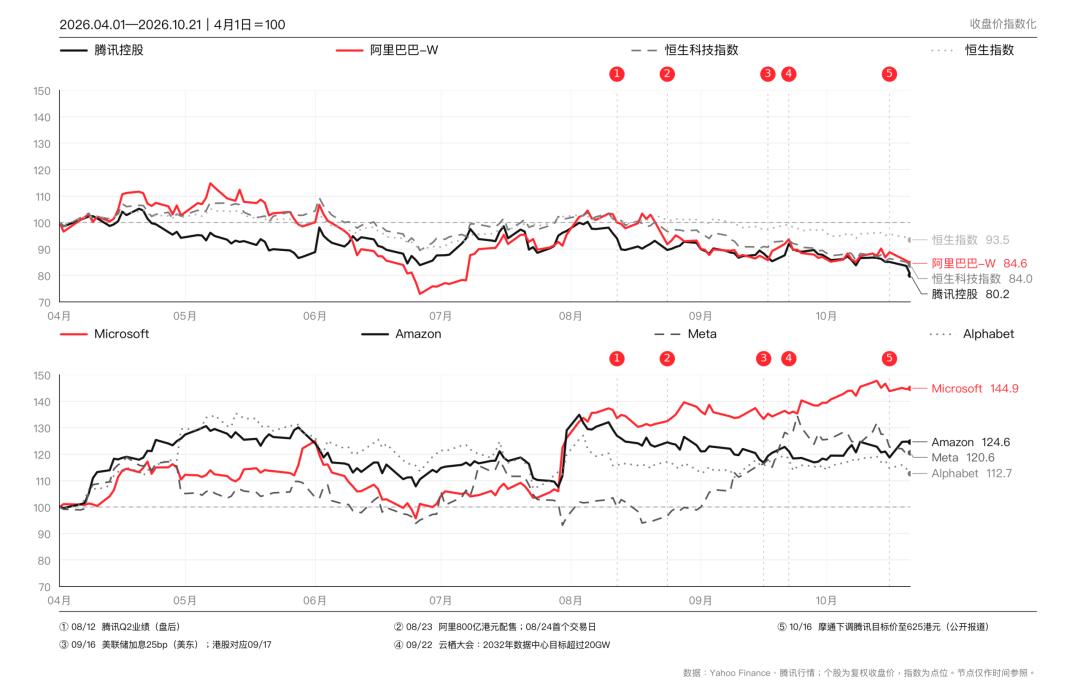
Taking April 1 as the starting point and calculated on the adjusted forward price basis, as of the close of October 22, Tencent fell 22.2%, Alibaba dropped 20.0%, the Hang Seng Tech Index decreased 20.2%, and the Hang Seng Index slipped 9.3%.
The Hang Seng Tech Index underperformed the Hang Seng Index by about 10.9 percentage points. Compared with the broader market, tech stocks have undergone more drastic price adjustments.
Tencent and Alibaba are the two core holdings of Hong Kong-listed internet assets. Funds holding the Hang Seng Tech Index also hold a portfolio of e-commerce, software, hardware, semiconductor and automotive companies through the index. The decline in the share prices of the two companies has directly dragged down the index. Consumer demand, earnings expectations of other constituent stocks, and capital flows shifting from the tech sector to other assets have further affected the performance of the Hang Seng Tech Index.
Several recent trading nodes can reflect the common pressure and the differences between the two companies.
On the first trading day after Alibaba announced the share placement in August, Alibaba fell 8.5% and the Hang Seng Tech Index dropped 3.6%, with Alibaba underperforming by about 4.9 percentage points.
In September, after the Federal Reserve announced a rate hike, the Hong Kong stock market fell on the first reaction day, but rebounded in the following trading days.
After October 15, the two companies and the Hang Seng Tech Index weakened again. These several fluctuations all point to one change: capital cost, operating returns and fundraising of new market shares are being incorporated into the same narrative system for valuation calculation, corresponding to macro factors, AI narratives, market environment and other aspects respectively.
02
Narrative: Global AI is still growing, and the market has begun to calculate the cost of growth
This revaluation also has important links with traditional internet businesses. Simply put, Tencent's games, advertising and payment businesses can still generate profits, and Alibaba's e-commerce and cloud businesses also have clear revenue streams. Both companies have users, usage scenarios and cash flow, and as large tech groups, they are also the main bearers of AI capital expenditure in China.
The problem is that the market has begun to care whether the cash generated by their core businesses can support competition, share repurchases, dividends and ever-increasing AI expenditures at the same time.
Revenue changes of global model companies provide a reference for this round of discussion. As previously mentioned by "Bright Company", according to information from Anthropic's Investor Day, the company's revenue in the first to third quarters of this year was approximately 4.7 billion, 11.6 billion and 16.8 billion US dollars respectively. The quarter-on-quarter growth in the second quarter was about 147%, and that in the third quarter was about 45%, "revenue continues to rise, but the quarter-on-quarter growth rate has dropped significantly".
The slowdown in growth has changed the market's calculation logic for the future. Previously, investors could extrapolate the revenue several years later based on continuous high-speed growth; now, expenditures on computing power, R&D and sales must all be included in the valuation. How much cash a model company can retain for every additional unit of revenue has become a more concerning issue for the market.
Looking at the listed US large tech groups, their share prices do not give a consistent answer.
Taking April 1 as the base point, as of the close of US stocks on October 21, Alphabet, Amazon, Microsoft and Meta rose by about 12.7%, 24.6%, 45.0% and 20.6% respectively. They are also increasing AI capital expenditure, but their share prices have not fallen in tandem with the Hang Seng Tech Index.
Take Microsoft as an example. Its revenue in the latest fiscal quarter increased by 18% year on year, and Azure revenue grew by 43%; investors can also see the expansion of cloud business revenue. These increases show that the market is still willing to pay for the realized business growth. For cloud vendors, only when orders are converted into revenue, revenue generates profits, and profits flow back to cash, can the continuously increasing investment be digested. The larger the capital expenditure, the more critical this chain becomes. If cloud revenue continues to grow, but profits are eroded by depreciation and reasoning costs, the current share price performance may also change.
In contrast, Tencent's revenue in the second quarter increased by 11% year on year, its adjusted operating profit rose by 9%, and its capital expenditure was about 52.8 billion yuan, up 176% year on year. Excluding new AI products, its adjusted operating profit increased by 19% year on year, with a profit margin of 42%; after including these products, the profit margin is about 37%. The profitability of the original business is improving, and investment in new products is also consuming part of the profits.
However, Tencent's free cash flow in the second quarter was negative 13.8 billion yuan, which included prepayments for computing power procurement; the company stated that after excluding relevant prepayments, the figure was positive 37.6 billion yuan. Prepayments affect cash flow first, and equipment depreciation will continue to affect profits later.
From Alibaba's perspective, the fundamental data of its core main businesses are also not bad. The quarterly performance ending June 30, 2026 shows that the revenue of its AI cloud and computing power service division reached 48.437 billion yuan, up 45% year on year, and the adjusted EBITA was 5.628 billion yuan. However, the adjusted EBITA of the AI lab and application division recorded a loss of 13.861 billion yuan. The group's adjusted EBITA was 27.329 billion yuan, down 30% year on year. The cloud business has generated revenue and profits, while the model and application segments are still consuming profits. Alibaba needs to drive the group's returns through cloud business growth.
The changes in the global AI narrative have spread to the Hong Kong stock market. Tencent and Alibaba each have a bill that needs to be "fulfilled", which is one of the core drivers of the current capital "shift". Model capabilities and computing power scale are still important, financial fulfillment has begun to determine how much premium they can get.
In other words, both Tencent and Alibaba, and even all Hong Kong-listed companies that previously made high capital and operating expenditure investments, must strive to prove to the market how these investments can be converted into profits and cash flow at a faster pace in the future.
03
Capital: Choices of new shares, placements and southbound capital
At the capital level, the Hong Kong stock market is also facing new changes.
Alibaba announced in August that it would place about 710 million shares at HK$112.70 per share to raise about HK$80 billion, and the net proceeds are planned to be invested in full-stack AI capabilities and infrastructure. The company has obtained the funds required for long-term investment, and the per-share rights of existing shareholders have also been diluted. Alibaba underperformed the Hang Seng Tech Index on the first day of placement, which may also indicate that the market has included the financing cost in pricing.
Tencent announced the issuance pricing of 1.8 billion US dollars and 26 billion yuan of notes in October, and the proceeds will be used for general corporate purposes. The two companies have different financing forms, but point to the same problem — AI investment requires capital, and the return after investment needs to cover the cost of capital.
In addition, there are more new shares in the Hong Kong stock market waiting for "absorption". Data from KPMG shows that in the first three quarters of this year, 116 listings were completed in the Hong Kong market, raising more than HK$388 billion, and the amount increased by more than double compared with the same period last year. New share issuances and placements of existing shares have increased the supply of investable stocks, and are also competing for institutional allocation quotas.
The short-term trading of southbound capital shows changes in absorption capacity. According to data from AlphaEngine and BofA's sales trading desk, southbound capital net sold about 217 million US dollars of Tencent on October 21, making it the largest selling order of the day. Data from the Hong Kong Stock Exchange in the same period shows that Stock Connect recorded net selling of 17.23 billion yuan and 44.35 billion yuan respectively on October 20 and 21, marking the sixth consecutive trading day of net selling.
For the Hang Seng Tech Index, capital pressure also includes sector allocation changes. When funds reduce their tech positions, they often sell a basket of stocks; subscription and redemption of index funds will also affect multiple constituent stocks. The financing and earnings expectations of Tencent and Alibaba themselves may therefore overlap with the capital changes of the entire sector. Subsequent issuance pace, fund subscription and redemption, and corporate repurchases will affect whether the sector can get new absorption.
04
Macro: High interest rates raise return requirements
In September this year, the Federal Reserve raised the policy interest rate by 25 basis points to 3.75%-4.00%. When the yield of US dollar bonds is at a high level, stocks need to provide higher expected returns. On October 21, the yield on the 10-year U.S. Treasury note was 5.13%. AI infrastructure requires spending first, and revenue from models and applications will be realized later; the longer the payback period, the more sensitive the valuation is to interest rates.
The Hong Kong dollar is pegged to the US dollar, so Hong Kong assets cannot be separated from the US dollar interest rate environment . After the Federal Reserve announced a rate hike on September 16, the Hong Kong stock market began to react on the 17th. In the following five trading days, Tencent, Alibaba and the Hang Seng Tech Index rose by about 1.8%, 3.4% and 1.2% respectively. The market rebounded briefly, but the requirement of high interest rates for future cash returns still exists.
The divergence between Chinese and US tech stocks also comes from corporate operations. US cloud giants are facing the same US dollar interest rate, but their share prices still rise due to business growth. The adjustment of the Hang Seng Tech Index is superimposed on the earnings expectations and financing needs of Chinese internet companies.
To sum up, the market has begun to price AI investments based on returns, but the transition is not yet complete. The existing businesses of Tencent and Alibaba can still generate profits, and AI also has room for growth. Previously, increasing investment in computing power and models was enough to raise growth expectations; now, investment needs to be gradually converted into revenue, profits and cash.
The answers of the two companies will be different. Tencent needs to make the revenue of AI products keep up with capital expenditure, and Alibaba needs to make the profit of cloud business cover the investment in models and applications. After financing, whether per-share returns can be improved will also affect valuations.
The adjustment of the Hang Seng Tech Index reflects that this requirement has expanded to the entire sector. The upcoming financial reports will determine how much premium the market is willing to pay for AI growth.
This article is from the WeChat Official Account "Bright Company" (ID: suchbright), author: MD, published with authorization from 36Kr.