Long-time arch-rivals have joined hands, GPT is now hosted on Gemini's platform, and OpenAI has secured partnerships with the three major cloud service providers within just half a year.
Whoa, GPT is moving into Gemini's house!
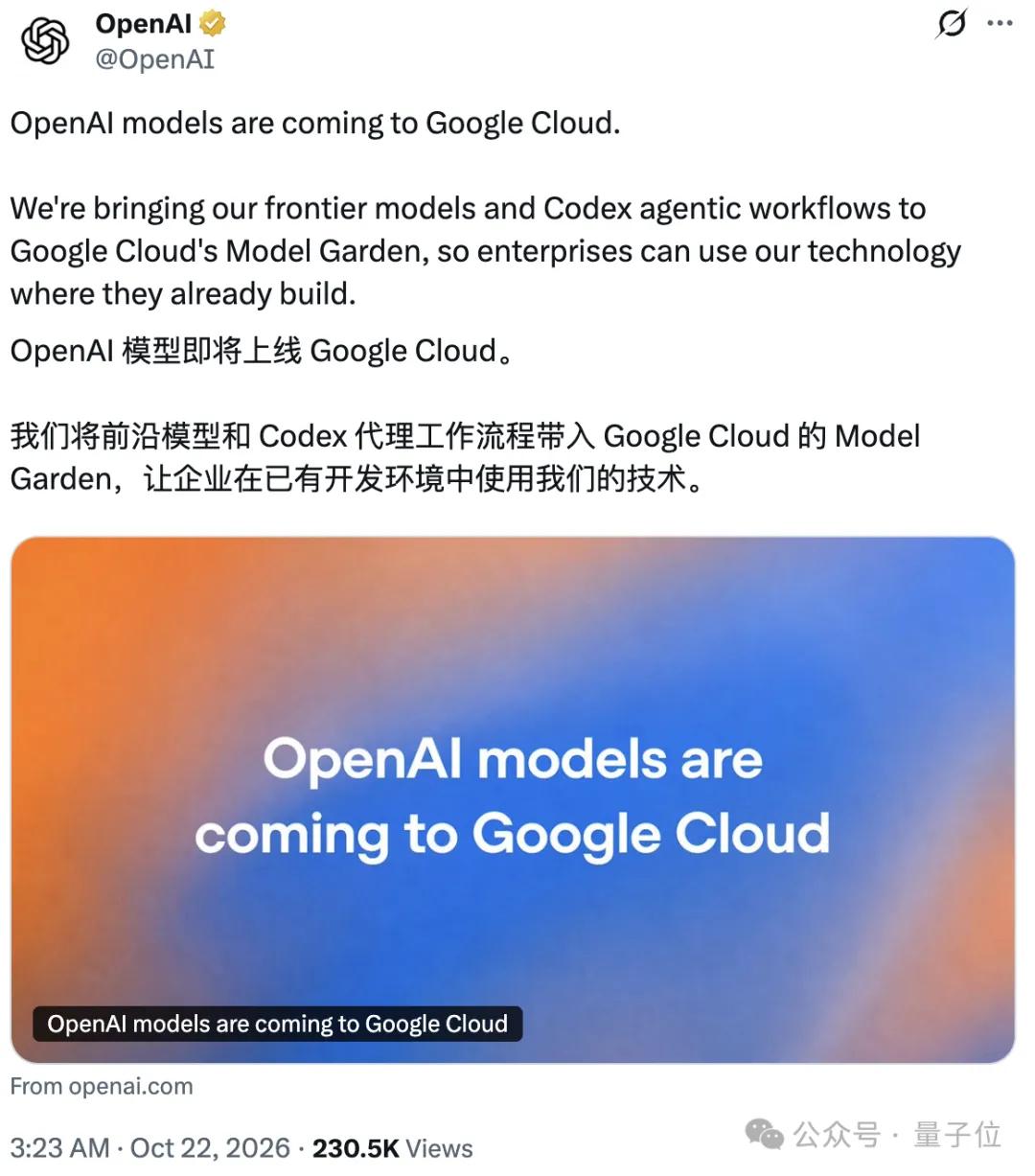
Just today, OpenAI and Google Cloud officially announced their partnership:
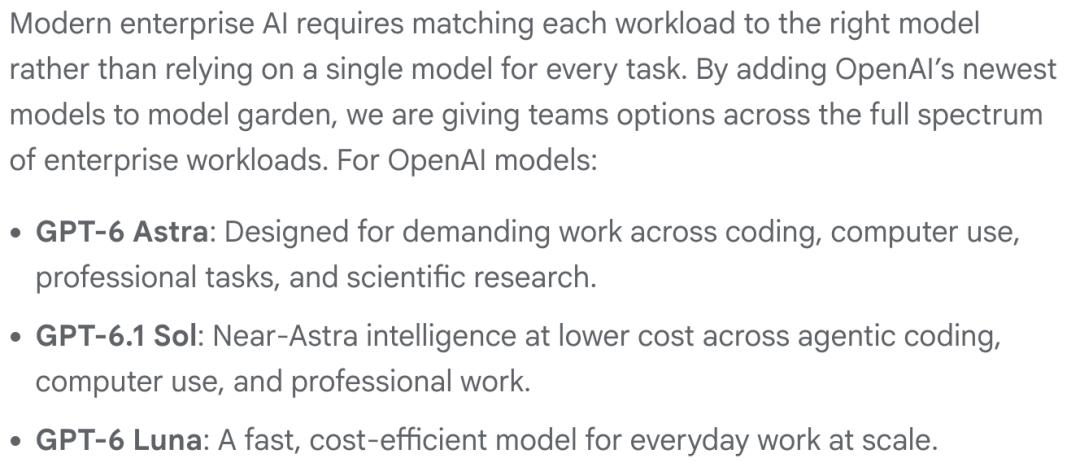
GPT-6 Astra, GPT-6.1 Sol, GPT-6 Luna and Codex will be officially launched on Google Cloud.
The first batch of models has already been made available to some enterprise customers, and will later be integrated into Google Antigravity and Gemini Agent.
△
Wait a second, aren't these two sides still fighting fiercely on the battlefields of large models, search, and programming agents?!
How did sworn enemies turn into channel partners in the blink of an eye, and even start doing business with each other?

More importantly, following Azure and AWS, OpenAI has now officially secured partnerships with the three major U.S. cloud providers.
OpenAI, which was once tightly locked in Azure, is completely bidding farewell to the era of exclusive distribution.
Sworn Enemies Start Selling Each Other's Products
At present, GPT-6 Astra, GPT-6.1 Sol and GPT-6 Luna have entered Google Cloud's Model Garden, and private preview has been opened to some enterprise customers.
Enterprises can call these models directly through the Google Cloud API, and can also connect the local Codex CLI and desktop workflows to Google's Gemini platform, allowing Codex to complete inference via Google Cloud.
△
OpenAI stated that they will launch a general availability plan in the coming weeks.
This partnership may hit two key points that resonate deeply with enterprise customers:
1. Enterprises can directly purchase OpenAI's models with the funds in their Google Cloud accounts in the Google Cloud Marketplace.
2. The invocation fees for different models can be consolidated into a single Google Cloud bill, and can even be included in cross-model Flexible Savings Plans.
This means that in the future, enterprises can freely switch between the two sets of models without re-signing contracts or creating separate bills.
When they want to use them, they just need to check the options directly in the familiar Google Cloud working environment.

At the same time, enterprises can continue to use Google Cloud's existing data governance, security and permission control systems; prompts, context and outputs all remain within the specified data boundaries, and model invocations go through isolated gateways and unified identity authentication.
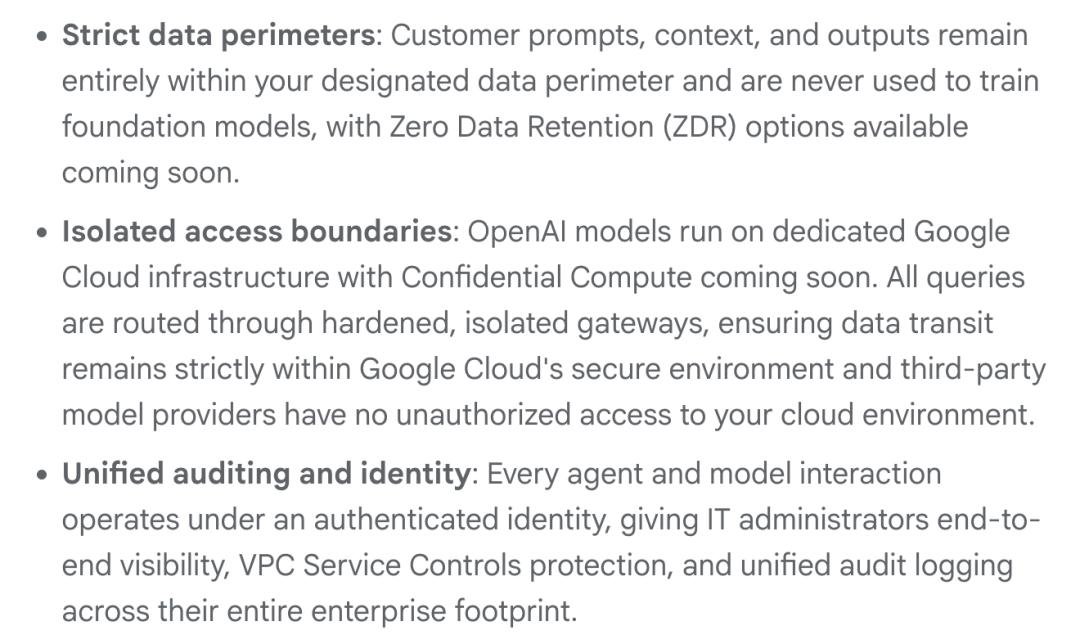
When OpenAI's models are launched on Google Antigravity and Gemini Agent in the future, users will be able to flexibly switch between models to complete tasks according to actual needs.
Google Cloud is obviously very proud of this, and couldn't help showing off in its official blog post:
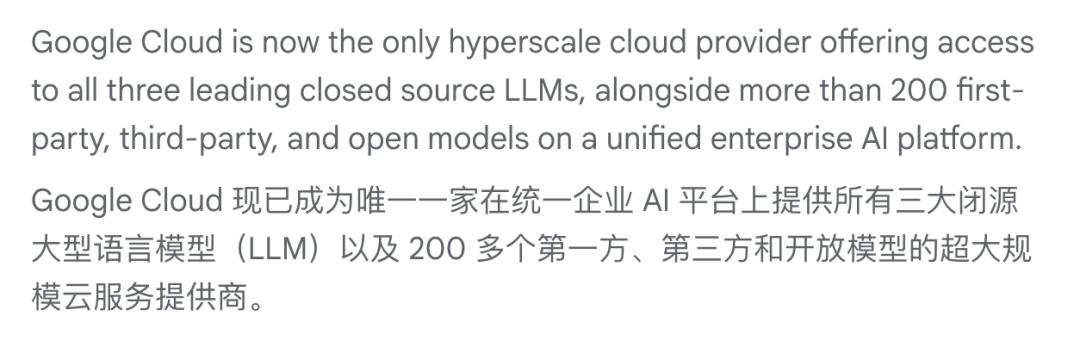
We have become the only hyperscale cloud provider on the market that offers three leading closed-source large models, plus more than 200 self-developed, third-party and open-source models!
△
OpenAI Partners With All Three Major Cloud Providers In Just Half A Year
Seeing this, many people must be wondering:
Wait, wasn't OpenAI previously bound by Azure on an exclusive basis?

That's right.
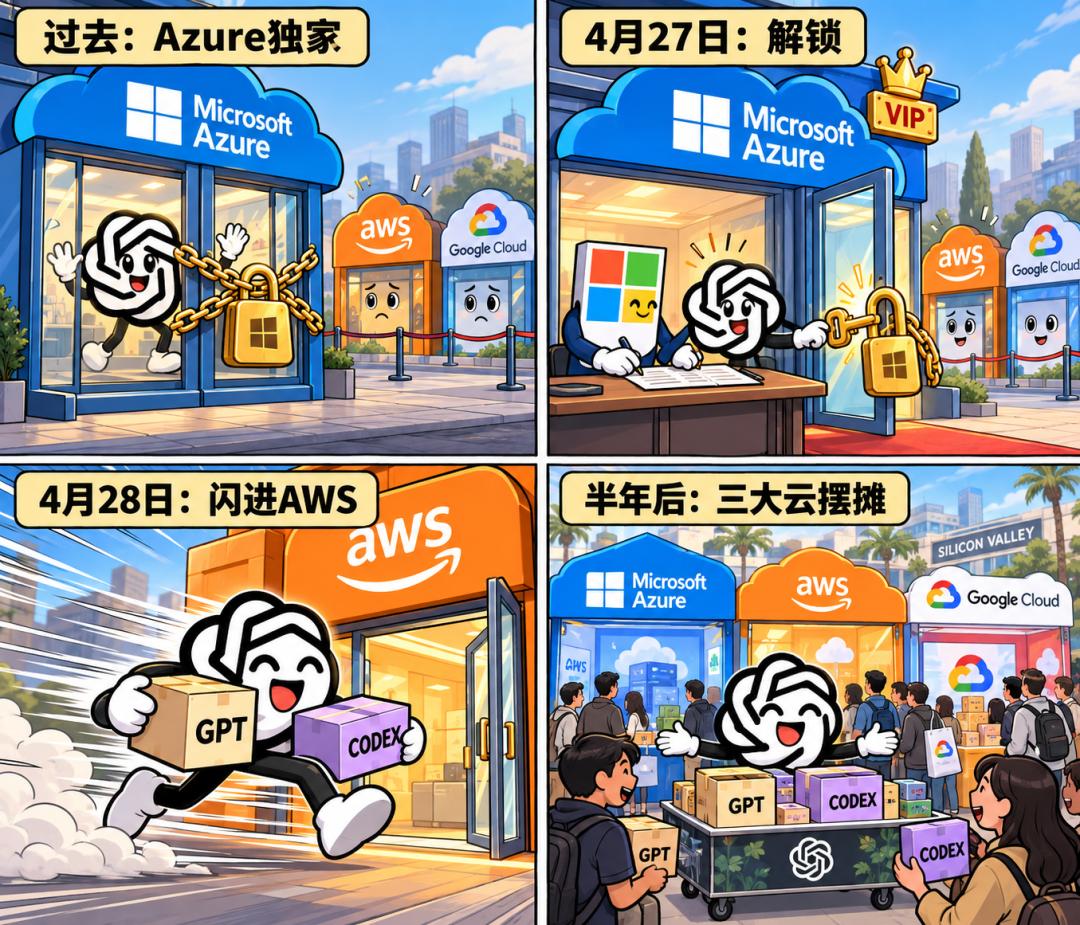
In the past, Azure has always held the exclusive cloud distribution right for OpenAI's stateless APIs.
Even if OpenAI cooperated with other manufacturers, in principle, the related API invocations still had to run on Azure.
But on April 27 this year, this exclusive binding was finally loosened.
Microsoft and OpenAI re-modified their cooperation agreement and removed this exclusive restriction.
From then on, OpenAI can provide products to customers through any cloud platform, and the authorization of OpenAI's models and products held by Microsoft has also been changed to non-exclusive.
The moment the restriction was lifted, OpenAI stepped into AWS the very next day.
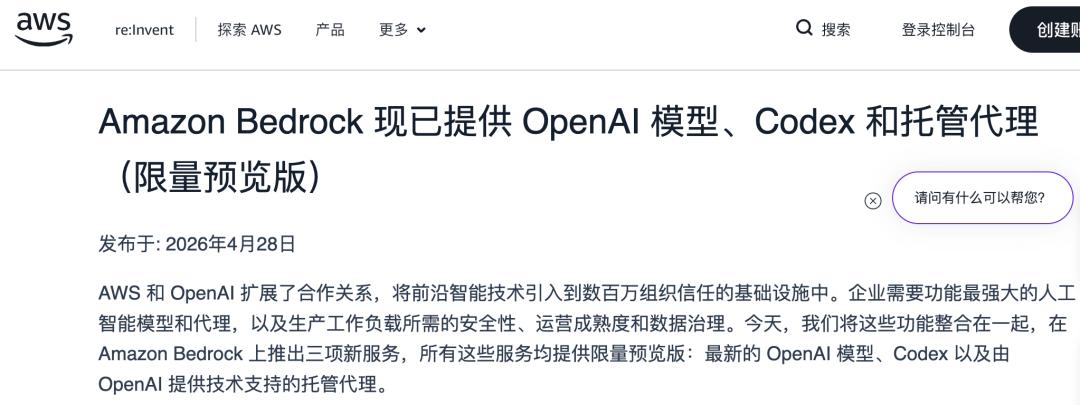
On April 28, GPT and Codex were quickly integrated into Amazon Bedrock.
AWS customers can directly call the models with their original identities and enterprise control systems, and the related fees can also be deducted from their existing cloud consumption commitments.
Now, OpenAI has stepped into Google Cloud.
From Azure exclusivity, to AWS, and then to Google Cloud, OpenAI took only half a year to deploy its models across the three major U.S. cloud providers.
Wherever the enterprise business is hosted, it will set up a stall there, focusing on the strategy of selling products wherever it goes.

At the same time, Microsoft has not been left behind by OpenAI.
According to the new agreement in April, Microsoft is still OpenAI's main cloud partner, and OpenAI products will also be prioritized for launch on Azure.
No wonder it's called the first partner, its position is completely stable.
However, Azure is no longer exclusive, and AWS and Google Cloud can finally sell the same products.
△ AI Generated
Models Compete Fiercely, Cloud Providers Make Money Quietly
As everyone knows, GPT and Gemini are old rivals that have been fighting on the arena every day.
So why did OpenAI and Google Cloud suddenly join hands?
In fact, both sides have made very careful calculations for their own interests.

What OpenAI wants is enterprise customers.
Because when enterprises purchase AI models, their considerations are no longer limited to which model ranks higher on the leaderboard.
Where the data is stored, who the existing contract is signed with, and which cloud the security and audit systems run on, will also directly affect the final choice.
Therefore, OpenAI is starting to penetrate into the customer relationships that cloud providers have already built.
If an enterprise runs its business on Azure, OpenAI sells on Azure; if the business runs on AWS, it integrates into Bedrock;
If the data is stored on Google Cloud, it brings GPT and Codex to the Model Garden.
Customers do not need to specifically access OpenAI's own API platform, and GPT can directly enter the workplace where customers work every day.

△ AI Generated
What Google Cloud wants is platform business.
If customers choose Gemini, Google can make money directly from the model;
If customers choose GPT, even though the model is from a competitor, Google still retains control over the Marketplace, cloud infrastructure, data governance and security services.
Even the fiercer the model competition is, the more enterprises want to switch back and forth between different models for different tasks, and the higher the value of Google Cloud as a model marketplace will be.
△ AI Generated
As for enterprises, what they want is simply two words: convenience.
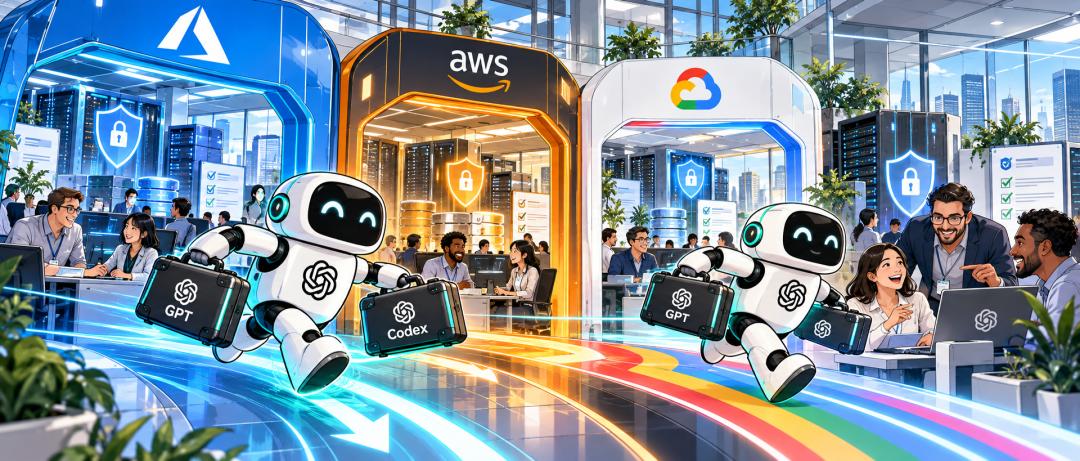
They don't need to migrate data, don't need to change cloud platforms, don't need to sign a new set of supplier contracts, and can assign different tasks to Gemini, GPT or Claude according to their capabilities, latency and cost.
In the past, when people chose models, there was a sense of "bet on one supplier and follow all its products";
But now, there is a whole row of shelves on the same cloud platform, users can pick whichever works better, switch to whichever is cheaper, which is really much more convenient.
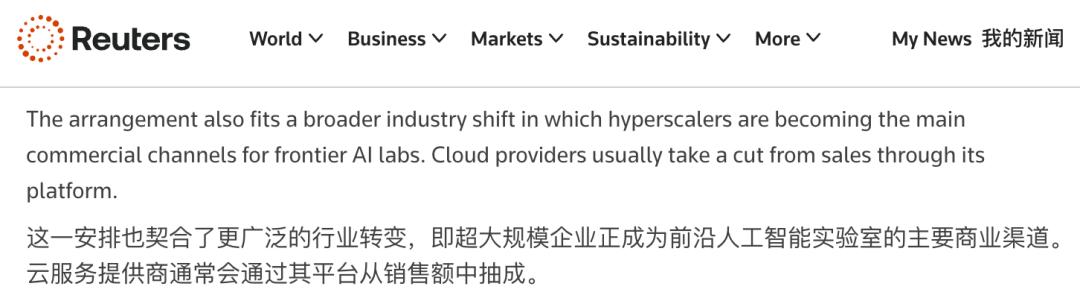
Reuters also summarized it as a broader industry trend:
Hyperscale cloud providers such as Microsoft, AWS and Google Cloud are becoming the most important commercial distribution channels for cutting-edge model labs.
Among them, model companies are responsible for developing products and improving capabilities;
Cloud providers are responsible for controlling enterprise customers, procurement entrances and settlement systems, and then taking a cut from each transaction.
△ Source: Reuters
Therefore, on the model arena, GPT and Gemini will continue to compete as before;
But off the arena, Google Cloud has silently set up shelves for GPT.
Competition is competition, business is business. The people in Silicon Valley are really all good at making smart business decisions.
One More Thing
Interestingly, even though the partnership has been established, the two sides, Sam Altman and Sundar Pichai, still did not stop their verbal attacks at all.
Not long ago, Altman implied in a sarcastic tone:
Google is just adding AI to old products such as search as an add-on, and OpenAI's AI-native products built from scratch are the real trend.
The very next moment, Pichai hit back sharply on