Who did the 600-billion-yuan national AI fund invest in?
The 600-billion-yuan national AI fund has made multiple investments covering multiple links across the entire AI industry chain.
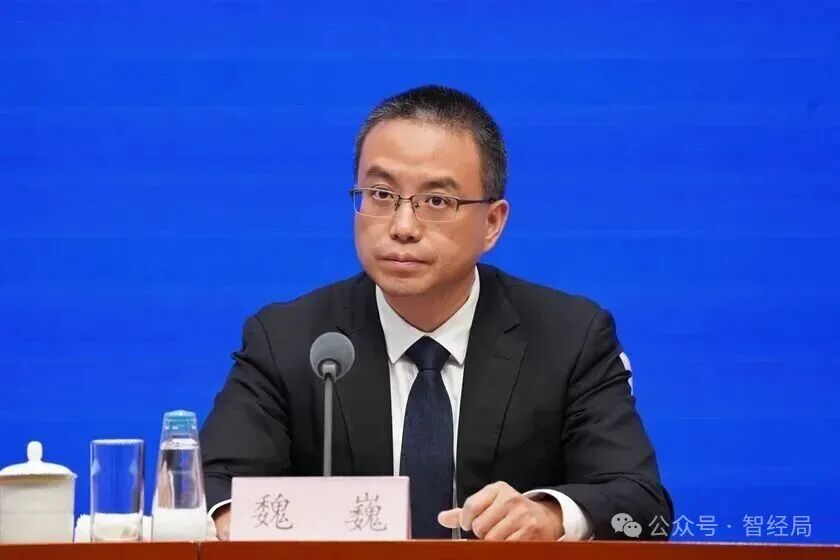
The national team is ramping up artificial intelligence investment. On October 19, Wei Wei, Director-General of the Department of Science and Technology of the Ministry of Industry and Information Technology, stated at the press conference of the State Council Information Office that the 600-billion-yuan National Artificial Intelligence Industry Investment Fund has invested in a number of high-quality projects. In 2025, the scale of China's core artificial intelligence industry exceeded 1.2 trillion yuan, the penetration rate of artificial intelligence technology application among manufacturing enterprises above designated size surpassed 30%, and the number of artificial intelligence enterprises in China exceeded 6,600 by the end of June this year.
The official list of what exactly these "high-quality projects" are has not been disclosed. According to statistics from Caixin on October 20, there are currently three publicly disclosed direct investment projects, all invested in leading large model companies. Combining announcements of listed companies, industrial and commercial registration information and financing news, the fund has at least eight public investments, covering five links: models, applications, embodied intelligence, computing power chips and AI security.
01. The invested list has not been disclosed by the official
The National Artificial Intelligence Industry Investment Fund was established on January 17, 2025, led by the Ministry of Industry and Information Technology and the Ministry of Finance, with a capital contribution of 600.6 billion yuan. The third phase of the National Integrated Circuit Industry Investment Fund contributed 600 billion yuan, making it the only limited partner of the fund. The manager is Guozhitou (Shanghai) Private Equity Fund Management Co., Ltd., whose actual controller is the State-owned Assets Supervision and Administration Commission of Shanghai Municipality. The fund is settled in Xuhui, Shanghai, with a duration of 13 years.
21 months after its establishment, the official has never disclosed the names and amounts of any invested projects. Wei Wei's introduction on October 19 was limited to "a number of high-quality projects".
The most systematic official introduction of the fund came from an embodied intelligence symposium held by the Shenzhen Stock Exchange on April 10, 2025. Zhang Jianhua, Deputy Director-General of the Department of Planning of the Ministry of Industry and Information Technology and Deputy Head of the National AI Fund Preparatory Team, stated at the time that the fund will carry out investment layout around the entire artificial intelligence industry chain, covering computing power, algorithms, data and enabling applications, follow the law of industry development, "appropriately invest in early-stage, small-scale and cutting-edge projects", and have the attributes of both industrial investment and venture capital. The introduction did not involve specific projects.
Subsequent official statements focused on positioning. In January this year, the Ministry of Industry and Information Technology stated that it would strengthen the fund's support for the humanoid robot sector; on August 26, Vice Minister Xin Guobin proposed at a press conference of the State Council Information Office to promote the AI fund to gather financial "living water" and increase investment intensity.
Eight publicly disclosed capital contributions can be sorted out.
According to Caixin reports, the fund contributed about 980 million yuan in DeepSeek's first round of financing. Caixin said the post-investment valuation of this round was 350 billion yuan, while Securities Times and *Caijing* reported a figure of nearly 400 billion yuan. The fund also participated in the F-round financing of Moonshot AI (Kimi), whose post-investment valuation reached 35 billion US dollars.
Another investment was disclosed in the announcement of a listed company. On August 31, Kuaishou announced on the Hong Kong Stock Exchange that the fund invested 1.4 billion yuan in the domestic entity of its video generation large model Kling AI, holding about 1.14% of the shares. Calculated based on this proportion, the valuation of Kling AI's domestic entity exceeds 120 billion yuan. Due to the performance of the mandatory disclosure obligation, the information of this investment is the most complete.
Neolithic, the autonomous delivery vehicle company, is the fund's first investment in this track. On October 20, Neolithic announced the completion of nearly 400 million US dollars in financing, which was officially described as "jointly led by Boyu Capital and a national-level fund"; reports from Xinhua Finance and other media stated that the fund is the national AI fund. So far, Neolithic's cumulative financing has exceeded 10 billion yuan.
Another four capital contributions were reported in earlier news. In March, Galaxy Universal completed 2.5 billion yuan in financing, with investors including the fund, and its post-investment valuation exceeded 20 billion yuan; at the end of January, the fund appeared in the shareholder list of smart driving chip company Xinxin Hangtu; on January 27, AI security company Chaitin Tech completed 500 million yuan in financing, with investors including the fund; according to Xinhua Finance, the fund also invested in AI computing power chip company Muxi.
Among the eight capital contributions, the total publicly verifiable investment amount is about 5.4 billion yuan, accounting for less than 10% of the 600.6-billion-yuan fund size.
02. Head concentration, capital flows to computing power
Distribution of the eight capital contributions by industry chain position: Two in the model layer, DeepSeek and Moonshot AI, both adopting the open source route — Kimi K3 was fully open sourced on July 27 this year, with a parameter scale of 2.8 trillion, making it the world's largest known open source model; two in the application layer, Kling AI and Neolithic; one in embodied intelligence, Galaxy Universal; two in computing power chips, Xinxin Hangtu and Muxi; one in AI security, Chaitin Tech. The eight invested enterprises are distributed in five links, most of which have formed products and customers in their respective segmented tracks.
The flow of funds goes beyond the invested enterprises. The main use of funds obtained by model companies after financing is to purchase computing power. DeepSeek completed 51 billion yuan of the first round of external financing in June this year, with a post-investment valuation of nearly 400 billion yuan; according to reports from *Caijing* and other media, the company is subsequently promoting the construction of a large data center in Ulanqab, Inner Mongolia, planning to deploy at least 160,000 Huawei Ascend accelerated chips, with a chip procurement scale of about 17 billion yuan. The fund also made a direct investment in Muxi, laying out at the computing power supply end.
This flow has already been reflected in macro data. Data from the National Bureau of Statistics shows that in the first three quarters, the added value of the digital product manufacturing industry above designated size contributed more than one third to the growth of industries above designated size, and the output of integrated circuits increased by 23.3%.
03. The money of the national team follows the usable AI
Why these companies, and why at this point in time?
A research report released by CITIC Securities on October 21 provides an explanation. The report estimates that the total ARR (Annual Recurring Revenue) of domestic models is about 8 billion US dollars, which is only equivalent to the level of overseas models 18 months ago; their valuation is about one tenth of that of overseas models. The report believes that once the capability gap narrows, the low base, fast growth rate and low valuation of domestic models are expected to promote a systematic revaluation.
The capital rhythm of the invested enterprises is accelerating. Moonshot AI completed its Pre-IPO round after the F-round, with a valuation of about 50 billion US dollars. It has submitted a confidential listing application to the Hong Kong Stock Exchange in September, planning to list in the first quarter of 2027; the second round financing size of DeepSeek has been revised up to about 100 billion yuan, with a pre-investment valuation of about 500 billion yuan, led by CATL and Tencent. It has hired CITIC Securities to plan its Sci-Tech Innovation Board listing, targeting to go public in 2027.
In addition, the impact of AI on the employment structure has begun to emerge. According to an audit industry source close to the National Bureau of Intelligent Economy, accounting firms have introduced AI to assist work this year, the number of recruits has decreased compared with last year, and the number of intern positions has also been reduced. Wang Guanhua, Spokesperson of the National Bureau of Statistics, said on October 19 that AI is accelerating from being a "technical option" to a "standard production configuration".
In addition, the development of AI is a "money-burning" battle. Goldman Sachs research report predicts that global AI investment will reach about 1.02 trillion US dollars in 2026, of which the United States accounts for about 581 billion US dollars; the total 2026 capital expenditure guidance of Microsoft, Amazon, Alphabet and Meta is about 725 billion US dollars, an increase of 77% from about 410 billion US dollars in 2025, and the vast majority of the capital is invested in data centers and AI chips.
The input intensity determines the competition threshold. Every step up in industrial scale requires hundreds of billions of dollars in capital support; the return cycle of such investment is calculated in five or ten years, exceeding the upper limit of the duration of most market-oriented funds. Long-cycle capital has thus become a necessity, which is the direct background for fiscal and state-owned capital to set up special funds.
Finally, the 600.6 billion yuan is equivalent to 5% of the core AI industry scale in 2025, and the publicly verifiable capital contribution is less than 10%. The fund size is not large, but the direction has been clearly drawn.
What remains to be seen is the realization. Moonshot AI has submitted a confidential listing application to the Hong Kong Stock Exchange, DeepSeek's second round of financing has doubled to 100 billion yuan, with CATL and Tencent in the lead investor list, and the companies invested by the national team are going to the secondary market one by one. On the listing day, "what the national AI fund has invested in" will be written into the shareholder list of every prospectus, and also into every K-line chart. Whether this sum of money is worth it, the market is already voting with its feet.
This article is from the WeChat official account "Caineng Circle", authorized for release by 36Kr.