350,000 AIs are deployed to "chat" with scammers, and AI anti-fraud has become the new darling of capital.
What can AI do? For this Australian AI company, AI can act as an undercover agent to waste scammers' time and make profits from the intelligence it obtains.
Australian firm Apate.ai has recently closed an $8.15 million large seed round financing, led by Lobby Capital, with participation from OIF Ventures, Investible, Concept Ventures and Baobab Ventures, bringing its total accumulated financing to nearly $10 million. Back in August 2025, Apate also completed a A$2.5 million seed round financing led by OIF Ventures with participation from Investible.
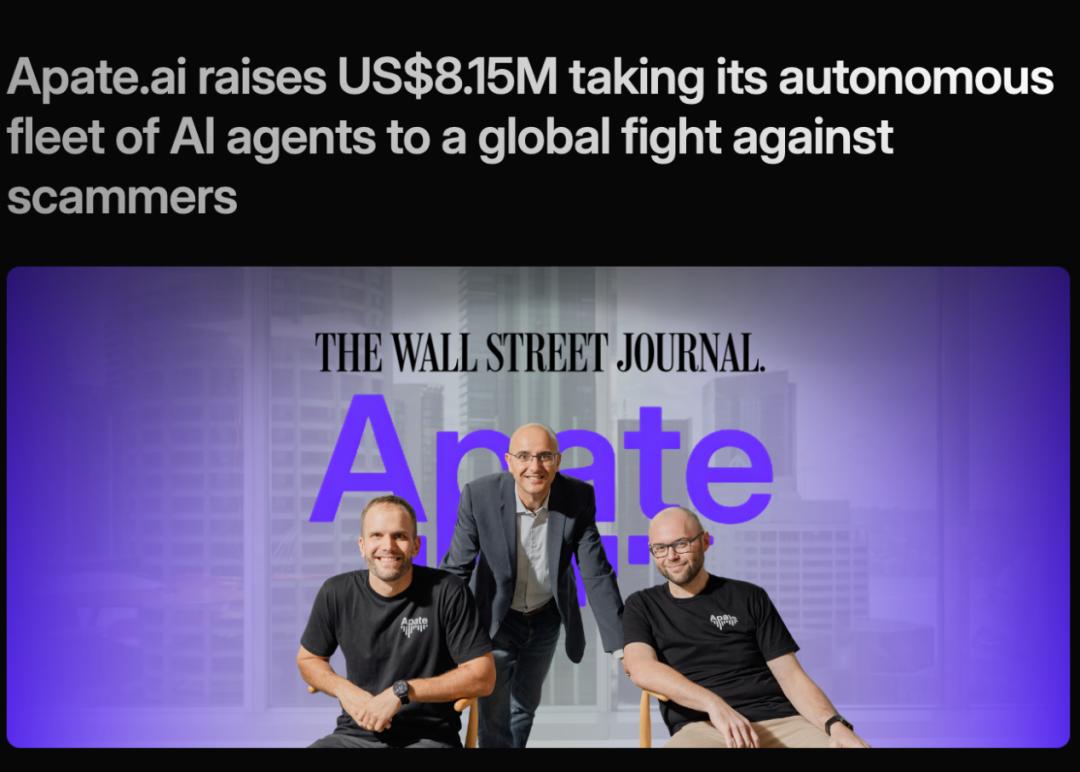
Image source: Official website of Australian company Apate.ai
This business originally started from a 44-minute phone call during a picnic
In November 2021, Dali Kaafar, a professor of cybersecurity at Macquarie University in Sydney, was enjoying outdoor time with his family. His phone rang with an unknown call, and the person on the other end claimed to be from a well-known tech giant, trying to defraud him with skilled rhetoric.
Kaafar, who studies cybersecurity, did not hang up the phone immediately. Instead, he dragged out the conversation with the scammer for a full 44 minutes. This episode during the picnic did not end there, and Kaafar later turned this incident into a business. He founded Apate.ai in 2024, using large model-powered AI to pretend to be ordinary people with simulated technical anxiety and cognitive delays to keep scammers online, while tricking them into disclosing payment accounts, wallet addresses and phishing domain names.
According to the company's disclosure, its AI has completed about 2.5 million conversations, cumulatively wasting the equivalent of 17 years of scammers' time. According to statements from Apate founder and CEO Dali Kaafar cited by foreign media, the Apate platform has around 350,000 AI bots, has been adopted by banks, and has received support from telecom companies. Apate has collected more than 250,000 real-time pieces of information about fraudsters, including fraud URLs, accounts used to collect and transfer stolen funds, and bank account details.
Cao Xiao, chief expert at the Institute for Chinese Path to Modernization of Shanghai University of Finance and Economics, believes that the competition of AI anti-fraud is ostensibly a technological competition, but essentially a competition in the speed at which the national governance system answers three major institutional propositions: "who has the right to deploy deceptive AI, what standards should be adopted for intelligence admissibility, and who should be claimed for compensation by mistakenly injured parties". The party that establishes rules and systems first can turn this round of technological variables into a historic first-mover advantage in the modernization of anti-fraud governance.
Who is paying for Apate.ai?
According to media reports, Apate's clients include Commonwealth Bank of Australia, Australian telecom operator TPG Telecom, as well as other utility enterprises, telecom operators and government agencies.
Cao Xiao, chief expert at the Institute for Chinese Path to Modernization of Shanghai University of Finance and Economics, pointed out that in the past, most anti-fraud work followed the pattern of "statistics after incidents happen": scammers commit fraud first, victims report to the police, and then the blacklist is updated. Traditional anti-fraud faces three problems: first, it is always half a step behind, and the blacklist can never catch up with scammers changing their tactics; second, the cost is asymmetric, the defending side has to spend a lot of manpower and material resources to screen, while the scamming side has almost zero cost for trial and error; third, it is highly passive, relying on victims to report cases, so if scammers do not succeed in defrauding and no one reports, the defending side can hardly be aware of the fraud.
Cao Xiao said that the value of Apate's model lies in addressing all three pain points at the same time: AI pretends to be victims, in turn consuming scammers' time and manpower, shifting the cost burden to scammers; before the money is transferred out, it identifies clues such as payment accounts and phishing URLs; in the past, only a small number of volunteers were willing to "tease scammers", but now AI has turned this into a large-scale business.
Brad Joffe, Apate's co-founder and Chief Commercial Officer, revealed that TPG has transferred nearly 590,000 calls to Apate's AI agents, and the publicly reported fraud losses of Commonwealth Bank of Australia have dropped by 76%.
Shifting from "settling accounts after incidents" to "collecting intelligence in advance", Cao Xiao believes that this is a real paradigm expansion in anti-fraud theory, namely shifting from "statistics after losses occur" to "intelligence science before losses occur". The people chatting with AI do not pay, and the paying parties are those institutions that care about "what clues can be left after the conversation". For the first time, fraud intelligence has become a priced and tradable commodity. Anti-fraud is evolving from a compliance cost center to an intelligence-driven active defense system, and this shift is irreversible.
However, Cao Xiao reminded that we should stay sober about the reliability of intelligence obtained through such "active deception". Its difference from traditional transaction data risk control is not only the level of accuracy, but the data source and generation method are fundamentally different. For example, after scammers know the existence of AI honeypots, they can deliberately feed fake accounts and fake URLs, and the misleading cost is very low. Besides, it is difficult to confirm or falsify whether an account is the payment account of a scammer before funds flow into it; payment accounts and phishing links may become invalid in just a few hours, and it is not easy to detect them in time.
Cao Xiao suggested that a classification mechanism should be established for such intelligence, mandatory multi-source cross-verification should be implemented, and a disposal gradient of "only slowing down rather than blocking" should be set, with an attenuation time window and automatic invalidation mechanism attached to each piece of intelligence. Treating conversational intelligence as the same level of blocking basis as transaction data is the biggest financial risk of this model; treating it as a low-confidence clue that triggers enhanced review is its correct positioning in pre-incident risk control.
Where did the $8.15 million financing funds go?
This August, Apate completed the $8.15 million seed round financing. Brad Joffe, co-founder and Chief Commercial Officer of Apate, revealed that Apate has raised nearly $10 million in total so far, while the team size is only 20 people.
Next, Apate also plans to expand into overseas markets. According to the company's disclosure, it will open a new office in London next quarter to serve European clients, while strengthening its business in the United States. Peter Eckermann, co-founder and Chief Product Officer, will relocate to the United States to lead the North American expansion. Apate's technology and research team will expand and remain based in Sydney. A concurrent move is that the company completed the main entity re-registration on August 25, changing to a Delaware-registered enterprise in the United States to support its global expansion.
There was another similar financing event this year. Also in August this year, Visa announced that it would acquire Israeli anti-fraud company BioCatch for $2.4 billion in cash.
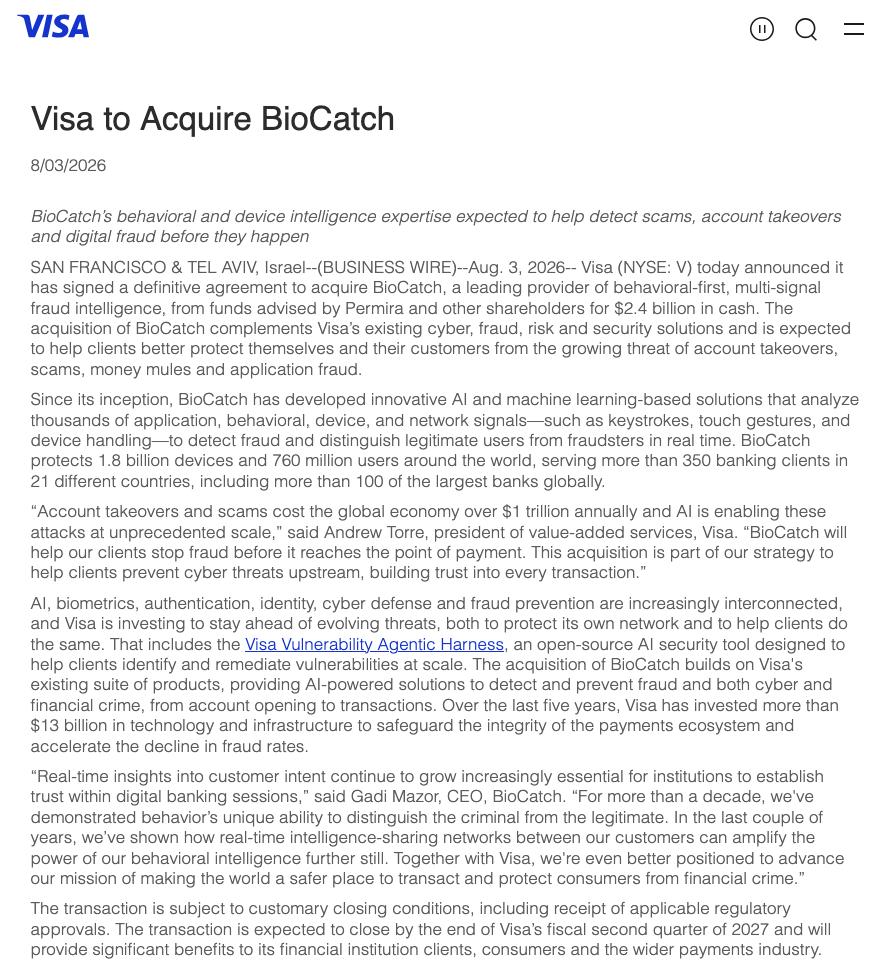
Image source: Visa official website
Founded in Israel, BioCatch's technology platform detects fraud in real time by analyzing thousands of application, behavioral, device and network signals. The collected signal dimensions include keystroke rhythm, touch gestures, screen touch pressure and device operation methods, so as to distinguish real users, fraudsters and bot programs. The company disclosed that it currently protects 1.8 billion devices and 760 million users globally, providing services for more than 350 banking clients in 21 countries, including more than 100 large global banks.
At the level of policy recommendations, Cao Xiao proposed that a national pilot of AI active anti-fraud perception capability can be deployed, implementing "authorized list + full traceability of records". It is recommended that the Ministry of Public Security take the lead, together with the Ministry of Industry and Information Technology, the People's Bank of China and the Cyberspace Administration of China, select 2 to 3 cities in provinces with high incidence of telecom and online fraud and key border directions to carry out the pilot, and authorize qualified enterprises to deploy AI decoy systems under the supervision of public security authorities.
"The pilot can implement three rigid constraints: the deployment entities, target scope and speech boundary are all included in the authorized list; all interaction records are stored on blockchain for full traceability and retrospective audit; intelligence outputs directly enter the law enforcement clue pool, and any form of commercial circulation is prohibited. The pilot period is two years, and after maturity it can be promoted nationwide to form China's unique active anti-fraud capability system of 'public power leading, enterprises providing energy'", Cao Xiao said.
Cao Xiao judges that in the next five years, the reshaping of AI on risk prevention and control will far exceed the single anti-fraud field. The window period for new scenarios is about three to five years. Risks will not wait for the system to be ready before emerging, and the speed of layout itself is an integral part of risk control. Sorted by maturity, the following five newly implemented scenarios are worthy of advance layout.
First, end-side real-time protection. Google DeepMind has cooperated with the Government Technology Agency of Singapore to launch an end-side fraud detection model based on lightweight model fine-tuning.
Second, forgery identification and traceability of AI-generated content. Detection, watermarking and traceability systems for synthetic content (voice cloning, deepfakes, etc.) will grow into infrastructure-level demands, just like today's cryptosystem for network communication.
Third, intelligent tracking of capital chains. Graph analysis of abnormal capital flows across banks, payment institutions and virtual currencies.
Fourth, identity governance of agents. When AI agents start to perform operations such as fund transfer, contract signing and customer service on behalf of humans, "how to prove that the operation instruction comes from the real will of the person" will become a new cornerstone issue of financial risk control, and will give rise to brand new industries such as agent identity authentication and intention confirmation protocols.
Fifth, cross-institutional intelligence federation. Supported by privacy computing technologies such as multi-party secure computation and federated learning, banks, telecom operators and internet platforms can share risk signals without exchanging original data, solving the long-standing deadlock of "data silos" and "privacy protection", which is exactly the combination point where China's market-oriented reform of data elements can make efforts.
This article is from the WeChat official account "Financial Associated Press AI Daily", author: Wang Nai, published with authorization from 36Kr.