The title of the 10th national aviation hub city has changed hands, and this time it goes to Northwest China.
The 10th largest air passenger transport city in China has a new occupant again.
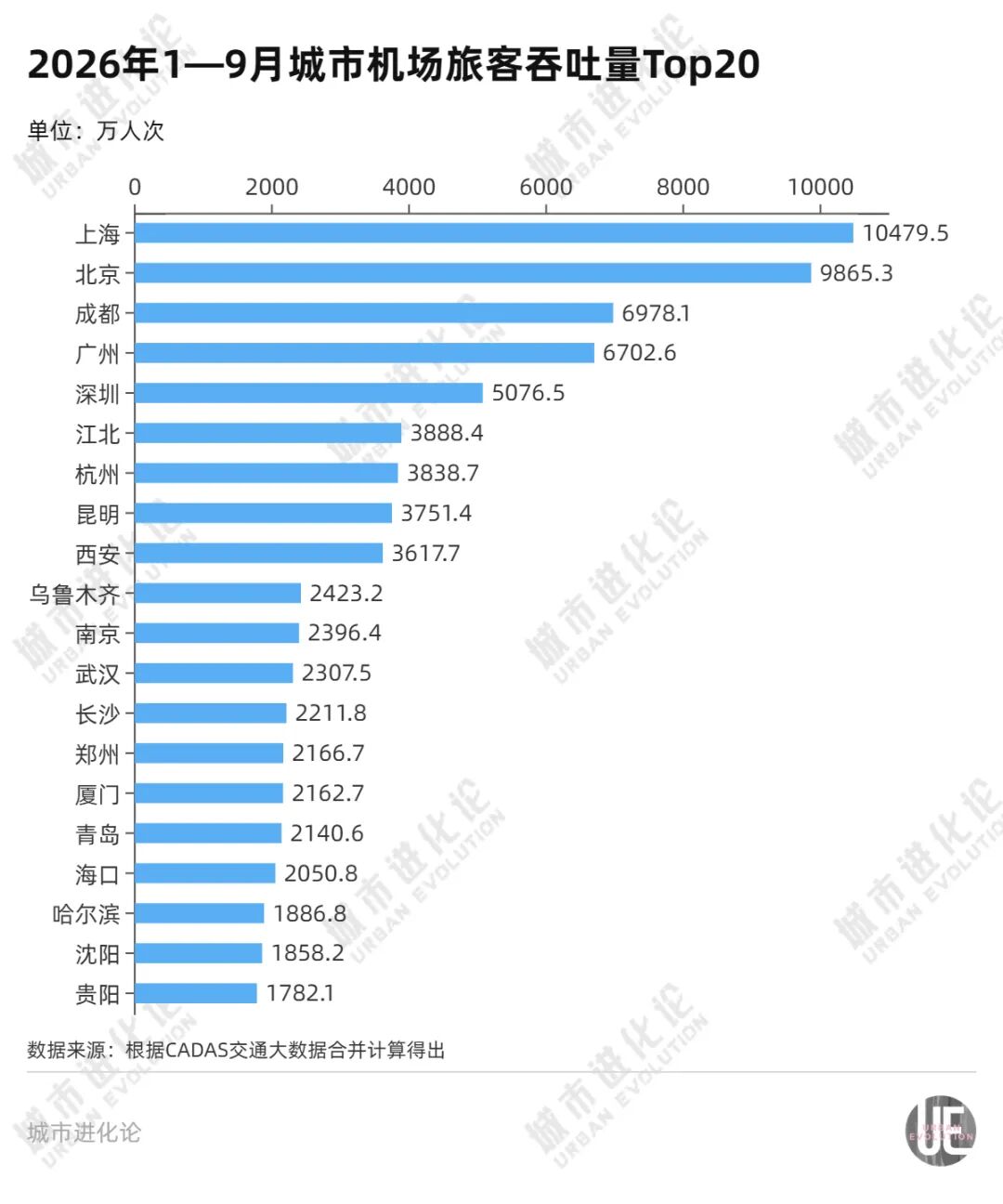
According to CADAS transport big data, in the first three quarters of 2026, Urumqi Airport recorded 24.232 million passenger throughput, a year-on-year increase of 7.7%, overtaking Nanjing Airport in one fell swoop and ranking among the top 10 cities nationwide.
For many years before, this position had long rotated among eastern and central cities such as Nanjing, Wuhan and Changsha. Why is Urumqi the one that takes the lead this time?
Looking back at 2025, Nanjing took the title of "the 10th largest air passenger transport city" with a throughput of 31.378 million passengers, while Urumqi ranked 15th among all cities nationwide, with a gap of nearly 2.2 million passengers compared with Nanjing. However, after only three quarters, Urumqi left tens of millions-level large aviation cities such as Nanjing, Wuhan, Changsha, Xiamen and Zhengzhou behind, achieving a reverse ranking.
This is not a simple ranking fluctuation. Not long ago, the collective negative growth of passenger flow at airports of six provincial capitals in central China once aroused widespread public attention. Behind this trend, the "Eight Vertical and Eight Horizontal" high-speed rail network is becoming increasingly dense, short and medium-haul air passenger flow is continuously diverted, and many traditional inland aviation hubs have fallen into growth bottlenecks.
At the same time, with the changes in the international environment and the advancement of the opening-up strategy, the demand for long-distance cross-border air travel is accelerating to be released. Urumqi, located at the geographical center of the Eurasian continent, is expected to usher in a window period for the re-evaluation of its value as a gateway hub.
01
Change of Occupant
Air passenger throughput is an intuitive reflection of a city's status in the national transportation network and even the economic territory.
At present, the top ranking of national urban air passenger throughput is basically stable. The three dual-airport cities of Shanghai, Beijing and Chengdu firmly occupy the top three positions, among which the annual passenger throughput of Beijing and Shanghai both exceeds 100 million passengers, and Chengdu's passenger throughput in 2025 exceeded 90 million passengers for the first time; Guangzhou and Shenzhen firmly rank in the top five, with passenger throughput of 83.58 million and 66.49 million respectively in 2025.
The four cities of Hangzhou, Chongqing, Kunming and Xi'an, whose annual passenger throughput ranges from 40 million to 50 million, have long occupied the 6th to 9th positions. Behind them, the competition for the title of the 10th largest air passenger transport city is particularly fierce.
For a very long time in the past, the title of the 10th largest air passenger transport city mainly rotated among eastern and central hub cities. From 2021 to 2025, the three cities of Changsha, Nanjing and Wuhan took turns to hold the position, and no one could firmly secure the title of "the 10th largest air passenger transport city".
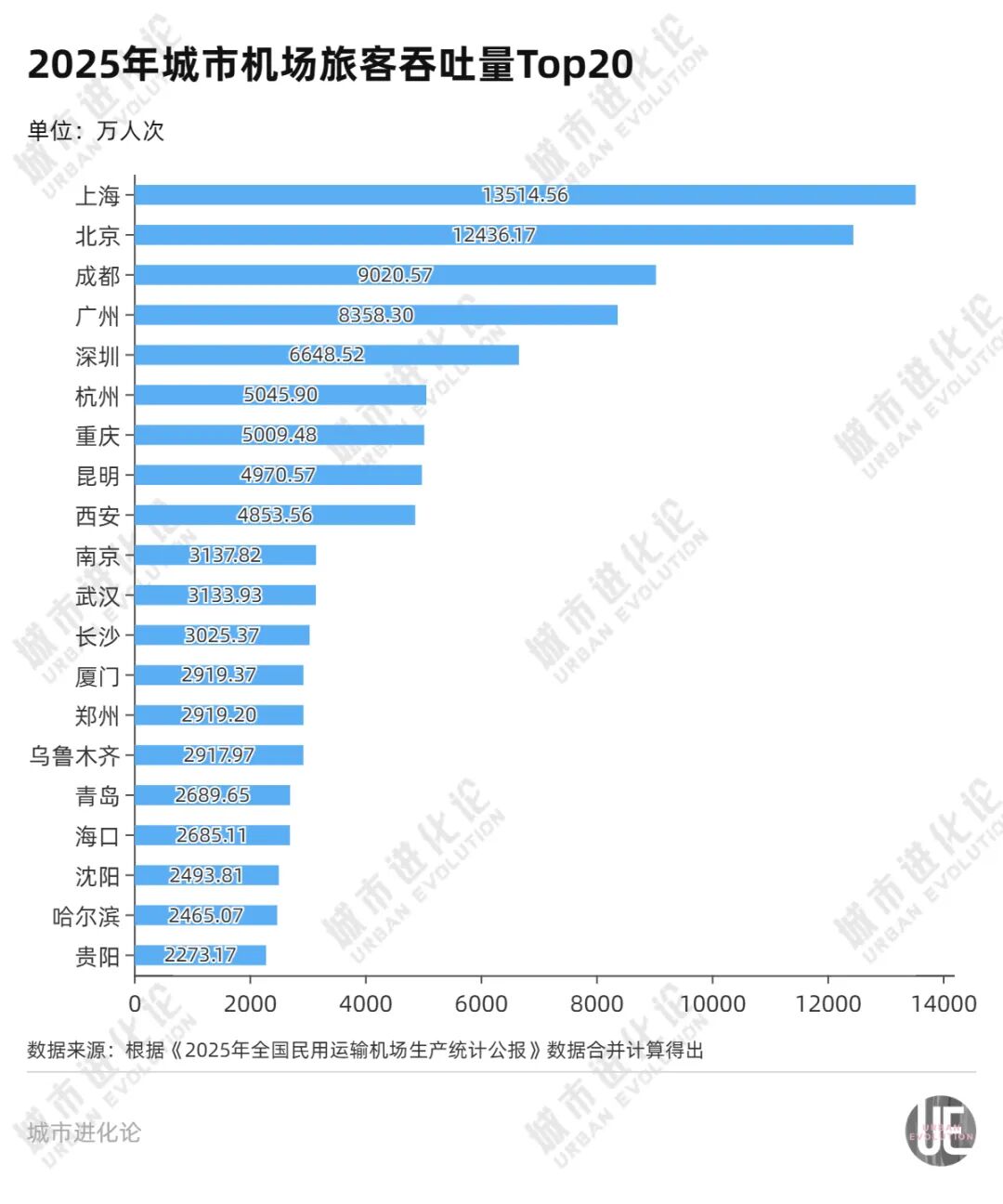
In 2025, Nanjing Airport achieved a throughput of 31.378 million passengers, overtaking Wuhan to return to the title of "the 10th largest air passenger transport city". During the same period, the passenger throughput of Wuhan Airport and Changsha Airport reached 31.339 million and 30.254 million respectively.
In contrast, Urumqi was not that prominent — its annual passenger throughput was 29.18 million, ranking 18th among national airports and 15th among cities. Ahead of it, there were Xiamen and Zhengzhou, whose passenger throughput also exceeded 29 million and led by a narrow margin.
Looking back at the ranking of passenger throughput of national urban airports in recent years, Urumqi basically hovered between 14th and 16th, and there was still a gap compared with cities such as Nanjing, Wuhan and Changsha. In other words, judging from the performance of previous years, Urumqi was hardly in the discussion of the fierce competition for the 10th largest air passenger transport city.
Now, the reversal has taken place.
According to CADAS transport big data, from January to September this year, Urumqi Airport jumped to the 13th position among national airports with a passenger throughput of 24.232 million. In terms of urban ranking, Urumqi squeezed out popular competitors such as Nanjing, Wuhan, Changsha and Zhengzhou, and historically advanced into the top 10 cities nationwide.
After carefully sorting out the trend of air passenger flow in various regions, this counterattack is no accident.
Since last year, the passenger flow growth of airports in the above-mentioned regions has shown signs of fatigue. According to the 2025 National Civil Transport Airport Production Statistical Bulletin, the passenger throughput of Nanjing Airport and Zhengzhou Airport in 2025 increased slightly by 0.6% and 2.4% respectively, while the year-on-year growth rate of Wuhan Airport and Changsha Airport was -0.2% and -3.1% respectively, ranking at the bottom among the top 20 national airports in terms of passenger throughput.
In 2026, this trend continues to expand. CADAS transport big data shows that from January to September this year, the passenger throughput of Nanjing Airport recorded zero growth, the throughput of Wuhan Airport and Changsha Airport decreased by 3.5% and 5.1% respectively, and that of Zhengzhou Airport and Xiamen Airport decreased by 1.7% and 1.5% respectively.
During the same period, Urumqi achieved a growth of 7.7%, ranking the third among the top 20 airports in terms of growth rate, which helped it widen the gap significantly and achieve ranking progress — it not only overtook Nanjing, but also widened the gap with Wuhan and Changsha.
02
Differentiation
Behind the change of the 10th largest air passenger transport city is the differentiation and reconstruction of a new round of aviation hub pattern.
Steady growth on its own coupled with the pressure on its "rivals" is the key reason why Urumqi can achieve this counterattack. The two trends exactly correspond to the completely different situations that aviation hubs are currently facing.
According to CADAS transport big data, from January to September this year, 34 airports across the country recorded passenger throughput exceeding 10 million, among which 11 airports saw a year-on-year decrease in throughput, and the airports with large decline included Tianjin (-5.8%), Taiyuan (-5.7%), Changsha (-5.1%) and other urban airports. Together with Wuhan, Zhengzhou, Hefei and Nanchang, the six airports of provincial capitals in central China all recorded negative growth in passenger flow collectively.
Among them, the impact of high-speed rail is extremely significant. According to industry insiders, the range of 800 to 1200 kilometers is often the section where high-speed rail and aviation compete most fiercely, and the mainstream cross-city travel distance of provincial capitals in central China with a central geographical location almost falls within this range. With the accelerated formation of high-speed rail networks in central China in recent years, the substitution effect on civil aviation has become increasingly prominent.
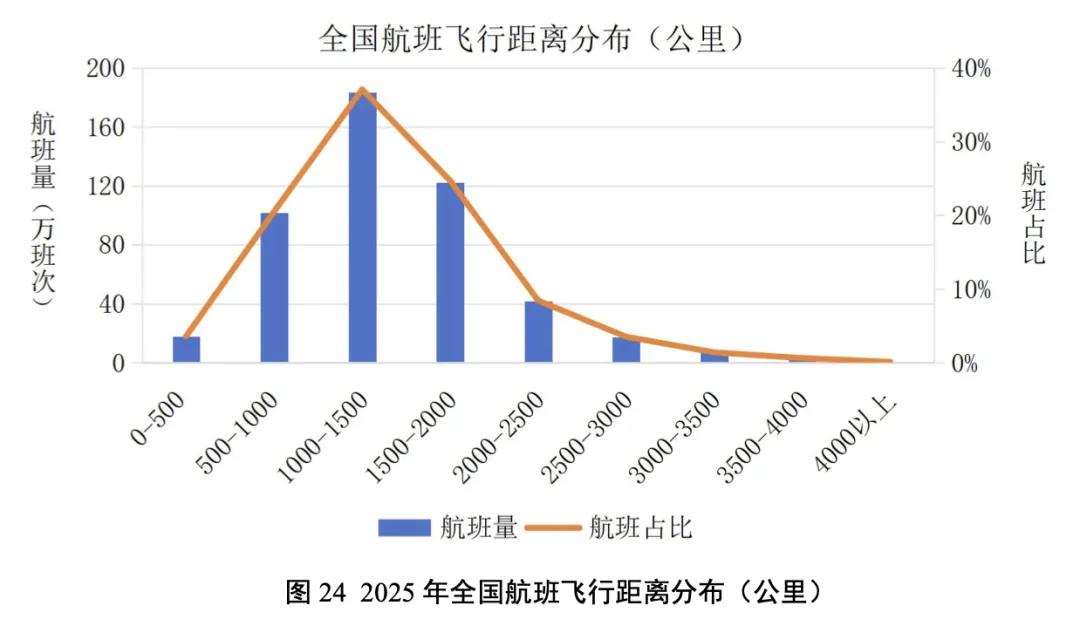
Data source: 2025 National Civil Aviation Flight Operation Efficiency Report
In contrast, some common features of urban airports with leading growth are worthy of attention. For example, Guangzhou Baiyun Airport, whose passenger throughput overtook Shanghai Pudong and ranked first in the country this year, saw strong growth in international passenger flow in the first 9 months of this year. The total number of entry-exit personnel inspected at the port exceeded 15 million, a year-on-year increase of more than 18.3%, hitting a record high for the same period in history, making it the first gateway in southern China to Southeast Asia, Africa, the Middle East and Oceania.
Looking deeper, behind the differentiation of airport passenger flow is the change in growth logic brought by different airport functions. While high-speed rail continues to divert the passenger flow of traditional aviation hubs, some international gateway airports have benefited from opportunities such as the favorable visa-free policy and international market expansion, embarking on a new growth curve.
Urumqi, the latest "dark horse" that emerged, is a typical representative.
In the "3+7+N" international aviation hub functional system determined at the national level, Urumqi, together with Chengdu, Shenzhen, Chongqing, Kunming, Xi'an and Harbin, has been identified as 7 international aviation hubs that enhance the complex functions of regional gateway.
As the relevant person in charge of the Civil Aviation Administration of China said, these cities "have strong comparative advantages in geographical location and strategic value of location", and it is required to combine the urban function positioning to achieve differentiated and coordinated development, and transform the comparative advantages of location into the competitive advantages of hubs.
Xinjiang, located in the hinterland of the Eurasian continent, is the provincial-level administrative region with the largest land area, the largest number of neighboring countries and the longest land border in China. Urumqi, the capital, is located at the geographical center of the Eurasian continent, which is an important hub connecting China with Central Asia and Europe, and the gateway for China's opening to the west.
What comes along with the national positioning is undoubtedly substantial policies, as well as the inclination of core resources such as air rights, slots and transport capacity.
For example, in June this year, the Civil Aviation Administration of China announced the Several Measures for Optimizing the Policy of International Passenger Air Right Allocation (Draft for Comments), which clearly defined each hub airport in the "3+7+N" system and its specific national strategic direction. Among them, the specific direction of Urumqi is "Central Asia, West Asia, Europe, Southeast Asia and Africa", and it is also the only hub airport covering Asia, Europe and Africa among the 7 regional gateway complex international aviation hubs except Chengdu, whose importance is self-evident.
Some views point out bluntly that when the airspace in eastern China tends to be saturated and high-speed rail in central China continues to divert short-distance passenger flow, long-distance and cross-border air demand has become a definite growth engine for Urumqi.
Data shows that in 2025, the international passenger throughput of Urumqi Tianshan International Airport reached 989,000 passengers, with an increase of 62.31%; the international cargo and mail throughput reached 122,700 tons, a sharp increase of 204.8%. From January to July this year, the international and regional passenger throughput of the airport reached 649,700 passengers, a year-on-year increase of 29.36%; the growth rates of international and regional cargo and mail throughput and international all-cargo aircraft throughput both exceeded 20%. Among them, the number of flights and passenger flow to the five Central Asian countries ranks first in the country.
03
Tests
According to CADAS transport big data, from January to September this year, the passenger throughput of national airports reached 1.178 billion passengers, a year-on-year increase of 2%, among which the domestic and foreign passenger volume increased by 1.5% and 6.9% respectively. Under the background of the new round of differentiation, with the overall passenger transport market, especially the overseas demand continuing to grow, this northwestern city is expected to usher in a window period for the re-evaluation of its aviation value.
The local government obviously does not want to miss this round of opportunities.
Shortly after being included in the "3+7+N" international aviation hub functional system, the north terminal area of Urumqi Tianshan International Airport was put into operation in April 2025. This is the largest civil aviation construction project in Xinjiang so far, and the terminal building of 500,000 square meters has become the largest single building in Xinjiang.
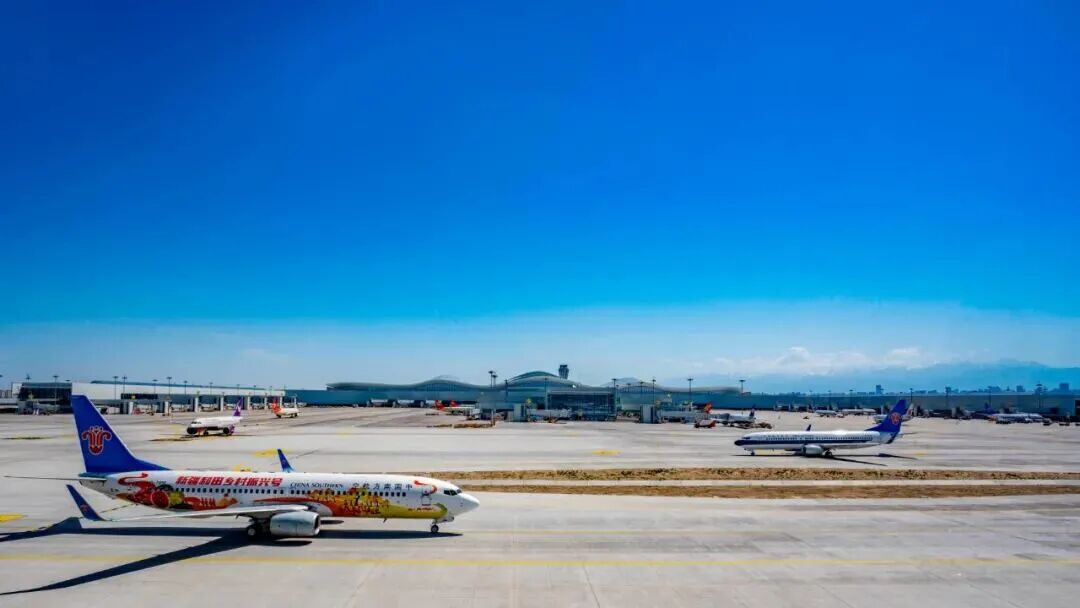
Image source: WeChat official account of "Xinjiang Airport Group"
The opening of the north terminal area has greatly raised the physical ceiling that has long restricted the development of the airport — the planned annual passenger throughput is 48 million, the cargo and mail throughput is 550,000 tons, and the annual aircraft take-off and landing is 367,000 sorties. The passenger and cargo and mail throughput have both expanded by more than twice compared with the original support capacity.
Moreover, with the completion of the south area renovation in the second half of this year, the airport will officially have 3 runways, which can support an annual passenger throughput of 63 million passengers and a cargo and mail throughput of 750,000 tons in the long term, leaving huge space for future development.
After this counterattack, can Urumqi hold the position of "the 10th largest air passenger transport city" steadily?
Xinjiang's tourism has always had obvious fluctuations between peak and off seasons, with passenger flow surging in the summer travel peak and falling in the off season. Relying solely on tourist sources cannot support a stable position as the "10th largest air passenger transport city". How to further expand business, international passenger flow and cross-regional transfer services in the follow-up has become the key to consolidating its hub status.
On the other hand, Urumqi is far from the only city targeting the gateway hub for opening to the west.
Among the 7 national regional gateway complex international aviation hubs, 5 are located in western China, namely Chengdu, Chongqing, Urumqi, Kunming and Xi'an. Among them, the competition and cooperation relationship between Xi'an, which is also located in northwest China, and Urumqi has attracted much public attention.
According to the data, in 2025, the passenger throughput of Xi'an Airport reached 48.536 million passengers, ranking 9th among all cities nationwide. In the first three quarters of this year, the passenger throughput of Xi'an Airport reached 36.177 million passengers, firmly ranking as the 9th largest air passenger transport city, only one position higher than Urumqi, but the gap in passenger throughput between the two exceeded 11.9 million passengers.
Even so, the potential of Urumqi as the "chaser" is still optimistic.
"The northwest region is vast, and the distance between Xi'an and Urumqi is very long. The ecological niches of the two hubs are completely different." Li Hanming, a civil aviation industry insider, once analyzed to Urban Evolution that Xi'an is close to the geometric center of China, and such a geographical location makes it very convenient to fly to any place in China. In addition, Xi'an has developed industries and is also a famous tourist destination, so the domestic passenger flow of Xi'an has remained at a high level all year round, which indirectly reduces the necessity of building an international hub.
In contrast, Urumqi's location in the remote corner of northwest China just provides convenience for opening to the west. In addition, Urumqi Tianshan International Airport is currently the