Unitree H2-X is here: it can act as a "bodyguard", block knife attacks, and has a maximum battery life of 8 hours.
On October 21, Unitree Robotics released a demonstration video of the H2-X "Kung Fu Legend" humanoid robot.
Different from conventional humanoid robot demonstrations, this video not only showcases highly difficult movements, but also designs scenarios including knife blocking, car lifting for rescue, and emergency evasion, connecting the robot's physical capabilities with safety protection functions.
Unitree officially stated that the maximum battery life of the H2-X is about 8 hours. However, apart from the battery life information, Unitree has not announced the complete hardware configuration of this robot, nor has it detailed the implementation methods of various movements in the video.
Judging from the demonstration content, what the H2-X tries to present is not only the robot's motion capability, but also the application of strength, balance and fast movements in specific scenarios. However, to what extent these footage can reflect the actual capability of the robot still needs to be judged in combination with more technical information and test results.
01 Leaping over cars, kicking car doors, Kung Fu show performed in containers
At the beginning of the video, the H2-X leaps into the air over a sedan, turns around and lifts its leg immediately after landing, kicking the car door hard, causing the door panel to dent on impact. Right after that, it swings its arm and hits the hood hard with its elbow, continuously demonstrating kicking and elbow striking movements.
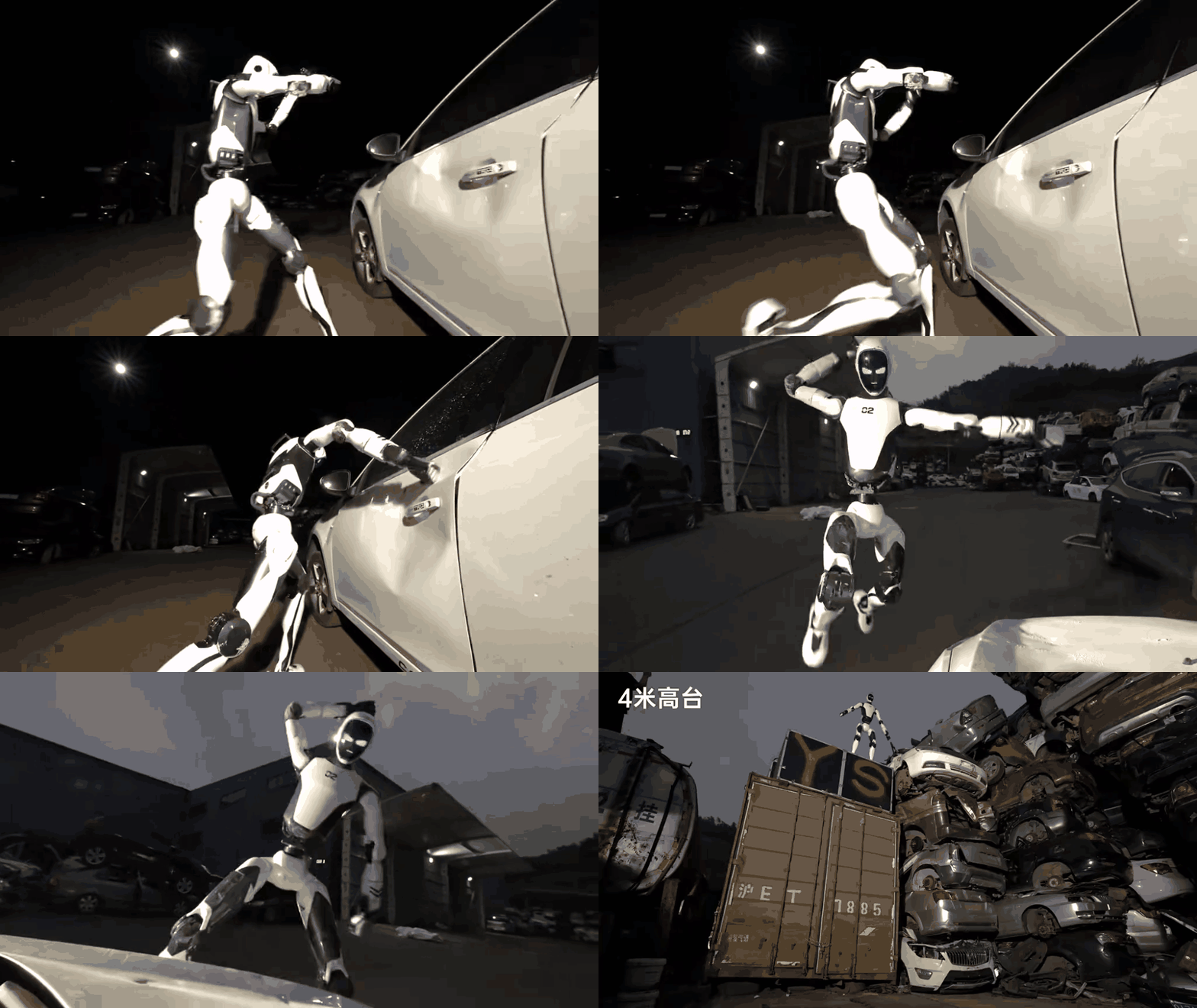
Then the scene switches to a scrapyard at night. The H2-X leaps down from the top of a red container, stabilizes its body quickly after landing, then assumes a fighting stance, throws continuous punches and kicks, and constantly adjusts its body direction during the movement.
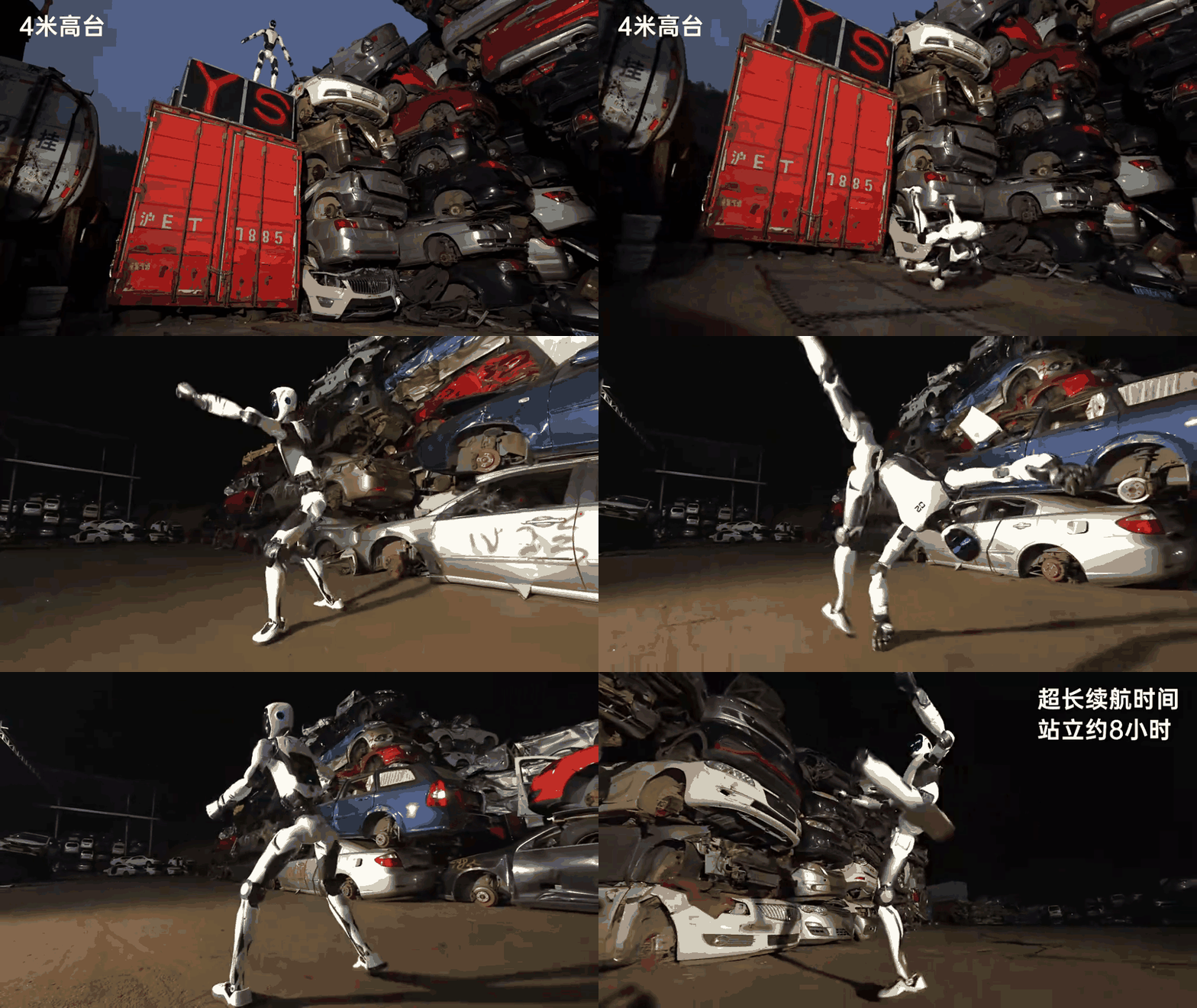
From leaping over the car, jumping from a height to continuously performing Kung Fu movements, this set of demonstrations intensively shows the robot's capabilities of dynamic balance, posture adjustment and movement connection. Compared with basic movements such as standing and walking, such highly dynamic movements put forward higher requirements for full-body coordinated control and landing stability.
Discussions on the X platform also focus on these details. One user believes that what is worth paying attention to is not only the explosive power of a single movement, but also the connection between leaping, kicking and landing, as well as the robot's ability to adjust its posture in the air and restore its center of gravity after landing.
Another user exclaimed that the movements of Unitree's robot are getting closer and closer to human beings, and the progress speed is amazing.
However, the video does not explain what control method these movements adopt, nor does it disclose how much role manual remote control, preset movements and autonomous control play respectively. Therefore, it is impossible to judge whether the robot can independently complete the same movements in an unfamiliar environment only through the demonstration footage.
02 Blocking knives in the villa courtyard, the robot acts as a bodyguard
After the Kung Fu demonstration, the video turns to the personnel protection scenario.
In the villa courtyard in the daytime, a woman is sitting at the dining table, and a man in a black hoodie holding a knife gradually approaches her. The H2-X immediately steps forward, stands between the two, and copes with the opponent's attack through sideways movements and arm actions.
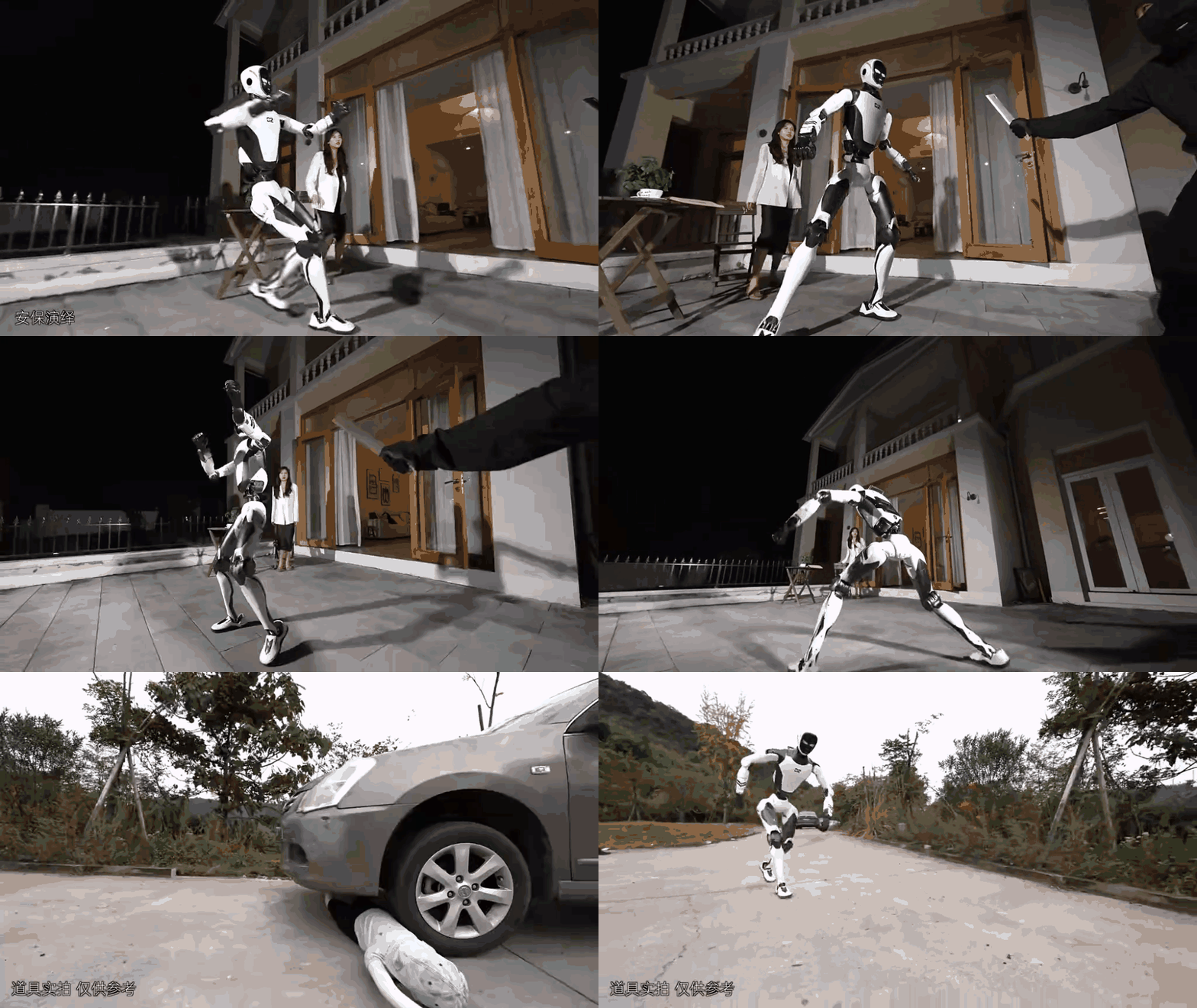
This scene puts the robot's movement capability into a more specific task: after detecting a potential threat, it moves in front of the person who needs to be protected and uses its body position to block. Compared with simply demonstrating punches and kicks, such scenarios also involve issues such as threat identification, intervention timing and movement selection.
However, the knife-blocking plot in the video is only a scenario demonstration, and it cannot be concluded that the H2-X has mature security capabilities. The attack direction, speed and distance in the real environment are difficult to determine in advance, and whether the robot can accurately identify dangers, respond in time, and avoid hurting other people during the protection process still needs further verification.
03 Lifting cars to save people, pushing people to avoid risks, demonstrating emergency rescue scenarios
In the second half of the video, the H2-X demonstrates two more movements related to emergency rescue.
In the first footage, a sedan is pressing on a trapped person. The H2-X comes to the side of the car, adjusts its standing posture, uses its arms to prop against the car body, then exerts force to lift the car, making space for the trapped person. The footage focuses on the process of the robot supporting the car body and cooperating with the lower limbs to exert force.
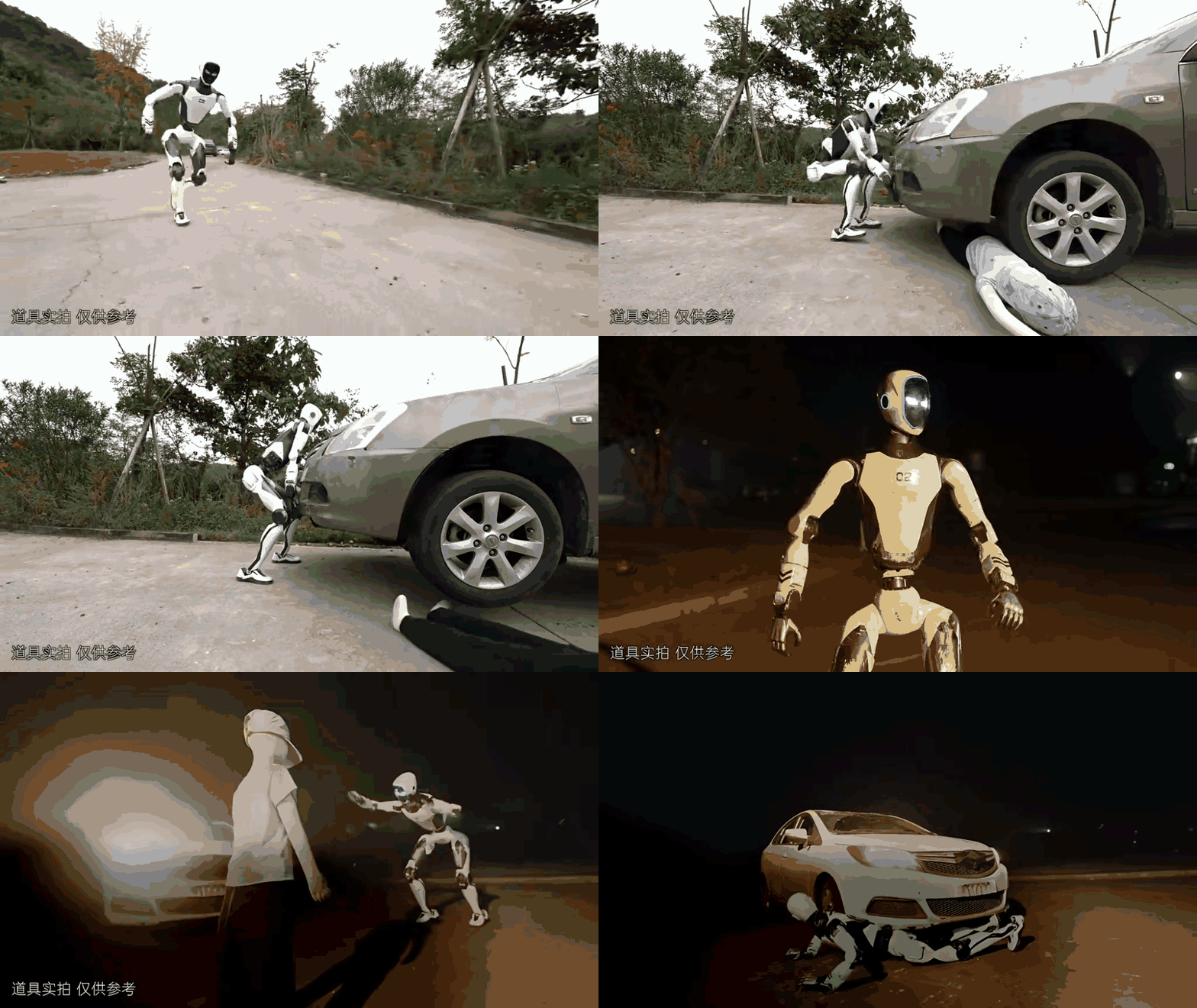
In the other footage, a car is driving at high speed. The H2-X quickly pounces on the person next to it and pushes the person away from the driving route of the car. The car passes the original position where the two were, the robot is knocked down, and then stands up again.
These two sets of scenarios respectively demonstrate the movement capabilities when lifting heavy objects and performing emergency evasion, and also connect the previous strength demonstration with specific practical uses. However, the demonstration footage does not provide sufficient information, so it is impossible to judge the actual load, vehicle status and test conditions when the robot lifts the car, nor can it confirm whether it can independently identify dangers and decide when to intervene.
Battery life is another indicator that has attracted much attention. Unitree states that the maximum battery life of the H2-X is about 8 hours; for reference, the publicly announced battery life data of the standard version H2 is about 3 hours. However, the official has not explained the test conditions adopted by the two models, nor has it disclosed the battery life performance during high-intensity exercise, load bearing or continuous task execution.
A user on the X platform raised a question about this: under what conditions is the so-called 8-hour battery life achieved? This question also touches on the test that humanoid robots must face when moving towards practical applications.
The movements in the demonstration can be tested repeatedly under specific conditions, but real tasks may last for several hours, accompanied by load changes and environmental interference. In addition to battery life, task success rate, failure rate and operation safety are equally important.
Compete in physical capability, and also compete in practical landing capability
The H2-X is not a brand-new platform independent of Unitree's existing product line, but a derived model built on the basis of the H2. At present, Unitree has laid out three major series of H, G and R, covering different sizes and application directions.
The H series is dominated by full-size humanoid robots, with representative products including H1, H1-2 and H2, focusing on dynamic movement and full-body coordinated control; the G series is represented by G1, which is about 1.32 meters tall and weighs about 35 kilograms, taking into account flexible movement, object operation and embodied intelligence development; the R series is represented by R1, which is about 1.23 meters tall and weighs about 25 kilograms, adopts a lightweight design, and is oriented to scientific research, education and development applications.
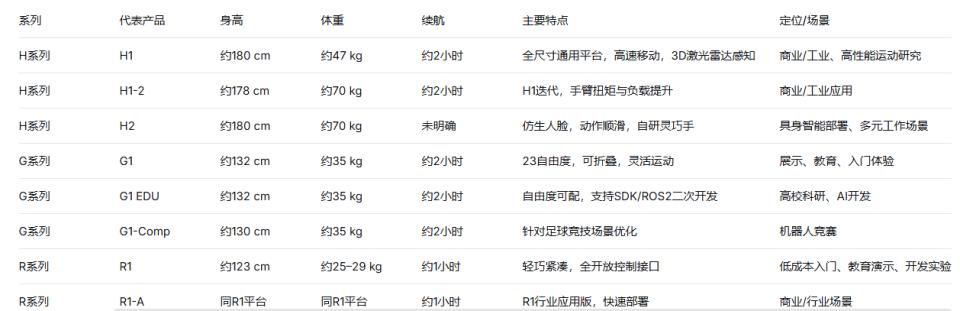
At present, Unitree has not announced the complete hardware configuration of the H2-X, so it is impossible to confirm the specific differences between it and the standard version H2 in terms of joint torque, drive system and other aspects. The test conditions behind the 8-hour battery life, as well as the autonomy of the movements in the video, also need further explanation.
From the perspective of the whole industry, the product layouts of Tesla Optimus and Unitree reflect different priorities. Tesla continuously emphasizes the application of general-purpose humanoid robots in the manufacturing industry, while Unitree explores multiple models and application directions through different series.
The H2-X takes "Kung Fu and guardianship" as the theme this time, making the movement capability more intuitively displayed, but whether it can enter the actual working scenarios depends on the comprehensive performance beyond movements.
Unitree also reminded users at the end of the video not to carry out dangerous modifications to the robot or imitate the extreme tests, and suggested that people keep a safe distance of at least 2 to 3 meters from the robot.
Highly difficult movements can demonstrate the upper limit of the robot's capability, but cannot replace long-term verification in actual tasks. For the H2-X, the next step is to answer whether it can judge independently in the real environment, perform tasks stably, and take into account both efficiency and safety during continuous operation.
Special contributing translator Jin Lu also contributed to this article
This article is from "Tencent Technology", written by Zhou Xiaoyan, edited by Xu Qingyang, and published by 36Kr with authorization.