For the first time in 32 months, the year-on-year growth of second-hand home prices in Shanghai has returned to positive territory, and housing prices have stabilized.
Property prices in a growing number of cities have stopped falling and started to pick up.
The context of this round of recovery has gradually become clear: first-tier cities have stopped falling and stabilized as a support, and the trend is gradually spreading to second- and third-tier cities.
The newly released September housing price data of 70 major cities has precisely verified this trend: the month-on-month new home prices in first-tier cities have stopped falling for 8 consecutive months, while the secondary home market is more stable, with month-on-month growth for 7 consecutive months. In the same period, the year-on-year and month-on-month indicators of new and secondary homes in second- and third-tier cities have also seen comprehensive improvement.
What is truly of signal significance is that: after 32 months, Shanghai has become the first city among the 70 surveyed cities to record a positive year-on-year growth in secondary home prices. The certainty that property prices have stopped falling is getting stronger, which has also become one of the key signals confirming the bottom of the property market in 2026.
01
This round of property price recovery has formed a pattern of "first-tier cities stabilizing, second-tier cities halting declines, and third-tier cities seeing slow price drops".
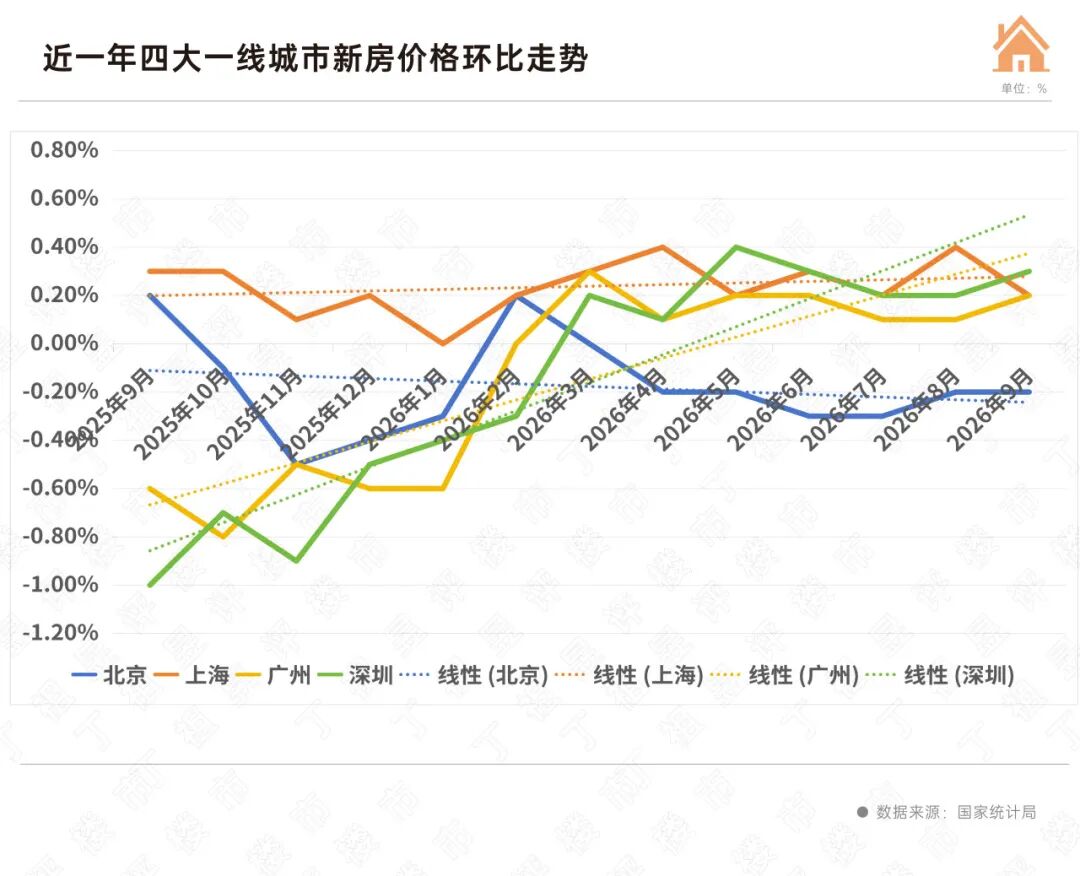
First-tier cities have shown strong resilience, with new home prices stopping falling in February 2026, followed by four consecutive months of month-on-month growth from March to June, remaining flat in July, and rising for two consecutive months from August to September, it has now stopped falling for 8 consecutive months, and the market bottom is very solid.
Shanghai, Guangzhou and Shenzhen are the main forces driving the recovery of new home prices, while the trend in Beijing is relatively weak.
The resilience of Shanghai's property prices ranks among the top across all cities in China, from August 2019 to September 2026, the new home prices have not recorded any month-on-month decline for 86 consecutive months, with only a few months of flat month-on-month performance. Since 2026, Shanghai's new home prices have only remained flat in January, and returned to the rising track after February, it has risen for 8 consecutive months as of September, with a cumulative increase of 2.2%. Guangzhou and Shenzhen have also risen for 7 consecutive months simultaneously, up 0.2% and 0.3% respectively in September.
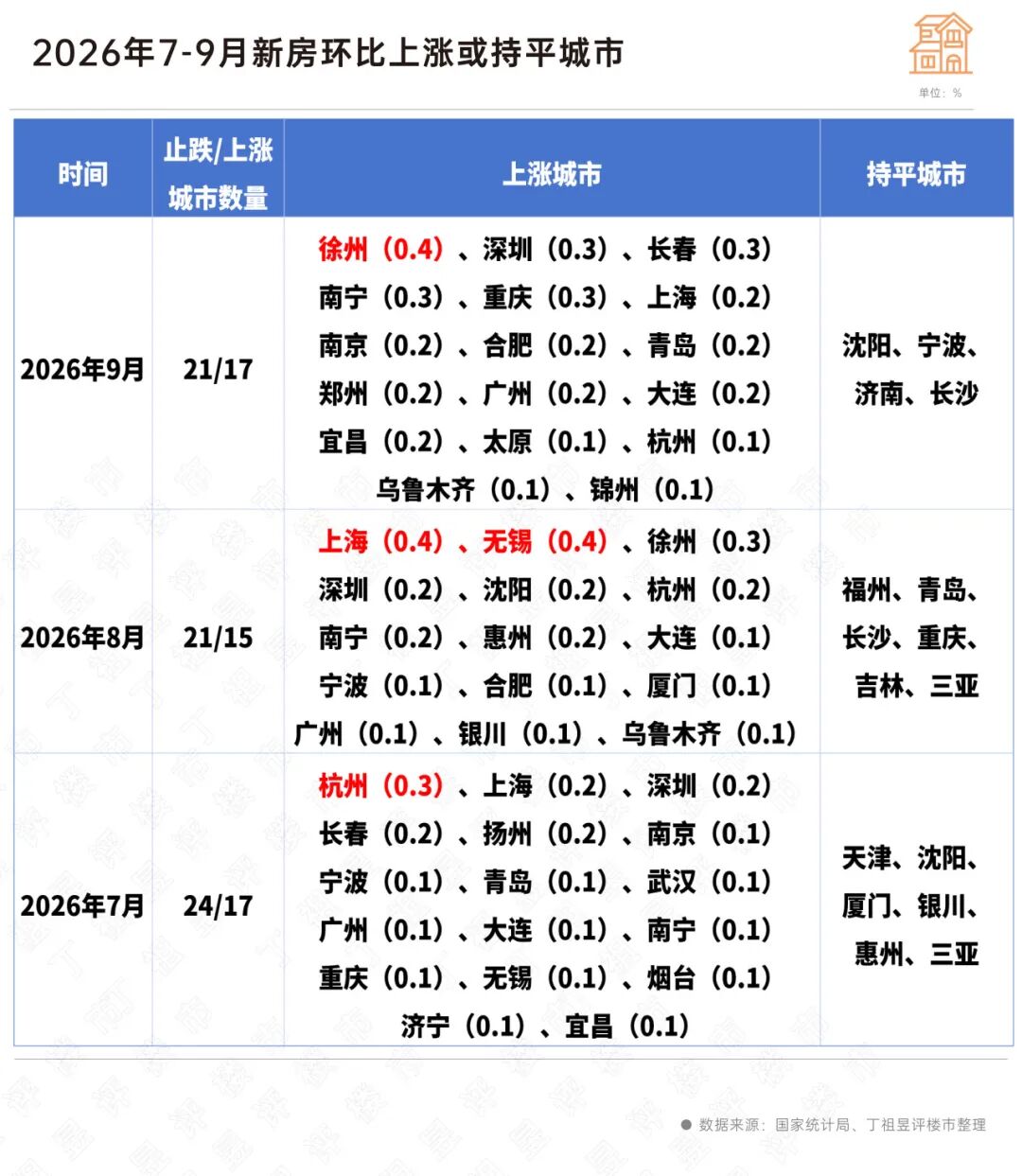
After property prices in first-tier cities stabilized, the recovery effect is gradually transmitted to strong second-tier cities with net population inflow and solid industrial foundations, and a number of cities have seen a sustained uptrend of consecutive price increases.
A typical example is Hangzhou, since new home prices turned from decline to a 0.2% increase in February this year, it reached the peak of the year with a 0.5% growth in May, and then maintained a moderate upward trend. As of September, it has recorded 8 consecutive months of month-on-month growth, with a cumulative increase of about 2.2%, making it the most representative city with the highest certainty of property price recovery among core cities.
In addition, Ningbo, Nanning, Qingdao and Dalian have also achieved consecutive growth for multiple months. For example, in Ningbo, property prices remained flat month-on-month in September, but have risen for 6 consecutive months from March to August; in Nanning, it has risen for 5 consecutive months since the trend turned upward in May, with the growth rate expanding slightly month by month, up 0.3% month-on-month in September.
Cities including Wuhan, Changchun, Shenyang, Hefei, Xiamen, Xuzhou, Wuxi, Huizhou and Yichang have all seen periodic month-on-month increases for 1 to 2 months, with property prices fluctuating slightly on the whole.
02
If the stabilization of new home prices is the result of supply structure adjustment and policy support, the recovery of the secondary home market can better represent the change of real market expectations.
The most reversed signal of property prices in September exactly comes from the secondary home market.
First-tier cities remain the main force driving the recovery of secondary home prices, with a 0.2% month-on-month increase in September, 0.1 percentage points higher than that in August. So far, the secondary home prices in the four first-tier cities have risen for 7 consecutive months month-on-month.
Different from the internal differentiation in the new home market, the secondary home prices in Beijing, Shanghai, Guangzhou and Shenzhen all recorded positive month-on-month growth in September, with Shanghai leading the rise with a 0.5% month-on-month growth, and Beijing, Guangzhou and Shenzhen up 0.1%, 0.1% and 0.2% respectively. Among them, Shanghai has risen for 9 consecutive months month-on-month since January this year, leading the recovery pace across the country, and Shenzhen has also risen for 7 consecutive months.
Outside first-tier cities, signals of secondary home prices halting declines are also emerging intensively in second- and third-tier cities.
Among the 70 surveyed cities in September, 9 cities saw month-on-month secondary home price growth, 6 more than that in August. Apart from the four first-tier cities, third-tier cities including Wuxi and Xuzhou recorded relatively high growth, and more and more second-tier cities such as Hefei, Dalian and Wuhan have joined the ranks of halting decline and picking up. Previously, the secondary home prices in these cities generally fell excessively, and have seen rising or flat performance for multiple months this year, so the secondary home prices have basically stabilized.
The most significant signal in September comes from the breakthrough on the year-on-year side of secondary home prices. Data shows that the secondary residential property prices in Shanghai rose by 0.8% year-on-year in September, which is the first city among the 70 major cities across the country to achieve positive year-on-year growth in secondary home prices in a full 32 months since January 2024.
The number of cities with positive year-on-year secondary home price growth among the 70 surveyed cities has changed from 0 to 1, which is of strong signal significance, marking that the two-year-long comprehensive year-on-year decline channel of the national secondary home market has officially ushered in a structural inflection point, and the price recovery in core cities has moved from the stage of "stopping decline month-on-month" to a new stage of "turning positive year-on-year".
Shanghai has also become a city across the country where both new and secondary home prices record positive growth on both month-on-month and year-on-year bases.
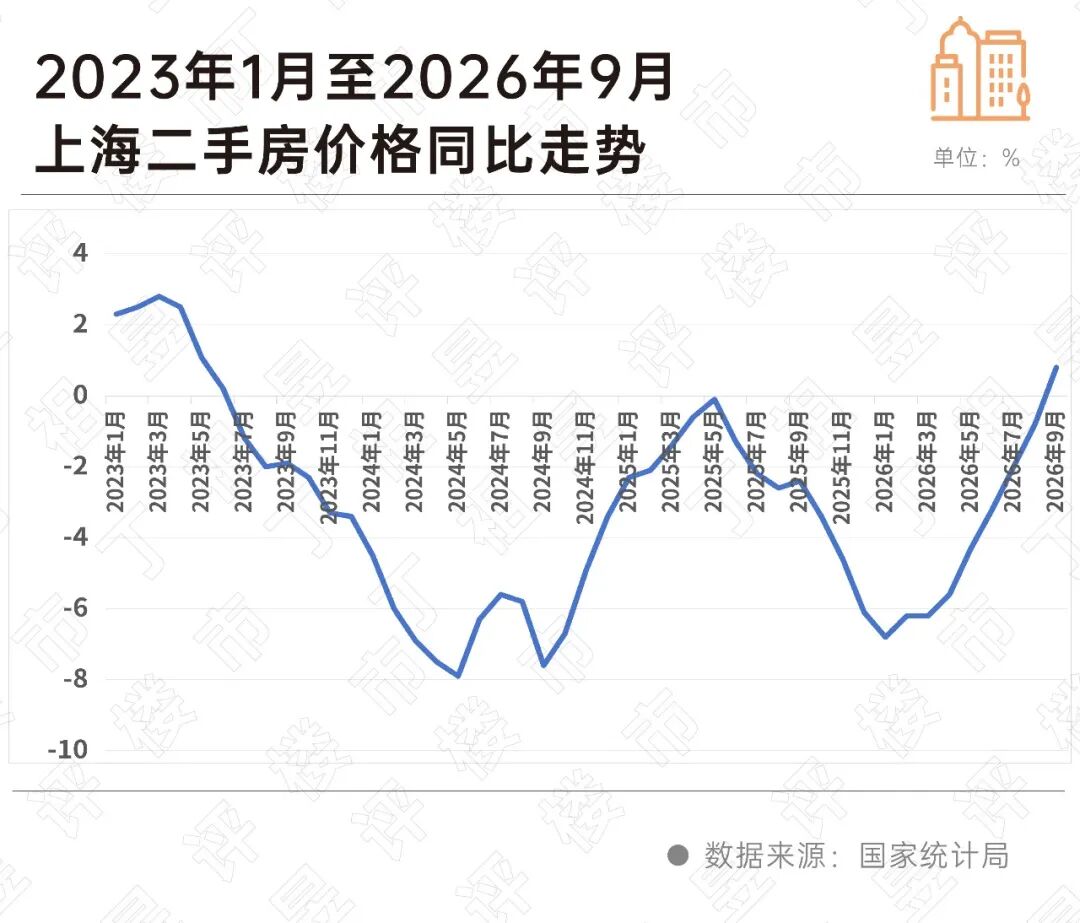
The positive year-on-year growth of Shanghai's secondary home prices is closely related to the rising transaction activity in the secondary home market and the consecutive month-on-month growth of secondary home prices.
In terms of market performance, Shanghai's secondary home market has maintained high activity since the beginning of this year, the rule of "volume leading price" is being fulfilled. The number of secondary home transaction units in Shanghai has remained above 20,000 per month except for the Spring Festival month of February since the start of this year, and the monthly transaction scale has risen for 7 consecutive months since March. The cumulative transaction volume in the first 9 months of 2026 reached 214,000 units, up 12.8% year-on-year.
The continued recovery of transaction volume has also driven the recovery of secondary home owners' expectations. At the end of September, the number of secondary home listings in Shanghai dropped by 5.50% compared with the annual high at the end of April, while the average listing price was only 1.15% lower than that at the end of April, the smallest decline among the 15 key cities. Property owners are no longer eager to sell at a discount, and the relationship between market supply and demand is gradually returning to a balanced state, jointly driving the price to achieve positive year-on-year growth.
Current property prices have entered a structural inflection point. Under the combined effect of demand-supporting policies and the recovery of supply and demand relationship, property prices in large and medium-sized cities are expected to hit the bottom first, and the trend will spread to more second- and third-tier cities. Stopping decline and rising month-on-month, coupled with continuous narrowing of year-on-year decline, will become the common trend of most cities, and the market bottom will become more and more stable.
This article is from the WeChat Official Account "Ding Zuyi Reviews the Property Market", written by the editorial department, and authorized for release by 36Kr.