WeChat is moving away from the product philosophy of "leave as soon as you are done with it".
On October 19, WeChat Open Platform, in conjunction with the Short Video Account team, officially launched the incentive program for "Adapting Official Account Novels into Micro Short Dramas". Both authors and production partners of selected works can receive an additional 5% cash incentive from the monetization revenue during the priority distribution period, with no upper cap.
Just over half a month ago, the mini-program "Green Bubble Short Drama", operated directly by WeChat Short Drama Content Center, was fully launched, covering three categories: live-action short dramas, AI-generated short dramas and manhua dramas, and deeply integrated with core entrances such as WeChat Search and Short Video Accounts.
From the continuously extended Short Video Account feed stream and the steadily rising ad load rate, to the official's direct entry into the short drama business, and then to the IP-based transformation of Official Account content, WeChat is accelerating its transformation from a national communication tool to a content and entertainment platform at a visibly noticeable speed.
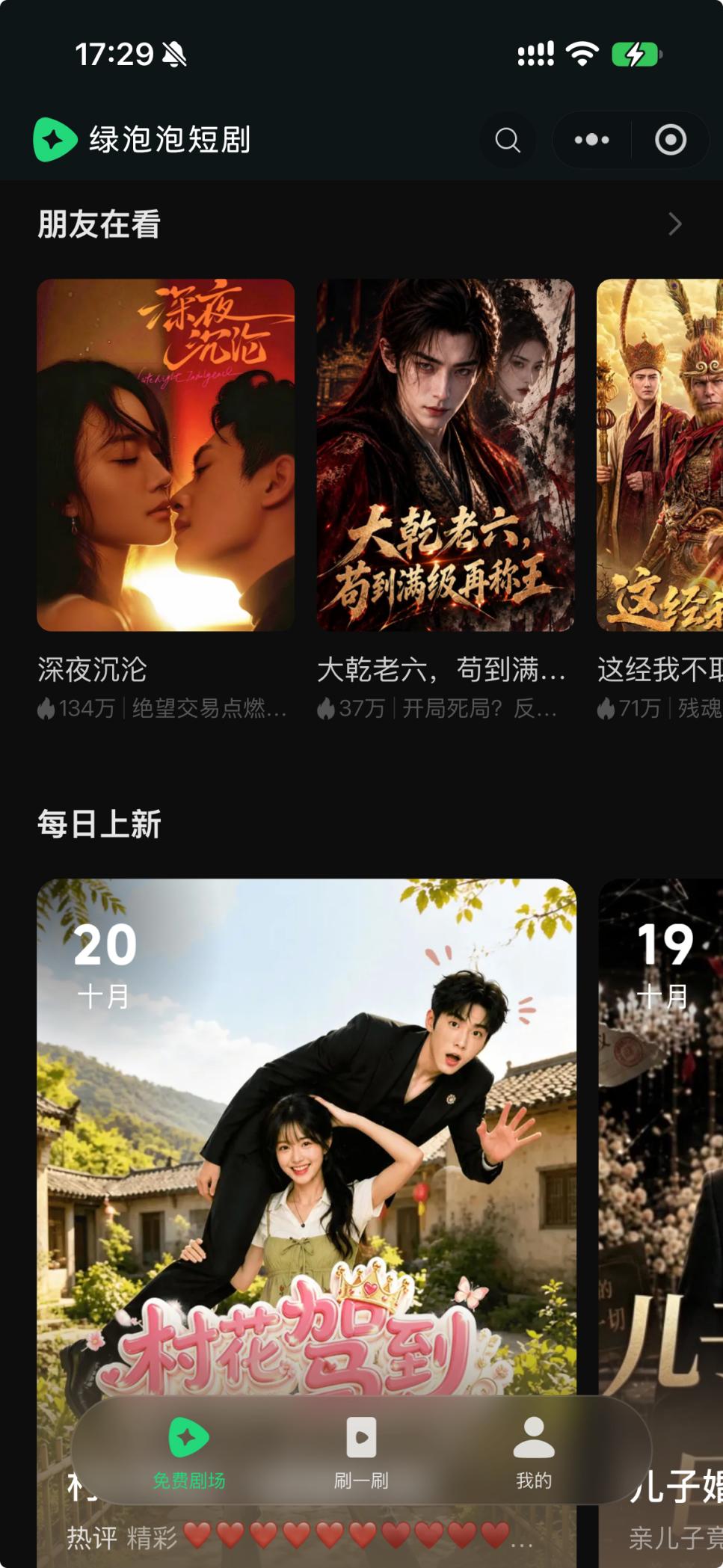
* Screenshot from Green Bubble Short Drama mini-program
Faced with the temptation of over 100 minutes of daily user time spent on short dramas, WeChat's old slogan "A good product is one that you can finish using and leave immediately" sounds more and more like a distant legend.
01 "The Time Black Hole More Aggressive Than Short Videos"
Short dramas are redefining the way Chinese people kill time, and their ability to attract attention is even more impactful than short videos.
Third-party data shows that in August 2026, the average daily usage time per user of Hongguo Short Drama under ByteDance reached about 125 minutes, which not only exceeded that of Douyin, but also significantly led WeChat. A product that has been online for only three years, with its average daily per-user duration surpassing that of social apps, is extremely rare in the history of the Internet.
What is even more striking is the depth of user addiction. On social platforms, netizens keep posting screenshots of their screen usage time. Some people spend more than 10 hours a day scrolling through short dramas, joking that "I open it as soon as I wake up, and keep watching until the middle of the night". When the topic #HongguoShortDramaMakesPeopleDumber# hit the hot search, a large number of users reported that after watching short dramas with high-density plot twists, they felt their minds slowed down and could not concentrate easily.
Zou Ying, deputy chief physician of the Department of Clinical Psychology, the Second Affiliated Hospital of Zhejiang Chinese Medical University, explained that the dense twist hooks of short dramas continuously stimulate dopamine secretion, making the brain passively excited and overloaded; after long-term high-frequency consumption of this neurotransmitter, people tend to feel tired when dealing with daily affairs. "It is not that the IQ has really decreased, but the dopamine reserve is overdrawn, leading to a temporary decline in the ability to concentrate and understand."
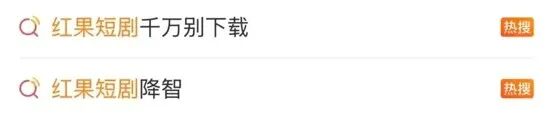
* Source from social networks
Is it all the user's fault for lacking self-control? In fact, this is a complete set of precisely designed addiction mechanisms at work.
Take a look at the common creation rules in the industry: the first three episodes must push the protagonist to the bottom — broken engagement, humiliation, being kicked out, full of aggrieved emotions; the first reversal and face-slapping scene is arranged at the end of the third episode to release emotions; after that, suspense hooks are left at the end of each episode. Users think that they decide to watch the next episode, but in fact, the algorithm and screenwriters jointly push them to move on.
The rapid rise of Hongguo Short Drama and its terrifying user usage time fully confirm the power of this mechanism. DataEye estimates that the market size of domestic micro short dramas (including manhua dramas) will exceed 1.21 trillion yuan in 2026.
It is precisely because of seeing this huge attention cake that WeChat has significantly accelerated its pace of entering the market in 2026. In late September, the "Green Bubble Short Drama" mini-program was officially launched to the public, operated by WeChat Short Drama Content Center itself, rather than a third-party developer — this is not the first time Tencent has made short dramas, but it is the first time that the short drama business is directly implanted into the core of the WeChat ecosystem.
WeChat has opened the highest-level traffic entrances for this product: direct access by searching "short drama" in WeChat, visible in the drop-down mini-program list, episode jump links can be mounted in Short Video Accounts, the homepage is equipped with "What Friends Are Watching" and regional popularity rankings, and supports floating small window playback — when a WeChat message comes, the drama shrinks to a small window, users can watch while replying to messages, without leaving the entire ecosystem.
Green Bubble adopts the "free + ad" model, and the "swipe to browse" function directly follows the up and down sliding feed stream logic, minimizing the cost of user switching.
Data disclosed by WeChat officials shows that the average duration of users watching through Green Bubble is about 5 times the industry average, and the retention rate is more than 2.5 times the industry average. During the gray test phase, the AI-simulated real-person short drama "Actress Yaya" exceeded 100 million views within 3 days of launch, and the mini-program and Short Video Account together reached more than 10 million users.
At the same time, the Short Video Account itself is also accelerating the consumption of user time. Tencent's 2026 Q2 financial report shows that the total user usage time of Short Video Accounts increased by more than 20% year on year.
On one side is the verified content form, on the other side is the huge base of 1.4 billion monthly active users. When the two are deeply integrated, the chemical reaction generated is not addition, but multiplication.
02 "Uninstallable, Impossible to Truly Close"
Facing short drama addiction, users at least have one last choice — uninstallation.
In ByteDance's product system, abstinence is feasible. Hongguo Short Drama is an independent app, and Douyin is also an independent app. If users feel that they are addicted and it affects their lives, they can uninstall it at any time, and force abstinence through physical isolation.
But WeChat is different.
You can uninstall any app that makes you addicted, but it is very difficult to uninstall WeChat — because it is not just a content app, but also your social ID, work communication tool, payment entrance, and contact channel for family members. It binds all your social relations, and the cost of uninstalling WeChat is almost equivalent to social death.
And Short Video Accounts and short dramas are built in such an app that you "have to keep".
When you open the "Discover" page of WeChat, the Short Video Account entrance is right below the Moments. Although users can hide this entrance through a very hidden operation path: Me - Settings - Other Functions - Discover Page - Short Video Account, turn off "Show this feature on the Discover page".
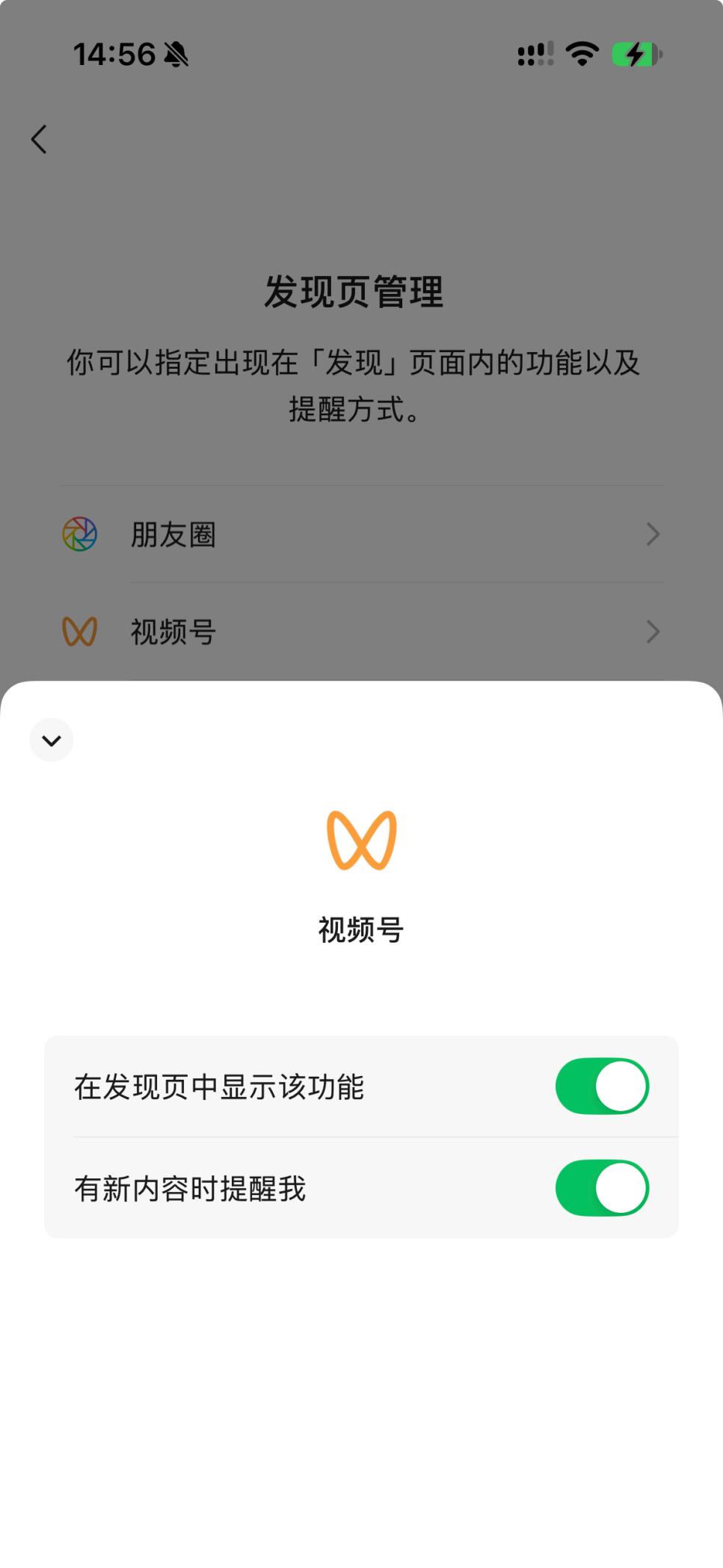
* Screenshot from WeChat
But this operation is almost meaningless — closing the entrance does not mean closing the content, and closing recommendations does not mean closing the social communication chain.
Short Video Account content can still be opened directly through links shared by friends, mounted in Official Accounts, and directly clicked in Moments. Trigger points are all over the entire WeChat app, every drop-down, every search, every share from friends, may pull users back again.
There are many help posts online. Some people tried to turn off personalized recommendations for Official Accounts, but found that Short Video Account content shared by others can still be played directly; some people were forced to enable the minor mode to block it forcibly; others tried various methods, and finally found that there is no solution unless they uninstall WeChat.
Now, Green Bubble Short Drama has also joined this "unrejectable" ranks — direct access via WeChat search, mounted in Short Video Account feed streams, mini-program entrances are everywhere. Users open WeChat to reply to messages and handle work, but they may accidentally click into the Short Video Account, or be attracted by short drama recommendations, and scroll for an hour.
Hongguo has higher daily active users and longer per capita duration, but at least it is a product you can reject: if you don't download it, it has nothing to do with you; if you delete it, your work groups, family groups, payment and daily life will not be affected at all.
WeChat is different. Embedding highly addictive content into a super app that users cannot leave due to social relations means taking most of the choice away from users.
The cost of this structure first falls on the groups that are least able to say "no". Cases recently disclosed by People's Daily are shocking: a 70-year-old senior in Xinjiang accumulated 225,800 yuan in recharge in hundreds of short drama mini-programs in two years, with extremely small single transaction amount and extremely high frequency. The elderly often do not know the exchange ratio between virtual currency and cash, and the money has been spent when their family members find out.
For minors, the "teen mode" already has duration reminders, recharge restrictions, and one-click disable; but the "brake" for the elderly is still largely blank.
Technically, the threshold is no longer a problem. The only difference is whether the platform regards the elderly as a group that needs protection as well, or regards them as the part of traffic with higher ARPU and lower complaint rate.
03 "The Cost of Restraint"
In January 2016, WeChat's product values were first publicly expounded at the WeChat Open Class. "A good product is one that you can finish using and leave immediately." "Any product is just a tool. For a tool, a good tool should help users complete their goals with the highest efficiency, and then let them leave as soon as possible."
In that year, WeChat was still strictly restricting marketing in Moments, with zero tolerance for induced sharing, and the Official Account subscription list was folded to avoid disturbing users. "Restraint" was the most distinctive label attached to WeChat, and it was also the bible in the hearts of countless product managers.
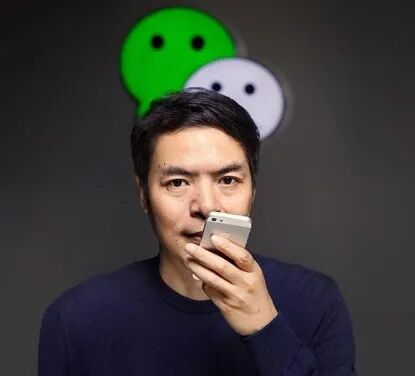
* Source from the Internet
However, WeChat today is deviating from this concept.
The Short Video Account, from an inconspicuous entrance under the Moments at the beginning, to single-column feed stream, live streaming with goods, gradually increasing ad load rate, and now full access to short dramas, every step of the Short Video Account is running wildly in the direction of "increasing user duration".
The entry of Green Bubble Short Drama pushes this contradiction to the extreme. The product logic of short dramas is fundamentally against "finish using and leave": it is designed to keep you from stopping, to make you scroll episode after episode, and to maximize the stay duration.
WeChat officials even stated that the core assessment criterion of the platform is no longer the number of views or clicks, but the user stay duration.
The driving forces behind it include both external competitive pressure and internal commercial considerations.
According to Tianyancha, Tencent's 2026 Q2 financial report shows that the company's total revenue reached 204.785 billion yuan, a year-on-year increase of 11%; among which, marketing service revenue was 43.565 billion yuan, a year-on-year increase of 22%, which is the fastest growing part among the three major revenue drivers.
The official driving factors include AI-optimized ad recommendation model, Tencent Marketing AIM+ upgrade, and WeChat ecosystem closed-loop marketing capability integration. The financial report also specifically mentioned that "the total user usage time of Short Video Accounts has increased by more than 20% year on year".
Short dramas are playing an increasingly important role in it. In 2025, the average daily IAA monetization scale of short dramas in the WeChat ecosystem reached tens of millions of yuan, with an annual growth of 122%. The "free + ad" model essentially uses content to exchange for duration, and uses duration to exchange for ad revenue.
Every extra minute users stay, there is more room for the ad eCPM to rise. In this equation, "finish using and leave" is no longer a product ideal, but a growth bottleneck that needs to be broken.
04 "Final Notes"
Short dramas themselves are not wrong, short videos are not wrong either. Users have the right to entertain, and platforms have the freedom to make profits. The real question is: When a product is so powerful that users cannot leave it, does it have the obligation to actively keep a distance from highly addictive content?
WeChat gave the answer "yes" back then. But WeChat today is giving another answer through its actions.
This article is from the WeChat Official Account "Orange Finance", author: Qing Feng, published with authorization from 36Kr.