Have the world's top life science funds unexpectedly received such a massive amount of funding this year that they now have more capital than they know what to do with?
Arterial Network notes that multiple life sciences funds have completed record-breaking fundraising since the start of this year.
It all started on March 30, when Blackstone Life Sciences closed its sixth fund at $6.3 billion, directly smashing the industry record for dedicated life sciences funds. Two months later, previous record holder Patient Square closed its second fund at $4.4 billion, surpassing its own prior benchmark. The momentum of record-breaking fundraising has surged sharply in recent periods: since October, three funds have consecutively announced record fundraising results. On October 6, Netherlands-based Forbion raised 2.3 billion euros to break its 20-year record, marking the largest life sciences fundraising deal in Europe this year. Two days later, TCGX's first Asia fund closed oversubscribed at $600 million. In the following week, OrbiMed announced the close of two funds with a total of $3 billion raised, among which the Asia fund exceeded $1 billion in fundraising for the first time.
It appears that after years of stagnation, hot money has begun to pour back into the life sciences sector.
01
Life Sciences Funds Usher in Another Prime Era
According to the VCBeat Orange database, since the start of this year, a total of 8 top-tier global life sciences funds have completed 9 rounds of fundraising, attracting a total of nearly $200 billion. Among these, 6 rounds of fundraising have broken their own past records or industry benchmarks. Blackstone and Patient Square have respectively completed ultra-large single fund fundraising of $6.3 billion and $4.4 billion.
Judging from the current pace, this round of life sciences fund fundraising boom features prominent professionalization. At the same time, the world's wealthiest consortia have begun to shift their focus away from the traditional mature markets in Europe and the United States, directing substantial capital to Asian projects and early-stage projects.
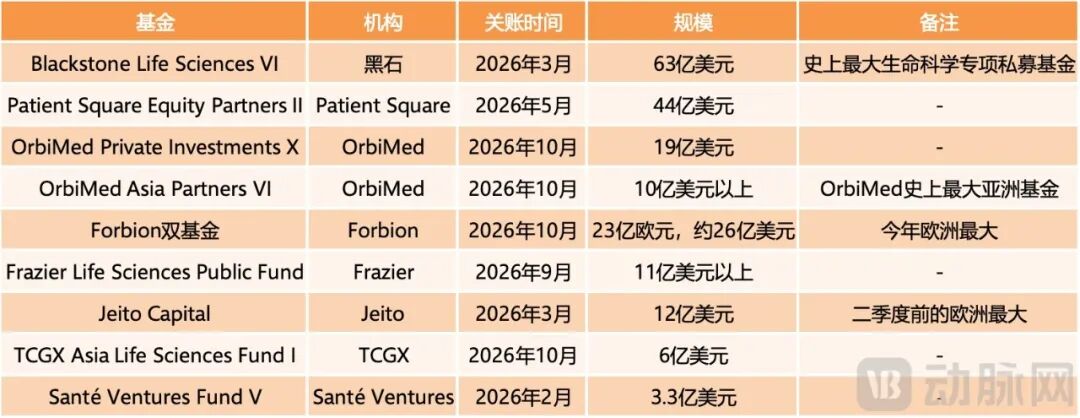
Partial data of life sciences funds that completed record-breaking fundraising since the start of this year Source: Sorted out by Arterial Network based on public data
First, apart from Blackstone, most private equity funds that have completed record-breaking fundraising this time are focused on the vertical life sciences sector. In the past, funds that obtained ultra-large fundraising were mostly cross-industry funds, while vertical sector funds long maintained the feature of being small-scale and high-quality. Now, both OrbiMed and Forbion have broken through the fundraising ceiling for vertical funds. Different from dedicated funds of general institutions that prefer holding acquisitions, late-stage products and royalty assets, vertical institutions have more flexible target selection that can cover all stages of life sciences innovation.
Among the vertical sector funds closed in this round, the most representative one is OrbiMed. On October 15, OrbiMed announced the close of two funds that raised a record total of $3 billion. Among them, Asia Partners VI closed at $1 billion, which is $800 million higher than the largest fund in the same series, making it the largest Asia fund in OrbiMed's history. It is understood that this fund will invest in growth equity and venture capital in Asia, aiming to cultivate leading enterprises in the fields of biopharmaceuticals, medical devices, diagnostics and technology-enabled healthcare services. Carl Gordon, Managing Partner of OrbiMed, listed the rise of China as a biotechnology powerhouse as one of the reasons for increasing its allocation in Asia.
Forbion, which completed its close shortly afterwards, was originally the largest life sciences-focused venture capital firm in Europe. It only invests in biopharmaceutical companies without cross-industry allocation, covering company formation, pre-clinical and late clinical stages. Over 20 years, it has invested in 142 companies, 37 of which were established by itself, and 21 products have been approved.
Patient Square, which closed its fund earlier, was founded in 2020 by Jim Momtazee, former head of healthcare at KKR. It only engages in holding acquisitions in the life sciences sector but boasts an astonishing growth rate. In 2023, Patient Square led a consortium to acquire Syneos Health for $7.1 billion, took Premier private for $2.6 billion in 2025, and acquired Paradigm in February this year. In April this year, Patient Square's second fund closed at $4.4 billion in May, ranking second only to Blackstone in size.
Second, among the 7 vertical institutions, 2 have set up separate funds dedicated to Asia. In addition to the record-breaking Asia Partners V fund under OrbiMed mentioned earlier, TCGX has also established its first Asia fund and completed oversubscribed fundraising. This institution, which raised its first fund only in 2021, has accumulated total fundraising of $3.1 billion to date, and its invested projects have been acquired by MNCs such as Roche and BMS at huge sums. It is understood that the TCGX Asia fund will operate independently from its flagship funds focusing on Europe and the United States, targeting innovative biotechnology enterprises in Asia, with offices in Shanghai and Hong Kong set up alongside the fund. Chen Yu, founder of TCGX, stated that Asia has become an important source of global biotechnology innovation.
Finally, although the funds closed this time still take mid-to-late stage projects as their core deployment focus, funds focused on early-stage investment have also begun to refresh fundraising records. Since its establishment, Santé has only invested in seed round and Series A projects in biotechnology, medical devices and digital healthcare, and its vision for selecting early-stage projects is widely recognized by MNCs. Previously, Laminar, which Santé led the Series A round of and held exclusively, was acquired by Johnson & Johnson; AbVitro, which Santé funded exclusively in its first round, was acquired by BMS. In February this year, Santé's fifth fund closed at $330 million, exceeding its $300 million target and surpassing its own previous record.
Jeito, another fund focused on early-stage life sciences projects, completed the close of its second fund in April, with the fundraising amount 2.4 times that of its first fund, making it the largest fundraising ever for an independent European biopharmaceutical fund. Early-stage projects selected by Jeito are also favored by MNCs. Previously, EyeBio, whose Series A round was led by Jeito, was acquired by Merck for up to $3 billion; HI-Bio, another company whose Series A round was led by Jeito, was acquired by Biogen for up to $1.8 billion.
These record-breaking raised funds are quickly being injected into the general trend of life sciences innovation and entrepreneurship.
On May 7, U.S.-headquartered early-stage venture capital institution Anagram completed a $250 million Series B financing, with Blackstone as the sole investor. On May 27, Apogee, a biotech focused on inflammatory and immune diseases, reached a non-dilutive financing deal of up to $1.3 billion with Blackstone. Less than two months later, AbbVie acquired Apogee for approximately $10.9 billion. In addition, after Patient Square's second fund closed in May, it pushed U.S. orthopedic and prosthetic service and equipment provider Hanger to acquire mobile solution provider Numotion in cash in early September, with Patient Square holding controlling stake in the merged entity. Jeito's second fund closed at the end of March, and within two weeks it led the $75 million Series C round of Danish biotech Adcendo, with the announcement clearly stating that the investment came from the second fund; 9 days after Forbion closed its fund, it led the $310 million Series C financing of Oxford biotech OMass.
Overall, current capital clearly prefers assets with clear pricing benchmarks. In terms of development stage, capital is concentrated in stages with clearer exit paths: Blackstone's $6.3 billion sixth fund only invests in late-stage products and royalty assets, and Patient Square's $4.4 billion second fund only engages in holding acquisitions, and this preference becomes more extreme as the fund size increases. In terms of track, capital is narrowing down to a small number of sectors: the main players in IPOs and M&As this year are concentrated in metabolism, inflammatory immunity and oncology. Two months after the Phase II data of Apogee's long-acting IL-13 antibody was released, it was acquired by AbbVie for $10.9 billion. In terms of region, capital is shifting to Asia: OrbiMed's portfolio already includes 22 Asian biopharmaceutical companies, and in the Series A round of Connexus led by its Asia Partners VI, HitGen holds founding equity.
02
But Has the Primary Market Recovered?
The answer is no.
Data shows that in the first half of 2026, the total seed round and Series A financing obtained by global biotech companies reached $4.4 billion, 15% lower than the same period last year, and still 47% below the peak in the first half of 2021. During this period, the number of disclosed financing events for global biotech companies was 142, the lowest in the same period in 10 years, more than half lower than the peak in 2021. Taking Massachusetts in the United States as an example, in the first half of 2026, biopharmaceutical venture capital in the state reached $3.45 billion, a year-on-year increase of 25%, but the top 10 transactions took 47% of the total amount. The average seed round amount was only $4.65 million, compared with $7.65 million in the same period last year and $11.1 million in the same period of 2022.
Even on the fund fundraising side, the situation in the primary market is equally difficult. As mentioned earlier, many global life sciences funds have completed oversubscribed fundraising, but this phenomenon takes place against the background that more life sciences funds failed to close as scheduled. Data shows that in the first half of 2026, only 11 healthcare funds completed their close, with the annualized number nearly halved compared to last year. For example, Paris-headquartered life sciences investment fund Kurma Partners completed the close of its fourth biotech fund in April 2026, raising 215 million euros, which failed to reach the hard cap of 250 million euros. Another example is Canada-headquartered life sciences investment fund Lumira Ventures, which set a target of $200 million for its fifth fund, actively lowering it from the $220 million target of its previous fund, only seeking a smooth close.
The flip side of the coin is that transactions of mature life sciences assets have become exceptionally hot.
On the one hand, the fundraising amount of biotech IPOs in the U.S. stock market has risen sharply. Data shows that in the first half of 2026, 13 U.S. biotech companies completed IPOs, raising $4.5 billion, nearly 3 times the total amount of 2025. Among these IPOs, the median fundraising amount was $302 million. In the past 5 years, this number only ranged from $150 million to $250 million.
Among them, Kailera Therapeutics, which went public in April, raised $624 million, exceeding the $604 million raised by Moderna in 2018. And just in June, Parabilis Medicines raised approximately $670 million in its IPO, breaking the new record just set by Kailera Therapeutics, and its share price rose 58% on the first trading day.
On the other hand, the size of the M&A market has expanded dramatically. Data shows that in the first half of 2026, the global biopharmaceutical sector completed 52 M&A deals, nearly doubling from last year, among which there were at least 34 M&As with a value of more than $1 billion, totaling more than $1.3 trillion, making it the period with the fastest scale growth in the past 7 years.
Among them, Sun Pharmaceutical acquired Organon for approximately $12.6 billion, marking the largest overseas acquisition by an Indian enterprise since Tata acquired Corus in 2007. In addition, AbbVie acquired Apogee, which develops long-acting IL-13 antibodies, for $10.9 billion, and GSK acquired Nuvalent, which develops small-molecule drugs for lung cancer, for $10.6 billion. These are all rare large-scale deals by MNCs in recent years. Behind these transactions, the support of the aforementioned life sciences funds is indispensable. For example, before Apogee was acquired at a high premium by AbbVie, it had obtained investment from Blackstone.
In essence, capital has indeed returned to the life sciences sector in batches, but it is chasing projects completely different from those in the previous cycle. "Capital is not invested in scientific possibilities, but in assets with clear calculable exit paths. Clinical data, listing windows, M&A buyers, if any of these elements is missing, it will be difficult to obtain capital." An industry practitioner told Arterial Network. According to statistics from BioCentury, two-thirds of the capital flows to companies that already have clinical-stage drug candidates.
03
The Industry Is Still Undergoing Structural Adjustment
Behind the rapid return of capital and its rapid concentration in mature projects is the structural change of fund contributors and asset buyers, leading to a sharp shortening of the capital cycle.
On the one hand, fund contributors have shifted from the previously dispersed family offices and fund-of-funds to large institutions such as pension funds and sovereign wealth funds. Their single commitment amount is larger, and their pursuit of high investment returns is not as urgent as that of family offices and fund-of-funds, but they prioritize stability more, and put forward higher requirements for the historical performance and exit record of fund managers. In other words, new contributors pay more attention to the liquidity of the portfolio. PitchBook data shows that between 2021 and 2023, the internal rate of return of funds from pension funds and sovereign wealth funds was 10.2%, lower than the industry average of 12%. Therefore, they are more willing to allocate capital to veteran institutions that have survived multiple cycles, allowing senior institutions such as Blackstone, OrbiMed and Forbion to complete record-breaking fundraising.
On the other hand, asset buyers have shifted from dispersed financial investors and mid-sized pharmaceutical companies to a small number of well-funded multinational pharmaceutical giants. With the patents of blockbuster drugs such as Keytruda and Opdivo expiring intensively around 2028, MNCs including Eli Lilly, GSK and Gilead have accelerated their pace of deploying new drug pipelines, and have allocated hundreds of billions of dollars for M&As in the short term, becoming important buyers in the life sciences asset market. These limited number of powerful buyers undoubtedly prefer mature assets that can generate commercial returns faster.
Neither the investment funds supported by new contributors nor the asset buyers eager to build new growth curves consider the large number of early-stage life sciences projects in the primary market as investment targets that match their cycles.
In addition, in the United States, early-stage life sciences companies also have to compete for capital with two types of alternatives. One type is AI platforms, which is the most capital-attracting track at present. Taking star project Isomorphic Labs as an example, its single round of financing reached as high as $2.1 billion, approaching half of the total amount of U.S. seed round and Series A financing. The other type is assets that have completed Phase II clinical trials in China. These innovative drug assets have relatively sufficient data, which can help multinational pharmaceutical companies reduce the risk of pipeline deployment. In the past, they usually needed to nurture companies that can develop new drug pipelines starting from the seed round.
Interestingly, in a sense, the mismatch between overseas life sciences capital and assets has left a rare window of opportunity for domestic biotech companies. For this reason, many domestic biotech companies are actively adjusting their corporate structure. Arterial Network notes that in order to access U.S. dollar capital, more and more assets are being placed into newly established NewCos overseas, while the domestic entities retain the Greater China rights and R&D teams.
For example, in January this year, Haisco placed the non-China rights and interests of HSK39004 into the newly established AirNexis, with a total transaction value of $1.063 billion and an upfront payment of $108 million, and the latter completed a $200 million Series A financing in the same period. Another example is that on July 14, Hansoh Pharma granted the overseas rights and interests of its oral IL-23 receptor antagonist HS-20118 to Avere Therapeutics, with a potential total amount of $2.3 billion and an upfront payment of $120 million. Avere then completed an all-stock merger with Nasdaq-listed NextCure, and Hansoh holds 30% to 40% equity of the merged entity. Of course, this window of opportunity is extremely short. Once the U.S. early-stage financing recovers, or policies restrict U.S. dollar capital from entering China's biopharmaceutical sector, this price gap will narrow.
Therefore, whether for overseas life sciences entrepreneurs or domestic biotech companies, the current period is still an unstable transition