Human delivery riders have not been replaced yet, but autonomous delivery vehicles have already been burnt out amid the rampant involution.
The autonomous driving delivery vehicle track has entered a new round of fierce competition in the fourth quarter.
On October 20, Neolithic, an autonomous delivery enterprise, announced the completion of its Series E financing of nearly 400 million US dollars, equivalent to about 2.68 billion RMB. This round of financing was jointly led by Boyu Capital and a state-level fund, with participation from institutions including Alibaba's affiliated funds. So far, Neolithic's total accumulated financing has exceeded 10 billion RMB.
Just one day earlier, according to exclusive reports from Big Tech Daily, Meituan's autonomous vehicle division also announced new organizational and performance assessment adjustments: the department has postponed the promotion and rating schedule for this year, arranging the review work to be carried out at the end of the year. If employees pass the promotion review at the end of the year, the company will make a one-time retroactive payment of the corresponding salary for the postponed months.
According to internal sources, the core reason for adjusting the promotion schedule is that the promotion review cycle conflicts with the launch timeline of the new autonomous driving vehicle model. The team chose to postpone the promotion, planning to incorporate the business results related to the new vehicle into this promotion assessment index after the new vehicle project is fully launched. To put it simply, the team prioritizes the implementation of the new vehicle project, and will uniformly carry out performance evaluation and promotion assessment after the project is completed.
On one hand, Neolithic has secured nearly 2.7 billion RMB in financing to continue expanding its autonomous delivery business; on the other hand, large internet platforms like Meituan are adopting an attitude of "no results, no retreat".
Has the business model of autonomous delivery vehicles been fully proven, or does the capital market see opportunities while enterprises are still exploring profitable paths?
When we shift our focus from Meituan to the entire industry, we will find that more and more enterprises and capitals are pouring into the autonomous delivery track, and it seems that people are beginning to believe that autonomous vehicles are truly a promising business.
01
It is not easy for autonomous vehicles to replace delivery riders
Looking back at all the changes in Meituan's autonomous vehicle business this year, we can find that this promotion postponement is not the starting point.
In January this year, Zhang Jing, former head of Meituan's Cycling Division, was transferred to the Autonomous Vehicle Division to take over related businesses. Zhang Jing had previously been in charge of businesses including family services, in-store integrated services, and Xiaoniao Supermarket, with a professional resume more focused on business operation.
The reason for his transfer was not that the group increased investment in the autonomous vehicle business, but to take over the position from the senior technical veteran who was about to leave. In April, Xia Huaxia, the former vice president in charge of Meituan's autonomous vehicle business, officially resigned. This technical expert, who graduated from the Department of Computer Science of Tsinghua University and previously worked at Google and Baidu, started from a project team of only 3 people and led the team to build Meituan's autonomous delivery system. The career trajectories of the two people form a sharp contrast.
As a result, the outside world can easily interpret this personnel change as a handover from a technical expert to an operation expert.
The main reason is that after years of technical accumulation, Meituan's autonomous vehicles have already acquired certain autonomous driving capabilities, but the progress of commercialization has not met expectations. Letting a person who is better at business operation take over means that Meituan's autonomous vehicle business has begun to shift from technical exploration to commercial verification. To put it more directly, in the past, the team cared more about whether the vehicle could drive, but now it needs to care about whether the vehicle can make profits.
While the personnel changes are taking place, a more essential question has not been answered: What problems did Meituan originally want to solve with autonomous vehicles? Why did some businesses shrink gradually while others were retained, and even became the key development direction in the next stage?
An industry insider revealed to Foci that Meituan's previous autonomous vehicle business mainly had two directions: one was the delivery business centered on scenarios such as Xiaoniao Supermarket, and the other was intra-city delivery. The two lines sound like they are both doing autonomous delivery, but the problems they actually want to solve are not exactly the same.
The business related to Xiaoniao initially explored how to use autonomous vehicles to complete part of the transportation tasks in retail delivery. According to the vision at that time, autonomous vehicles could travel back and forth between multiple points, transport goods to designated locations, and then users or the delivery chain would continue to complete the subsequent processes.
From a technical perspective, this vision is not difficult to understand. Fixed routes and relatively stable delivery demands mean that vehicles can repeatedly drive on the same route, reduce unnecessary scheduling, and make it easier to improve the level of full automation.
However, the problem is that real retail delivery does not operate completely in the way technical personnel imagined.
When consumers place an order on Xiaoniao Supermarket, they usually hope that the goods will be delivered directly to their door, instead of waiting for an autonomous vehicle to drive to a designated location and then go downstairs specially to pick up the goods. Especially in urban villages and old residential communities, issues such as access control, elevators, staircases, and temporary contact with users are all tasks that delivery staff have to deal with every day.
Even if an autonomous vehicle can successfully drive near the community, it does not mean that it has completed the delivery. What if the vehicle cannot enter the community? What if the user is not at home? What if the goods need to be delivered upstairs? If the vehicle has to stop and wait for the user, or requires an extra relay from a delivery staff every time, the labor cost that was originally expected to be saved may reappear in another form.
Last-mile delivery is exactly the scenario where manual experience is most valuable.
Delivery staff are familiar with the areas they are responsible for, know which entrance of which community is faster to enter, who to contact when encountering access control problems, how to deal with temporary changes in customer requirements, and how to drive against traffic to greatly reduce the time required for order fulfillment. In these highly non-standard scenarios, humans can respond flexibly, but autonomous vehicles may not necessarily bring efficiency improvements.
Another person close to Meituan said that Meituan tried human-vehicle collaboration in some high-performing station areas, and found that the original intention of improving efficiency through autonomous vehicles may actually run slower than pure manual operation. Especially in areas with dense orders and complex communities, delivery staff already have high operation efficiency, and autonomous vehicles may not be able to create sufficient incremental value.
In the end, although the Xiaoniao delivery team explored some feasible scenarios, they were almost all short-distance branch transportation. Coincidentally, the intra-city delivery team was already studying larger-scale branch transportation and point-to-point delivery.
Whether it is B2B transportation between enterprises or long-distance C2C intra-city delivery between consumers, they are all topics that the intra-city delivery team has been exploring. In contrast, the partial feasible scenarios found by the Xiaoniao-related business are only a small part of them.
As a result, most of the personnel in the Xiaoniao-related business line were reassigned, and a small number of personnel were transferred to the intra-city delivery team. Part of the demands originally explored by the Xiaoniao-related business were also classified into the business scope of intra-city delivery.
02
Xia Huaxia: The setback came from a mid-sized vehicle with no clear positioning
If the reason for the failure of the Xiaoniao scenario is that autonomous vehicles tried to enter an overly complex last-mile delivery scenario, then the remaining path for the intra-city delivery business has found a clearer commercial logic at least in some scenarios.
According to relevant sources, one of the directions that Meituan's autonomous vehicles focus on is to cooperate with large logistics enterprises to carry out branch transportation, and cover longer-distance intra-city delivery.
These two types of businesses do not look new, but they are exactly the areas where autonomous vehicles can more easily give full play to their advantages.
Taking express delivery as an example, the daily work of couriers is not only to deliver parcels to users. Before that, they also need to travel back and forth between the station and the delivery area to transport goods to the area they are responsible for. For stations with long distances and large coverage, this part of transportation also requires investment of time and manpower.
If this part of the work is handed over to autonomous vehicles, the division of labor will become much simpler: people stay in the delivery area to be responsible for complex last-mile delivery; vehicles travel back and forth between the station and the area to undertake relatively standardized transportation tasks.
The most important part of this model is that it no longer requires autonomous vehicles to complete the entire delivery chain, but splits the tasks, only letting them undertake the most suitable part for automation.
Especially in remote areas, the distance between delivery points is long, and manual round trips take a lot of time, while stations may be restricted by the number of personnel and delivery time limits. In contrast, autonomous vehicles can run on fixed routes, reducing the investment of manpower in the transportation link.
The person close to Meituan also said that when the Xiaoniao business receded, in some remote station scenarios that are more similar to urban distribution business, some operators even took the initiative to propose that they hope to purchase the vehicles directly for continued use. The reason is very realistic: for these stations, autonomous vehicles do solve the transportation problem.
Moreover, branch transportation is not the only scenario where autonomous vehicles can achieve commercial success.
As the delivery distance increases, the traditional instant delivery model will also face new cost problems. Delivery of about 5 kilometers may still be suitable for riders or other flexible manual capacity; but when the distance expands to 10 kilometers or 20 kilometers, spanning multiple urban areas, the cost of manual delivery and scheduling difficulty may rise significantly.
This type of long-distance intra-city delivery is also a direction that autonomous vehicles can explore. It does not need to solve all complex last-mile problems. As long as it can complete transportation on relatively fixed routes, it has the opportunity to reduce the unit delivery cost.
Meituan's autonomous vehicle business has gradually realized that the value of autonomous vehicles does not lie in how many people they can replace, but in whether they can complete tasks that originally required manual labor at a lower overall cost in specific scenarios, and partial branch transportation and urban distribution are exactly the areas where they can show their full capabilities.
However, finding a suitable application scenario only solves half of the problem. If the product itself is not designed according to the needs of these scenarios, even if the business direction is correct, it may not be able to form competitiveness.
An internal source told Foci that there may be some design-related controversies in the technical route selection of the previous generation of models.
At that time, the team wanted to solve the problem of autonomous vehicles driving on expressways, but the requirements for vehicles for expressway transportation and urban distribution are different. In order to solve the problem of expressway access, the previous generation of models adopted a technical solution with a cab, but was restricted by factors such as vehicle size, and finally formed a mid-sized vehicle with no clear positioning.
However, the market may need two completely different products: either a standard truck suitable for branch transportation with sufficient loading capacity, or a small autonomous vehicle suitable for urban roads that can flexibly complete short-distance delivery.
If a vehicle is not large enough to fully meet the loading capacity requirements of branch transportation, and not small enough to give full play to the cost and flexibility advantages of urban distribution, then even if the technical solution can be realized, it does not mean that it meets market demands.
In the view of this internal source, the problem of the previous generation of models is that they paid too much attention to how to technically solve the problem of expressway access, but did not fully consider whether the final vehicle form meets real commercial demands.
He also regarded this product route choice as a major strategic mistake, and linked it with Xia Huaxia's resignation, which also gave another explanation for Meituan's autonomous vehicle personnel adjustment this year.
The outside world previously often started from Xia Huaxia's technical background and Zhang Jing's business resume, and interpreted the handover between the two as Meituan's autonomous vehicle business shifting from technical exploration to commercialization. But according to the review of the above internal source, the problem may not just be who the company wants to be in charge of the business, but the previous product route and application scenario selection need to be tested by real commercial results.
If we combine this arrangement with the previous promotion postponement, things will become easier to understand.
After the new vehicle is launched, what the team needs to verify is not only whether the technology can be realized, but also whether the previous scenario selection and product definition are correct. The promotion review waiting for the new vehicle results essentially means that business results will be included in the assessment.
The answer is no longer just how many technologies have been developed and how many autonomous driving tasks the vehicles can complete, but whether we can find truly automation-friendly scenarios, build products that meet demands, and then transform them into sustainable businesses.
For Meituan, the next-generation model needs to deliver exactly such an answer sheet.
03
The autonomous vehicle business is starting to attract all players
While Meituan is exploring and "correcting deviations", the autonomous delivery scenario has begun to show commercial value, and more and more enterprises and capitals are pouring into this track.
The most direct signal is financing.
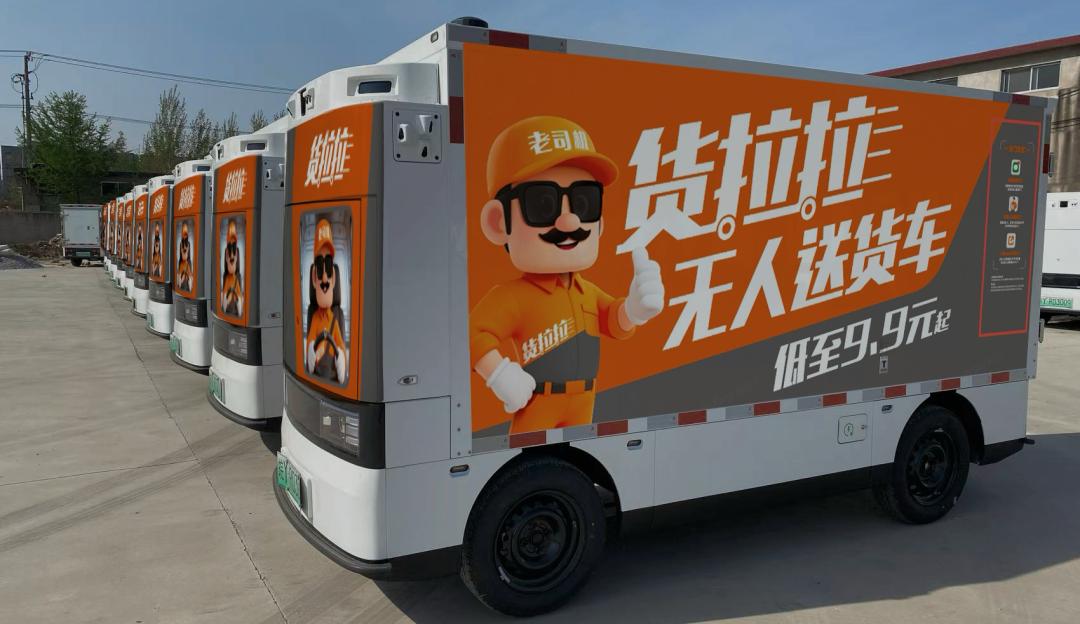
In 2025, the autonomous delivery industry ushered in a financing boom. Head enterprises such as Neolithic, Jiushi Intelligence, and White Rhino successively obtained financing, and the total annual financing amount of the industry was close to 100 billion RMB. Entering 2026, the capital boom continues. In February, Jiushi Intelligence completed more than 300 million US dollars in financing; on October 20, Neolithic secured another nearly 400 million US dollars in Series E financing.
In addition to these unicorns, intra-city freight platforms such as Lalamove and Didi Delivery have also begun to integrate autonomous vehicles into their business systems.
In April 2026, White Rhino and Lalamove launched large-scale autonomous freight operation in Linyi, Shandong, connecting autonomous delivery vehicles to the Lalamove platform to provide instant delivery services for consumers and small and micro merchants. In July, Uisee signed a strategic cooperation agreement with Didi Delivery, planning to integrate autonomous driving vehicles, autonomous driving technology and platform order resources to promote the implementation of autonomous delivery in more cities.
The reason why all parties enter the market in batches is very simple: the cost of autonomous vehicles is indeed much lower than that of human labor.
According to internal estimates, the purchase cost of a common 4.2-meter truck is about 100,000 to 150,000 RMB, but the monthly salary of a driver is 7,000 to 10,000 RMB. In contrast, vehicle depreciation is only part of the fixed cost. In long-term operation, labor expenditure is the real major cost.
While autonomous driving is developing, the transition from fuel to electric power is also advancing at the same time. An analyst with experience in the online car-hailing industry told us that in the past, fuel vehicles traveled about 500 kilometers a day, and the daily fuel cost was close to 300 RMB. After switching to electric vehicles, the monthly electricity cost is only more than 1,000 RMB.
From fuel to electric power, energy costs have dropped significantly. If the dependence on drivers is further reduced, autonomous vehicles will have the opportunity to compress costs in both the labor and energy links at the same time.
More importantly, manual driving is restricted by factors such as working hours and rest arrangements, while autonomous vehicles can continuously run on fixed routes with the cooperation of remote monitoring and operation management. In some remote branch scenarios, relevant station owners said that one autonomous vehicle can save the cost of about two staff members.
This is why more and more enterprises are beginning to re-examine the commercial value of autonomous delivery.
For professional players such as Neolithic and Jiushi Intelligence, the opportunity lies in developing and selling vehicles, and then spreading the cost through large-scale operation; for platforms such as Lalamove and Didi Delivery, if they can connect autonomous vehicles to the existing order network, they will have the opportunity to undertake part of the transportation demand with lower-cost capacity.
Meituan's exploration also shows that autonomous vehicles cannot make profits in every scenario. The businesses that are really worth competing for are those with high labor costs, relatively fixed routes and stable transportation demands.
When driver salaries, energy costs and vehicle utilization rates are all included in the same account book, the competition in autonomous delivery is no longer just a competition among technology companies, but more like a