Is the king of cost-performance in China's domestic AI sector about to be replaced? MiniMax is here for real.
How fierce has the price war among domestic large models become?
On October 19, MiniMax officially unveiled M3.1 Flash: the input price is only 1 yuan per million tokens, the output price is 4 yuan, and the cache reading price is as low as 0.1 yuan.
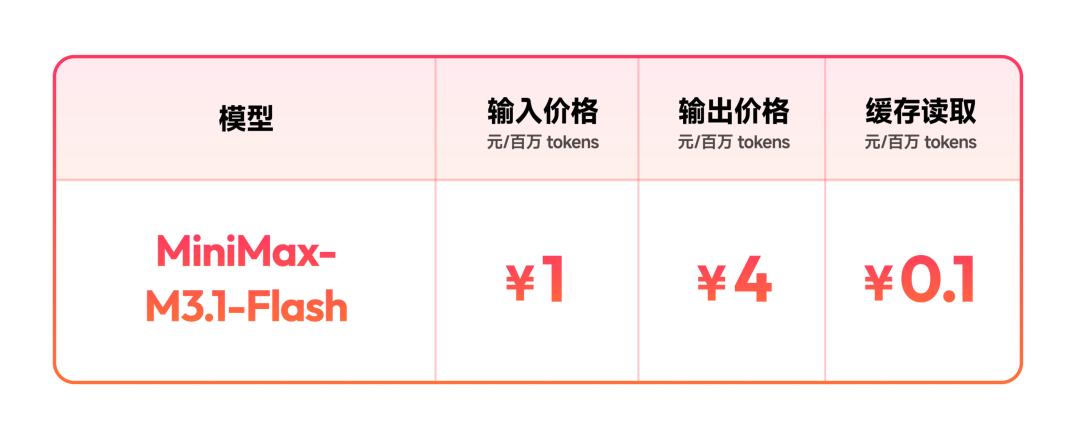
The official claims that the model's inference speed has increased by nearly 3 times, and the comprehensive usage cost of Agent tasks has been reduced by 70%.
Wow, domestic models have once again slashed the prices this time.
But being cheap alone is nothing special.
After all, domestic models such as Tongyi, Zhipu, and Doubao have long pushed the input price of some Flash models below 1 yuan.
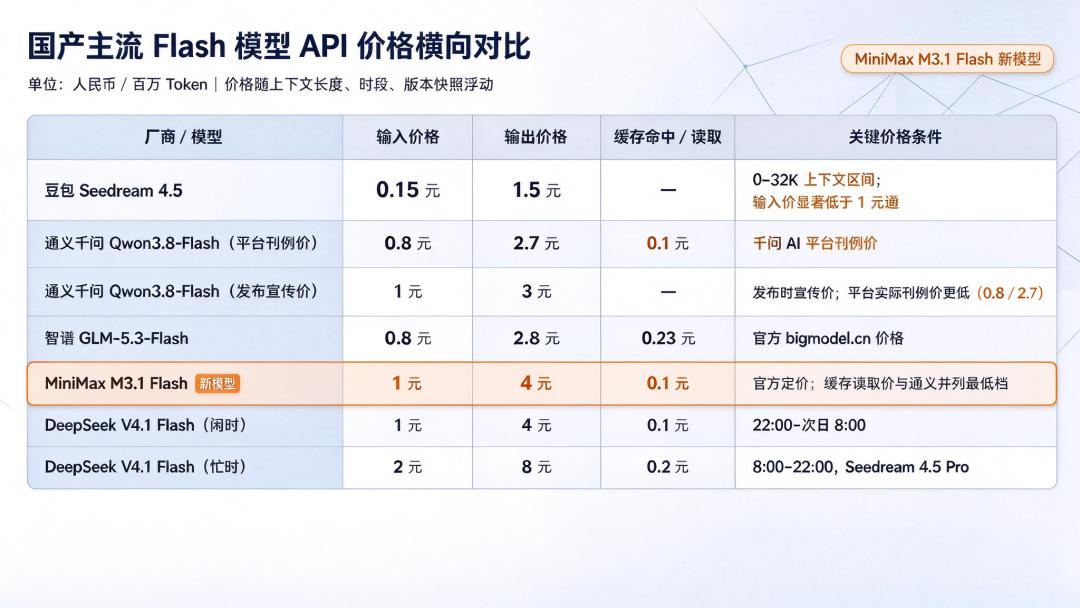
Before this price war broke out, M3.1 Flash had already been put to the test under another identity.
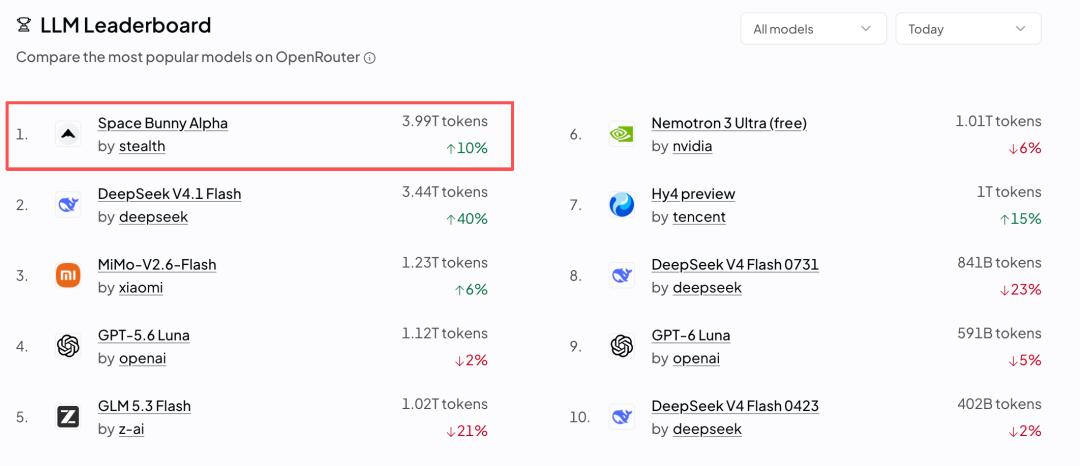
Previously, it was tested in real use scenarios in the developer community under the identity of the anonymous model Space Bunny.
Within 3 days after its launch, it topped the list of single-day token usage on OpenRouter and OpenCode, attracting a lot of attention.
Now that its identity is officially revealed, MiniMax has made its direction very clear: targeting tasks such as Coding, complex Agents, and computer operations, striving to make the model faster, more capable, and at the same time lower the invocation cost.
After all, if the price of AI chat is reduced by a few cents, users may not feel much difference.
But if an Agent needs to call the model dozens of times in a row to write code, fix bugs, and run tests, the cost gap may be multiplied.
Full competition in benchmark scores, speed and cost
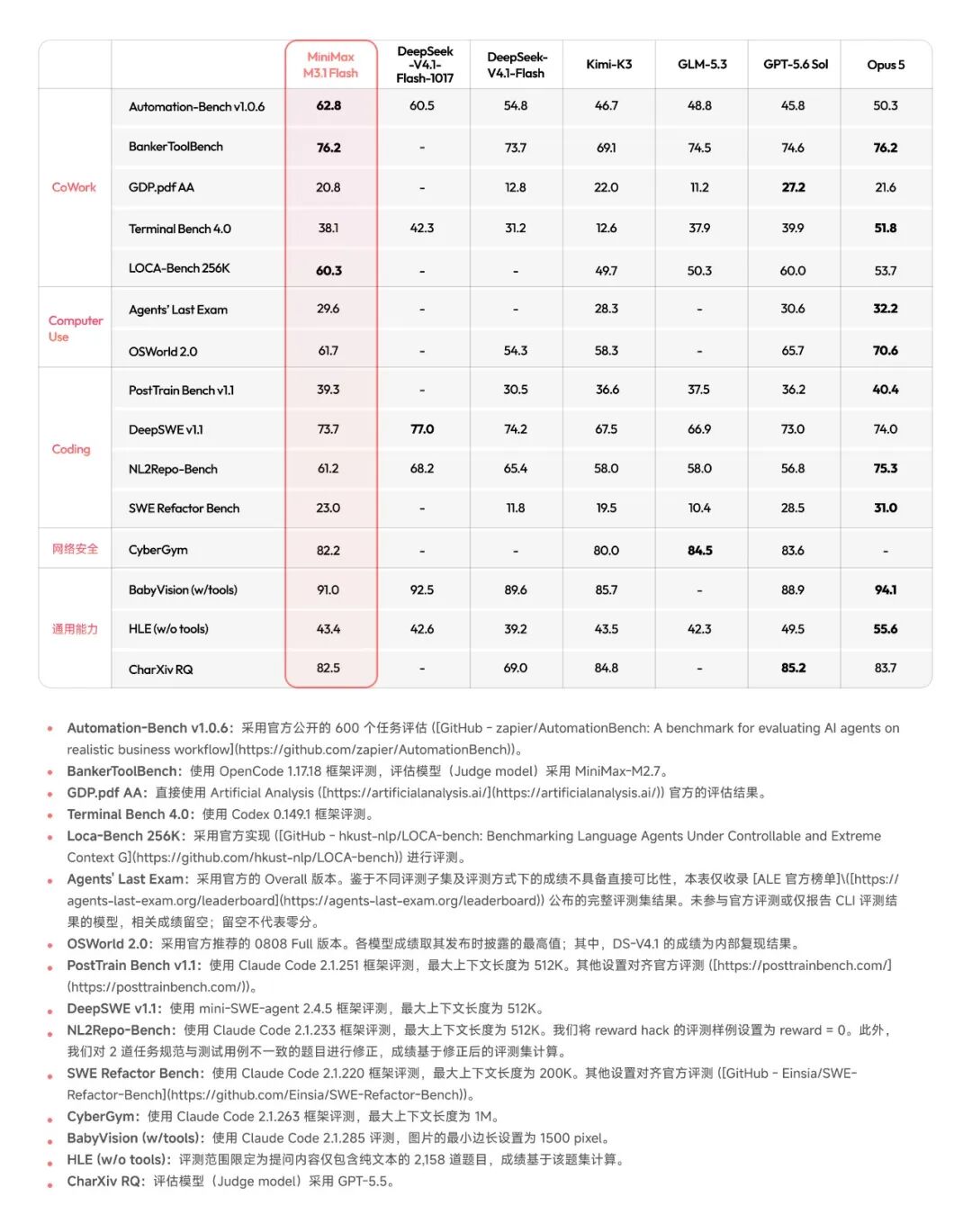
First, let's look at the strengths of M3.1 Flash: enterprise workflow automation and financial tool invocation.
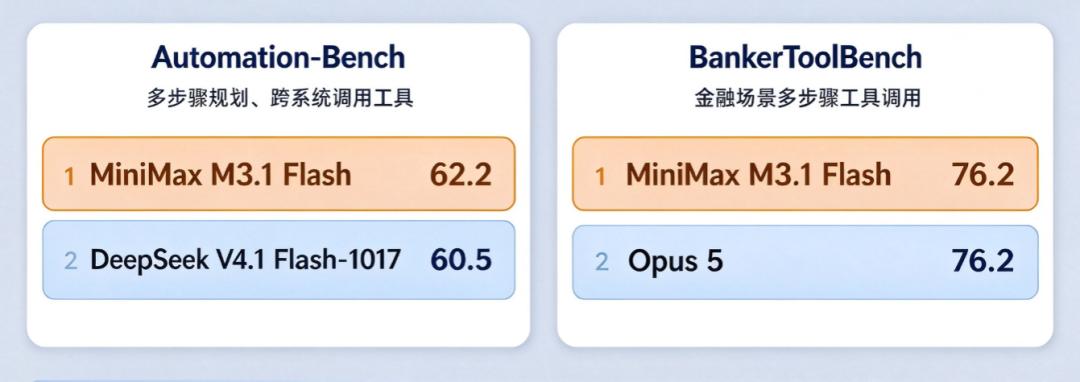
These two results show that M3.1 Flash's strengths are not limited to generating text, but also understanding tasks, invoking tools, advancing processes, and completing tasks as much as possible.
The computer operation test also confirms this direction.
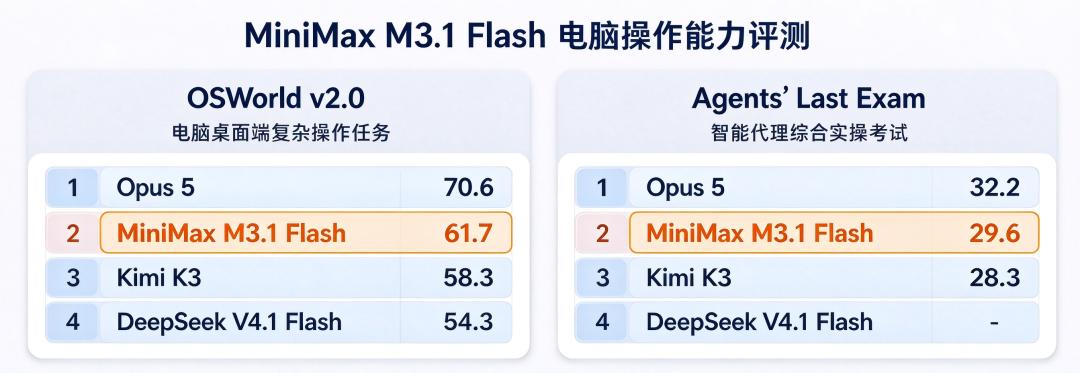
MiniMax says both of these two results rank first among domestic models.
In other words, it is more like an execution-oriented player: good at breaking down tasks, invoking tools, and then completing the process step by step.
However, when it comes to complex code development and terminal operations, M3.1 Flash is not that competitive.
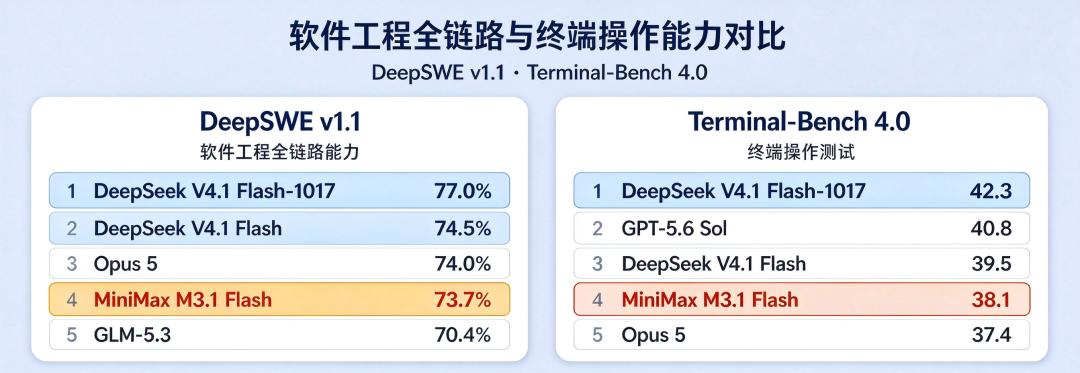
Next, let's look at the evaluation from third-party Artificial Analysis ⬇️
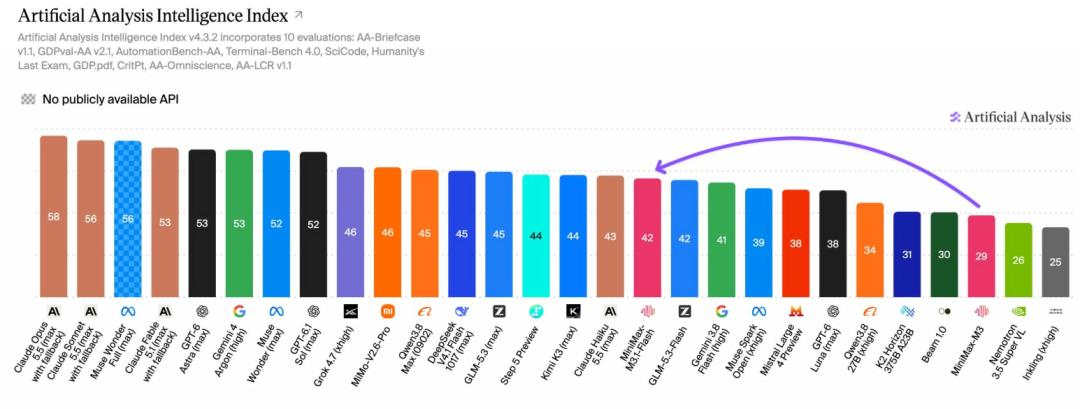
M3.1 Flash scored 42 in the comprehensive evaluation, which is a significant improvement over the previous generation M3, but slightly lower than DeepSeek V4.1 Flash-1017's 45 points.
The progress is indeed considerable, but it has not yet reached the level that outperforms similar models by a large margin.
Interestingly, the cost gap has been widened significantly ⬇️
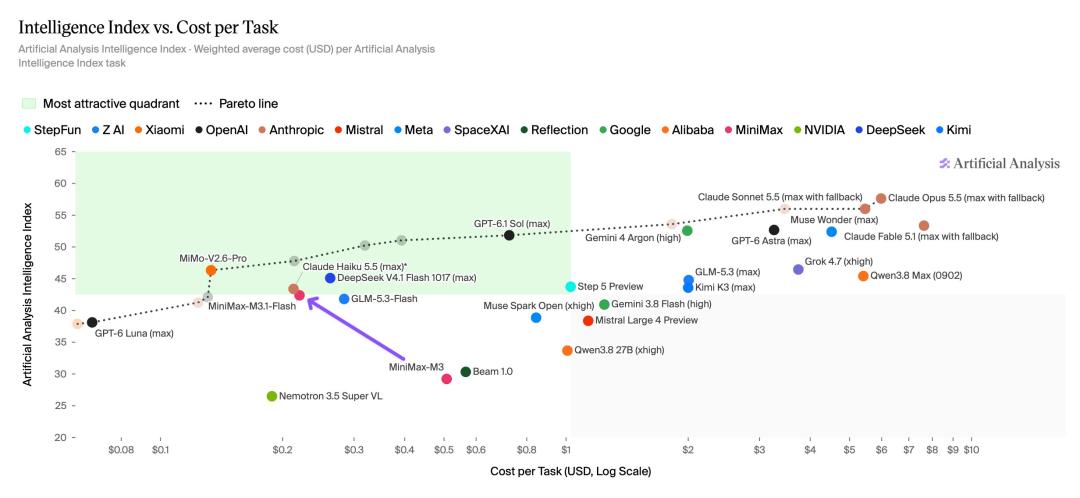
To complete the full set of Intelligence Index evaluation, the cost of M3.1 Flash is about 0.22 US dollars, lower than DeepSeek's 0.26 US dollars and GLM's 0.28 US dollars, and far lower than Gemini 3.8 Flash's 1.24 US dollars.
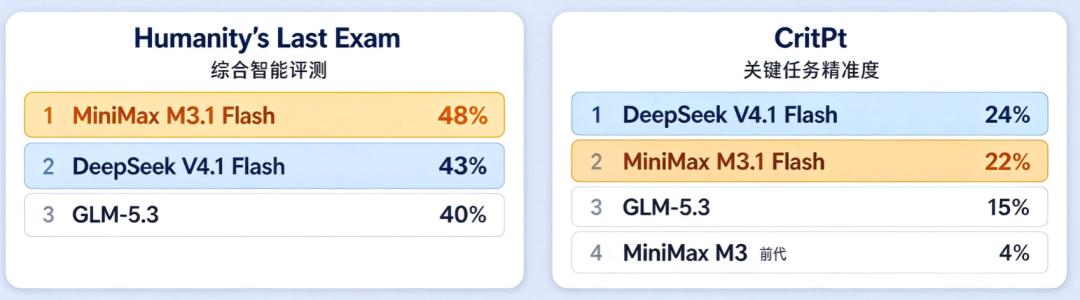
It also has its highlights in sub-items ⬇️
Then look at the cost of automated tasks. Another set of official Automation-Bench data from MiniMax shows that under the test setting of the highest inference intensity, M3.1 Flash scores 62.8%, and the cost of a single task is about 0.045 US dollars.
Coupled with the officially claimed output speed of over 200 TPS, and the comprehensive cost of Agent tasks is 70% lower than that of the previous generation.
Putting all these results together, the selling point of M3.1 Flash is clear: with the same budget, who can complete more Agent tasks.
M3.1 Flash Field Test
Benchmark scores are one thing, to know whether the model is really easy to use, you have to put it into real work.
A developer used MiniMax Code to test a small-town train project in Japan.
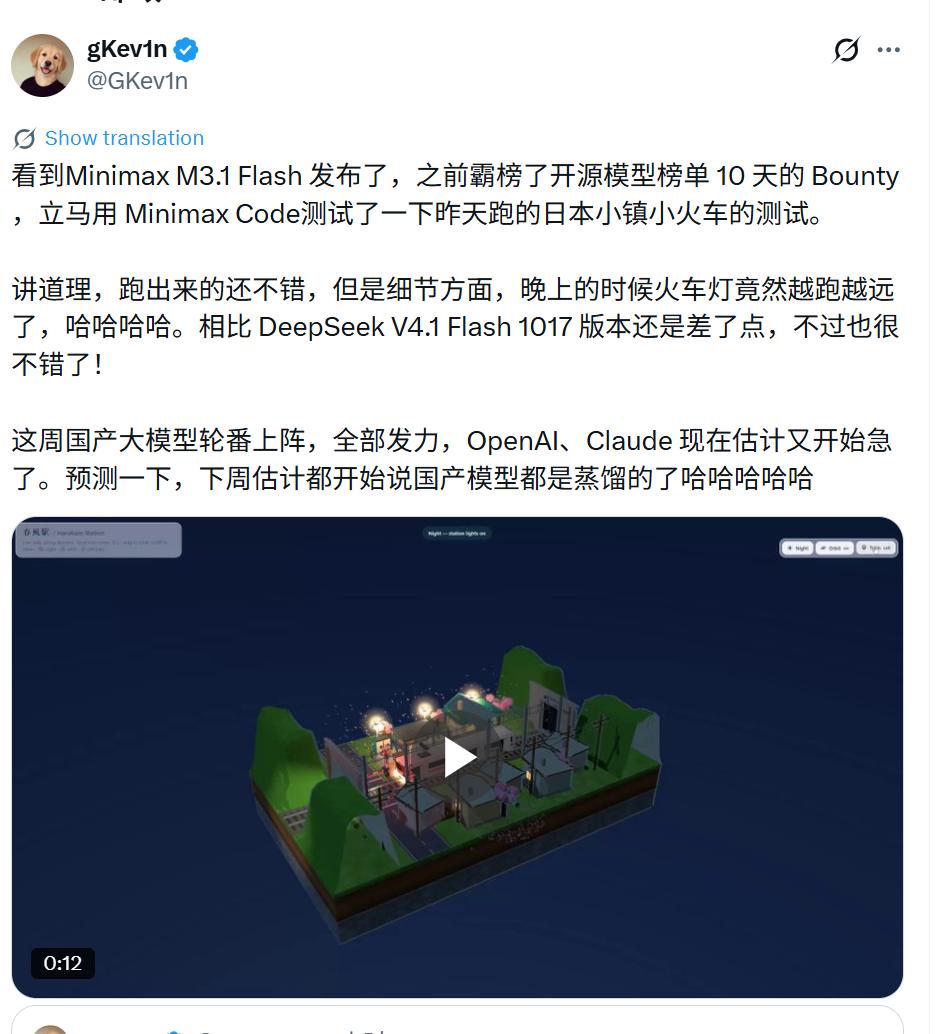
The overall generation effect is good, but there is also a very interesting bug: in the night scene, when the train is running, the headlights look like they are getting farther and farther away.
Another developer used MiniMax M3.1 Flash and DeepSeek V4.1 Flash 1017 to complete the same Eiffel Tower project.
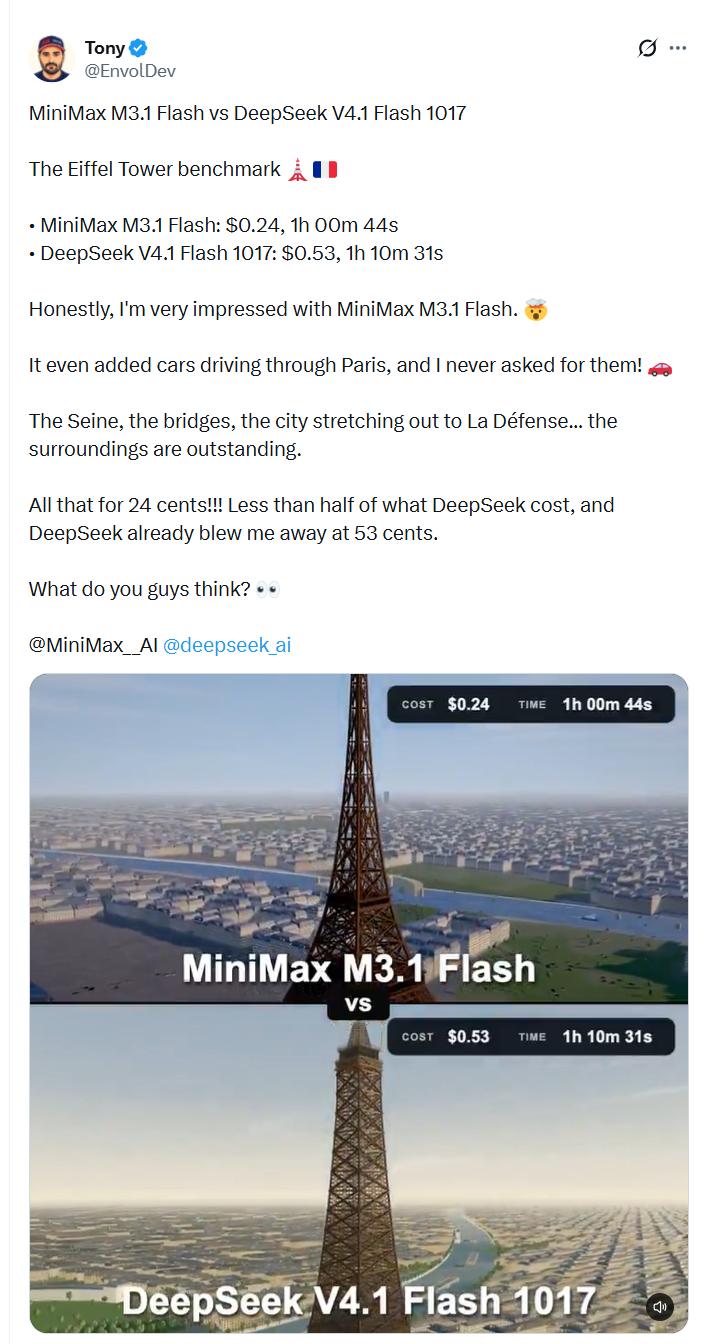
The low cost and generation capability of M3.1 Flash are really impressive: it not only restores the Seine, bridges and city skyline, but also actively adds vehicles driving on the streets of Paris.
However, in another test of the first-person driving scene of Tesla Roadster, the blogger thinks that although MiniMax M3.1 Flash is cheap, its visual effect is the worst.
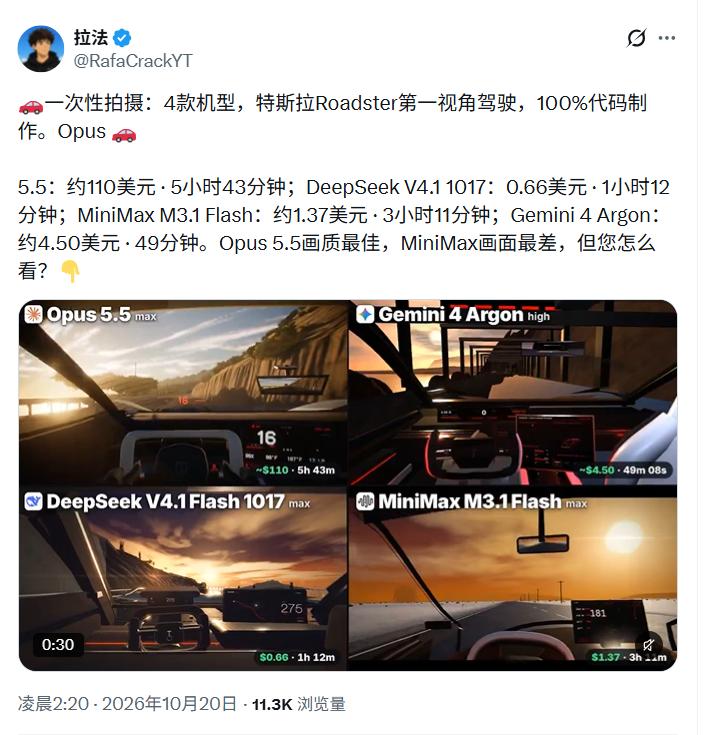
In contrast, DeepSeek V4.1 Flash 1017 performs extremely well.
It can be seen that in slightly more complex tasks, the cost-effectiveness advantage of M3.1 Flash cannot always be converted into an effect advantage.
But when it comes to pixel-style waterfront city generation, the result is different.
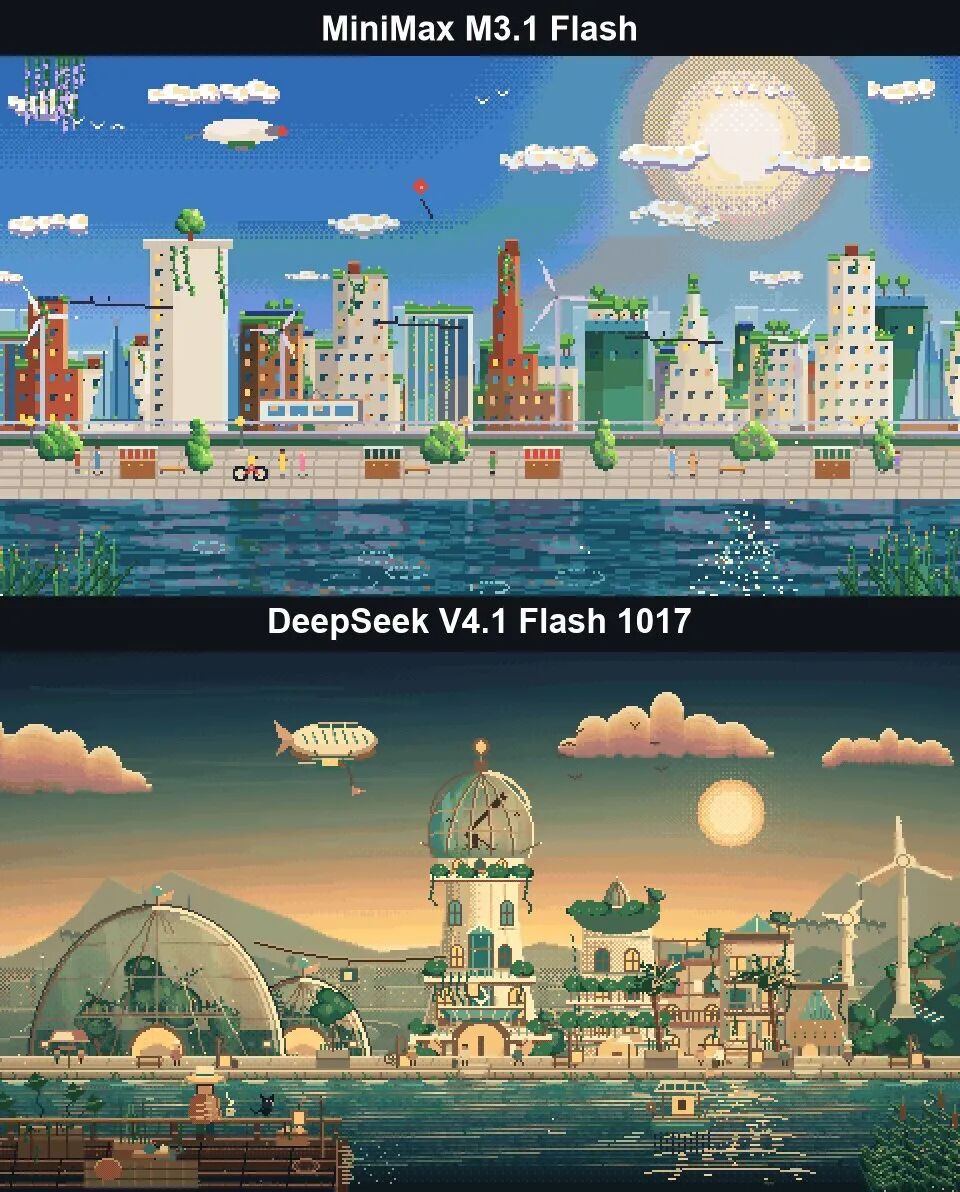
With the same prompt words and inference parameters, MiniMax M3.1 Flash and DeepSeek V4.1 Flash 1017 have different styles, which can be said to be comparable.
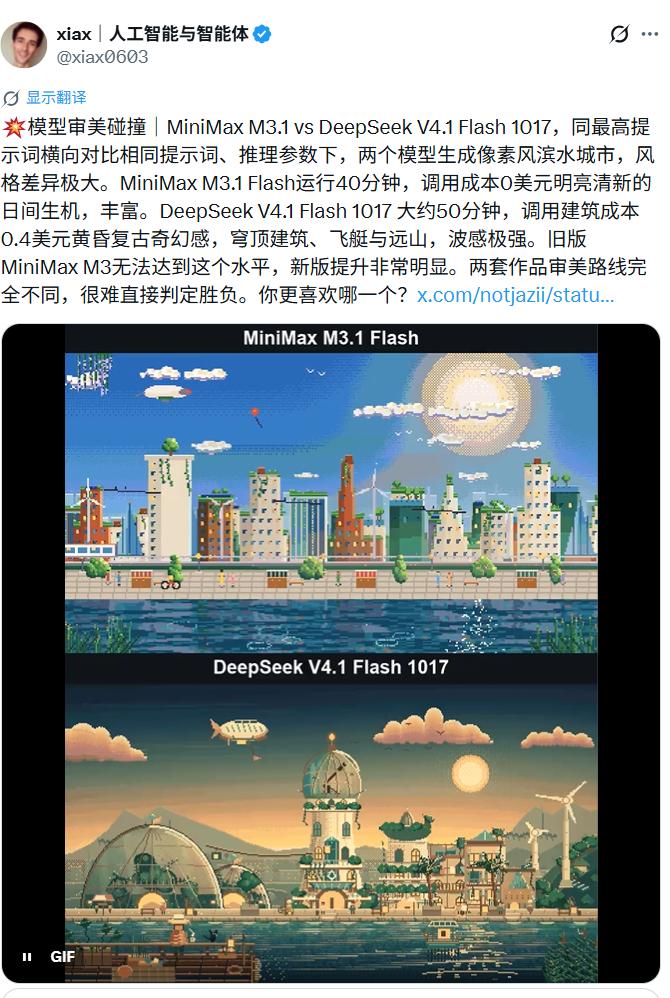
Overall, in this round of tests, many testers said that M3.1 Flash has made significant progress compared with the previous generation.
But when compared head-to-head with DeepSeek V4.1 Flash 1017, the overall performance of the two can be said to have their own advantages, and neither can outperform the other completely, and both have their own cost advantages.
However, at least from these actual tests, M3.1 Flash already has the strength to compete head-to-head with DeepSeek. The final choice depends on the specific task and actual cost.
Domestic Flash models start to compete for better work performance
In the past, Flash models were often regarded as low-cost alternatives to high-performance models, suitable for simple Q&A, summarization and classification.
Now, manufacturers are starting to push them to scenarios such as Coding, computer operations, complex Agents and automated processes, and the focus of competition has shifted from "cheap enough" to "whether it can handle complex tasks well".
Each manufacturer's model has its own advantages, and no one is clearly superior to others, which shows that the domestic Flash track is not a zero-sum game.
For developers, model selection does not only depend on the ranking list, task success rate, invocation speed, total cost and final effect should all be considered together.
As for what changes MiniMax's subsequent Pro version will bring, it remains to be seen after its official release and actual testing.
But it is certain that the competition of domestic models extending from price to capability is far from over.
This article is from the WeChat official account "Tech Fox" (ID: kejihutv), written by Hu Mei, republished by 36Kr with authorization.