After securing four rounds of 100-million-yuan-level financing in half a year, where does Euler Wanxiang aim to lead the home robot industry?
Imagine this scenario: you drag your tired body home after work, open the app in the elevator to send a message to the robot that you are almost home. When you open the door, it has already taken out your slippers for you, and placed the shoes you just took off onto the shoe rack.
When you get to the living room, both you and your dog are resting on the sofa, and the robot will pick up the toys scattered all over the floor and put them back in their proper positions. After you finish your takeout, tell it "tidy up the table" and lie back on the sofa, it will sort the takeout boxes on the table into the bag.
Now, this is no longer just an imaginary scene, but the latest home landing practice launched by Euler Robots, a home embodied intelligence enterprise. A few days ago, this company that was established only half a year ago just announced the completion of its fourth round of financing of several hundred million yuan.
In the current embodied intelligence industry, the home scenario is almost the one that everyone is optimistic about, but few people dare to give a definite conclusion. It has sufficiently high frequency, sufficiently rigid demand, and sufficiently non-standard characteristics. Each of the above scenarios is not difficult for humans, but for robots, it means a series of judgments, adjustments and executions.
Therefore, if robots want to truly enter the home, what they face is not only whether the action execution is accurate, but also the continuous adaptation to specific tasks and usage environments. So the real question should be: should home robots rely on pre-programmed and trained skills to complete tasks, or can they gradually adapt to the environment, understand needs, and continuously expand their capabilities in the process of use?
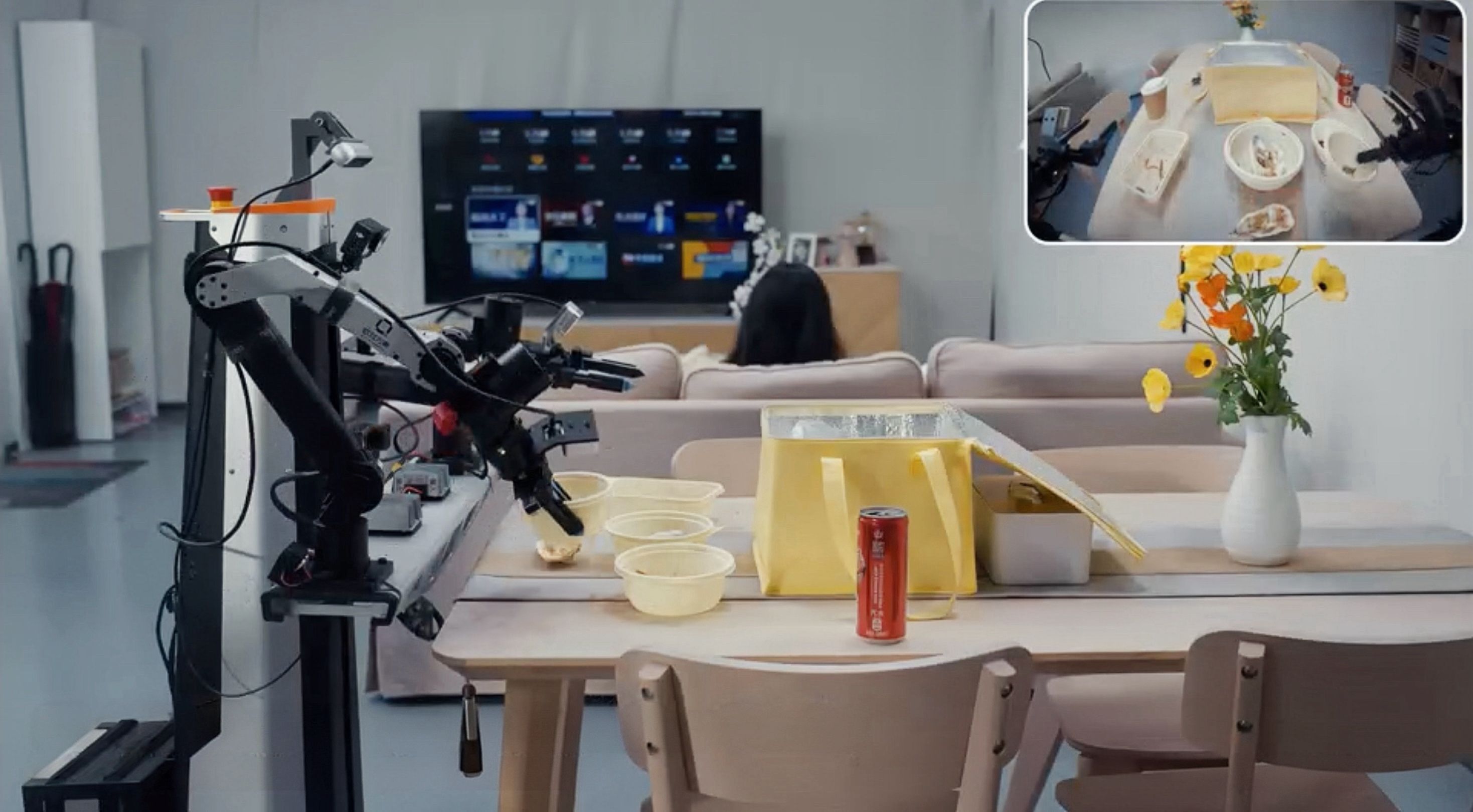
The answer of Euler Robots is the latter. Zhou Shunbo, CEO of the company, said that the company has emphasized the concept of "nurturing" from the very beginning — robots do not have to know how to do all housework when they leave the factory, but they can be taught by this home, learn new skills from user demonstrations, find the parts that they do not do well enough in every real execution, and continuously iterate through the self-evolution system to improve performance. As for how far this path can go, it will ultimately be tested by the stability and reliability of robots in real homes.
01. The hardest part of home robots is not doing chores, but understanding life
How many types of doors are there in a house? How to open different doors?
Room doors need to be twisted, balcony doors are pushed and pulled horizontally, and wardrobe doors may need to be pressed. The product team of Euler Robots found through research that things as simple as opening a door for humans can already stump robots.
The daily life that humans are accustomed to involves a series of understanding, judgment, execution and reflection, among which human beings are the biggest variable. In the small world of home, people release themselves and do whatever they want. "The diversity of families and the needs of different users are multiplied, which makes home robots' task processing extremely complicated," Zhou Shunbo admitted.
The complexity of the home environment determines that robots cannot define products from the perspective of "taking over all housework". Euler Robots chooses to first find out the tasks that users encounter repeatedly and that current technology has the opportunity to solve, and then delineate the first batch of verification scenarios accordingly. Safety, privacy and long-term use reliability will also affect whether these capabilities can finally enter the home.
In order to obtain the real needs of users, Euler Robots collected more than 1000 valid long questionnaires in robot communities at home and abroad. It takes nearly 15 minutes to complete all the questionnaires, and the questions are as detailed as whether there are thresholds over 3 cm at home, housework habits, the most painful housework, etc., and then determine the high-value tasks that home robots are most worth completing.
For example, the problem that users most want robots to help solve is desktop storage. "Everyone will ask a housekeeper to clean the whole house every once in a while, but the desktop may change from tidy to messy every day, and it is unrealistic to always ask a housekeeper to tidy up a table."
For another example, compared with the demand for robots to fold clothes that is promoted on the market, most people care more about the hour waiting for the clothes to be washed and dried. "Many people go home from work very late. Because the washed clothes are left in the washing machine overnight, they are afraid of getting peculiar smell if they are not hung out in time, so they can't sleep well until the clothes are washed," Zhou Shunbo said. On the contrary, folding clothes is a refreshing and decompressing thing for many users.
In this exhibition of Euler Robots, the scenarios are selected based on real needs. The technical team of Euler Robots said that taking taking shoes from the entrance as an example, it seems that it is just picking up a pair of shoes from the ground and putting them into the shoe cabinet, but in fact it connects a series of links such as target recognition, position judgment, movement, grasping and placement. The robot not only needs to identify the shoes, but also determine the position of the shoe cabinet and the appropriate placement position, and coordinate the moving chassis and the robotic arm during the execution process, that is, coordinate movement and operation, so as to complete a series of continuous actions. Deviations in any link may affect the final result.
The difficulty also lies in the fact that movement and operation must be connected together. When the robot walks towards the shoes, it must judge whether the robotic arm can reach it next; during the grasping process, if the position changes, the movements of the body and hand must also be adjusted accordingly. Euler Robots is following the Action-Native Foundation Model route to explore handling movement and operation under a unified model framework, reducing the situation where the robot "arrives but cannot operate".
In the Easter egg of this exhibition, the robot can not only continuously pick up toys in the living room, but also update the grasping position in real time when the toys are moving continuously. This means that the robot needs to move repeatedly, find the target, extend the robotic arm, complete the grasping, and then bring the toy near the storage basket. The real difficulty is that the robot cannot only act based on the environmental information seen at the beginning of the task, but needs to continuously perceive the surrounding environment during the entire execution process, and adjust the subsequent actions in time according to the changes of the toy's position and its own position.
Desktop organization tests the understanding ability. Users often simply say "tidy up the table", but what they want is not to take away all the things on the table. On the desktop of a real home, some things need to be thrown away, some need to be kept and placed in a suitable position. The robot must judge which ones should be processed, which ones should be kept and placed in a suitable position.
The technical team of Euler Robots introduced that this judgment comes from two layers of design. One layer is inside the model. In the pre-training stage, semantic understanding and trade-off judgment are combined, supplemented by additional target detection and labeling work, so that the robot has seen enough prior knowledge such as "the leftover takeout box should be thrown away". The other layer comes from AgenticOS on it. This system is connected to the general large model, responsible for higher-level task planning, and calls other detection models to assist in identification; after combining all kinds of prior information, it formulates a detailed execution plan and hands it over to the self-developed model for implementation.
These scenarios jointly demonstrate the robot's continuous task execution ability in complex dynamic environments: it can not only complete specified actions under clear conditions, but also continuously adjust behaviors according to changes in the environment and task status to promote task completion when the position of objects changes, targets move dynamically, tasks continue to advance or instructions are open to a certain extent.
02. "Nurturing" starting from the first day
In the scene exhibition of Euler Robots this time, there is another noteworthy link: humans wear a data headband to demonstrate to the robot how to feed the dog, and the robot tries to master the corresponding movements by learning this demonstration.
Letting the robot truly learn human movements is not as simple as just handing the video to the model. First, it is necessary to correct the pictures collected by the headband to reduce the influence of lens distortion on position and movement judgment. Then, it is necessary to remove human body information irrelevant to the task, and convert human movements into movements that the robot can understand and execute. According to the team, the position mapping error in this conversion process can be controlled at the sub-millimeter level. The converted data then enters model training, and finally the robot actually executes it.
For users, the entire process is simplified as much as possible: just set a task you want to complete at home, provide dozens of demonstrations according to the difficulty of the task, and the subsequent data processing, model training and deployment are automatically completed by the system. According to the current verification of Euler Robots, for some relatively simple tasks, users only need to participate in data collection for about 10-20 minutes, and the complete end-to-end process takes about 6 hours. This means that users only need to invest a small amount of time to demonstrate, and the robot has the opportunity to complete the learning and deployment of new skills on the same day, and try to perform corresponding tasks.
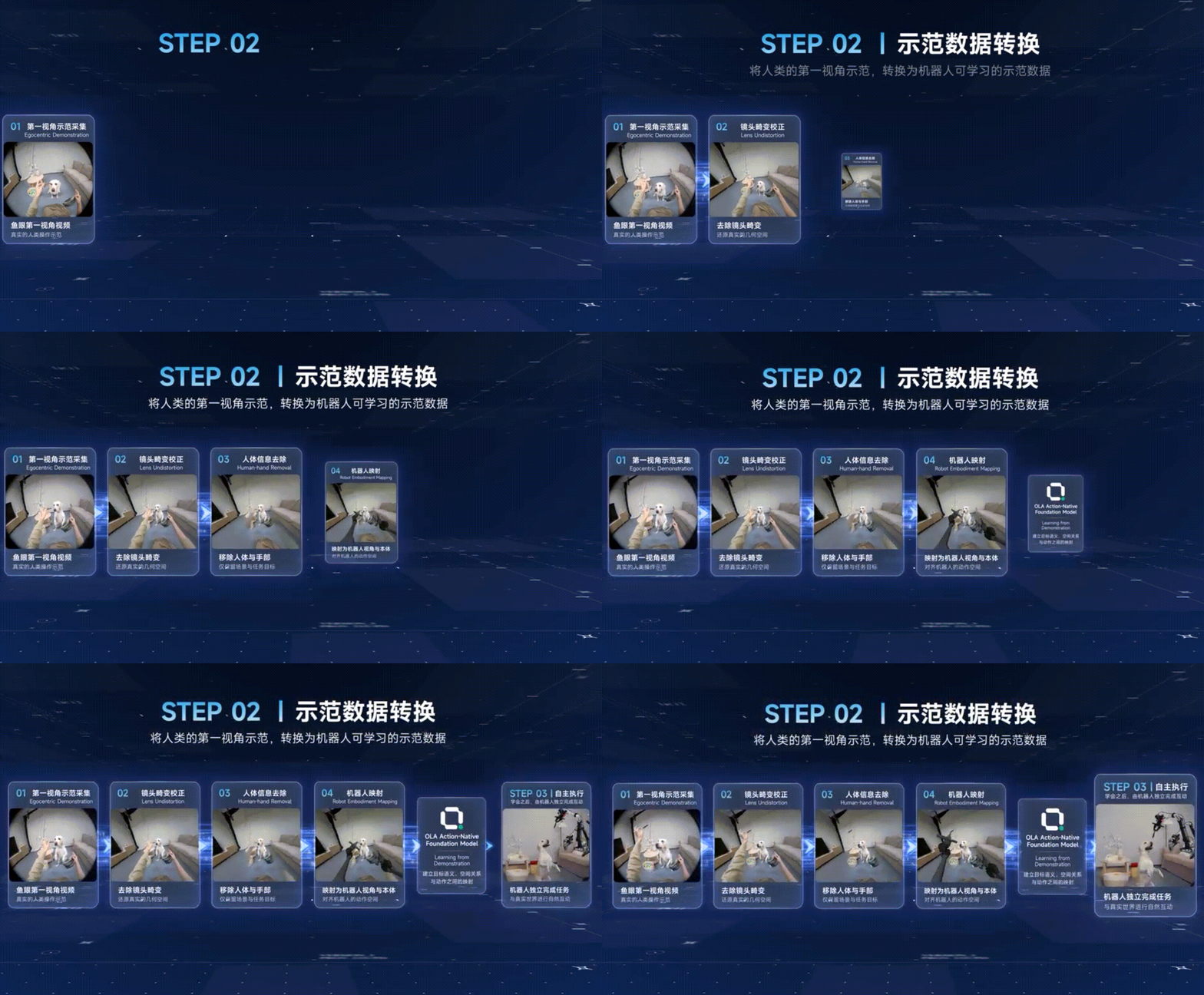
"We hope to lower the threshold for robots to acquire new skills, including the data threshold," the technical team said, "What the robot learns in this process is not a fixed action, but your task intention, the interaction relationship between objects, and the physical laws behind it."
The technical team of Euler Robots mentioned that the long-tail demand in the home is particularly complex. "Almost no two people's homes are exactly the same, and the pre-set functions at the factory are difficult to cover all needs, so we still hope that after the robot enters the home, it can appropriately collect some data to form characteristics related to this home."
They learned in the survey that a user hoped the robot could help him knock the wooden fish — because he often worked at home, he wanted to keep calm through the sound of knocking the wooden fish. This kind of demand seems small, but it has a distinct personal feature, which is difficult to be pre-summarized as a general function. But if the robot can really realize it, it can not only provide users with emotional value beyond practical functions, but also enhance the connection between users and robots. For this kind of personalized demand that is difficult to pre-define, Euler Robots hopes that through the skill development tool chain, users can train a small strategy model from scratch, and transform the originally difficult-to-preset demand into skills that the robot can learn and execute.
However, the scenarios currently demonstrated all come from high-value tasks selected through research, rather than a set of general housework capabilities. More scenarios are still in the research and development stage. The real difficulty of housework lies in the safety and stable task completion rate during long-term operation, which also needs to be verified for a longer time in real homes.
Demonstration can let the robot learn a new skill, but the changes in real tasks will expose the shortcomings of this skill. How to make skills continue to improve in real scenarios is another problem that Euler Robots has been thinking about since day 1. Real-World RSI (Recursive Self-Improvement) is the answer it gives.
How to understand Real-World RSI? The technical team takes tidying up shoes at the entrance as an example: when the robot performs the task, it successfully picks up the shoes, but fails to place them accurately when putting them into the shoe box. The traditional approach is that engineers analyze the problem, decide how to collect a large amount of data, and then train the model, so that skill expansion can hardly keep up with the diversity of home tasks. But now, all these links have become the autonomous participation of the system.
When the robot performs the task, the system can get the complete execution results, observation data and evaluation feedback. Because the system itself has accumulated a lot of know-how of algorithm engineers, it can judge whether the shoes are not placed well because the spatial position judgment is inaccurate, or the chassis control and dual-arm cooperation are not in place, and then further diagnose the specific data demand accordingly — for example, if it is confirmed that it is a spatial positioning problem, supplement the data of different perspectives. "Supplement the prior information needed for the next round through data collection or synthesis and conversion, and then retrain the model."
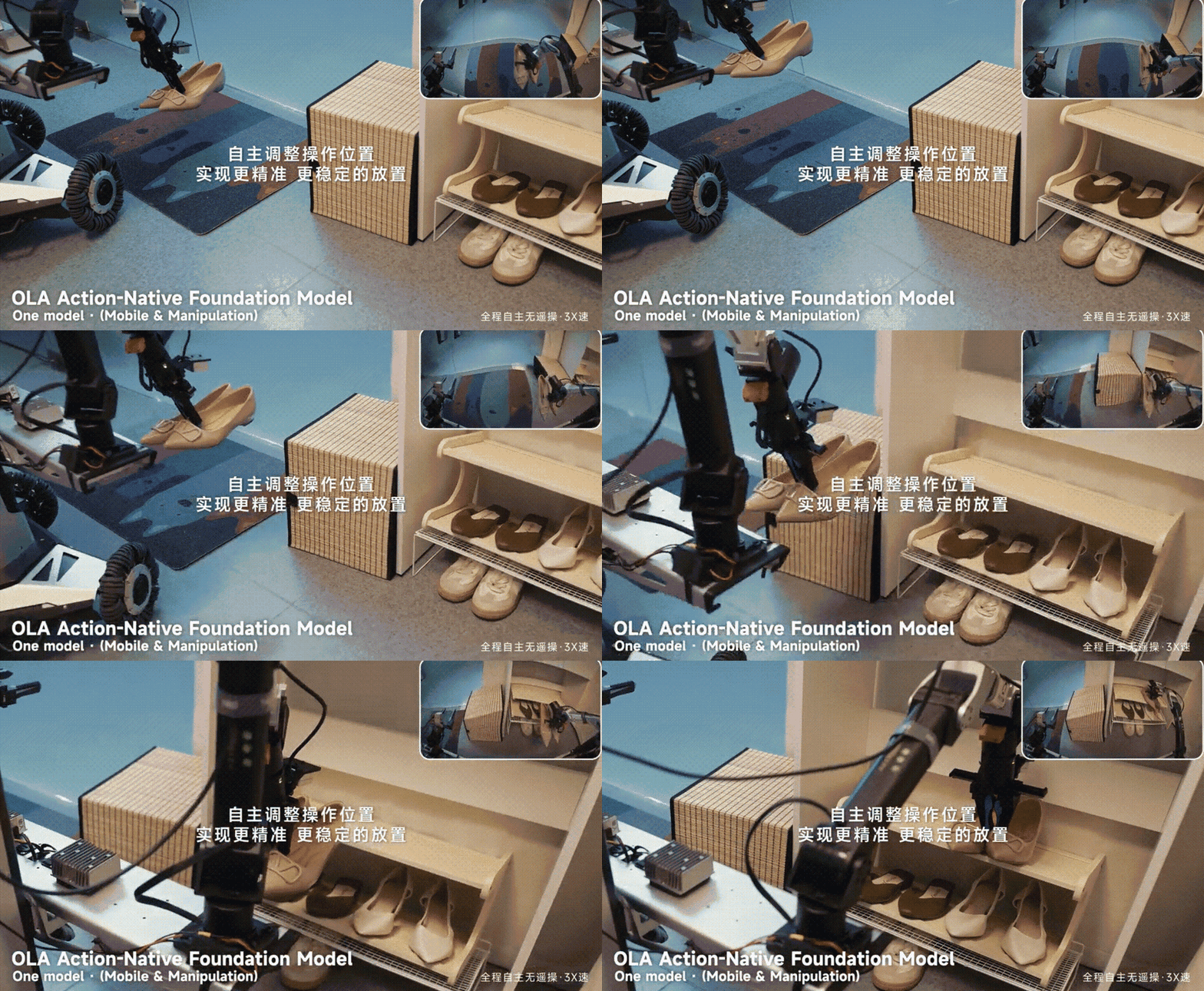
The technical team of Euler Robots introduced that at present, Real-World RSI (real-world recursive self-evolution) has been gradually integrated into all links from data processing, model training to evaluation and deployment, covering the main process of model iteration. Since the first version of the model was trained at the end of August this year, Euler Robots has released two versions of the model on the robot operation simulation benchmark RoboTwin2.0, both of which have achieved SOTA (state-of-the-art) results.
The significance of RSI is not only to improve the efficiency of model training, but also to establish a continuous self-improving robot capability growth mechanism. It connects the base model, data and training infrastructure, evaluation system and robot body, and gradually realizes that AI and the system automatically identify failures, abnormalities and insufficient capabilities in real tasks, and convert this information into the input for the next round of model, system or body improvement, forming a continuous closed loop of "execution — problem discovery — improvement — re-verification".
"Taking a single large-scale ablation experiment as an example, using 64 GPUs for training for about 2.5 days, the cumulative training resource consumption is about 3,800 GPU-hours." The technical team of Euler Robots introduced that through continuous optimization of the training and experimental process, with the number of algorithm engineers basically unchanged, the model iteration efficiency has increased by about 2-4 times. The task attempt in this home scenario is carried out based on this continuously iterated base model.
03. Be a "butler" rather than a "housekeeping worker"
With the development of embodied intelligence to today, home robots have become a development direction that both the artificial intelligence and robot industries are optimistic about, but the industry has not yet formed a unified answer on how to achieve this goal. Some start from mature single-function products to gradually expand the capability boundary of robots, while others bet on humanoid robots, hoping to adapt to the existing living environment through a form closer to human beings.
What really determines the development of the industry is not only whether robots can realize more functions, but also whether they can create practical value for ordinary families at a reasonable price, with less manual intervention and a stable task completion rate.
From a PhD in robotics at the Chinese University of Hong Kong, to the first embodied intelligence employee at Huawei, and then to starting a business by choosing the home robot direction, Zhou Shunbo has worked in the robotics field for more than ten years. His judgment is very clear: according to the current maturity of the robot body and model, it is impossible to make a robot product that can be directly oriented to end ordinary users in a short time. This is also the reason why Euler Robots chooses Maker as its initial target group: they are willing to accept new things and have certain hands-on ability. Interaction with them can help the company gradually define the product