The AI version of "Little Genius" has taken the kindergarten market by storm, selling a whopping 400,000 units in just half a year.
The past two years have seen a booming AI hardware circle. Robots dancing on the Spring Festival Gala have been all over social media feeds, AI glasses, voice recorders and smart rings have successively hit trending search lists, and Fu Zai, an AI companion doll that can chat, has also attracted many young people to "raise" it as a virtual pet.
Recently, Operation Research Society noticed that AI conversational agents for children have also become popular among parents. The Tingli Xiong Mooni M1, marketed as an AI smart watch for kids, sold 400,000 units within 180 days of its launch, once topping the sales rankings on major platforms including JD.com, Tmall and Douyin.
So why has Tingli Xiong been such a sales hit? Is the children's AI smart hardware sector a good business opportunity?
01 400,000 units sold in half a year, the AI version of "Imoo" is a smash hit
In January this year, Tingli Xiong, a youth smart hardware brand, cooperated with Alibaba Cloud's Tongyi Qianwen to launch Mooni M1, a product tailored for Generation Alpha, featuring the three-in-one functions of "AI emotional companionship, safety protection and immersive audio learning".
In terms of form, it is more like a conversational AI smart watch, weighing only 43 grams, lighter than most children's watches. It can also be hung around the neck or held in the hand, wrapped in food-grade silicone, supporting IP67 waterproofing, with a built-in 4G IoT card that does not rely on Wi-Fi.
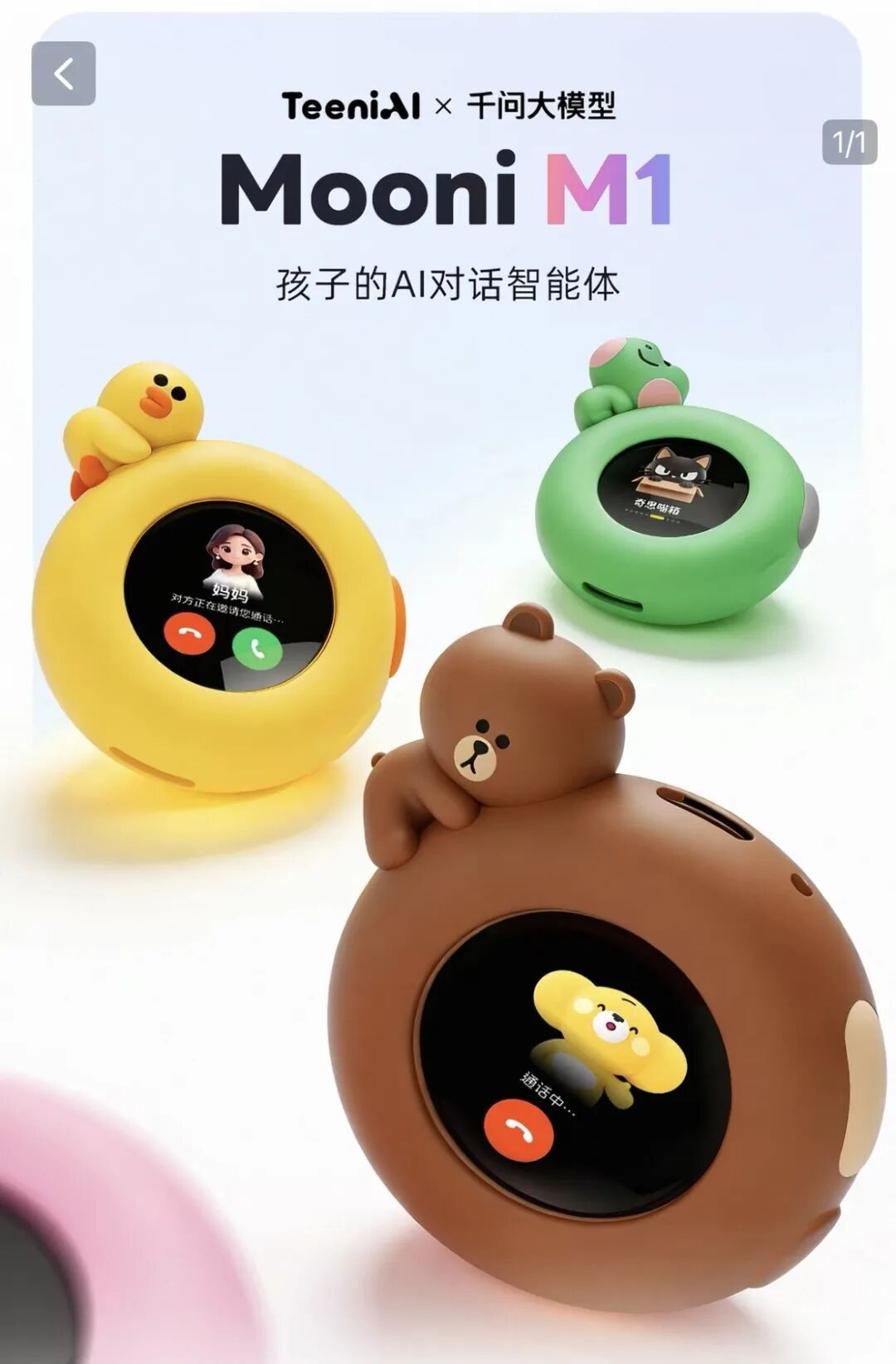
In terms of functions, it splits a large language model into six roles: Teeni, the curious buddy, handles encyclopedia Q&A; Polly, the English buddy, conducts bilingual conversations; Mia, the story buddy, accompanies children to continue compiling stories; the emotion buddy gives hugs to comfort kids; Bunny, the exploration buddy, tells stories about city trips; and the thinking buddy, the creative cat box, accompanies children to solve riddles. The agent will actively slow down its speech speed and control its vocabulary within the scope of school-age children.
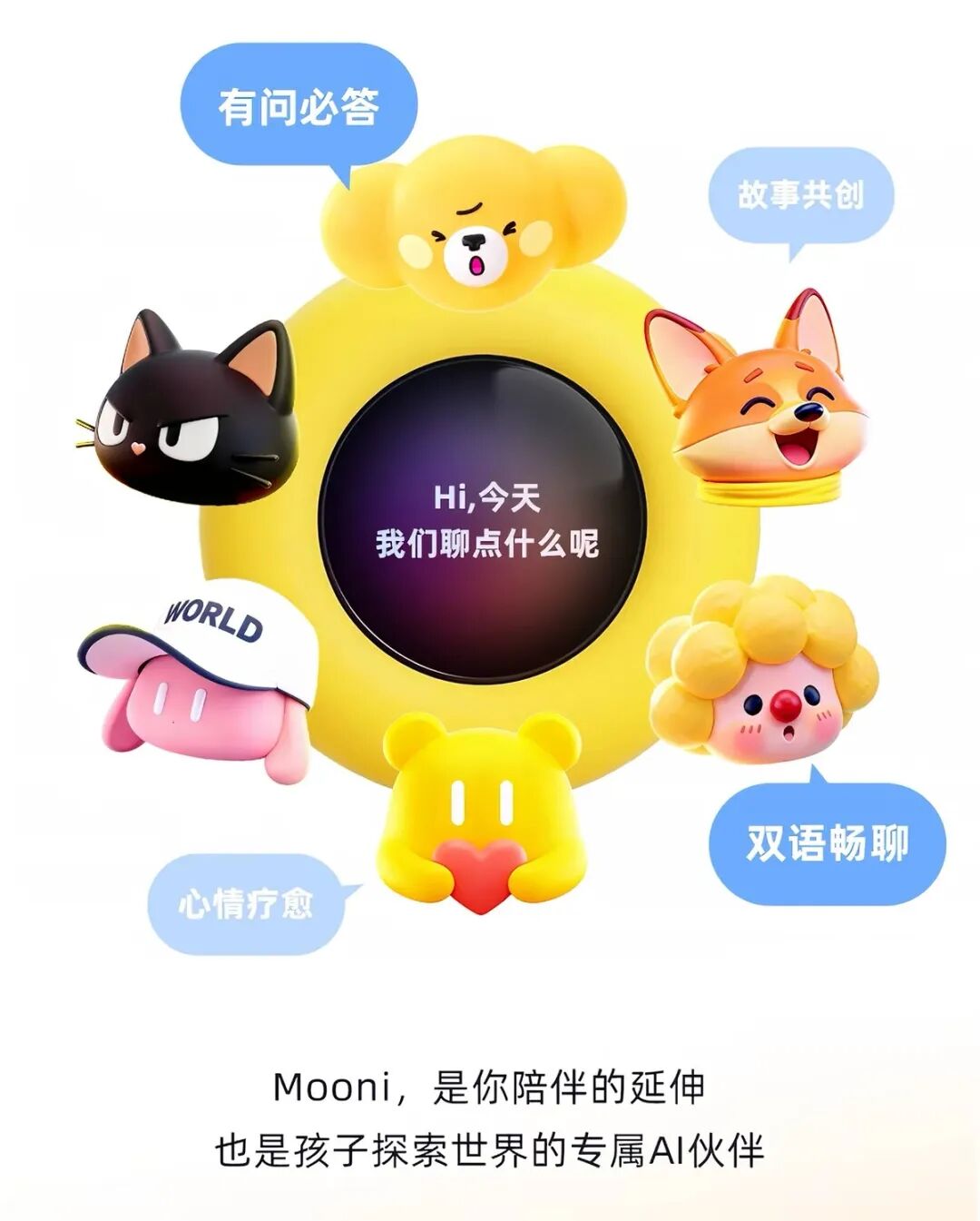
6 AI Roles
In addition, it has BoBo Radio with audios synchronized with school textbooks, supporting 4G calls and real-time positioning. Parents can remotely set usage periods and filter content in the App, and also guide children's conversation topics with Teeni, such as reminding them to go to bed and wake up early and protect their eyes. The yellow bear on the device will talk in a child-friendly tone about topics like "being the early rising champion" and "using the bear towel and rabbit toothbrush". The conversations between children and AI are presented as "footprints", so parents can see what their children have talked about with AI on the App and get corresponding parenting suggestions accordingly.
The brand's official live stream positions it as an AI version of the smart watch, equivalent to a child-specific Qianwen assistant + smart watch + immersive audio player. With platform consumption coupons and national subsidies, the final price is generally under 300 yuan, much cheaper than smart watches that often cost thousands of yuan.
The brand officially disclosed that Mooni M1 sold 400,000 units 180 days after its launch in 2026. By distribution channel, the official flagship stores on JD.com, Tmall and Douyin have sold more than 140,000 units in total, with a total transaction value of nearly 40 million yuan. In addition to mainstream e-commerce platforms, Tingli Xiong has also distributed products to offline chain channels including Toys R Us, Kidswant, Sam's Club and Sisyphe Bookstore, and Mooni M1 has also entered many private domain group buying channels.
So who are the buyers? The transaction profile data from Chanmama shows that female buyers account for 88.66%, and mothers aged 31-40 are the absolute main force, with the label of "exquisite mother" accounting for 45.45% in the crowd tags.
Such a small pendant priced at two to three hundred yuan has achieved such impressive sales, and the company behind it is also remarkable.
Tingli Xiong (Teeni.AI) is backed by Shenzhen Tingling Intelligence, founded in 2021. Yuan Lin, the CEO, is a mother of two children from Generation Alpha. She participated in the founding of Pudding Robot, a children's robot brand in the early years, and entered the market with audio learning players in 2022. Later, she shifted the product orientation from "tool" to "companion", independently developed the large language model TeeniGPT, and gradually deepened the AI companionship scenario. Mooni M1 is the brand's layout in the children's conversational agent track.
Public data of the brand shows that the total number of activated users of Tingli Xiong's full line of products has exceeded 1 million, with annual sales of 150 million yuan, and the model of hardware plus value-added subscription has been verified. According to the survey by iiMedia Research, Tingli Xiong Teeni.AI has won the global sales champion of children and adolescent AI portable agents for three consecutive years.
02 Why has the AI version of smart watch become a sales hit?
The children's smart watch track already has leading players like Imoo. Why can Mooni M1, this "AI smart watch", achieve such hot sales?
1) No games or social functions, the first smart watch for young children
Mooni M1 does not actually target the huge "children's watch" market, but the neglected niche segment of 2-9 years old, namely from kindergarten to the third grade of primary school.
For many families with young children, ordinary immersive audio players can play stories, but cannot make calls, do not support positioning, and are not easy to carry around; smart watches like Imoo have no immersive audio learning resources, and parents worry that their children will add strangers through social functions, and their price of thousands of yuan is not cheap. The AI smart watch perfectly fills the gap between the two, targeting the niche market of kindergarten children.
There is also a very practical point: older children already have a smart watch each, and younger children will also feel jealous. Tingli Xiong just uses the concept of "smart watch" to satisfy this little vanity of young children. The Operation Research Society has gone through a large number of post-purchase reviews, and most parents buy it for children aged 3-6. After getting the device, children will excitedly make calls to all their relatives.
Tingli Xiong has also made great efforts in appearance. Most similar products are designed as small round cakes, and Tingli Xiong is one of the few brands that do IP co-branding. It has co-branded with popular IPs loved by children such as LINE FRIENDS and Eggy Party, adding the image of a bear, rabbit or Eggy to the appearance compared with other products, which directly appeals to children.
2) Massive KOL content seeding to penetrate the mother group, and paid traffic delivery on self-broadcast live streams to drive conversion
With the correct positioning, the next step is to get people to place orders. Tingli Xiong's strategy is very straightforward: first, rely on a large number of parent-child education KOLs to do content seeding to penetrate the mindset of mothers, then use the brand's self-operated live streams to convert the seeding traffic, and finally use super-head live streams to build brand awareness.
According to the third-party data backend, since the beginning of this year, Tingli Xiong has only cooperated with 4 head live stream accounts: @New Oriental Live, @Yu Hui Tong Hang, @Lan Zhi Chun Xu and @Teacher Fang Fei. These accounts are all transformed from educational training institutions or teachers, and naturally have high credibility in the education category. Their role is not to drive large sales volume, but to widen the gap with other no-name brands, eliminate parents' concerns about the brand and product, and build trust.
Mid-tier and small KOLs with less than 1 million followers contribute 25% of the brand's total sales. Most of them are parent-child and education accounts, whose children are exactly 2-9 years old. The key of their content seeding and goods promotion is that "their own children are using the product".
Take the top sales KOL @Tutu will eat spicy hot pot tonight as an example. She is a post-95s mother with nearly 400,000 followers, who usually shares her life of raising children. In her short video for product seeding, she starts by recommending this good product to parents whose children are aged 3-6, then talks about the product positioning, functions of making calls, AI chatting and telling stories combined with her own usage experience, and inserts several real clips of her own child chatting and asking questions to the AI. Finally, she shows the price of just over 200 yuan and free gifts to attract fans to reserve the live stream.
This set of content templates is very smart: parents talk about functions, share usage scenarios and experiences, and the clips of children making calls and talking to AI are real shots, which show that children are really using the product and parents have real feelings. Combined with a large number of parent-child KOLs' seeding recommendations and live stream goods promotion, this strategy increases the exposure and penetration of the product in the target parent group through massive content, and also drives the algorithm recommendation.
The two brand self-broadcast accounts @Tingli Xiong Mooni Official Live Stream and @Tingli Xiong Official Flagship Store stream stably every day to receive traffic, and about half of the traffic in the live streams comes from paid traffic delivery. The interest users and target users accumulated in the seeding stage are accurately pulled to the official live streams through paid promotion, and the price advantage of platform subsidies and national subsidies is used to stimulate conversion.
3) Make listening and chatting a daily habit for children
The biggest worry for children's hardware products is that children are unwilling to use them and the product ends up gathering dust at home. So how to keep both parents and children using the product continuously? Tingli Xiong's idea is to integrate the product into the daily routine of parents and children.
The first is timed content push to make listening to stories a daily routine. The parent side supports timed subscription of content push, with options such as bilingual news, Chinese news and children's songs at nodes like getting up early and lulling to sleep. Parents set the time and content in advance, and the device will play automatically on time, directly replacing the alarm clock, and taking over the daily necessary tasks of waking children up and lulling them to sleep. Listening to Teeni telling stories thus becomes a fixed daily part of children's life, naturally integrated into their lives.
The second is parents can set what topics Teeni talks about. Especially for those topics that parents are inconvenient to mention, or that children will not listen to even if parents say, such as watching less TV, eating more vegetables and going to bed early, all these topics that parents need to remind and educate their children repeatedly in daily life can be handed over to AI to talk about. Teeni will talk to children equally in a child-friendly tone and role, from the perspective of a "peer kid", to help parents express what they want to say.
These two designs make children listen every day and make parents willing to use the product, keeping both parents and children engaged in the product. The subsequent payment logic is also very simple: the first year gives free data flow, and users can renew the subscription in the App for 39 yuan per year afterwards. Some parents have calculated that 39 yuan a year, with the functions of making calls and positioning, is much more cost-effective than mobile phone call charges.
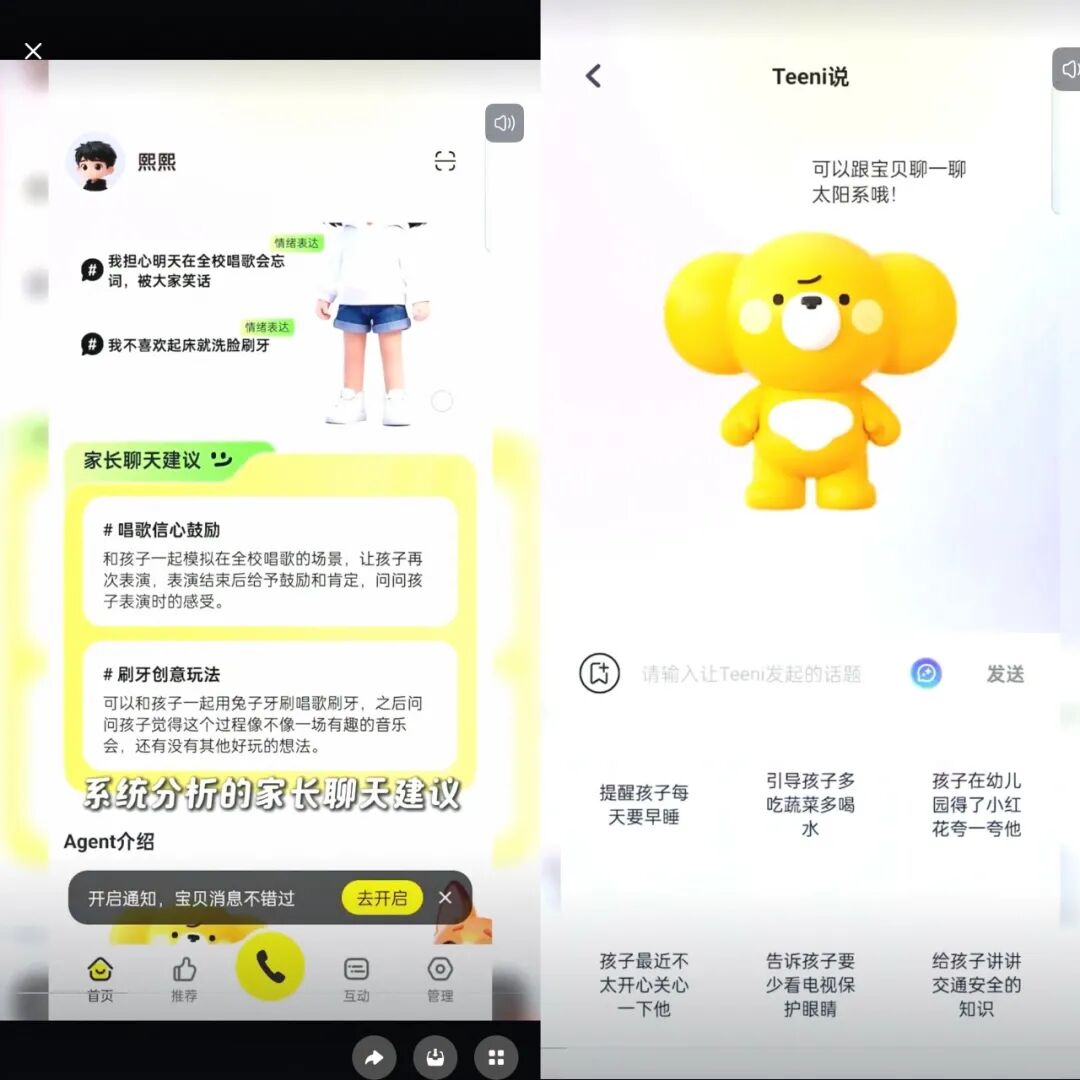
Parents can check children's interaction with AI and set chat topics on the parent side
03 Conclusion
Looking back, Tingli Xiong's youth smart hardware category has achieved full age group coverage from kindergarten to primary and secondary school. The Mooni series targets children below the third grade, focusing on smart watch + AI companionship; the T series of audio learning players emphasizes systematic content, targeting primary and junior high school students who have more learning improvement needs; the X series of learning companion mobile phones targets teenagers. Yuan Lin, the brand founder, also said: "What Tingli Xiong wants to build is the smart entry point for teenagers."
Looking at the whole industry, the children and adolescent AI smart hardware track has continued to be hot in the past two years. Data from iiMedia Research shows that the market size of China's educational smart hardware reached 112.5 billion yuan in 2025, with a year-on-year increase of 16.94%. Divided by age and function, the track can be split into three layers: the top layer is learning machines represented by Zuoyebang, Xueersi and iFlytek, focusing on improving grades for senior students, with annual sales of nearly 20 billion yuan; the lower layer is audio learning players and immersive audio players such as Niu Tingting, Listeners and Youdao Audio Player, selling systematic immersive audio content and listening training, to do English audio input for preschoolers and primary school students; the lowest layer is the AI conversational companionship layer where Mooni M1 is located, focusing on young children and early education enlightenment, with brands like Xiaobanlong BB pager, Hongen and Mingxiaotang all making layouts in this direction.
Brands are accelerating their layouts, seizing parents' anxiety to make large-scale investments, and their sales are rising steadily. However, the usage rate and retention rate of users after purchase are much lower, and very few people still actively use the product half a year later. The survey from iiMedia Research also confirms this point: 65.32% of consumers stop using AI education products, because the interactive experience is poor and children are unwilling to use them actively.
The Operation Research Society also noticed that many parents have feedback on social media that the AI character setting in Tingli Xiong Mooni M1 is too rigid: the character that tells stories only tells stories, and the character that guesses riddles only guesses riddles. Once children interrupt and talk about other topics, the AI cannot follow up, and children quickly lose interest in chatting. Moreover, it has only been 9 months since M1 was launched, the retention and renewal situation after one year remains to be observed. Tingli Xiong's new product launch pace is also very fast: just over half a year later, it launched the M2 priced at 300+ yuan at the end of August, upgraded functions such as positioning and camera, added more enlightenment learning resources, and used iteration to make up for the shortcomings of the first generation.
Finally, are you optimistic about the children's AI smart hardware track?
This article is from WeChat Official Account "Operation Research Society" (ID: U_quan), written by the Editorial Department of Operation Research Society, and authorized for release by 36Kr.