Commercial performance rental fees have plummeted by 90%, enterprises represented by Unitree are ramping up their overseas layout, and robots are seeking a larger stage.
Some time ago, when Lei Technology (ID: leitech) went to Berlin, Germany to cover IFA 2026, it witnessed a very interesting scene in the exhibition hall: Unitree Robotics directly moved the competitive arena commonly seen at domestic exhibitions to the Berlin site, and several humanoid robots wearing boxing gloves performed boxing matches on the stage.
To be honest, this kind of performance remotely controlled by staff offstage has long been commonplace for domestic audiences at various exhibitions and shopping malls. But in the eyes of overseas audiences, this kind of performance is extremely rare, so much so that whenever there is a show next to the arena, the area is almost packed to capacity, and many foreign visitors hold up their mobile phones to film while cheering.
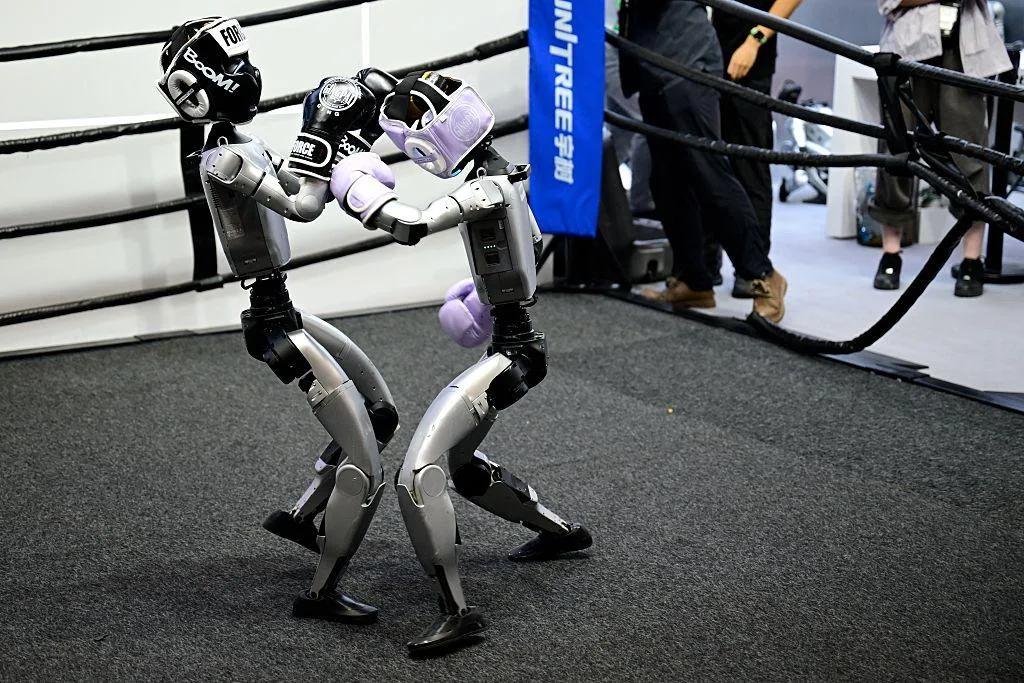
Image source: Lei Technology
Interestingly, while overseas audiences are still marveling at Chinese robots, the domestic "robot commercial performance rental" market, which was once extremely popular, has recently seen a sharp drop in rental prices across the board.
The daily rental fee for humanoid robots, which used to easily exceed 10,000 yuan a day, has now dropped to the mainstream price of a few thousand yuan. On platforms such as Xianyu, you can even find "traffic-attracting" prices as low as 200 to 300 yuan per day. What does that mean? To put it simply, 20,000 yuan last year might only be enough to let a robot perform a Yangko dance at the entrance for one or two days, but this year you can rent two or three robots to perform at the entrance for several consecutive days.
Many people may ask after reading this: The deployment of robots to factories for assembly line work has just started to show initial momentum, so why has the performance sector, which was the first to show profit potential, cooled down first? If you think so, you are actually wrong. In the view of Lei Technology, the drop in robot rental prices is precisely the beginning of the robot performance industry truly stepping onto the right track.
Rental prices plummeted by 70% in a year, is robot commercial performance no longer profitable?
The starting point for the explosion of robot performances must be when Unitree Robotics' humanoid robots became a national hit with their performance of "YangBOT" on the 2025 Spring Festival Gala stage. At that time, even a basic humanoid robot or quadruped robotic dog, as long as it was taken to a shopping mall or street to wave and dance, could attract a crowd of passersby to watch.
Under the market situation of "hard to get a single unit" at that time, the all-inclusive daily rental fee for a humanoid robot was generally as high as 10,000 to 30,000 yuan, and the daily rental for a quadruped robotic dog also ranged from 1,500 yuan to 3,000 yuan. Many individual players and small and medium-sized rental merchants who bought available machines early earned back the purchase cost in just one month by taking orders across the country and traveling to different venues. Some even posted videos saying that they made millions of yuan in half a year, which was a proper "cyber money printer".
However, the "super profit" period of this business only lasted for less than a year. At the beginning of this year, the price of some mid-to-high-end robot performances had dropped from the peak of 20,000 yuan per day to 5,000 yuan per day.
In the second half of 2026, on mainstream rental platforms, the all-inclusive daily rental fee for the humanoid robot labeled as "Unitree U2" by merchants has dropped to around 2,000 to 3,000 yuan. The daily rental of the more entry-level Unitree G1 is around 2,000 yuan, and on the JD rental platform, the bare daily rental of some humanoid robots is even less than 1,600 yuan.
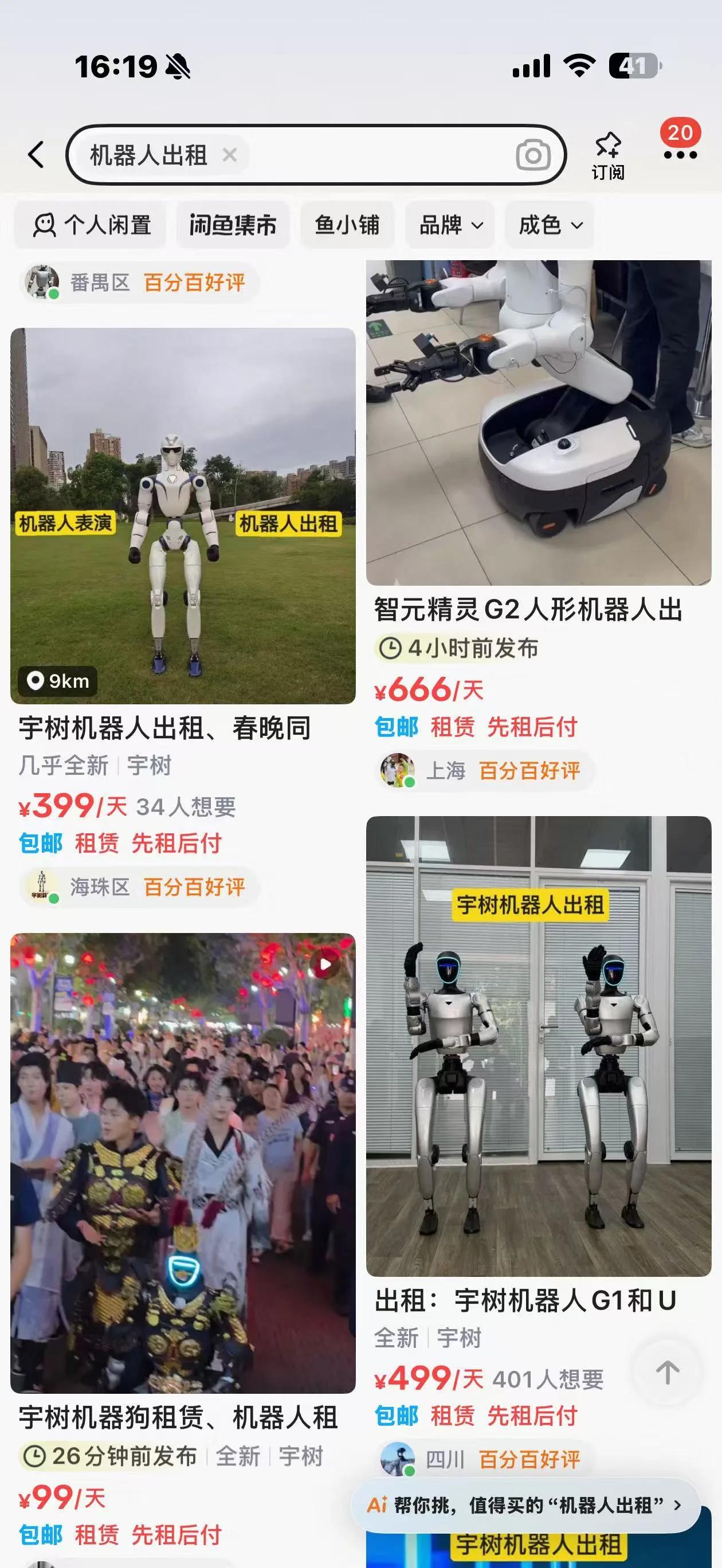
Image source: Lei Technology
As for the quadruped robotic dogs, the price is ridiculously low: the bare daily rental of Unitree Go2 in JD's self-operated rental store is only 164 yuan, and the average daily price for a 30-day rental is less than 100 yuan. The quotation given by offline rental merchants in Hangzhou is only 200 yuan per session (2 hours) or 300 yuan per day.
Why did the once unattractive robot appearance fee drop so sharply in just one year? Simply put, the price of robots has fallen while the supply has increased, and the cost of merchants themselves is decreasing, giving them more room to cut prices for competition. What's more, audiences have become "used to" robot performances, and repetitive programs are increasingly difficult to sell at high prices. In order to grab business, price wars naturally broke out.
In June this year, Agibot announced that the mass production of general-purpose embodied robots had reached 15,000 units, and just 3 months later, the total number of units produced had reached 20,000. At the same time, Unitree also released data in August showing that the total number of its humanoid robots produced had reached about 18,000 units. From the data of these leading enterprises, we can see that China's large-scale robot production has taken a key step.
The increase in market supply has naturally attracted a large number of entrepreneurs. According to the report from Qichacha, as of early April 2026, the stock of robot rental-related enterprises in China has reached 153,000, of which 38,200 were registered in 2025, with a year-on-year increase of 55.7% in registration volume, which shows how fierce and hot the market competition is.
However, if only these robot rental enterprises compete with each other, the price may not drop so fast. The most critical factor is that the "regular army" has started to enter the market. Last December, the open rental platform "Qingtianzu" co-initiated by Agibot was launched in Shanghai, followed by "Wanji Yizu" and JD's self-operated robot rental flagship store entering the market one after another.
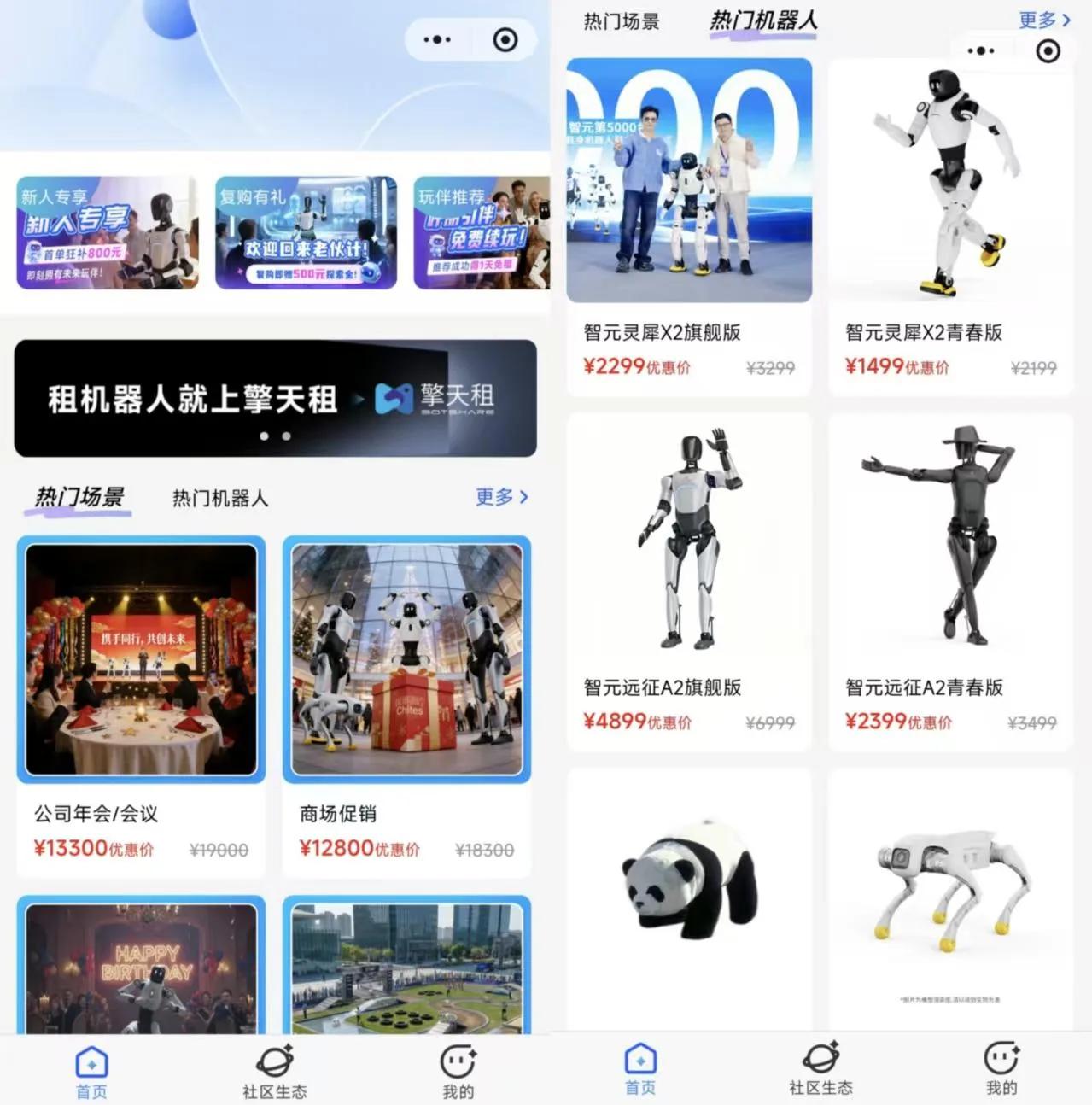
Image source: Lei Technology
The entry of these official and semi-official platforms has directly broken the premium brought by information asymmetry. Take the Lingxi X2 Youth Edition under Agibot as an example. The quotation of ordinary merchants used to be basically above 3,000 yuan, while the same robot with official team support, cooperated by Qingtianzu and Agibot, is only quoted at 2199 yuan per day (even including the engineer's travel expenses).
Even to promote the platform, they launched a "1-yuan flash rental" activity in major cities such as Beijing, Shanghai, Guangzhou and Shenzhen, which only costs 1 yuan for 2 hours. In this case, third-party merchants can only watch their robots collect dust in the warehouse if they do not cut prices.
However, to be honest, these are not the main reasons. The more core problem is that it is increasingly difficult for merchants to make money from simple performances. In the early days when robot rental just became popular, any random movement of the robot could attract onlookers. But, if you only repeat those few old tricks, audiences will naturally lose interest. If the performance can't attract the attention of audiences, shopping malls and shops will naturally have no need to rent robots.
In essence, most rental merchants actually have no secondary development capabilities. They can only use the dozen sets of built-in actions of the robot for performances, and can only make money by taking advantage of information asymmetry. In contrast, some large platforms are not only cheaper, but even can develop dances or actions according to demand, with much stronger competitiveness.
Therefore, it is not that the official entry and large rental platforms have strangled small rental enterprises, but that the cost and capabilities of some small rental merchants can no longer meet the needs of the robot performance industry after it becomes formalized and scaled up.
While domestic rental prices plummet, Unitree steals the show in the United States
Frankly speaking, if you think of robot performances as "renting a metal block to act as a mascot at the entrance of a supermarket", then this business has indeed come to an end. But if you look at an event that happened on the other side of the ocean this summer, you will find that the truly professional, IP-based robot stage performance has just begun.
From June to September this year, on the stage of the 21st season of "America's Got Talent", the ace program that has led the summer competition program market in US ratings for 20 consecutive years, dancer Wu Yufei from Sichuan, together with Chengdu Homis Dance Troupe, brought 8 Unitree Robotics humanoid robots to advance all the way, becoming the first Chinese team in the 21 seasons of the show to break into the finals.
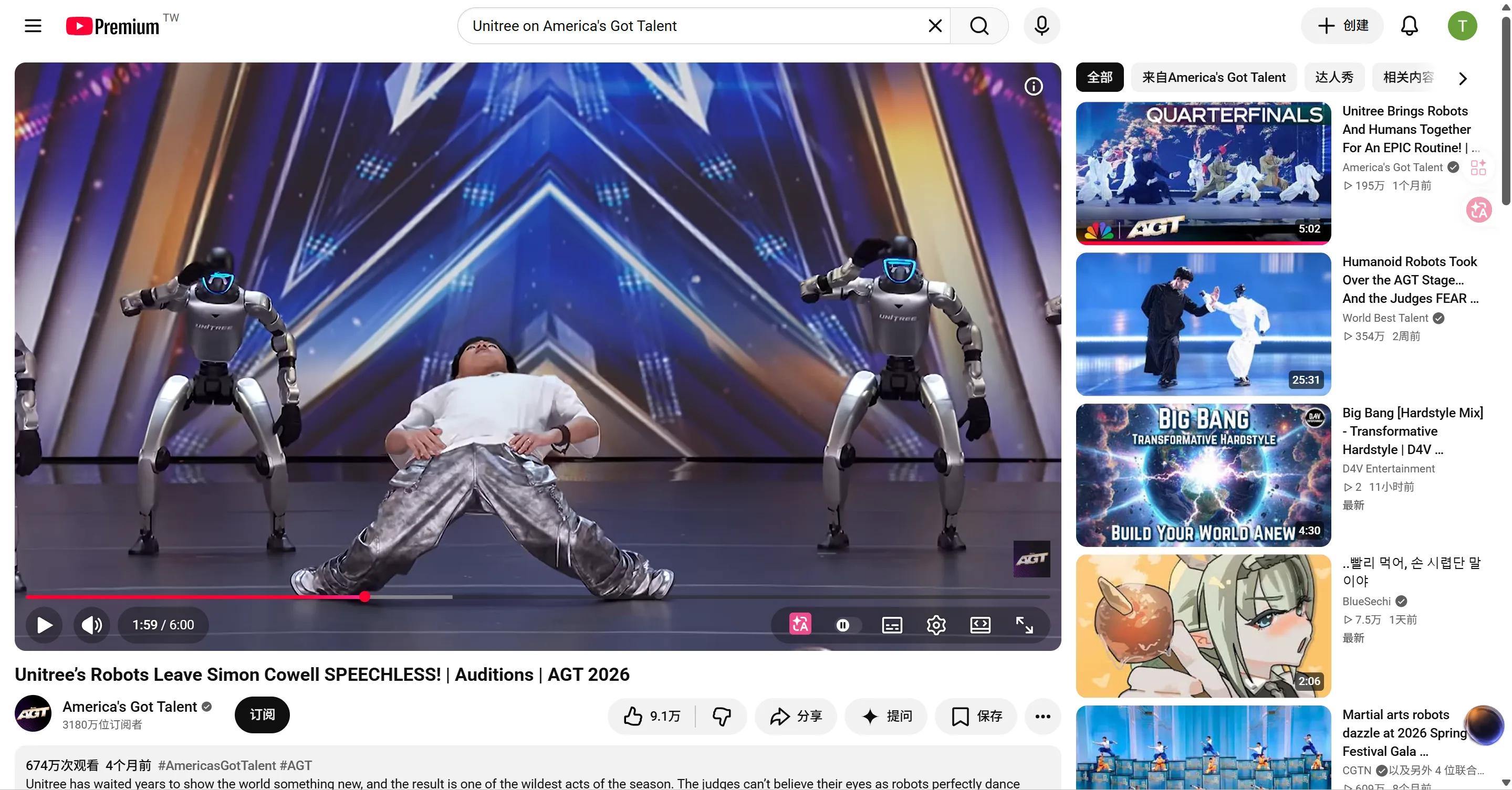
Image source: YouTube
How sensational was this performance overseas?
To put it this way, when the team first appeared in the audition, 8 Unitree G1 robots marched onto the stage in a square formation. The American audience at the scene looked confused at first, and even the judges in the studio had a kind of "uneasy curiosity". Then as the music of Lady Gaga's "Abracadabra" played, the 8 Unitree robots and Wu Yufei danced in perfect sync instantly, and in the climax part, they all completed neat and clean standing backflips together.
Before the performance was over, the entire audience had stood up and cheered. Even the always critical judge Simon Cowell directly exclaimed "It's crazy, but absolutely brilliant", while another judge Sofia Vergara said bluntly: "I have never seen a performance like this before. Usually those robots look very weird, but these robots actually have a sense of rhythm!"
In the subsequent quarter-finals, this Chinese team integrated Chinese martial arts into the rhythm of street dance, and directly performed a variety of difficult movements such as man-machine synchronized flying kicks on site. The wonderful level was no less than the performance on the Spring Festival Gala. It was this dance that directly made Sofia Vergara press the Golden Buzzer, allowing the team to skip the semi-finals and go straight to the finals.
Although Wu Yufei and the Unitree team failed to enter the top five in the finals, becoming the first Chinese team to reach the finals of "America's Got Talent" is already a very impressive breakthrough. At the same time, the related performance videos have also received millions of views on YouTube, and many foreign netizens said they never expected that robot performances could be so wonderful.
They are all robot performances, why is one side seeing prices drop to a few hundred yuan and increasingly difficult to sell at high prices, while the other side can cause a sensation on the international stage? The answer is "creativity". Robots are just tools, and performance content is the core. This also points out the future development direction of robot performances: it is not about selling hardware, but about selling content creation, or even human-robot co-creation.
From the stage to amusement parks, robots are looking for a bigger stage
In fact, leading domestic robot enterprises have already realized this point, and have begun to promote the development of user co-creation, robot cultural and entertainment industry cooperation and other matters. For example, Agibot signed a strategic cooperation agreement with Chimelong Group. The two sides cooperated to bring customized entertainment projects and performances to Chimelong amusement parks and hotel facilities, and Lei Technology was also invited to attend the signing ceremony on site.
Just one month later, on September 24, Agibot delivered the 20,000th embodied intelligent robot "Expedition A3 Ultra" to Chimelong, and launched the world's first large-scale embodied intelligent theme park project at Chimelong Spaceship Park in Hengqin, with more than 300 Agibot robots of all models working regularly at more than 100 points in the park.
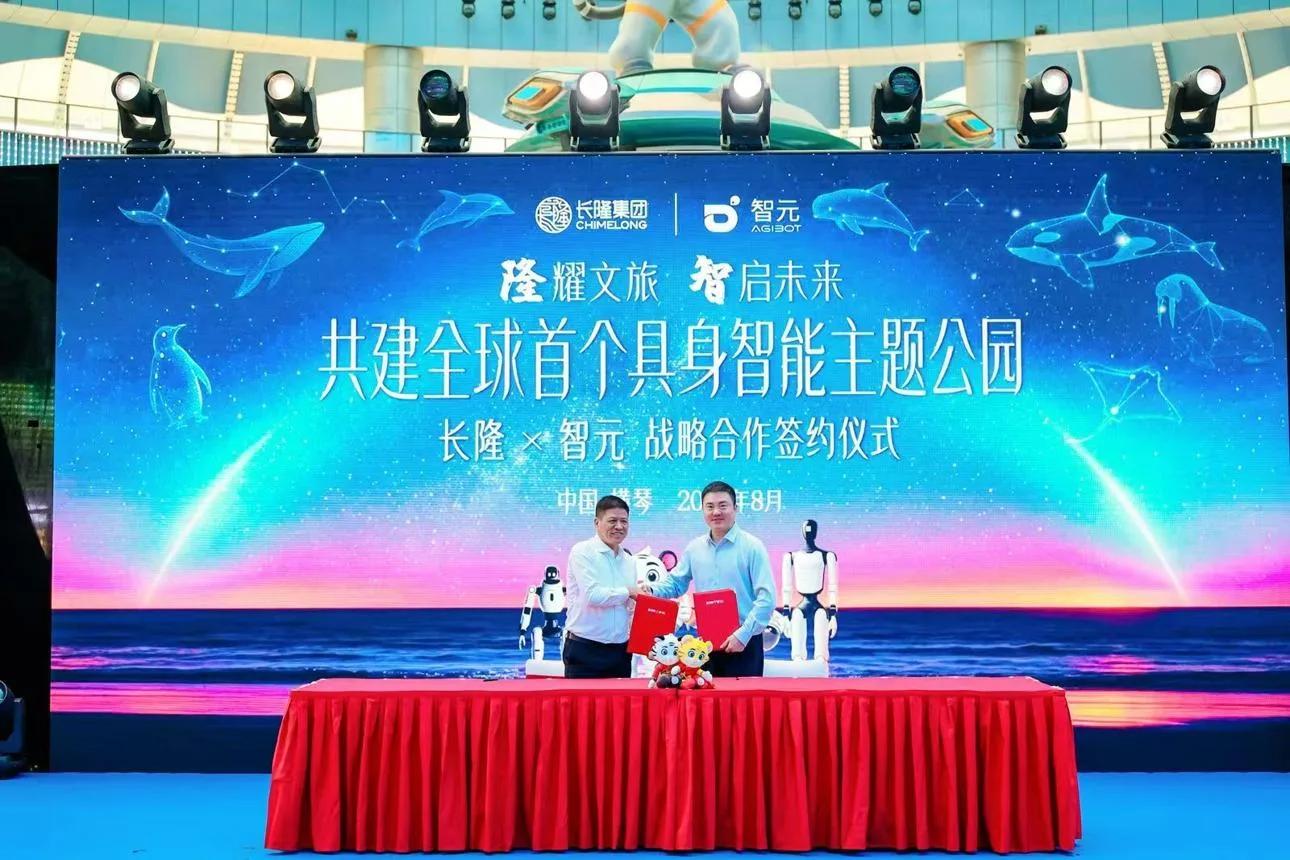
Image source: Lei Technology
As a very forward-looking enterprise in the field of robot cultural and entertainment in China, as early as February this year, Agibot held a global live gala "Wonderful Night of Robots" that was entirely led by robots, which attracted a lot of attention. One of the leading actors of this program is the highly bionic robot "Elf · Xuan". Lei Technology saw the physical object at WAIC, and from a distance, it even looked like a real person sitting at the exhibition booth.
From the stage to amusement parks, robots are rapidly entering the cultural and entertainment field. Another set of data can support this argument. According to data from Counterpoint Research, in the first half of 2026, among the shipment destinations of global humanoid robots, cultural and entertainment commercial performances, science education and data collection together accounted for more than 60%, intelligent manufacturing accounted for 13%, and warehousing and logistics accounted for 5%.
It can be seen that cultural entertainment, science and education are still the absolute mainstream of the current robot market, and also one of the most promising fields to achieve commercial revenue first. In this context, the plunge in the price of third-party rental is just the result of accelerated market competition in the process of the entire industry moving towards large-scale development.
From the perspective of the entire embodied intelligence industry, the significance of cultural tourism and commercial performances is far more important than the rental income earned at present. As Lei Technology mentioned in the previous Chimelong report, one of the biggest problems of embodied intelligence today is the severe lack of interaction data in the real physical world.
Whether it is working in factories for assembly lines or entering homes to take charge of specific housework, robots are required to have sufficient safety and autonomy. However, the current training data and models are still difficult to support work of this level. So where does the data come from? Cultural tourism projects may be an important source.
The annual tourist flow of large-scale cultural tourism scenic spots is basically starting from 100,000 or even millions. A large number of real human interactions have the opportunity to provide robot enterprises with rich real-world data, which becomes an important resource for next-generation model training. This is why Agibot has been continuously increasing its investment in the cultural and entertainment market, because the "data flywheel" model it proposed requires a large amount of real scene data for continuous driving, and finally forms a self-circulating accelerated iteration system.
Therefore, on the surface, the price of the robot performance market seems to have "collapsed", but in fact, the era of barbaric profits in the early stage of the industry has come to an end. When robots in the cultural tourism "novice village" obtain both capital and data at the same time, the huge business belonging to embodied intelligence has just begun.