Ahead of Anthropic's IPO bell-ringing, OpenAI is sprinting to raise $30 billion in financing, targeting a valuation of $1.4 trillion.
On October 20, Reuters reported that OpenAI is accelerating the push for a financing round of approximately 300 billion US dollars, with a target valuation exceeding 1.4 trillion US dollars, striving to lock in investor commitments before Anthropic's mid-November IPO. Existing investors including SoftBank and Abu Dhabi's MGX are in talks to participate; there is a discrepancy between the disclosure standard of OpenAI's annualized revenue run rate and public reports, and the debate over the gross method and net method is no longer an academic issue when both companies are seeking funds at the same time.
A Countdown-Tightened Financing Round
On October 20, Reuters released a piece of news that put the AI capital circle on high alert: OpenAI is accelerating a financing round of about 300 billion US dollars, with a target valuation of over 1.4 trillion US dollars, and the pace is "significantly faster than the usual speed of transactions of the same scale".
The timeline says it all. Anthropic is expected to go public in mid-November, and OpenAI wants to secure investor funding commitments before that. Last week, the two companies took actions almost simultaneously — OpenAI met with long-term holding funds and sovereign wealth funds, while Anthropic held its Investor Day. SoftBank, Abu Dhabi's MGX and a number of existing investors are in talks to join the deal. People familiar with the matter put it plainly: OpenAI hopes to avoid Anthropic's financial disclosure becoming a direct reference for the market to evaluate its own valuation.
This financing round was first disclosed by Bloomberg at the end of September, when it was positioned as a "bridge round as an alternative to IPO" — Sam Altman explicitly ruled out a 2026 listing in September, on the grounds that AI safety work is a priority. Three weeks later, the same transaction was fast-forwarded, with only one variable: the rival's IPO has changed from "expected in autumn" to "mid-November".
Two Sets of Ledgers, Two Accounting Methods
The growth story OpenAI presented to investors is quite impressive: revenue growth accelerated after the release of GPT-6 Astra, the annualized run rate has reached 500 billion US dollars, and it is expected to hit 700 billion by the end of the year. The company also emphasized that significantly reducing the cost of low-price models has driven a substantial increase in call volume, and there is still room for price reduction in the future. (Note: Public reports state that "the annualized revenue run rate is close to 700 billion US dollars". The 500 billion net figure here comes from people familiar with the matter who participated in the roadshow, and no public document has been found to support it yet.)
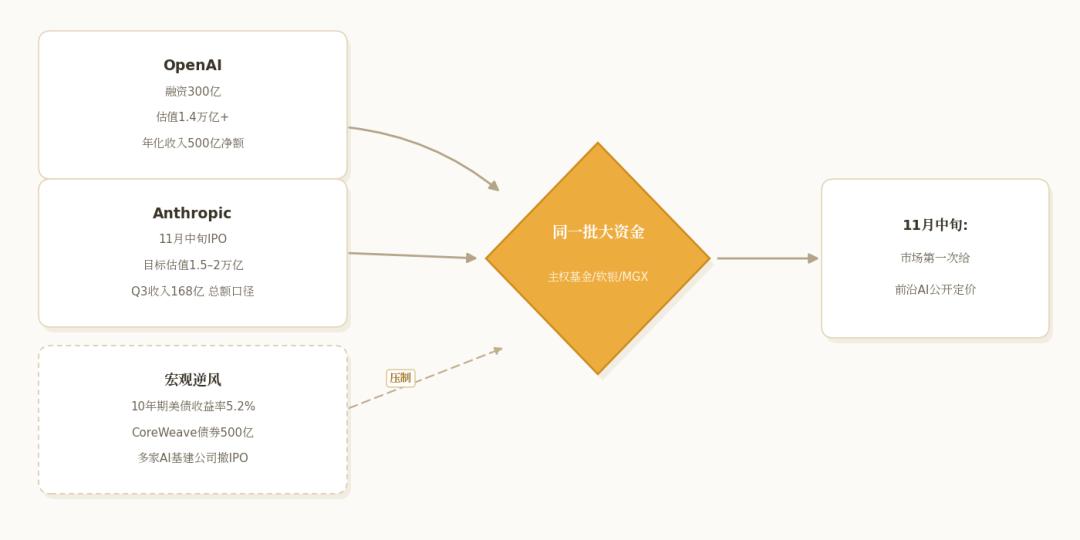
But there is a caliber issue in this ledger that must be pointed out. The debate between the gross method and the net method has long been public: Anthropic includes the full amount of contracts sold through cloud service providers in revenue (gross method), while OpenAI deducts the part distributed to partners (net method). OpenAI previously publicly accused Anthropic of "exaggerating business scale" using the gross method, and Anthropic responded that it follows existing accounting standards. This accounting dispute is no longer an academic issue when both companies are asking for money from the same group of institutions at the same time.
Anthropic's ledger also needs to be re-evaluated. Its third-quarter revenue was 168 billion US dollars (higher than the 116 billion in the second quarter), with a gross profit margin of about 85%, but the monthly revenue growth rate has slowed down. Some investors believe that the reasonable valuation for its IPO should be 1.5 trillion US dollars, rather than the 2 trillion the company expects.
Why Are All Rushing in This Winter
The macro environment is not friendly to trillion-dollar valuations. The 10-year U.S. Treasury yield is at a high level near 5.2% (the original draft of the article said it hit 5.21% on September 28, the highest since 2007, this specific date is recommended to be re-verified); the debt risk of AI infrastructure has begun to be examined — CoreWeave's debt is approaching 500 billion US dollars, and its stocks and bonds plummeted last week; Blackstone's AirTrunk, Nvidia-invested Firmus, and SoftBank's SB Energy have successively canceled or suspended their listings. The IPO window in autumn is narrowing, which in turn makes Anthropic's listing and OpenAI's rush to run take on the color of "the last train".
For OpenAI, the destination of this sum of money is also very clear: huge investment commitments in computing power and data centers. If the 2027 IPO is further postponed due to market conditions, cash reserves will be the resources to survive the winter. The 1220 billion US dollar financing round in March this year (valued at 852 billion) was once considered the last round before listing, but now it seems that the private market will have to act as a capital provider once again.
Digging Deeper
The most subtle part of this game is not the amount, but the order. OpenAI wants to set its own valuation first to avoid being "led by the nose" by the market pricing after Anthropic's listing. On the other hand, this also exposes a certain lack of confidence of OpenAI in its own story — if the revenue is solid enough, it should be happy to accept side-by-side comparison. The dispute over revenue recognition caliber will be further magnified by the magnifying glass of IPO audit, and at that time, "net or gross" may turn from public relations rhetoric to solid evidence of valuation divergence.
Looking further ahead, this is a limit test of capital supply. 300 billion in private placement plus Anthropic's maximum 1 trillion IPO fundraising, superimposed on the financing needs of SpaceX and xAI, there are actually only a handful of institutions in the world that can write such large checks. For the first time outside of model and customer competition, the two companies are competing head-on for the same capital supply — and capital is precisely the party that has the most alternative options. The plunge of CoreWeave's stocks and bonds has already demonstrated how fast divestment can be when the market begins to doubt the "return on computing power investment".
Conclusion
From 852 billion in March to 1.4 trillion now, OpenAI's valuation has increased by more than 60% in seven months; Anthropic, on the other hand, has been repeatedly weighed by the market between 2 trillion and 1.5 trillion. In mid-November, when Anthropic's prospectus undergoes the first review by the public market, the quality of the AI industry's "trillion-dollar club" will usher in the real pricing moment.
OpenAI chose to rush ahead, and Anthropic chose to face it directly — there is no right or wrong in the two strategies, only the order of precedence. No matter who comes first, this winter will become one of the most important footnotes in the history of AI capital.