Anthropic, Google, ByteDance and Tencent have entered the arena. Why are tech giants collectively flocking to AI-powered drug discovery?
New technologies revolutionize productivity, which is always worth looking forward to.
AI is advancing on two parallel tracks.
On one hand, AI is reconstructing traditional businesses. Muse, Cue, Tongyi Qianwen, and Doubao have all made layouts in Personal Agent, cutting into consumption scenarios such as shopping, travel, food delivery, and mobility to compete for the next-generation AI ToC super entry.
On the other hand, AI is revolutionizing productivity, creating incremental value and benefiting humanity.
The first track is Coding, which has supported Anthropic's latest ARR to reach approximately 650 billion US dollars, with a valuation of 1.5 to 2 trillion US dollars.
The second track is AI drug discovery. The 21st century is the century of life sciences, and AI has greatly shortened the R&D cycle of new drugs. Zheshang Securities believes that AI drug discovery will be comparable to Coding[1]. Demis Hassabis stated bluntly: The best use of AI is to improve human health.
Global tech giants are entering this track collectively. In the United States, Anthropic has started building physical laboratories (wet labs) and is actively recruiting talents in the field of biochemistry.
OpenAI has successively released life science models GPT-Rosalind and GPT-Rosalind-Discovery, aiming to become a tool supplier for pharmaceutical companies.
Isomorphic Labs, an AI drug R&D company under Google, continues to upgrade the AlphaFold protein structure prediction model, and its latest round of valuation has reached 40 to 50 billion US dollars.
In China, AI drug discovery is also booming. Tencent has made multiple heavy investments in XtalPi and Insilico Medicine, and has also carried out self-development, and has published the invention patent of GLP-1 short-peptide weight-loss drug fully designed by AI.
ByteDance spun off its AI pharmaceutical company Anew Labs, which completed a 290 million US dollar first round of financing, with a post-investment valuation of about 1.5 billion US dollars.
It can be said that as long as humans want to live longer and solve diseases, pharmaceutical R&D will be a long-term proposition. Neuroscientist Andrew Huberman judges: AI companies such as Meta, OpenAI, and Anthropic will eventually become biotech companies.
01 | Backed by Nobel Prize, AI Reconstructs Drug R&D
In 2024, half of the Nobel Prize in Chemistry was awarded to Demis Hassabis.
You read that right! It is Hassabis, the founder of Google DeepMind and Chief Scientist of Alphabet.
The official Nobel Prize website stated: Demis Hassabis and John Jumper developed an artificial intelligence model (AlphaFold) that solved a 50-year-old problem - predicting the complex structure of proteins.
At that time, AlphaFold focused on "understanding the known" and could identify more than 200 million protein structures.
But today's AI is more powerful, setting off an "efficiency revolution" at the discovery end and starting to "create the unknown". Take the IsoDDE drug design engine released by Isomorphic Labs as an example.
Traditional drug R&D needs to complete the search of 10^60 chemical spaces, which is like looking for a needle in a haystack. It takes more than ten years, costs billions of US dollars, and has a success rate of less than 10%.
But IsoDDE compresses the limit of "several years" to "several days".
AI directly conducts intelligent search in the boundless 10^60 chemical space. In just a few days, it independently completes massive molecular generation and iterative evolution, and combines with targets to design "perfect molecules".
It is worth noting that many new molecules have passed rigorous wet experiments and shown excellent drug properties.
This is not an isolated case. Insilico Medicine also used AI to assist in discovering the TNIK target from massive data, and through AI-assisted innovative molecular design, successfully launched Rentosertib (ISM001-055), a therapeutic drug for idiopathic pulmonary fibrosis (IPF).
According to public data, Rentosertib has shown excellent efficacy and safety in Phase I and Phase II clinical trials, and has now entered Phase III clinical trials.
It can be seen that AI is violently reconstructing new drug R&D, and drug discovery is moving from "handicraft workshop" to "industrial assembly line".
China Merchants Securities pointed out that the advantages of AI are mainly reflected in: analyzing complex biological systems, identifying disease biomarkers and potential drug targets, simulating drug-target interactions, predicting the safety and effectiveness of candidate drugs, and managing clinical trials, etc.[2]
According to the calculation of Zheshang Securities, from the perspective of economic value, AI compresses the drug discovery time by 30%-50%. The success rate of AI-discovered molecules in Phase I clinical trials reaches 80-90%, far exceeding the historical average of 52%.[3]
Up to now, more than 170 AI drug projects around the world have entered the clinical stage. Among them, 7 AI drugs have entered or completed Phase III clinical trials, covering diseases such as cancer, lung disease, and obesity.
Dario Amodei, CEO of Anthropic, boldly predicted: In the next 5 to 10 years, AI is expected to overcome most serious diseases.
If this is realized, humans will refresh their biological limits, and lifespan, health and well-being will be greatly improved. This, perhaps, is the correct way to use AI.
02 | Lack of Data and Clinical Productivity
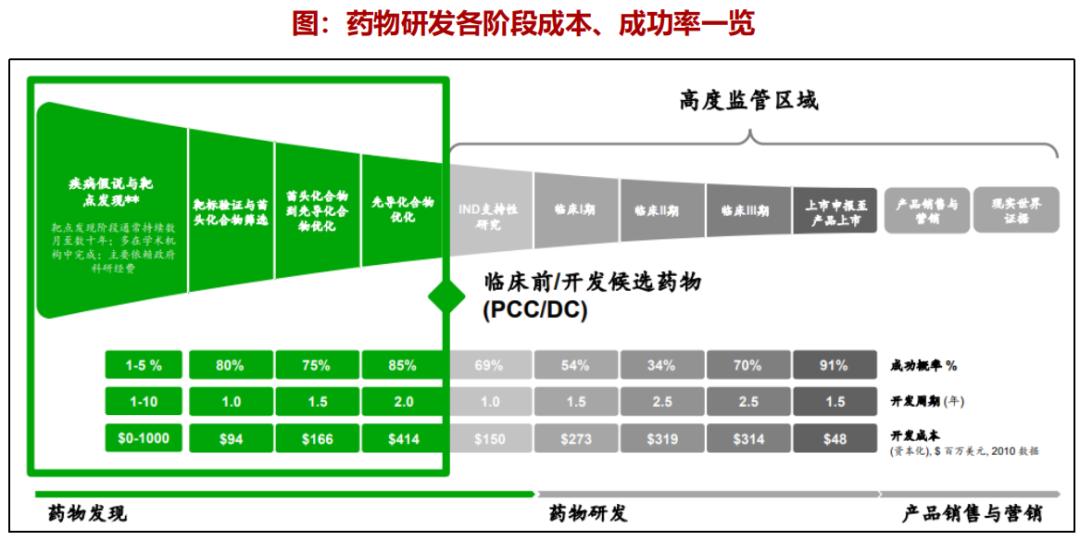
Pharmaceutical R&D (R&D phase) is an extremely long journey.
First, find targets and design molecules, then screen and optimize compounds, then carry out preclinical research and clinical trials (Phase I, Phase II, Phase III), and finally complete new drug registration and approval.
Source: Zheshang Securities
At present, AI is mainly transforming the upstream drug discovery link, which is far from enough. Zheshang Securities calculates that the cost of this stage accounts for only 38%. The remaining 62% of the cost is spent on clinical trials and approval.[3]
The chairman of an innovative pharmaceutical company believes that the next breakout point of the AI pharmaceutical track lies in AI clinical practice.
However, the biggest bottleneck restricting development is high-quality data. AI not only needs successful data, but also failed data to understand the real world and accelerate self-evolution.
But the reality is that a large number of data of failed molecules and failed targets are held by pharmaceutical companies and CROs, and are almost not made public. In China, massive historical medical records are piled up in hospital databases, left unused, and data cannot be circulated.
China Merchants Securities pointed out that the ultimate value of the AI pharmaceutical industry depends on the long-term technical barriers formed by algorithm models + proprietary data + closed loop of dry and wet experiments + clinical pipeline development + core pipeline rights and interests.[2]
In other words, whoever has large-scale experimental data, core pipeline rights, clinical development and commercialization capabilities can build long-term technical barriers and get the most value in the entire AI pharmaceutical industry.
Domestic and foreign AI giants and AI pharmaceutical companies are stepping up their efforts to "make up lessons".
On the data side, companies such as Google DeepMind, Isomorphic Labs, and Meta plan to invest 1.8 billion US dollars to build the next-generation biological AI model and build an open data infrastructure.
In terms of dry and wet laboratories, Anthropic has personally established its own biological laboratory, hoping to deeply connect Claude with scientific research data, professional models and experimental processes, and become the infrastructure supporting life science R&D.
XtalPi is also making large-scale layouts of AI + robot laboratories to create a "closed loop of dry and wet experiments" to break through the blind spots of scientific verification.
Even the multinational pharmaceutical giant Eli Lilly is increasing its layout. It directly opens its AI model that has accumulated decades of R&D data to the public, and the exchange condition is that participants need to feed back experimental data. At present, more than 125 enterprises have participated.
AI does improve efficiency, but the hurdles that need to be crossed still have to be crossed.
The first is the approval hurdle. The US FDA stated that digital transformation will not change the existing CGMP requirements, and the supervision responsibility of the quality department cannot be transferred due to the use of AI.
The attitude is very clear: strictly supervise AI pharmaceuticals. Pharmaceutical companies must provide more evidence to prove whether the intervention of AI can support the safety, effectiveness and quality of drugs.
The second is the commercialization hurdle. Up to now, no AI drug has passed regulatory approval and entered the market.
Therefore, we can observe AI pharmaceuticals over a longer time horizon. The direction of progress has not changed, but how to solve the specific problems, especially the problems of regulatory approval and commercialization, requires more communication and exploration.
03 | Chinese Companies Are Becoming the "Protagonists"
In the last wave of innovative drugs, China's market size and number of online pipelines have surpassed Europe, ranking second in the world.
In this wave of AI pharmaceuticals, China is expected to stand at the global "center stage". Evaluate predicts that Chinese assets may account for "more than two-thirds" of the total transaction value of innovative drugs in 2026.
This is mainly due to the fact that China has a complete supply chain and a mature CRO ecosystem: it can continuously optimize in the process of algorithm → automated experiment → data reflux, and realize "faster, cheaper and more controllable" from target discovery, molecular design to transformation verification.
At the same time, China also has engineer dividends, a huge patient population and rich clinical data.
Chinese companies are becoming the "protagonists" of AI pharmaceuticals. Among them, Anew Labs under ByteDance is worthy of attention.
Anew Labs was founded in 2021. This year, Zhang Yiming stepped down as CEO of ByteDance. He said in an internal letter that the impact of virtual reality, life sciences and scientific computing on human life has shown the dawn, and to seize this opportunity, innovators need to break through the inertia of business to explore.
Since then, Anew Labs has continuously introduced biomedical talents, including Liu Yongjun, former president of Innovent Biologics, Ma Ji, former chief scientist of Amgen, Zou Hua, former director of protein chemistry science at Takeda California, and others.
At present, it has made breakthroughs on the model side, released AnewMind, a large scientific reasoning model for drug R&D decision-making, and launched biological AI models such as Protenix and PXDesign, covering drug R&D links such as protein structure prediction and molecular design.
On the product side, it has 4 preclinical pipeline assets. Among them, the core pipeline AN-5162 is a small molecule inhibitor that can simultaneously inhibit three dimers of the IL-17 family, mainly targeting autoimmune diseases such as psoriasis.[4]
Backed by ByteDance, Anew Labs has completed a 290 million US dollar first round of financing, with a post-investment valuation of about 1.5 billion US dollars. The investor lineup is luxurious, including well-known institutions such as HSG, IDG Capital, GL Ventures, and 5Y Capital, as well as pharmaceutical companies such as China Biopharmaceuticals.
Another notable large company is Tencent.
In the past ten years, Tencent has built a huge pharmaceutical territory. Among them, XtalPi is one of its earliest and most invested projects, with a cumulative investment of about 475 million Hong Kong dollars.
After XtalPi went public, Tencent successively reduced its holdings by 240 million shares, cashing out at least 1.1 billion Hong Kong dollars. At present, Tencent still holds 200 million shares, equivalent to about 1.184 billion Hong Kong dollars. Roughly calculated, the return on this investment is nearly 400%.
In addition, Tencent has also invested in AI pharmaceutical companies such as Insilico Medicine and Fali Biotech.
At the same time, Tencent is also deeply involved in the front line of the industry. Earlier this year, it used algorithms to drive molecular screening and published the patent related to GLP-1 weight-loss drugs designed with the participation of AI.
In July, Tencent Hunyuan released the scientific discovery agent Hyra-1.0. In August, Tencent AI for Life Sciences Lab and Central South University jointly built a new AI framework called UniPert-G2CP.
All this shows Tencent's ambition to heavily bet on AI pharmaceuticals in the long run.
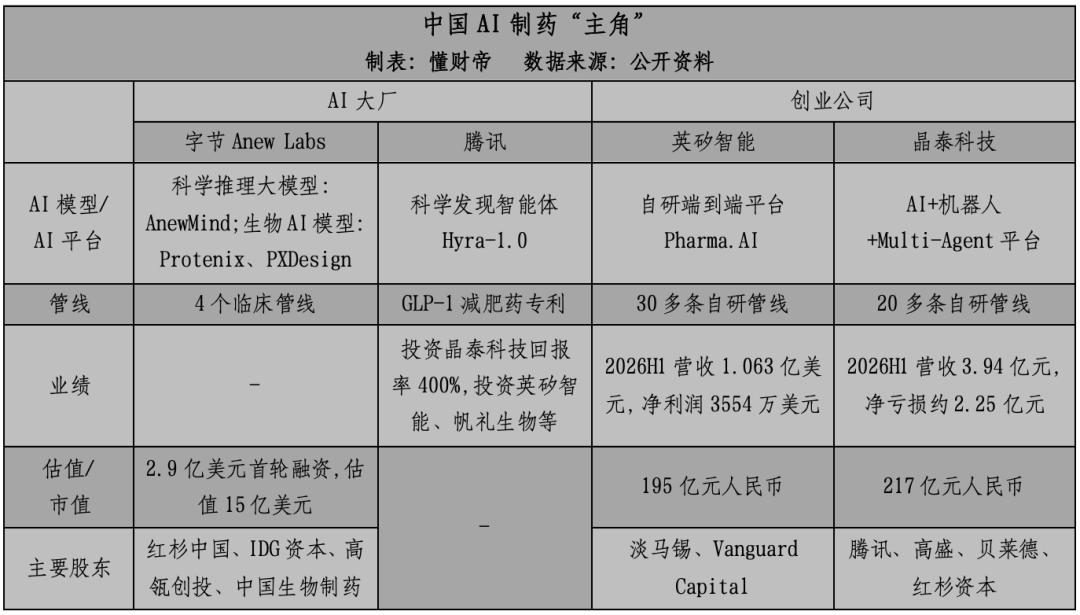
On the startup company side, the most outstanding performers are Insilico Medicine and XtalPi.
The two companies have different development routes. Insilico Medicine relies on its self-developed end-to-end platform Pharma.AI to empower the whole process of drug R&D from target discovery, molecular generation to clinical outcome prediction, and has self-developed pipelines.
XtalPi is a "shovels seller", empowering biomedical enterprises and chemical material enterprises with the AI + Robot + Multi-Agent platform.
Since the beginning of this year, the two companies have frequently won large orders. It is reported that Insilico Medicine has reached a cooperation with Servier with a total amount of 888 million US dollars, a cooperation with Eli Lilly with a maximum total amount of 2.75 billion US dollars, and a cooperation with SK Biopharmaceuticals with a maximum total amount of 2.5 billion US dollars.
XtalPi has reached a strategic cooperation with Dongyangguang Pharmaceutical with a total amount of hundreds of millions of yuan, and a cooperation with an international biopharmaceutical company with a total amount of more than 400 million US dollars.
Reflected in the financial report, in H1 2026, Insilico Medicine continued its strong growth, achieving revenue of 106.3 million US dollars, a year-on-year surge of 287%, and a net profit of 35.54 million US dollars, turning losses into profits.
In the same period, XtalPi's revenue was 394 million yuan, down about 24% year-on-year, and its net loss was about 225 million yuan, turning from profit to loss year-on-year.
This shows that AI's reconstruction of the pharmaceutical industry is no longer "empty talk", and the benefits have been realized in revenue. But at the same time, since AI drugs have not yet entered the commercialization stage, AI pharmaceutical companies have not yet reached the moment of making profits.
We might as well give AI pharmaceuticals more patience. In the future, once AI pharmaceuticals explode on a large scale, all mankind will benefit. At that time, some Chinese companies may rise to become the "Anthropic" in the AI pharmaceutical sector, or the Eli Lilly in the AI era.
New technologies revolutionize productivity, which is always worth looking forward to.
References:
[1] AIDD is comparable to Coding - Zheshang Securities
[2] From algorithm narrative to pipeline value, clinical realization and commercialization breakout are imminent - China Merchants Securities
[3] New Era, New Leap - Zheshang Securities
[4] The Strange Newcomer in AI Pharmaceuticals - Economic Observer