Ray Dalio, founder of Bridgewater Associates: The biggest risk of the AI bull market is not valuation, but...
On Monday, U.S. tech stocks staged a rebound. The Nasdaq 100 closed 1.2% higher, and the Philadelphia Semiconductor Index ended its longest eight consecutive losing streak since 2008. The storage, cloud computing power, semiconductor and optical communication sectors all strengthened, with Western Digital and APLD rising more than 6%, while SanDisk and SK Hynix rebounded in tandem.
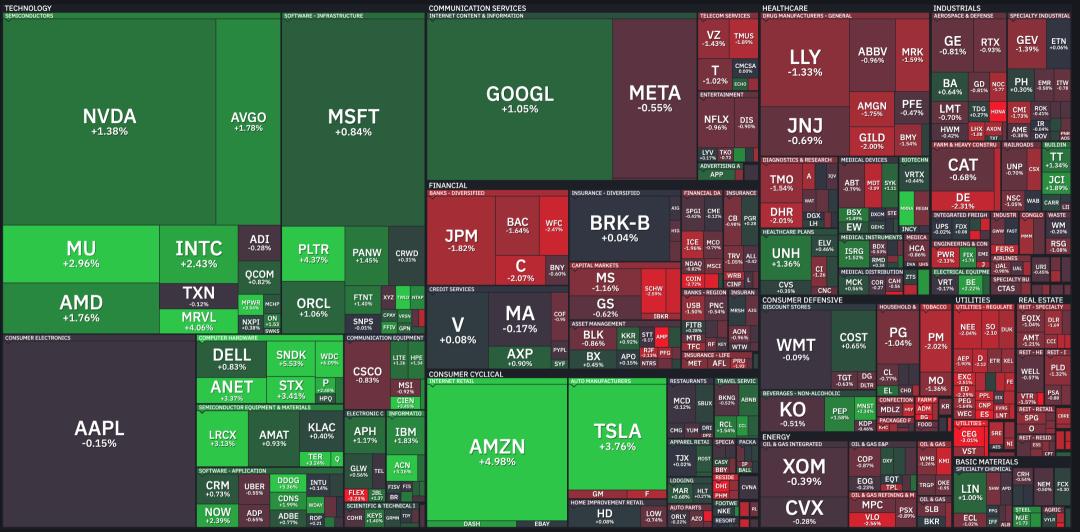
However, one detail is worth noting: the Goldman Sachs trading desk gave the market activity a score of only 3 out of 10 that day. This shows that although stock prices have rebounded, large institutional capital remains cautious on the whole.
Therefore, a more accurate characterization is:
This is a corrective rebound, not a trend reversal.
To understand whether this rebound can be sustained, U.S. Stock Investment Network believes it is necessary to clarify the causes of this decline, and then combine the recent warning from Bridgewater founder Ray Dalio on the AI investment boom to judge the risks the market really needs to guard against.
Why did tech stocks rebound?
Funding side: The pressure of concentrated selling may ease periodically
This round of decline is widely attributed to rumors that the AI-themed hedge fund VARA is facing forced liquidation. The fund holds heavy positions in targets such as Nebius, CoreWeave, SanDisk and Micron, and sold off regardless of price after blowing up its positions, leading to high-quality assets being mistakenly dragged down.
It should be noted that as of Monday, the statement that VARA has been officially liquidated has not been confirmed by reliable public evidence.
But trading data points to a similar mechanism: Goldman Sachs data shows that in the five consecutive trading days ending October 15, hedge funds cut their exposure to tech stocks at the fastest pace since at least 2016, with selling intensity hitting the highest level in nearly a decade.
This means that the sellers are holders who are forced to reduce positions, not new funds that take short positions actively. The feature of forced selling is that once the selling pressure is exhausted, prices will see a technical rebound.
The market rebounded sharply immediately after the collapse of the fund under Leopold Aschenbrenner in July this year, which is a sample of the same mechanism. But the driving force of this kind of rebound is the temporary clearing of sell orders, not the re-entry of buy orders based on new fundamentals. It cannot answer the question: Will the next round of forced selling come from other institutions?
Industry side: The market re-prices the short-term impact of Changxin Memory Technologies
Previously, Samsung fell more than 8% and SK Hynix fell more than 10%. The trigger was that Changxin Memory Technologies announced that it would launch server DDR5 chips based on the 4F² architecture before the end of the year, and the market worried that Chinese memory manufacturers were accelerating to catch up in advanced processes.
However, after institutional evaluation, the panic is obviously excessive.
South Korea's KB Securities measures by mass production time point, and believes that the DRAM process generation gap between Korean giants and CXMT is still 5 to 7 years.
Rosenblatt directly rated the short-term competitive threat as a "paper tiger", pointing out that product preview does not mean large-scale mass production, and yield, unit cost and cloud service provider customer certification are the decisive thresholds; and CXMT is restricted by U.S. export controls and cannot obtain advanced EUV equipment, so 4F² can only be achieved by repeated DUV etching, with natural pressure on yield.
Samsung's CTO also confirmed at SEDEX that large-scale commercial mass production of 4F² is expected to be later in this decade.
Therefore, the rebound of memory stocks on Monday corrected the wrong pricing of "product release equals capacity impact", rather than denying the authenticity of Chinese memory competition.
CXMT's global DRAM revenue share has reached 9.5%. Long-term competition is real, and short-term panic is excessive, and the two can hold true at the same time.
News side: CRWV rating upgrade and statements from industry leaders are sentiment catalysts
Goldman Sachs upgraded CoreWeave's rating from "Neutral" to "Buy" with a target price of $106; Jensen Huang also continued to emphasize the long-term demand for AI computing power infrastructure, and related news once pushed CoreWeave's share price higher.
However, the rating upgrade did not eliminate concerns in the credit market. CoreWeave finally closed down about 0.4%, and its bond spread remains at a high level.
This precisely reflects a core contradiction in the current AI market:
The U.S. stock market focuses on future growth, while the bond market pays more attention to solvency and financing risks.
When stock prices start to rebound but credit risks have not eased, we cannot only look at the rise itself, but also ask whether this round of AI investment can really earn back the cost.
This is also why Dalio's warning deserves attention.
Dalio issues another warning
Ray Dalio, founder of Bridgewater Associates, has received widespread attention for identifying and warning of credit risks before the 2008 financial crisis. Recently, he once again issued a warning on the AI investment boom.
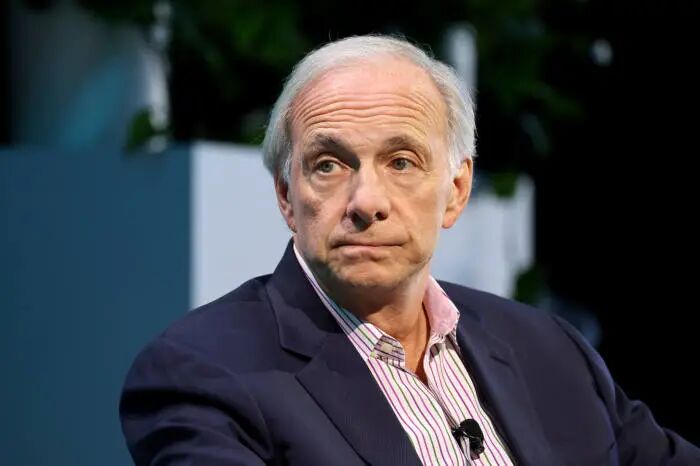
I think the point is not to simply judge whether there is a bubble in AI, but a more realistic question:
How much capital does AI actually need to invest, and how long will it take to truly earn all this money back?
Tech giants are continuing to invest in data centers, chips, network equipment and power infrastructure. AI does have the potential to create huge commercial value, but capital expenditures occur today, while revenue and profits need to be gradually realized in the future.
If AI demand continues to grow and enterprises can convert capital expenditures into sufficient revenue, profits and free cash flow, then huge investments may generate rich returns.
However, if the speed of infrastructure construction exceeds actual demand, or the growth of commercial revenue cannot keep up with investment, the market must re-evaluate the value of these assets.
Therefore, the long-term prospects of AI technology and the current investment value of AI stocks are two different issues.
Technology can continue to advance, but if stock prices have already priced in overly optimistic expectations, even if enterprises are still growing, investors may suffer losses due to valuation downgrades.
What is really worth guarding against is the simultaneous emergence of high growth expectations, huge capital expenditures and financing pressure.
What deserves more attention than valuation is debt and liquidity
The risk of AI investment depends not only on whether enterprises can make money, but also on whether they can continue to obtain capital.
Assuming an enterprise invests tens of billions of dollars to build data centers, expanding mainly through debt and external financing. If the market continues to be optimistic about AI demand, it can obtain capital relatively smoothly.
However, if interest rates rise, credit spreads widen, or investors begin to question future returns, financing costs may rise and financing conditions may also tighten.
For enterprises that still need to repay debts and continue to build data centers, this will bring greater cash flow pressure.
Risks may be further transmitted:
Rising financing costs compress project returns;
Downward valuation of assets reduces collateral value;
Investors reduce their risk exposure, which may further exacerbate stock price volatility.
For institutions that use leverage, falling prices may also trigger forced position reduction, further expanding selling pressure.
Therefore, falling asset prices do not necessarily mean that everyone suddenly no longer is optimistic about AI, it may also mean that some participants no longer have sufficient capital to continue to hold positions.
The recent divergence between CoreWeave's stock price performance and the bond market performance is a signal worthy of continuous observation.
At the same time, the continuous expansion of AI capital expenditures also means that tech enterprises and the U.S. government both need to compete for capital in the capital market.
If financing demand increases while capital supply cannot keep up synchronously, the yield of long-dated U.S. Treasuries and corporate credit spreads may become important variables affecting the valuation of tech stocks.
In particular, companies that rely on future growth and currently have weak free cash flow are often more sensitive to changes in interest rates and the financing environment.
AI can boost productivity, but profits do not necessarily belong to all AI companies
There is another easily overlooked problem: even if AI can indeed improve production efficiency, the final beneficiaries may not be every AI company.
Assuming that an enterprise uses AI to reduce the original work cost of $100 to $70, it can theoretically save $30.
But if competitors also adopt the same technology, industry competition may further intensify. Enterprises lower prices to compete for customers, and part of the efficiency gains will be transferred to consumers, rather than all becoming shareholder profits.
At the same time, AI enterprises may also need to continuously invest in chips, computing power, R&D and infrastructure to maintain technological advantages.
Therefore, the increasing popularity of AI applications does not mean that the profit margins of all related companies will increase synchronously.
What investors really need to study is: Who has pricing power? Who has irreproachable competitive barriers? Who can convert technological advantages into sustainable free cash flow?
This is closer to the essence of investment than simply judging how large the AI industry will be in the future.
What to focus on observing next?
I will not conclude that the AI market is coming to an end just because Dalio issued a warning; similarly, I will not ignore valuation and financing risks just because the long-term trend of AI is strong enough.
Next, I will focus on observing three directions
First, whether earnings can keep up with capital expenditures.
Tech giants continue to increase AI investment, and ultimately need to realize investment returns through revenue, profits and cash flow. If capital expenditures continue to expand, but commercialization progress and cash flow improvement are insufficient, the market may re-evaluate valuations.
Second, whether credit risks continue to spread.
Pay attention to the yield of long-dated U.S. Treasuries, corporate credit spreads, and the financing conditions of high capital expenditure enterprises such as CoreWeave. If the bond market continues to deteriorate, even if stock prices rebound in the short term, we cannot easily conclude that the risks have been lifted.
Third, whether financial reports can give new answers.
This week enters the intensive period of U.S. stock earnings reports, and companies such as Tesla, Meta, IBM, Lam Research and Texas Instruments will release their performance one after another.
These earnings reports not only affect individual stocks, but also help the market judge what stage the AI investment cycle is actually in: Will capital expenditures continue to expand? Is demand sufficient to support new capacity? Can profit margins and cash flow deliver the previously optimistic expectations?
For the AI industry chain, what really matters is not how much money the company announces it has invested, but whether these investments can generate sufficient economic returns.