The long-gestating Apple robot
Apple's long-rumored home smart screen HomeView has finally been released recently.
This is a $299 device equipped with a 7-inch screen, which can be placed at home and interact with users via voice.
This seemingly uncomplicated device has been delayed for nearly two years because the AI capabilities of the new version of Siri have failed to meet the requirements for a long time.
But for Apple, HomeView is only the first step in its home robot plan.
Apple has explored more complex desktop robots, robots that can move autonomously at home, and even studied enabling robots to complete household chores such as washing dishes.
However, from fixed screens to robotic arms, and then to robots capable of autonomous movement, Apple's vision continues to expand, but the actual products that have been launched are always limited.
Morgan Stanley predicted in 2025 that by 2040, the annual revenue of Apple's robotics business could reach 1330 billion US dollars. But at the moment, even the unique value of Apple's home smart screen still needs to be tested by the market.
If Apple wants robots to take over the growth baton from the iPhone, it must first prove that consumers really need such a device.
01. The Robot Dream Starting From a Robotic Arm
Apple's home robot program can be traced back as early as 2022.
In this year, Apple approved the desktop robot project codenamed J595, planning to install an iPad-like screen on a robotic arm, so that the device can rotate according to the user's position, supporting video calls, voice interaction and smart home control. Due to its shape similar to Luxo Jr. in Pixar animations, this product was later called "Pixar Lamp".
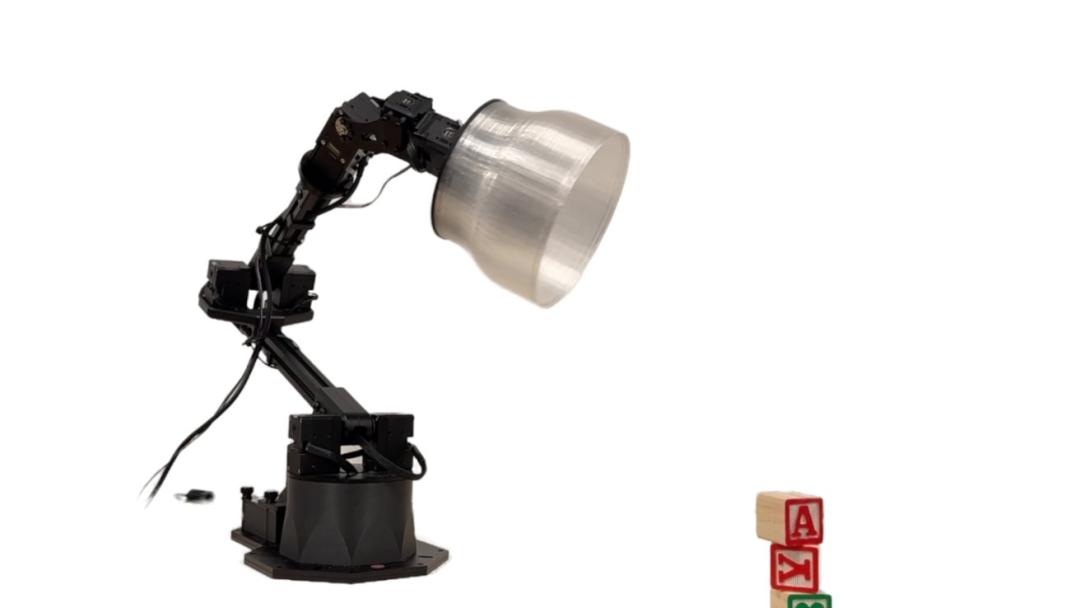
Apple's concept of the "Pixar Lamp" style robot
However, J595 was not the only direction Apple has explored.
Apple also considered developing robots that can move autonomously at home, allowing the device to follow users for FaceTime calls, monitor the home environment and perform simple tasks. However, furniture, sundries and thresholds in the residential environment bring many difficulties to autonomous navigation, and the robot must also recognize the surrounding environment during movement to avoid collisions.
Apple even evaluated robots that can take on housework, similar to Rosie the robot maid in the animation *The Jetsons*. However, the tasks that such products need to complete are more complex, and the R&D difficulty is also higher, and the relevant plans were eventually shelved.
In contrast, the desktop robotic arm does not need to move around the house, which can avoid complex navigation problems, and has an additional layer of physical interaction capability compared with a fixed screen. When the user speaks, the screen can turn to the other party; when making a video call, the robotic arm can also adjust the angle to align the picture with the user.
Apple hopes to use this to create a home terminal that can sense the user's position and actively respond to needs.
However, J595 did not initially get the highest priority. Until the beginning of 2024, after Apple terminated the car-building project "Titan" that had lasted for nearly ten years, some engineers turned to other businesses such as robotics, and technologies such as computer vision, autonomous navigation and motion control were also reallocated to relevant R&D.
In August of the same year, some media disclosed that hundreds of people had participated in the R&D of J595, led by Kevin Lynch, who was once in charge of Apple Watch, and Apple also began to contact the supply chain. The product design gradually took shape: a screen of about 9 inches was installed on a slender robotic arm, which can tilt up and down, rotate, and turn to the speaker according to the speech recognition result.
Apple also envisioned an interaction method for this device that is different from traditional voice assistants. It not only needs to respond to commands, but also remember the information in the conversation and put forward suggestions at the right time. Apple has tested adding visual images to Siri, including presenting the assistant status with the animated image of the Finder icon, so that the device has a more intuitive feedback method beyond the screen and actions.
In February 2025, Apple's machine learning research team announced the ELEGNT robot desk lamp research. This desk lamp can express different states through turning, tilting and other body movements, and have more expressive interactions with people. It is not the official product of J595, but it shows another idea of Apple on robot interaction: in addition to performing tasks, machines can also transmit information through actions.
The latest evolution is the launch of HomeView. In a sense, HomeView is a downgraded version of J595 - the robotic arm is removed, the screen and speaker are retained, and it is first launched to the market in the form of a smart screen. This is a typical Apple-style strategy: first use a relatively mature product to occupy the market, educate users and verify demands, and then gradually add more complex functions.
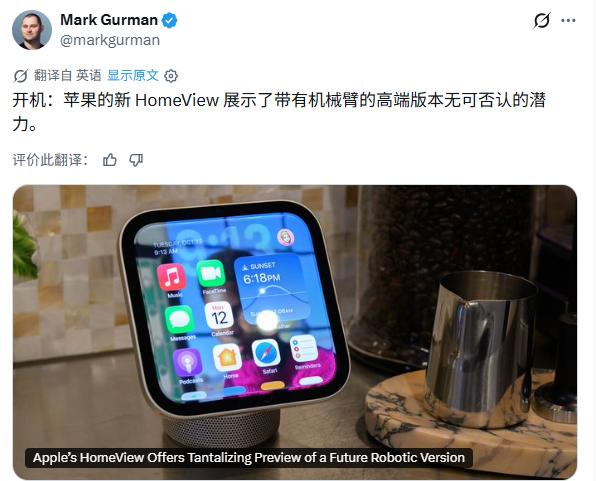
But the repeated adjustment of the form also reflects a deep-seated problem: Apple has not yet found the "killer application" for home robots.
Moving robots are too complex, robotic arms are too expensive, and smart screens are highly overlapping with the functions of iPad and HomePod. Each form has its rationality, but none has been proven to be truly indispensable to users. The ambiguity of product definition is one of the core problems faced by Apple's robotics business.
02. Hardware-Software Mismatch: Siri Holds Back Hardware
The biggest problem that prevented HomeView from being launched for a long time lies in Siri.
From the very beginning of design, HomeView has taken voice interaction as the core. Its envisioned experience is: Siri can access personal content, distinguish different members in the family, and display exclusive private information for each person. Users mainly control it through voice instead of touching the screen. Without a usable new version of Siri, all these functions are castles in the air.
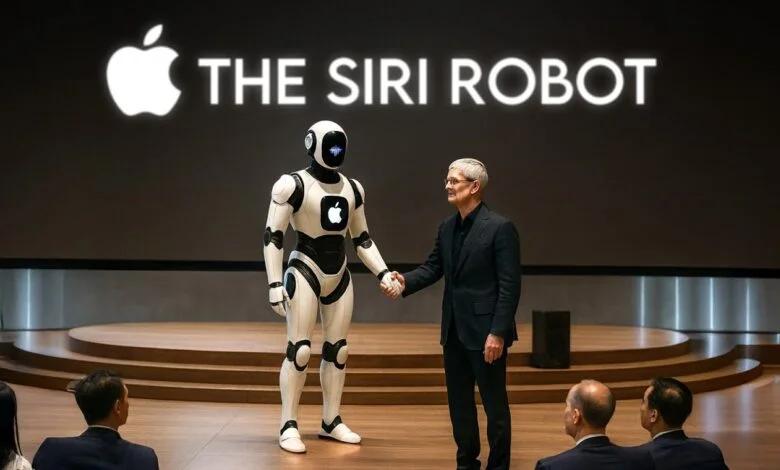
Thus a highly ironic situation emerged: the hardware was completed long ago, but the software is still nowhere in sight. The finished products have been packed and stored in the warehouse for almost a year, just waiting for Siri to mature. Thick bezels, A18 chip, 8GB of memory - these configurations reveal the true age of the product. It was designed several years ago, and has been held back from release just because the software cannot keep up.
The dilemma of HomeView is not an isolated case, but a microcosm of Apple's lagging AI strategy. In 2025, the AI upgrade of Siri was postponed due to quality problems, the AI team was reorganized, and the head John Giannandrea retired. In 2026, Apple had to cooperate with Google to borrow the other party's large model to support the Apple Intelligence function - admitting that its AI capabilities cannot keep up for the time being.
The lag of AI capabilities has a far more serious impact on the robotics project than on the smart screen. If HomeView needs a "usable" Siri, then J595 needs a "smart" Siri. Active dialogue, situational understanding, personalized interaction, emotional expression, each of which puts higher requirements on AI. Without a smart enough "brain", no matter how flexible the robotic arm is, it is just a rotating bracket.
This also explains why the launch time of J595 has been pushed back again and again. In 2024, the outside world expected it to be launched in 2026 or 2027, with a price of about 1000 US dollars. By 2026, the timeline has slipped to 2027 or 2028. According to Apple's usual practice, the possibility that this timeline will be further delayed is not small.
Apple's AI dilemma has deep-seated reasons. For a long time, Apple has adhered to the end-side AI-first route, emphasizing privacy protection and data security, which is in sharp contrast to the mainstream industry path that relies on cloud large models. End-side AI has advantages in speed and privacy, but the model capability is limited by the computing power of the device chip, and it is difficult to compete with cloud large models.
For robots, this contradiction is more prominent - perceiving the environment, understanding intentions, and making decisions all require strong AI capabilities. If Apple insists on running AI mainly locally, the intelligence level of the robot will be limited by the chip; if it turns to the cloud, it will touch the red line of privacy and latency.
The good news is that Apple has no shortage of accumulation in AI hardware. The computing power of the M-series chips is second to none in the industry, and 3D sensors and computer vision technologies have been accumulated along the way from iPhone and Vision Pro, all of which can be directly applied to robots. The key problem always lies in software. The more powerful the hardware capability is, the more it appears that the "soul" of AI cannot keep up.
03. The Trillion-Dollar Bet: Is Robot the Next iPhone?
Morgan Stanley's report ends with a bold prediction: "Apple's next trillion-dollar product will not be in your pocket - it will walk by your side." This sentence condenses all the market's imagination about Apple's robots.
Logically, Apple has unique advantages to enter the robotics market. The ecological foundation of 2.3 billion active devices, the capability of deep integration of software and hardware, and more than 130 billion US dollars of cash reserves are all advantages that competitors cannot match. The global robotics market is expected to grow from 250 billion US dollars in 2025 to 1.5 trillion US dollars in 2040, among which the annual growth rate of personal and home robots is about 20%, making it the fastest-growing segment.
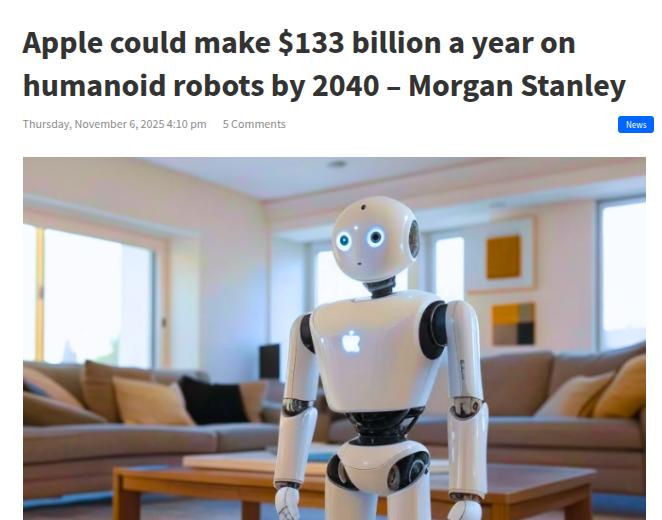
When Apple enters this market, it may reshape the robotics industry just like it reshaped the smartphone industry back then - turning complex cutting-edge technologies into products that ordinary people are willing to buy, know how to use, and like. Mac, iPhone, Watch, Vision Pro, every time Apple is not the first to enter the market, but it is often the one that does the best.
But history will not simply repeat itself, and robots face three major challenges:
The first is the price. Morgan Stanley predicts that the first generation of humanoid robots will be priced at more than 10,000 US dollars, a price that is destined to only target the niche market. Even for the desktop-level J595, the rumored price of around 1000 US dollars is far higher than that of ordinary smart screens. Apple needs to gain a firm foothold in the high-end market first, and then gradually reduce costs and expand its audience through technical iteration. This process may take many years.
The second is technical maturity. Bipedal walking is still an engineering problem to this day, with high cost and insufficient reliability. Home safety, user protection, privacy ethics, and social acceptance are all obstacles that need to be crossed. Apple enjoys a high level of trust among the public, which helps to alleviate privacy concerns, but cannot fundamentally eliminate these problems.
The third is the competitive landscape. Tesla's Optimus, Figure AI, Agility Robotics' Digit, Amazon's Astro, Sony's Aibo, the robotics track is already crowded with players, ranging from industrial to consumer grade, from humanoid to wheeled, and various routes are being explored. Although Apple has advantages in brand and ecology, it entered the market relatively late, and it is much more difficult to replicate the sweeping trend in the iPhone era.
What is more thought-provoking is Apple's AI hardware layout. In addition to home robots, there is also an AI wearable brooch the size of an AirTag, which is expected to be released in 2027, with the first mass production plan as high as 20 million units. There are also AirPods with enhanced sensors, smart glasses, security cameras, integrated products of Apple TV and HomePod... Apple is almost launching a full-scale attack on AI hardware.
This multi-line operation, on the one hand, reflects the anxiety about the hardware entry in the AI era: it is not sure which direction will succeed, so it places bets in every direction; on the other hand, it also disperses resources and attention. Against the background of the overall lag of Siri AI, so many AI hardware products are being promoted at the same time, and whether the software experience can keep up is a huge question mark.
The launch of HomeView is the first chapter of Apple's robot story. Its market performance will directly affect the promotion pace of subsequent products. If the $299 smart screen can open up the home market, the robotic arm of J595 and the future humanoid robots will have a more solid foothold. On the contrary, if HomeView receives mediocre responses, Apple may re-evaluate the priority of the entire robot strategy.
Apple has patience, financial resources and technical accumulation. But the window of opportunity for the robotics market will not be open indefinitely, and Google, Amazon, Meta, and OpenAI are all accelerating their layout. Whether Apple's trillion-dollar robot dream can come true depends not only on how well it does, but also on whether it can stay ahead of its competitors.
This article is from the WeChat official account "Tencent Tech", written by ZHOU Xiaoyan, and published with authorization by 36Kr.