From a journalist to a tycoon with a net worth of 100 billion yuan, the "top liberal arts student" hit the jackpot by betting on AI.
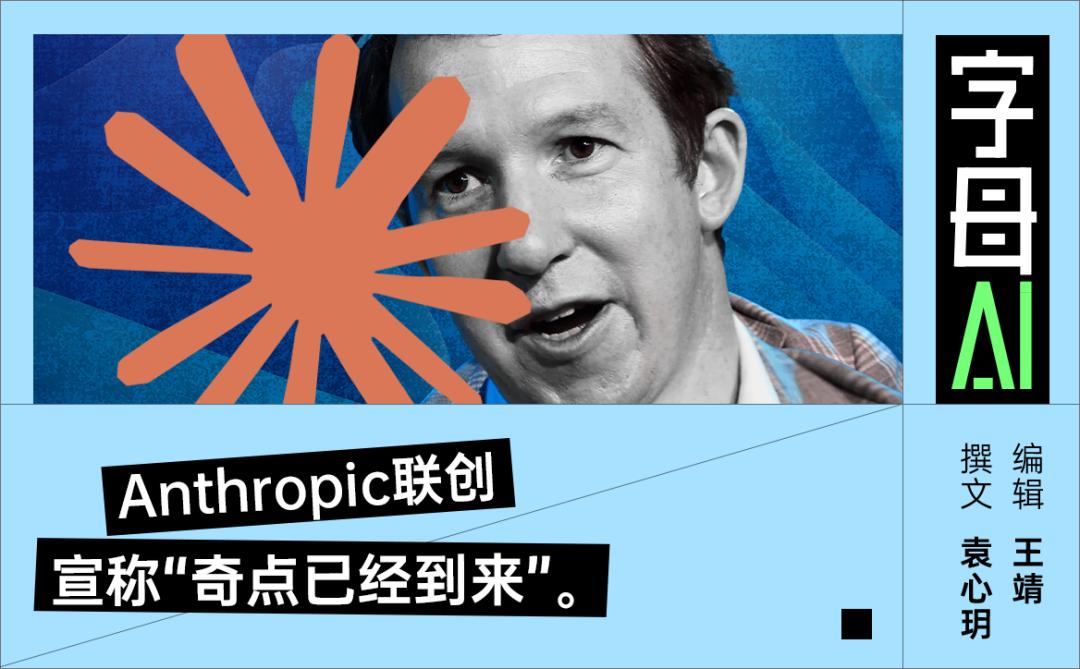
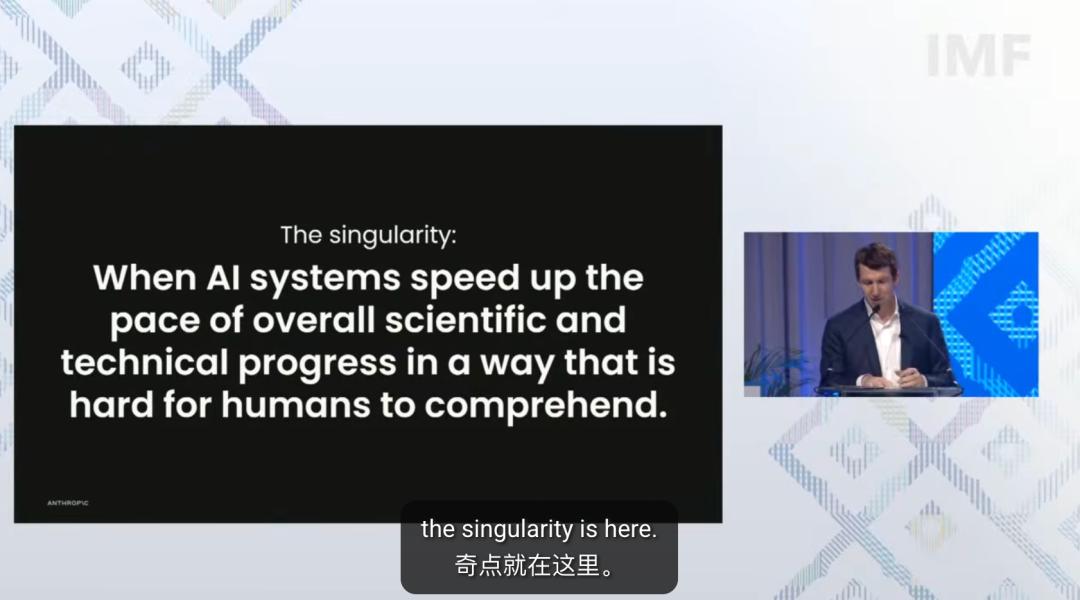
"The Singularity has arrived."
On October 17, during the annual meetings of the International Monetary Fund (IMF) and the World Bank held in Bangkok, Jack Clark, co-founder of Anthropic, stepped onto the podium of the Per Jacobsson Lecture and put forward this judgment.
He described a future for the economists and policymakers in the audience: One human scientist can lead hundreds or thousands of AI scientists to carry out research simultaneously. Today there are only about 10 million researchers around the world, but in the future, a billion virtual scientists may emerge.
Clark has always been quite certain about the future of AI. As early as ten years ago, he bet his own future on it.
At that time, he was still a technology journalist at Bloomberg.
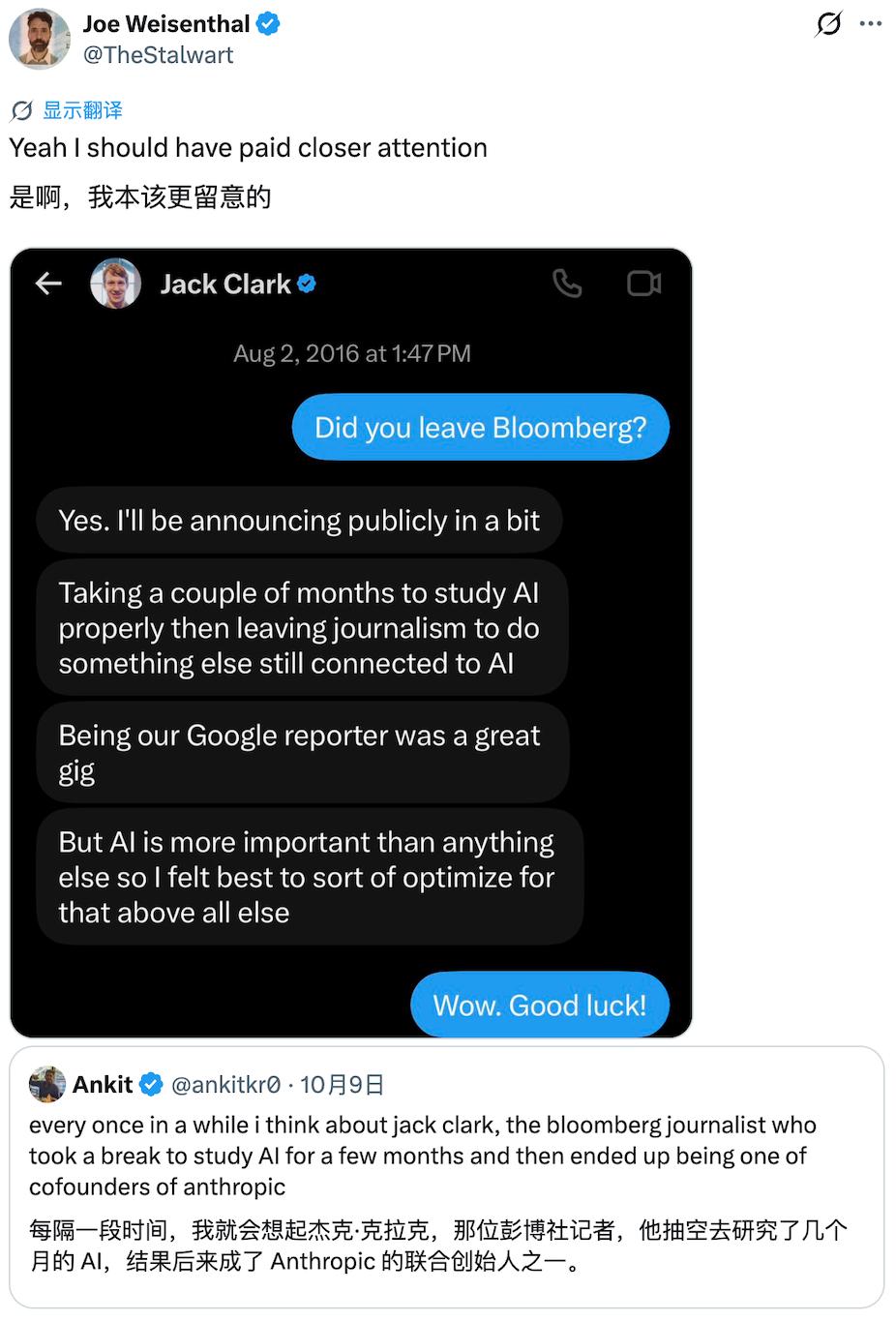
On August 2, 2016, Clark told his colleague Joe Weisenthal that he had left Bloomberg.
He planned to spend the next few months diving deep into AI research, then leave the journalism industry to do something related to AI.
He added: "AI is more important than anything else, so I want to prioritize it."
This September, the 37-year-old Clark was listed on the Forbes 400 Richest Americans list, with a net worth of 15.5 billion U.S. dollars, equivalent to more than 100 billion yuan.
Recently, someone reviewed this experience of Clark on social media. After Weisenthal saw it, he dug out the chat records between the two ten years ago and only sighed:
"I really should have been more careful back then."
A journalist more fascinated by AI than scientists
Clark is actually a liberal arts graduate. He was born in Brighton, UK, and graduated from the University of East Anglia in 2009, majoring in English Literature and Creative Writing. After graduation, he entered the technology journalism industry, and worked at British tech media *The Register* and Bloomberg successively.
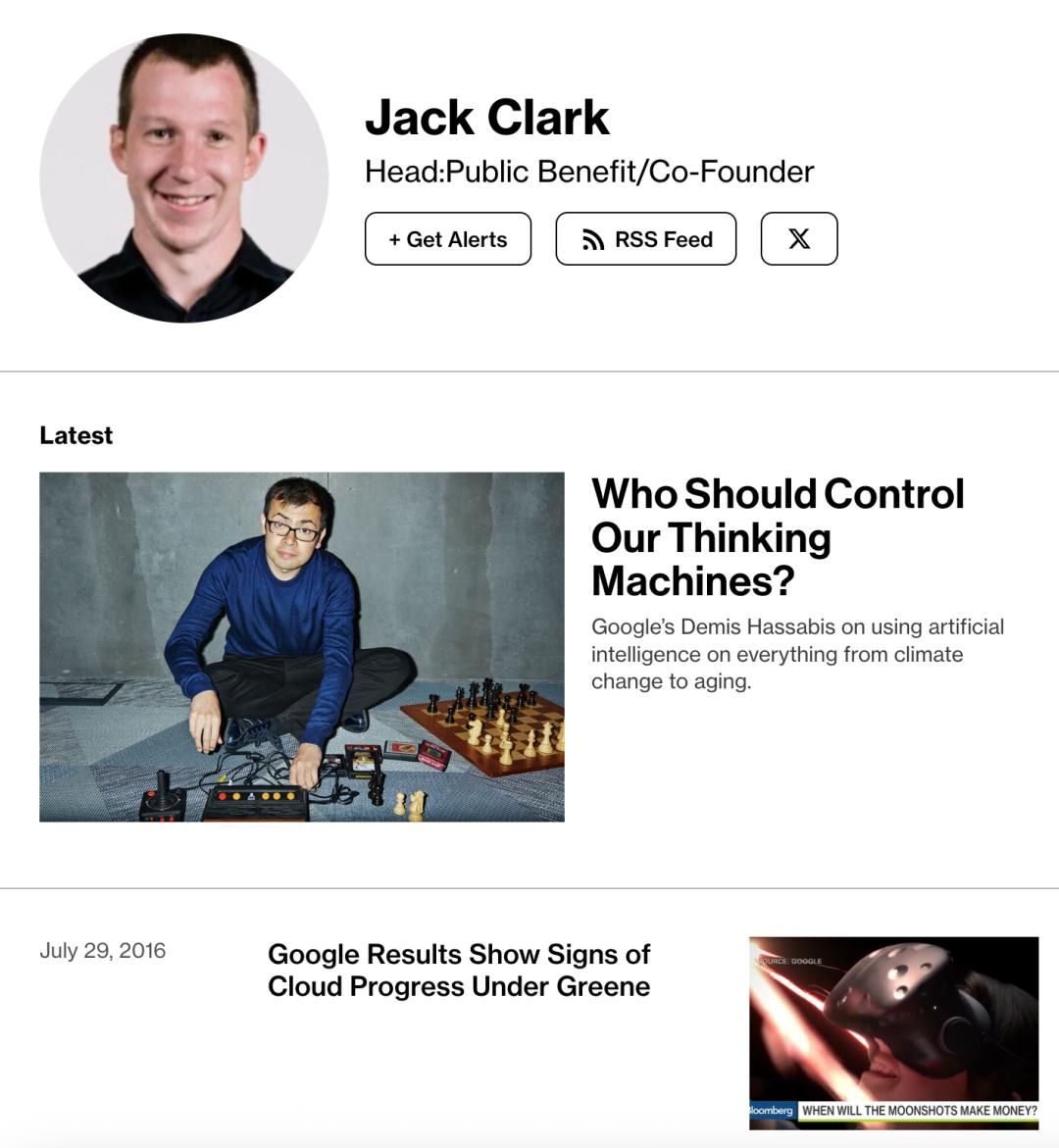
Caption: Jack Clark's author profile on Bloomberg, his last published article was in August 2016
At first, he covered technologies such as data centers, distributed systems and supercomputers. It was not until he joined Bloomberg in 2014 that he gradually shifted his attention to artificial intelligence.
At that time, AI was far less popular than it is today. ChatGPT would not be born until eight years later, deep learning had just begun to make remarkable progress in fields such as computer vision, and most ordinary people had no concept of neural networks.
But Clark was already completely fascinated.
His former supervisor, Bloomberg editor Alistair Barr, later recalled that in 2015, few people paid attention to AI at that time, but Clark wanted to write news about artificial intelligence almost every other day, and kept pitching relevant topics to editors.
In June 2026, Clark returned to Bloomberg as an interviewee and participated in the podcast *Odd Lots* hosted by his old colleague Joe Weisenthal. Weisenthal took out the chat records between the two ten years ago and asked him what he had seen back then that made him so certain about the future of AI.
Clark said that he spent two full years printing a large number of AI research papers back then. He also joked that he wasted a lot of printing funds from Bloomberg's boss for this.
In addition to reading papers, he did a very "Bloomberg-style" thing — charting the technological progress of AI. From computer vision, speech, video to the level of AI playing video games, he kept collecting research data and observing the changes of capabilities in various fields.
In this process, he found an interesting thing: these seemingly unrelated research directions have begun to show a similar exponential growth trend.
Clark gradually realized that what he was observing might be a general-purpose technology that had just started.
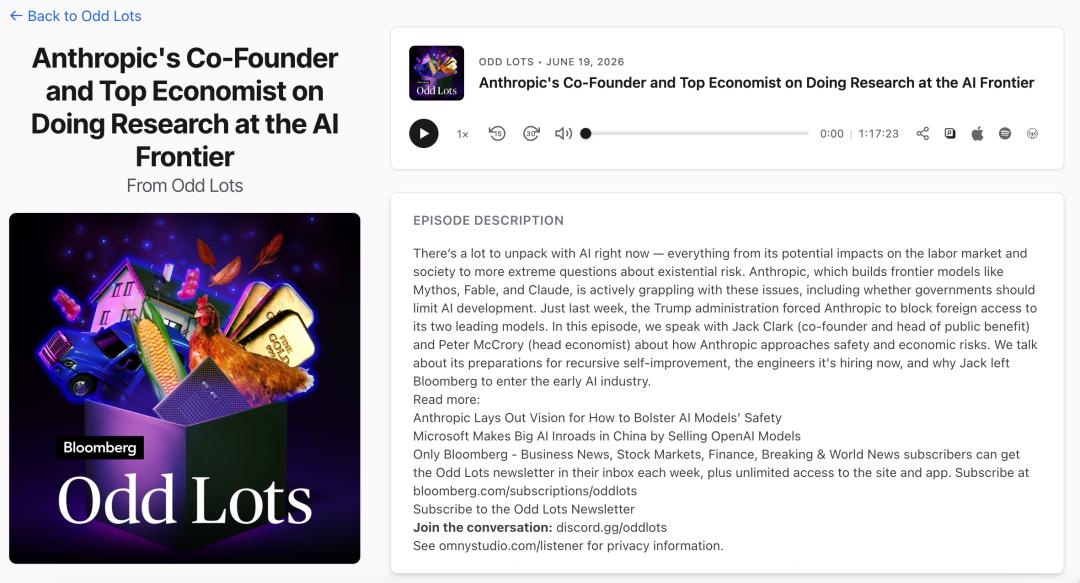
Caption: Bloomberg's *Odd Lots* interview with Jack Clark
Clark even noticed Nvidia in advance.
At that time, when he read AI papers, he found that researchers almost all used Nvidia's GPUs instead of AMD's products. He thought this was an important signal worth reporting, and once tried to push Bloomberg to write a special report on it.
But this topic was not finally completed. Ten years later, he still mentioned it on the podcast, which was somewhat of a pity.
Unfortunately, there is no reliable public information at present to confirm that Clark ever bought or held Nvidia's stocks — if he really bought it in 2015 and held it until today, that would be a huge amount of income.
Clark's in-depth research on technology also left a deep impression on the researchers at that time. Recently, former OpenAI researcher Andrej Karpathy recalled that he received many interview requests from technology journalists during his PhD, but Clark was the only journalist he kept replying to at that time. Because Clark would actually read academic papers and raise in-depth technical questions.
Karpathy said that he had hardly ever seen anyone like Clark before (or after).
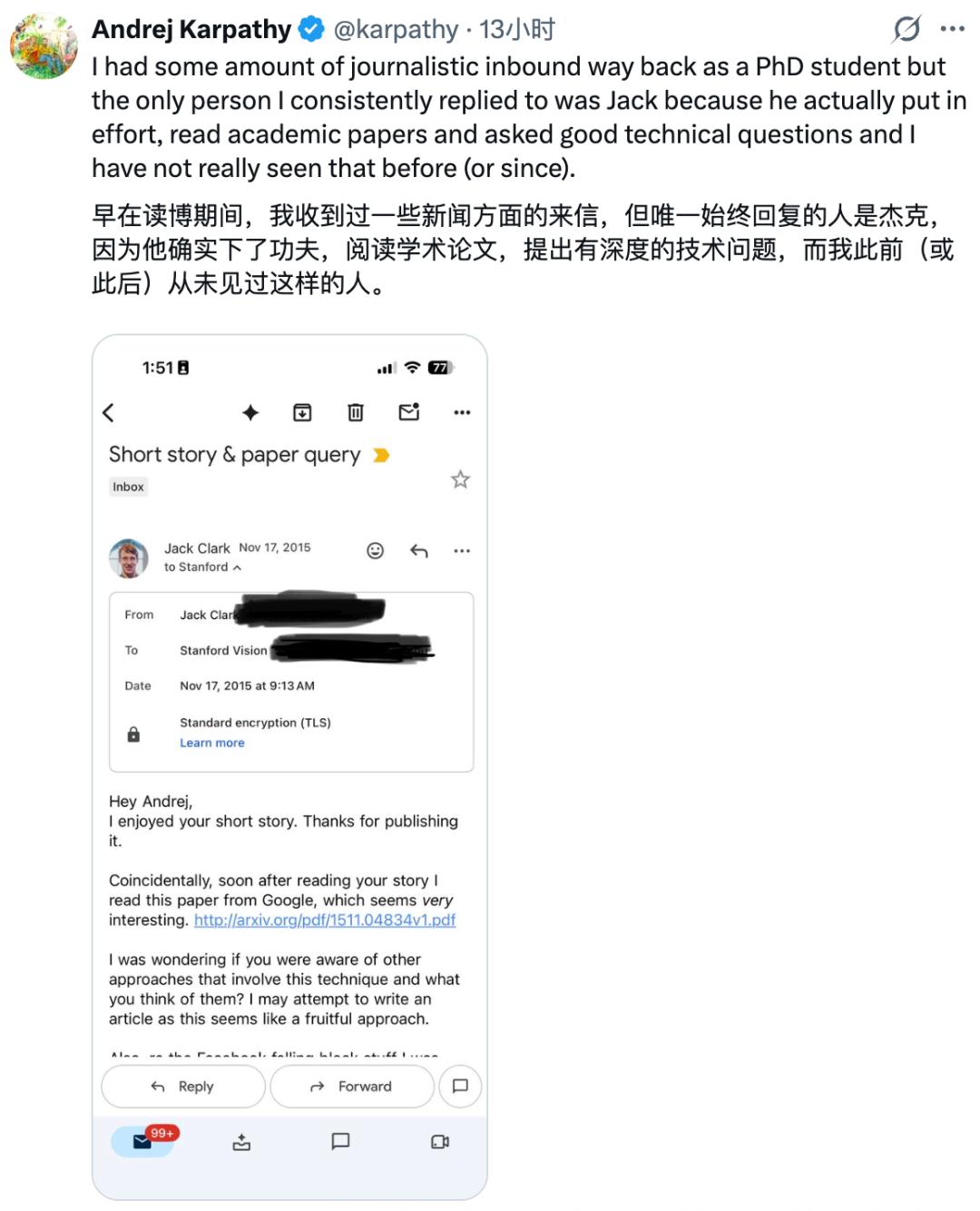
The deeper he studied AI, the more Clark felt that he could not always stand outside the industry as an onlooker.
The turning point came in 2015. At that time, an artificial intelligence research institution named OpenAI was being prepared for establishment. When Clark attended an AI conference in Canada, he interviewed Greg Brockman, who later became a co-founder of OpenAI.
After the interview, he turned off the recorder and suddenly asked Brockman a question: "How can I work for you?"
Clark later recalled that the moment he asked this sentence, he knew he could no longer be a journalist who maintained an objective stance. It was almost against the rules for a journalist to be so eager to join the company of the interviewee right after the interview.
In the following months, Clark kept in touch with OpenAI.
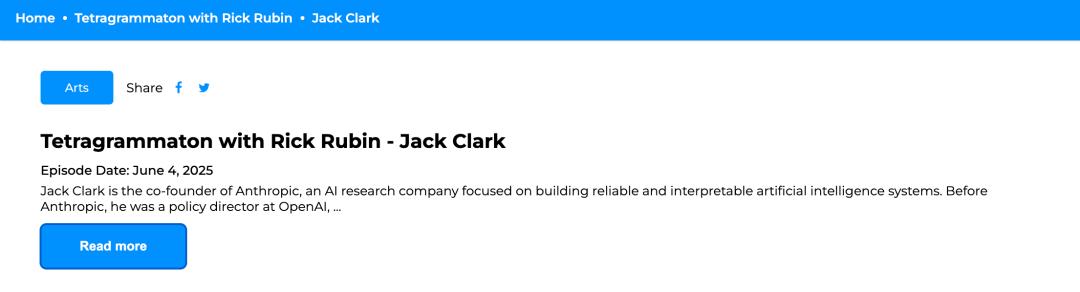
Caption: Rick Rubin's interview with Jack Clark, in which he talked about the old story of interviewing Brockman
In the summer of 2016, Clark walked up to his lead editor Alistair Barr and asked if they could go for a walk.
Barr already had a vague bad feeling — for an editor, a reporter under him suddenly asking for a private walk is usually not good news.
The two came to the edge of the San Francisco Bay and sat down on a bench. Clark told him that he planned to resign and join a non-profit organization called OpenAI.
Barr immediately expressed his disapproval. OpenAI had been established for less than a year at that time, was not well-known, and was mainly funded by supporters including Elon Musk. He could not see a clear development direction for this company, let alone know how it would sustain its operations in the future; in contrast, Clark had already established his position at Bloomberg, was responsible for covering Google and AI, had a stable job and performed well.
Barr tried to persuade him to stay, but Clark did not listen.
Clark later recalled that he also received many emails from fellow journalists, warning him that he was making the most serious mistake of his life.
Many years later, Barr specially wrote an article recalling the experience of persuading Clark not to resign back then. The title of the article is: *In 2016, my employee told me he was going to resign and join OpenAI. I said it was a bad decision. Now, he has become an AI billionaire.*
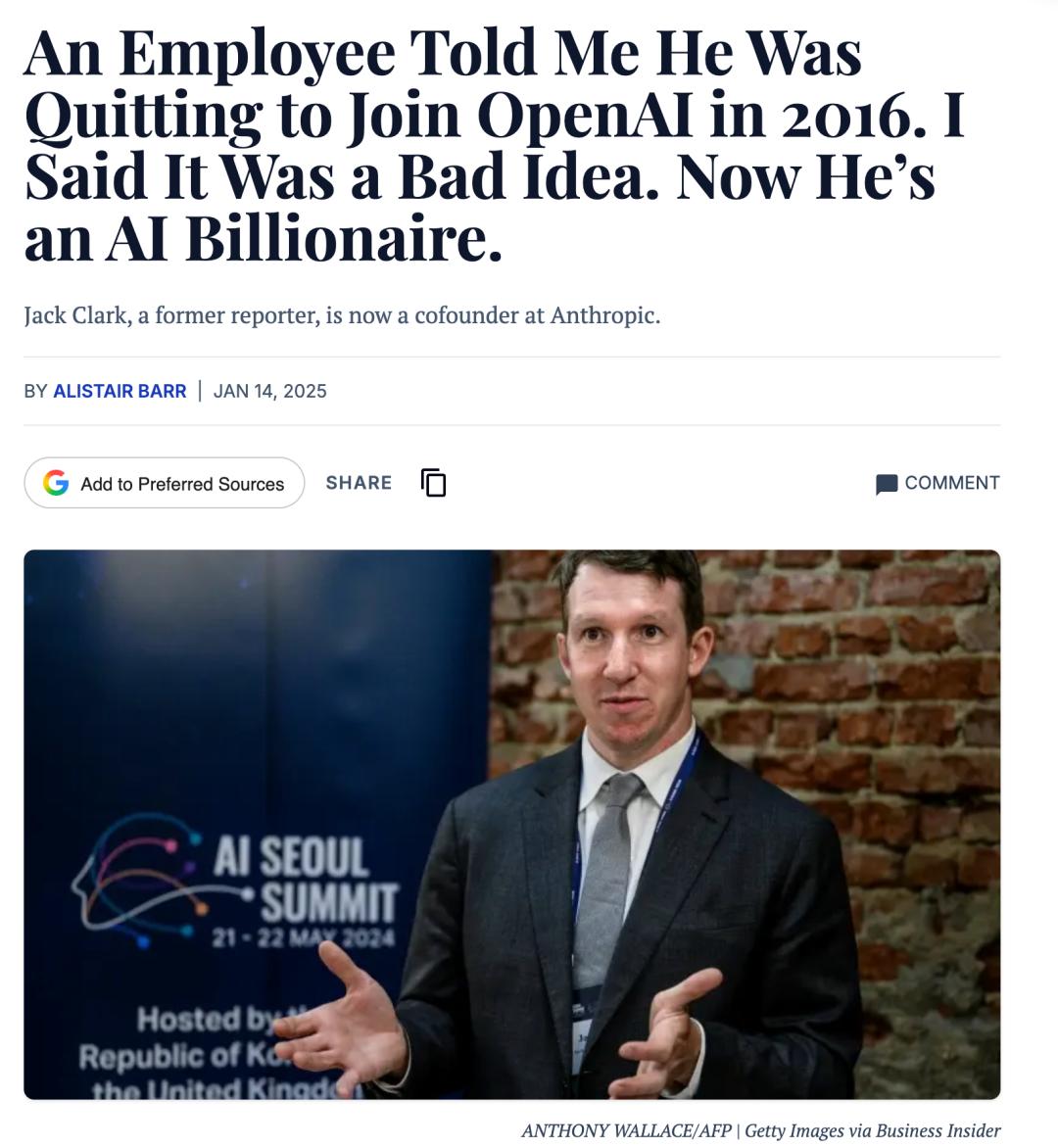
Caption: The memoir article published by Alistair Barr himself on January 14, 2025
Barr admitted that he misjudged the situation back then.
Clark also said in a later interview that Sam Altman and Brockman actually took a risk when they were willing to hire him back then.
After all, most of the people recruited by OpenAI were scientists studying artificial intelligence, while Clark majored in English literature, and his best skill was reading papers, interviewing scientists, and then writing their research into news.
Now, he finally no longer needs to study these people through a recorder.
From OpenAI to Anthropic
At OpenAI, Clark met Dario Amodei, who later became the CEO of Anthropic. The two worked closely together starting in 2016, and gradually found that they had similar judgments on the development of AI.
Clark was mainly responsible for strategy, communication and policy, and later became the Director of Policy at OpenAI. He began to participate in AI governance discussions, studying how increasingly powerful models should be opened to the public and what restrictions they need to be subject to.
In addition to his work at OpenAI, Clark founded the AI research newsletter Import AI in 2016, which regularly sorted out cutting-edge research papers; the next year, he co-founded the AI Index project at Stanford University to track the development of artificial intelligence through data.
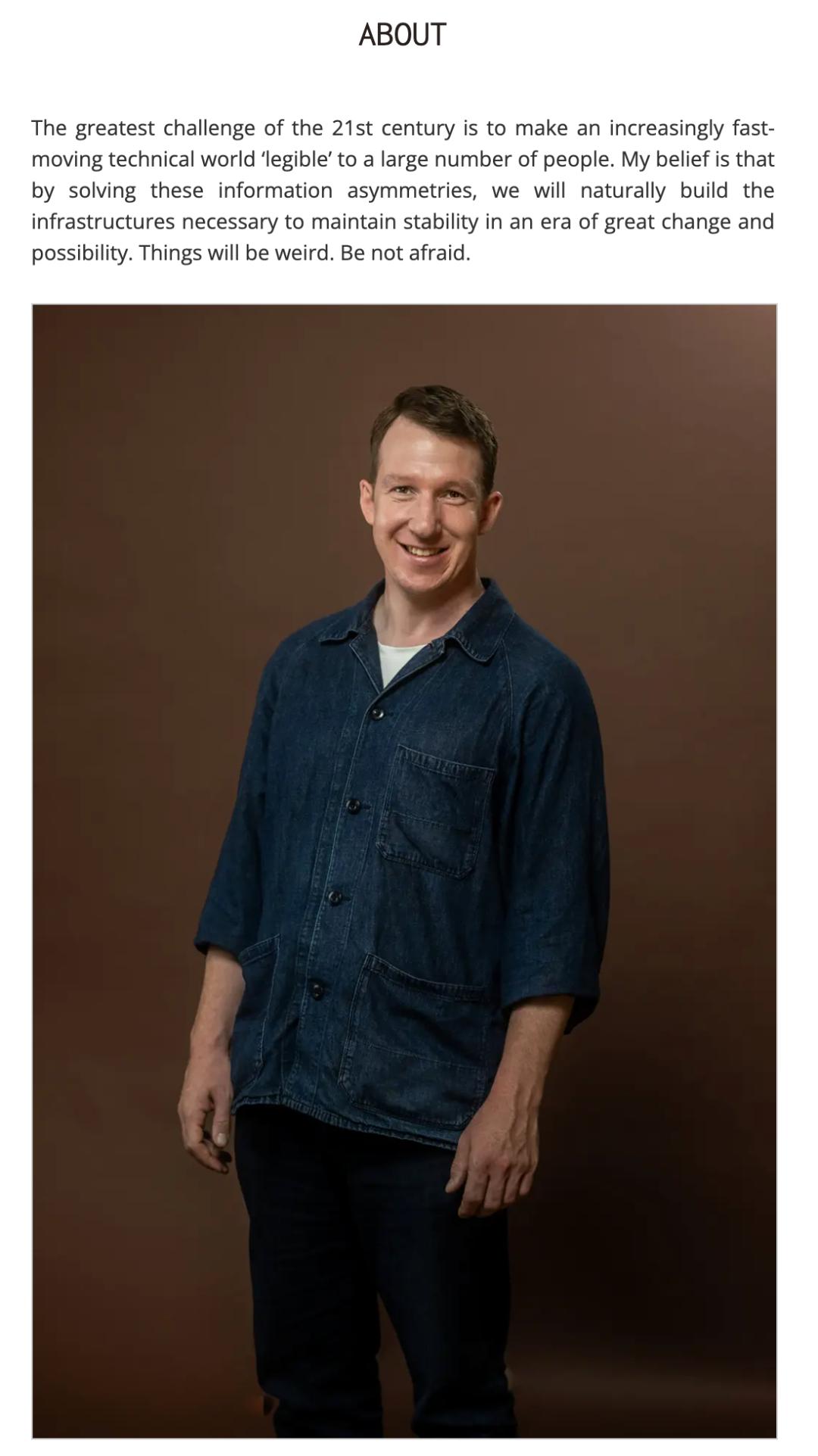
Caption: The introduction part of Import AI, the main content is two large photos of Jack Clark
The technological trends that excited him in the past few years have also been continuously verified.
Clark later recalled that during his years working at OpenAI, he witnessed AI learning to handle more and more complex video games, and gradually showing amazing language capabilities.
Every time researchers increase computing power and expand the model scale, the performance of AI will improve accordingly.
In 2020, the research on Scaling Laws participated by Amodei and others began to be able to predict the performance of models based on model parameters, data volume and training computing power. This gave OpenAI the confidence to train larger models.
In the same year, GPT-3 was born.
Clark recalled that when GPT-3 really achieved the expected performance, he was very shocked. They knew that greater changes were coming.
However, as AI capabilities continue to improve, researchers have also begun to face an increasingly tricky problem: how exactly should these models be opened to the public?
As early as 2019, when OpenAI released GPT-2, it chose to open it in stages instead of immediately disclosing the full version, due to concerns about the misuse of the model.
Clark participated in this decision. He later explained that if an organization really wants to be responsible for the social impact caused by AI, it cannot open source the model and then wash its hands of the matter.
This idea of cautious release has gradually become a common practice in the cutting-edge AI industry. Now, when companies such as OpenAI and Anthropic launch new models, they often open them to some users first, and expand the scope of use after testing.
But inside OpenAI back then, everyone had their own opinions.
According to an investigative report by *The Atlantic* in September 2026, in 2020, Altman once proposed to provide U.S. rapper Kanye West with private test access to GPT-3, but this arrangement was blocked by Clark, who was the then Director of Policy.
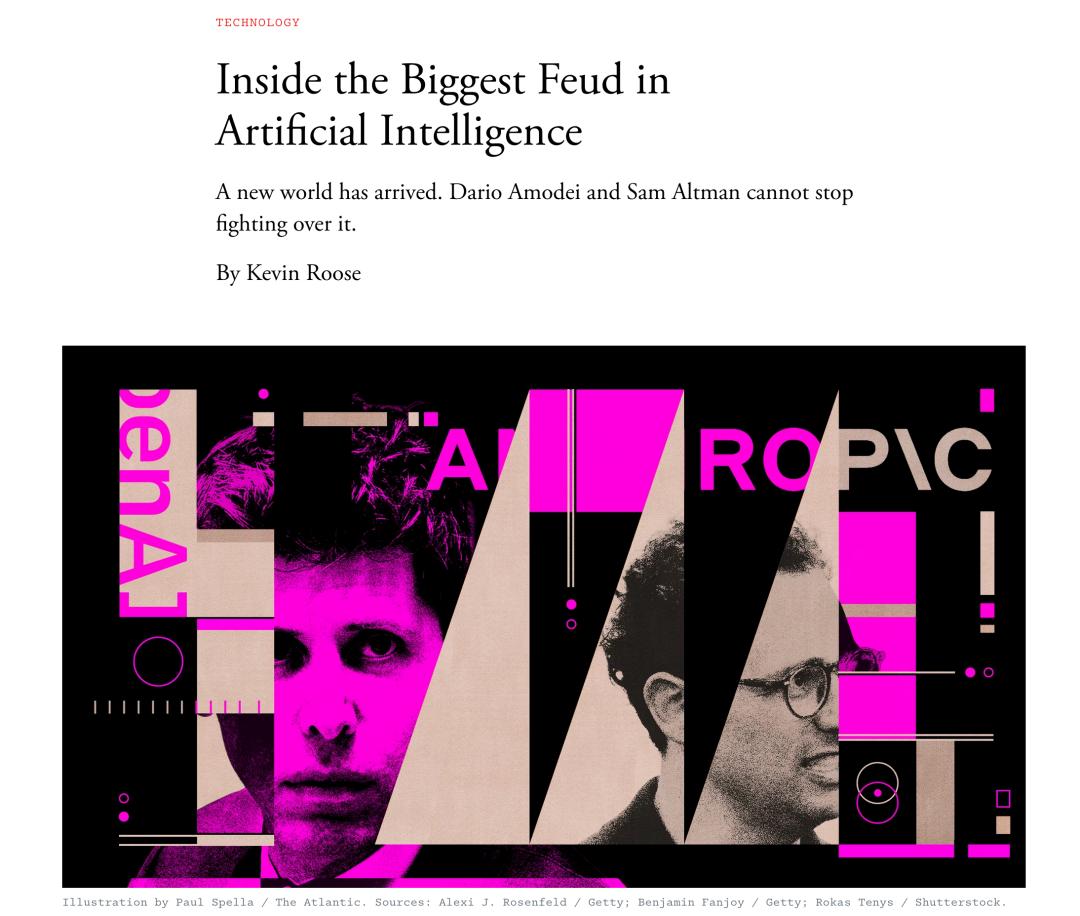
Caption: The investigative report of *The Atlantic*, titled *Inside the Most Fierce Turmoil in the AI Field*
Similar frictions are piling up.
Clark later recalled that they had constant arguments inside OpenAI over