Behind Micron's Rise: The Survival Battle, Capital Game and AI Rebirth of the Only Remaining U.S. Memory Chip Manufacturer
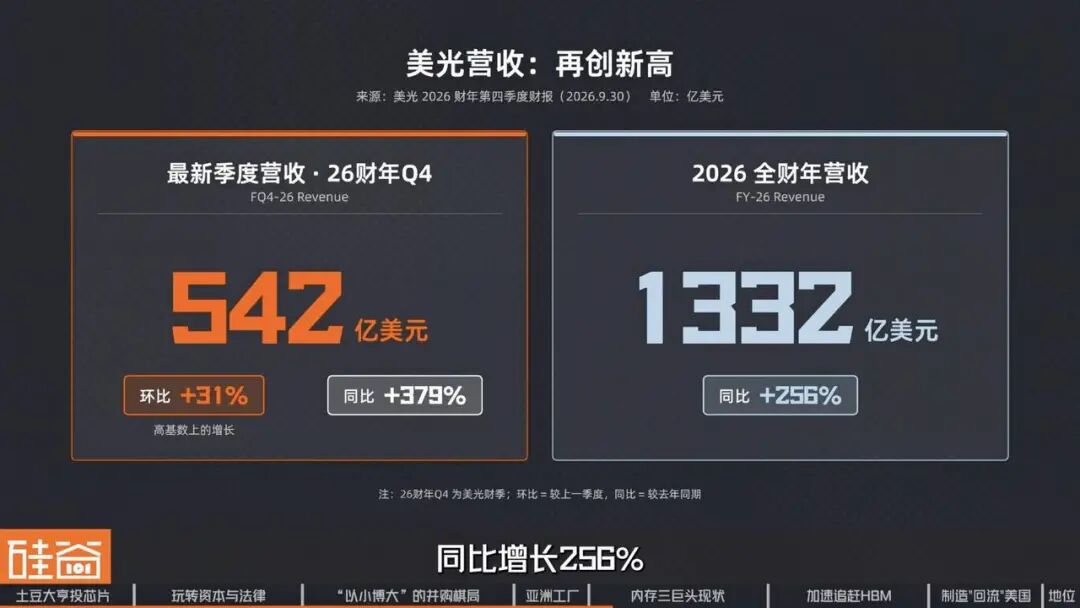
On September 30, Micron released another record-breaking financial report.
In the fourth quarter of fiscal 2026, Micron's single-quarter revenue reached 54.23 billion US dollars, with an operating profit margin of 80.7%, and both revenue and net profit hit new records. The strong demand brought by AI is pushing this memory chip company to the most profitable moment in its history.
However, looking back at Micron's nearly 50-year history, its growth was far less smooth than its current performance suggests. In the brutal price cycles of the memory industry, many former giants have withdrawn one after another, but Micron has survived losses and industry reshuffles time and time again, eventually becoming the only remaining player in the US memory industry.
In this process, Micron has gradually formed a special survival mode: backed by the US capital market, through a series of small but high-impact mergers and acquisitions, it has continuously extended its manufacturing business to Asia. Today, the vast majority of the production capacity of this US memory giant is located in Asia, while the US government is offering billions of dollars in subsidies to bring its advanced manufacturing capabilities back to the United States.
The starting point of all this is in Idaho, far from Silicon Valley, known as the "Potato State" of the United States. In the basement of a dental clinic, Micron took its first step in entrepreneurship. And its entry ticket to the memory chip manufacturing industry came unexpectedly from a "potato tycoon" who supplied frozen French fries to McDonald's.
From starting with investments from local businessmen, to expanding with the help of US capital and Asian manufacturing, to becoming a key company in the AI supply chain today, what exactly allowed Micron to survive the industry troughs again and again? Can its nearly 50 years of survival experience help it win the next round of AI competition?

Although located in the "Potato State", Micron is not a company that emerged out of nowhere. Its origin traces back to Mostek, a company that was very important in the early history of semiconductors but is rarely mentioned by people now.
Mostek was founded in 1969, and its founders came from Texas Instruments. In the era when DRAM was only at the 4K and 16K level, Mostek once occupied a high market share and was a key player in the early DRAM industry. Three of Micron's four founders were former employees of Mostek.
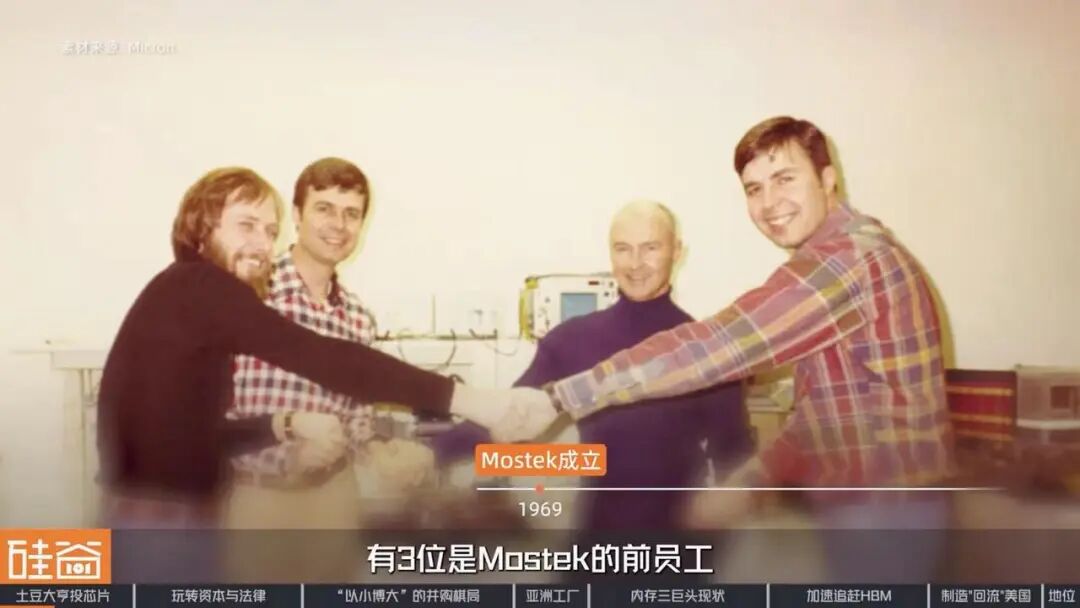
In 1978, Micron was founded in the basement of a dental clinic in Boise. At that time, Micron did not have any manufacturing business, and its entire business was providing semiconductor design consulting services for Mostek.
Far away from Silicon Valley, Micron did not follow the familiar path of raising VC (Venture Capital) funds as we know today, but raised money from several local "gentry" figures. This financing method is actually very similar to the early days of Starbucks: several successful local businessmen thought the young team was promising, and after a brief discussion, each of them invested a sum of money to support the startup.
But only a year later, this young company suffered a heavy blow. In 1979, after Mostek was acquired by United Technologies, Micron lost its contract with Mostek, and its only source of income disappeared.
After losing its only customer, Micron decided to manufacture chips on its own. Building a factory required more capital. Introduced by those local "gentry" investors, the founders of Micron got to know the potato tycoon J.R. Simplot.
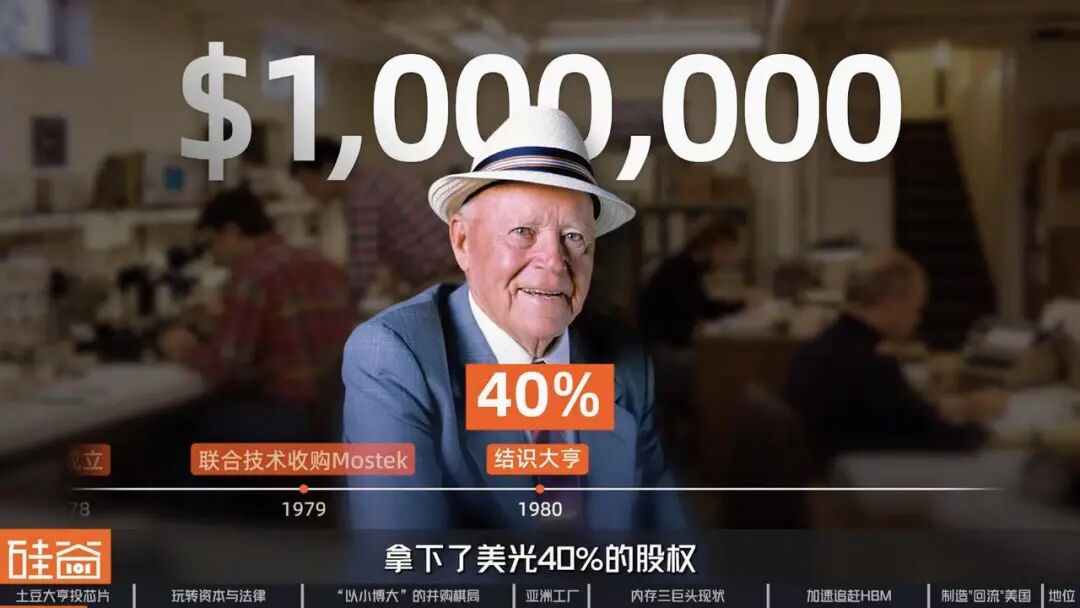
In 1980, J.R. Simplot was already in his 70s, having grown potatoes all his life, and his company was the largest supplier of frozen French fries to McDonald's. Without the complicated due diligence of VCs or the tedious deliberation of investment committees, after visiting Micron's office in the dental clinic basement, J.R. Simplot invested 1 million US dollars and took a 40% stake in Micron.
Why would an elderly man who had made his fortune growing potatoes and selling French fries, who was already wealthy and successful, invest in a tiny 4-person startup operating out of a basement, making memory chips that had nothing to do with French fries? Perhaps it was because both French fries and chips are called "chips" in English?
Of course, the 1 million US dollars Simplot invested was far from enough to build a factory, but it was equivalent to giving Micron a "credit pass". With his endorsement, Micron successfully obtained loans from local banks, and successively raised funds from other Idaho businessmen.
But at that time, the construction cost of a DRAM factory had reached hundreds of millions of US dollars, which Micron could not afford even if it spent all its cash.
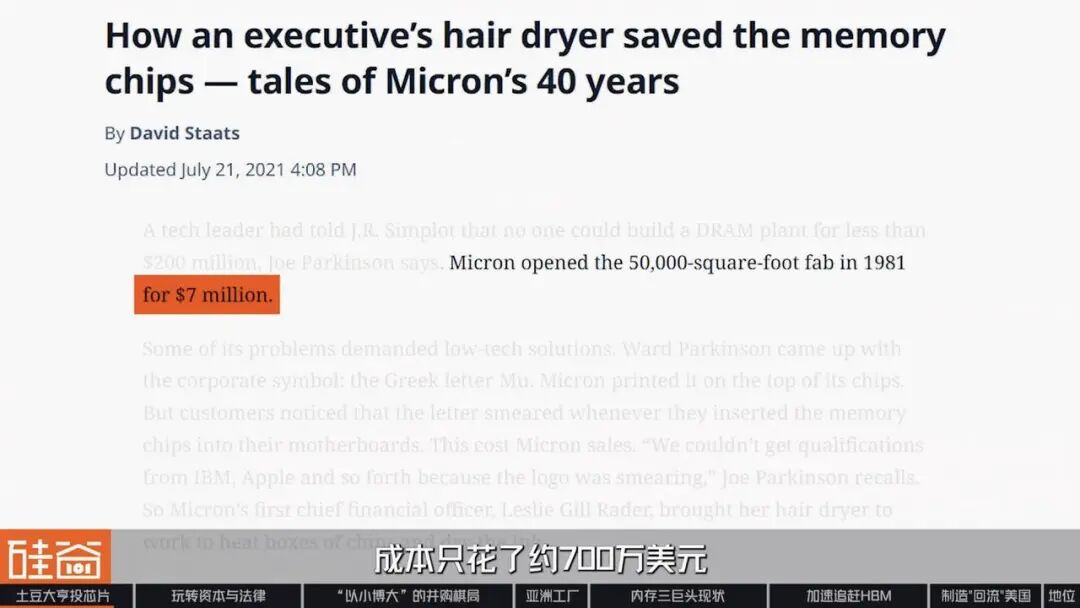
To minimize the cost, they modified a supermarket's architectural design to turn it into a factory, converted the original meat cold storage space into a clean room, and purchased a large amount of second-hand equipment eliminated by other manufacturers. In the end, this 50,000-square-foot wafer fab was completed in 1981 at a cost of only about 7 million US dollars.
In 1981, Micron began to produce 64K DRAM, officially transforming from a chip design company into a real semiconductor manufacturer. Micron's timing for building the factory can be described as extremely clever.
In 1981, as IBM PCs began to enter the market, the personal computer industry rose rapidly thereafter. As an indispensable core memory component of computers, the demand for DRAM rose rapidly accordingly. With its smaller and more advanced 64K DRAM design and relatively lower manufacturing cost, Micron quickly entered the market.
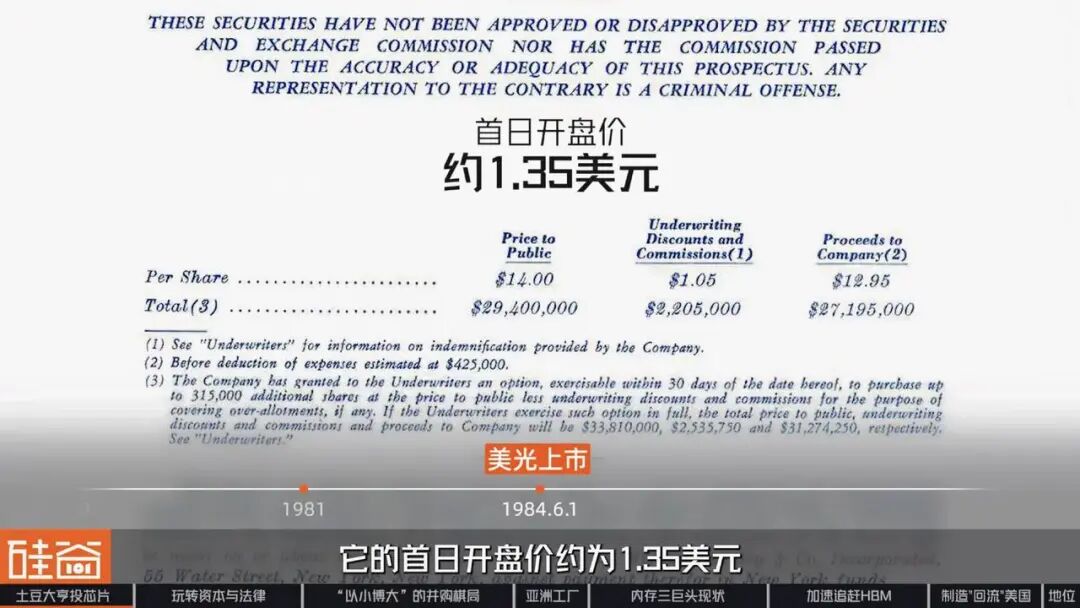
Only three years later, on June 1, 1984, Micron was officially listed on NASDAQ. According to the current stock split adjustment, its opening price on the first day of listing was about 1.35 US dollars.
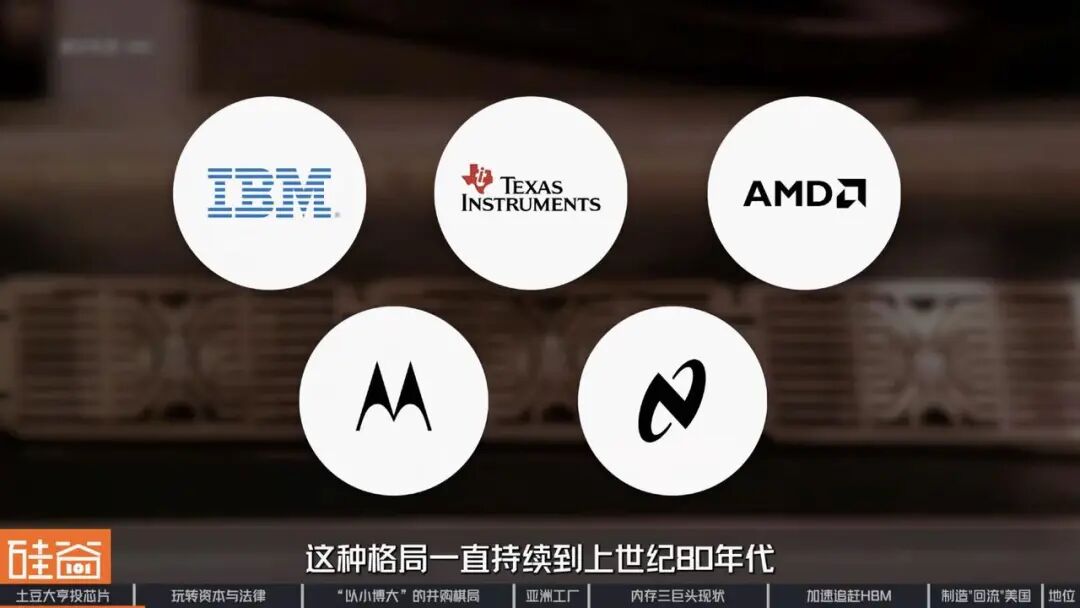
Although South Korea now occupies the dominant position in the global memory chip industry, the early memory industry was actually dominated by US companies. Intel's first mass-produced product was a memory chip, and well-known US semiconductor companies such as IBM, Texas Instruments, AMD, Motorola, and National Semiconductor have all dabbled in the memory industry.
This pattern lasted until the 1980s, when the competition in memory chips entered a new set of game rules.
Under these rules, national will became the driving force behind industrial competition. Some countries used administrative power to provide targeted support for specific enterprises from multiple dimensions including R&D, capital, and talent. Enterprises did not need to consider short-term profits and stock price performance, maintained extremely high capital expenditure, and even invested against the trend during industry downturns, just to outlast their competitors.
The rise of Japanese enterprises in the 1980s, and the subsequent rise of South Korean enterprises, all followed this path, with almost identical strategies: it does not matter if I make no profit, what matters is that you cannot survive.
As a result, Japanese enterprises used this strategy to squeeze out US enterprises, and later South Korean enterprises used it to squeeze out Japanese enterprises. Under such brutal competition, almost all US semiconductor companies withdrew from the memory business, leaving only Micron as the sole survivor.
YANG Yige
Head of the Technology Team, Asset Securities Research Department, Yangguang Insurance
Memory and foundry businesses are very similar, they are highly capital-intensive industries that require a large amount of production capacity investment and capital expenditure to maintain factory operations. When the memory cycle goes down, current profits cannot cover the depreciation of heavy assets, and many companies go bankrupt at this stage.
The core technical barriers in the technology chain are still concentrated in the United States and Europe, some upstream materials and components are concentrated in Japan, while Taiwan, China and South Korea benefit from lower manufacturing costs and early government support.
However, under such a market structure, why was Micron the only one that survived? After all, the United States does not have state-controlled banks that can provide blood transfusions to Micron, and the US capital market cannot tolerate any company that invests while losing money.
Here, we have drawn a conclusion that tries to answer the above question: Micron has a kind of "US-East Asian duality", it has both US attributes and East Asian attributes, and combines the advantages of both sides extremely well.
▍ Micron's "US Attributes"
Micron is first and foremost a US company, which is very important for understanding its success. Micron's US attributes are first reflected in the fact that it can rely on the developed US capital market and flexible financial instruments, and during industry troughs, with its identity as a US company, use extremely sophisticated capital operations to expand its production capacity at low cost.
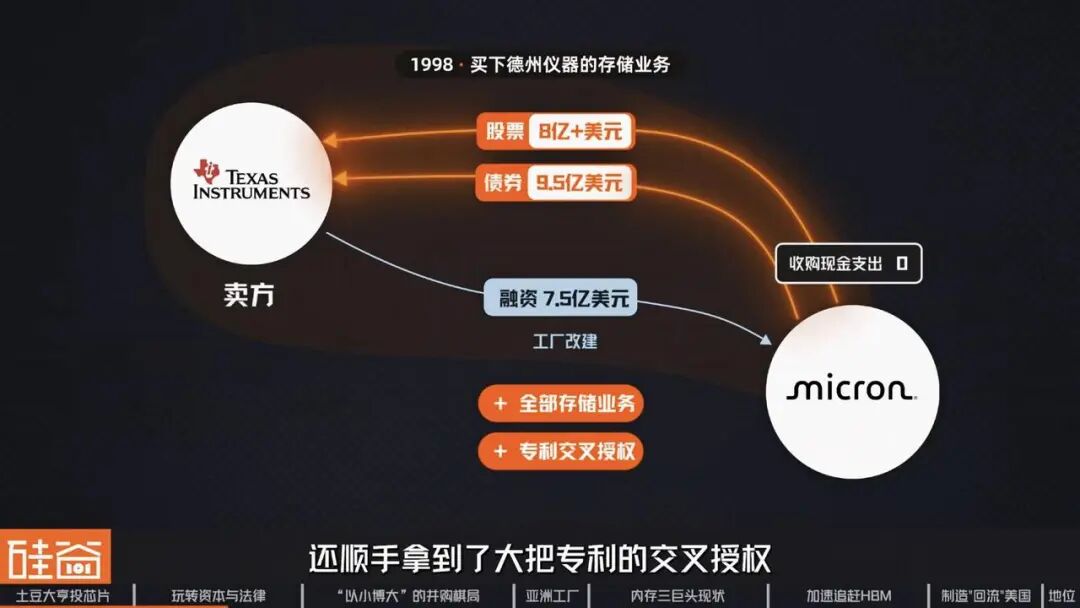
Let's look at an early case: in 1998, Micron acquired the memory business of Texas Instruments. The details of the transaction are very interesting. At first glance, it was a transaction worth more than 800 million US dollars. But in fact, Micron did not spend a single cent of cash. What Micron paid was more than 800 million US dollars worth of privately placed stocks and 950 million US dollars of corporate bonds.
Texas Instruments not only received no cash, but also provided 750 million US dollars in financing to Micron, which was used to convert the acquired factories to Micron's production processes. Yes, you read that right, the seller Texas Instruments additionally provided 750 million US dollars in cash to Micron.
1998 was the cyclical low point of the memory industry, and Texas Instruments was eager to get rid of its loss-making memory business. In this way, Micron took over all of Texas Instruments' memory business without spending a single cent of cash, and also obtained a large number of patent cross-licenses.
In addition to mature capital operations, there is another often overlooked dimension of Micron's "US attributes": the legal system. Since the 1980s, Micron has turned the US trade and judicial system into its own competitive tool again and again.
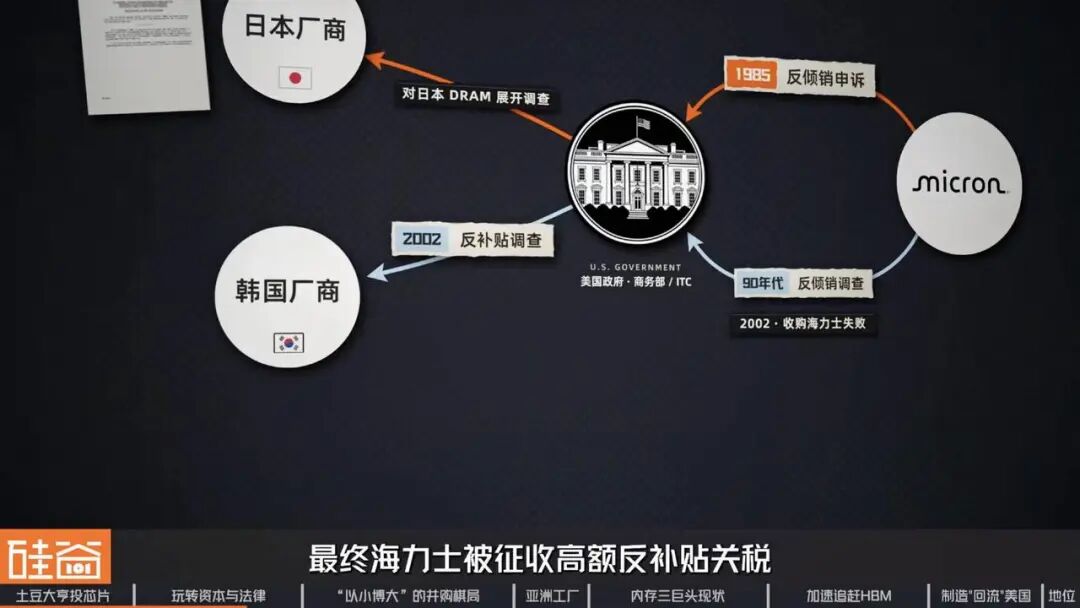
In 1985, when Japanese manufacturers defeated their US peers in the DRAM market, Micron filed an anti-dumping complaint with the US government, which eventually pushed the United States to launch an investigation into Japanese DRAM, and facilitated the signing of the 1986 US-Japan Semiconductor Trade Agreement.
In the 1990s, facing the rise of South Korean manufacturers, Micron launched another anti-dumping investigation. In 2002, after its acquisition of Hynix failed, Micron further pushed for an investigation into South Korean DRAM subsidies, and eventually Hynix was levied high countervailing duties.
But Micron's most classic "legal operation" was the DRAM price-fixing case.
In 2002, when the US Department of Justice investigated multiple DRAM manufacturers for colluding to raise prices, Micron was the first to report to the Department of Justice and apply for leniency, becoming the first involved enterprise to voluntarily cooperate with the investigation, providing key evidence of the cartel's operation and continuously cooperating with the investigation.
In the end, peers such as Samsung, Hynix, Infineon, and Elpida were fined huge sums, while Micron, as the whistleblower under the leniency policy, was not criminally prosecuted and did not even pay any fines.
