The surgical robot company backed by Bill Gates has gone bankrupt, while its Chinese counterparts have started to turn a profit.
Written by | Yao Jing
In 2026, Vicarious Surgical, a star surgical robot enterprise in the United States, completed the shareholder procedure in July and agreed to transfer its assets to creditors before going into dissolution and liquidation. The company's founders are from Apple, and its shareholder list once included Bill Gates and BD. It has been in operation for 12 years, never obtained FDA approval, never entered human clinical trials, and stayed far away from the operating room.
The company, founded in 2014, was once the most promising surgical robot unicorn in the eyes of capital that could challenge da Vinci. With a disruptive design of single-port access plus VR head-mounted display control, it raised a total of about 300 million US dollars (about 2 billion RMB), with a market value exceeding 1.2 billion US dollars at the time of its listing in 2021, and it also obtained the world's first FDA Breakthrough Device designation for surgical robots.
Around the same time, domestic MicroPort MedBot issued a positive profit forecast, expecting a net profit of 28 million to 40 million yuan in the first half of the year, compared with a loss of 115 million yuan in the same period of the previous year; revenue is expected to increase by 200% to 230% year-on-year, and the gross profit margin will rise by more than 15 percentage points. Although the company delayed the release of its performance and suspended trading due to relevant matters, and the official financial report still needs to be waited for, the first semi-annual profit forecast since its establishment in 2015 is enough to excite the industry.
Although the surgical robot sector is still a blue ocean, its development logic is completely different from that in the early stage. The focus of the industry has shifted from whether the robotic arm is stable, whether the aperture is smaller, and whether doctor training is easy, to whether the hospital will use it after purchase, how much it will be used, whether consumables can be repurchased, and whether cash flow can operate sustainably.
01 The slowest growing segment in the robotics industry
In the first 8 months of 2026, the financing of China's robotics track reached 1.2451 trillion yuan, which is about twice that of the whole year of 2025. But when it comes to the surgical robot subdivision, the situation is different.
It takes several years for a surgical robot to go from R&D to obtaining a registration certificate. Obtaining the registration certificate is only the starting point of commercialization. Subsequent steps including clinical verification, hospital bidding and implementation, doctor training, and surgical volume ramp-up need to be completed, and finally the repurchase of consumables is realized. Only after the whole process is completed can it be regarded as a self-sustaining business.
TRex-RS, the first total hip replacement robot of Longhui Medical, completed its first operation as early as March 2021 and was approved in September 2024. 16 months later, the company came to an end. This case shows that the registration certificate cannot solve the order problem.
In the Science and Technology Innovation Board application materials of Shurui, the company estimated that it will reach break-even by 2029. This prediction to a certain extent represents the long-cycle characteristics of the industry. On the same technical route, Shurui's single-port endoscopic surgical robot SR-ENS-600 has been approved, becoming the first approved single-port surgical robot in China and the second in the world — both betting on single-port and miniaturization, Eastern and Western companies have achieved completely different results.
The R&D, clinical trials, policy docking, regulatory access, clinical accumulation, and hospital procurement budget of surgical robots all require time to break through step by step. Capital investment can speed up the R&D progress of enterprises, but the cultivation cycle of doctors' clinical habits cannot be shortened. Therefore, the commercialization context of surgical robots cannot be compared with the development path of other general robots.
02 The exit of three companies
The exited enterprises have many commonalities in the reasons for their failure.
Take Longhui Medical as an example. Although it obtained the registration certificate, every link after registration including equipment installation, clinical path implementation, hospital procurement, and consumables repurchase requires continuous resource investment, and the enterprise failed to complete the whole commercialization process.
Vicarious was founded in 2014 and headquartered in Waltham, Massachusetts, USA. Its two founders Adam Sachs and Sammy Khalifa both majored in mechanical engineering at MIT, previously worked as engineers at Apple, and also brought in Barry Greene, a surgeon with years of experience in laparoscopic surgery.
Specifically for the product, they wanted to build a miniature surgical robot that enters the abdominal cavity through a single incision. The incision is only about 1.5 cm. Doctors wear a VR head-mounted display and remotely control the robotic arm in the body with an immersive three-dimensional field of vision, which is equivalent to "sending the doctor into the patient's body".
This set of designs is quite aggressive in terms of parameters: the robotic arm has 9 degrees of freedom, while da Vinci, the industry leader, has 7 degrees of freedom; it is equipped with 28 sets of high-precision sensors that can replicate the doctor's upper limb movements from the shoulder, elbow to wrist. Capital placed heavy bets on this. In 2018, the company completed a US$16.75 million Series A financing, with Gates Ventures under Bill Gates participating in the investment.
In 2021, Vicarious was listed on the New York Stock Exchange through a merger with the SPAC company D8 Holdings, with a valuation of about 1.1 billion US dollars, and its market value once exceeded 1.2 billion US dollars. Shareholders include BD, Innovation Endeavors of Eric Schmidt, former CEO of Google, AME Cloud Ventures of Yang Zhiyuan, founder of Yahoo, and Khosla Ventures.
In 2022, its product was selected as one of Time magazine's Best Inventions of the Year, and became the world's first surgical robot to obtain the FDA Breakthrough Device designation. The company originally planned to take abdominal wall hernia repair as the first indication to go through the FDA de novo approval channel, obtain permission in 2023 and promote commercialization.
The founders of Vicarious are from Apple, who are used to releasing products first and then iterating, letting the market grow up with the product. This method works in the software and consumer electronics fields. But the development logic of medical devices is completely the opposite. Verification and approval are only the beginning, and small-sample clinical trials are required before large-scale promotion.
Reviewing Vicarious's failure, the core problem is that its aggressive technology is divorced from industrial reality. In order to make the robotic arm perfectly simulate the movement of the human hand, the company adopted a decoupled drive scheme, which led to a geometric increase in structural complexity. The company spent several years trying to increase the yield from the single-digit level in the laboratory to the industrial level that can be mass-produced, but never made a breakthrough.
If the mass production threshold cannot be crossed, the product can only stay at the prototype stage. The product design itself also has hard flaws: it is only equipped with two robotic arms, while many complex surgeries require three or four arms to cooperate. The lack of auxiliary arms to undertake tasks such as traction, irrigation, and suction makes it difficult to cope with unexpected situations during surgery. Although the VR head-mounted display is amazing in concept, doctors will experience visual fatigue and dizziness after wearing it for a long time, which increases operational risks during surgeries that last for several hours.
This method of releasing first and then iterating applied to medical devices leads to full loss of rhythm control. Vicarious originally planned to obtain FDA approval in 2023; launch human clinical trials in 2024; and submit complete FDA approval materials by the end of 2025. All these key nodes were missed.
Over the 12 years, it did not obtain any FDA marketing authorization, did not enter human clinical trials, did not generate a penny of revenue, and always relied on financing for blood transfusion. It lost 63 million US dollars and 50.2 million US dollars in 2024 and 2025 respectively. As of March 31, 2026, the cash and short-term investment on the account was only about 3.7 million US dollars, the quarterly loss still reached 7.3 million US dollars, and the cumulative loss was about 246.1 million US dollars.
In July 2025, the company changed its top management, and Stephen From, a veteran in the medical industry, took over as CEO. He reduced the annual expenditure from 50 million US dollars to less than 20 million US dollars, and completed laboratory tests on synthetic abdominal models in May 2026, but never found a buyer or new financing.
In March 2026, the New York Stock Exchange initiated the delisting procedure due to consecutive non-compliance of market value. The company's stock price fell by more than 90% from its peak, and its market value shrank from 1.2 billion US dollars to the level of millions of US dollars; in June of the same year, the company submitted a shareholder vote to approve the transfer of assets to creditors and dissolve and liquidate. After the vote was passed in July, all members of the board of directors resigned, the company ceased operations, and most of its assets were handed over to the liquidation agency for disposal.
Vicarious's original core product design freeze time was the end of 2026, but the company entered the dissolution and liquidation procedure as early as July 2026.
When another surgical robot enterprise, Weiya Medical, was liquidated and auctioned, 17 patents, 72 trademarks and all fixed assets had a starting price of about 1.29 million yuan, of which the starting price of the intellectual property part was only about 87,000 yuan. After leaving the clinical path, the actual commercial value of technical assets is not high.
Vicarious fell before clinical trials, Longhui failed in operation after obtaining the certificate, and Weiya exited in the commercialization stage. Risks exist in all stages of the track, and their common point is that cash flow is exhausted before the business generates sufficient revenue.
03 New achievements of domestic products
Putting Vicarious's ending back into the global market will make the situation clearer.
According to data from The Business Research Company, the global surgical robot market size increased from 11.15 billion US dollars in 2025 to 13.52 billion US dollars in 2026, with a compound annual growth rate of about 21.3%. Among them, the global market size of endoscopic surgical robots in 2025 was about 11.8 billion US dollars, and Intuitive Surgical's da Vinci has long occupied about 80% of the share. The market has not disappeared, but the threshold is getting higher, and Vicarious just fell before the threshold.
Previously, the progress of domestic surgical robots was mostly based on news such as approval, first surgery, and entry into a certain number of hospitals. In 2026, the industry began to compare operating indicators such as the number of winning bids, overseas orders, repurchased consumables, and loss reduction range.
According to the bid winning data, a total of 27 endoscopic surgical robots were publicly won by public hospitals across the country in the first half of the year, of which 17 were domestic, accounting for 63%. The number of domestic manufacturers participating in the bidding increased from 5 to 7.
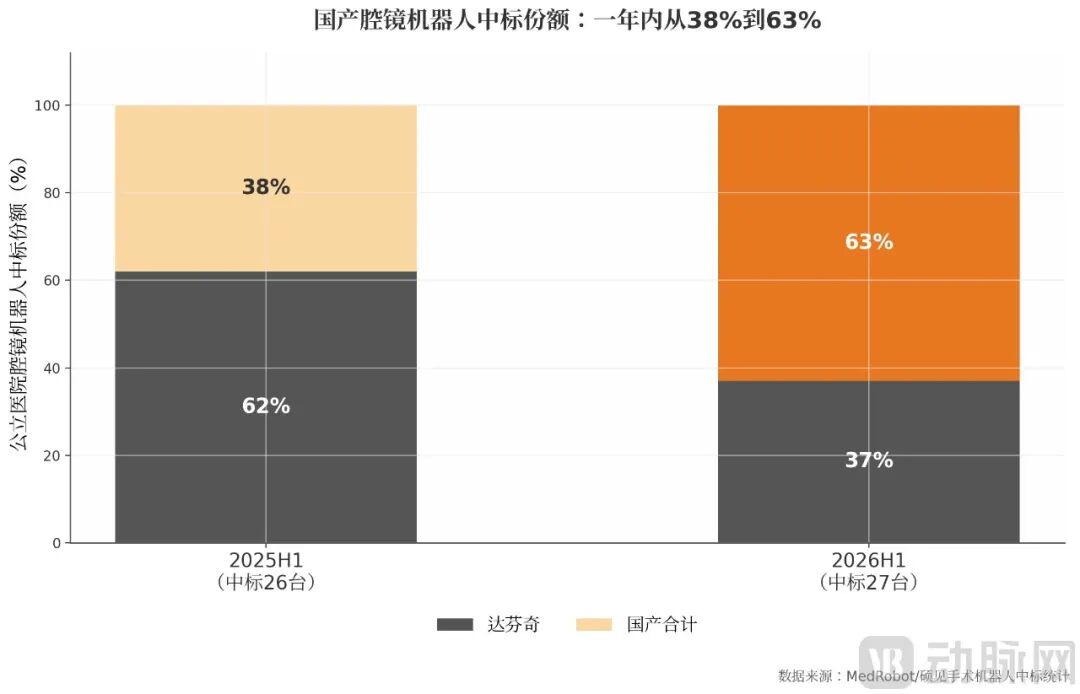
Domestic endoscopic robot winning bid share, mapped based on MedRobot data
Da Vinci's bidding share in China dropped from about 67% in 2023 to about 51% in 2024, and then fell below half in 2025. Intuitive Surgical installed 468 new units worldwide in the second quarter of 2026, with a total installed capacity of 11,710 units, and only 2 units were installed in mainland China and Hong Kong in that quarter.
The change in share is due to price factors. In the first half of the year, the average winning bid price of endoscopic robots dropped from about 17.69 million yuan to about 13.32 million yuan, a decrease of about 25%. In this context, the actual surgical volume and startup rate after equipment installation are the key indicators to judge the clinical recognition of domestic surgical robots.
In terms of going global, MicroPort's Toumai disclosed in June that its global commercial orders exceeded 300 units, and the third 100 units were completed in only 120+ days; Shurui won the bid for Vall d'Hebron University Hospital in Spain with 2.42 million euros in the first half of the year and delivered it, München Klinik Bogenhausen in Germany installed it on a pay-per-use basis, and it also obtained UniHA access in France. Jifeng installed or delivered 49 units overseas in the first half of the year, with a cumulative total of 103 units, and overseas revenue accounted for 69.8%.
In the past, the achievements focused on how many countries the products entered. Now, university hospitals in Spain make purchases, Germany adopts pay-per-use mode, and France realizes group procurement access. Different payment methods show that overseas customers are willing to include domestic equipment in the actual procurement and payment system of local hospitals, which better reflects the commercialization implementation ability of products.
In terms of financial data, MicroPort's profit forecast is yet to be confirmed by the official financial report. The company's sales expense ratio dropped from 80.8% in 2024 to 36.9% in 2025, and Toumai's independent repurchased consumable revenue increased 6 times year-on-year, accounting for about 12% of total revenue.
Jifeng Medical's revenue in the first half of 2026 was 319 million yuan, a year-on-year increase of 113.8%, the loss narrowed by 78.4%, and the gross profit margin rose from 62.8% to 64.1%. The loss reduction benefited from the decline in R&D expenses, and revenue growth and gross profit improvement are signals of business growth.
In the orthopedic track, Tinavi's Tianji has completed a total of 180,000 operations, 49,000 in the whole year of 2025, and 28,000 in the first half of 2026. Under the statistical caliber of orthopedic robot installation in the spine and trauma direction, the total installed capacity of Tinavi, Medtronic, and Zimmer Biomet accounts for about 98%, and Tinavi alone accounts for about 87%.
In July 2026, Tinavi announced that it plans to acquire the controlling stake of Shanghai MicroPort Orthopedics, trying to upgrade its business model from selling equipment to a business model combining robots and implants. The global orthopedic market is dominated by the joint segment. In 2025, the global knee and hip implant market was about 18.4 billion US dollars, while China's orthopedic robots are currently dominated by the spine segment. This acquisition points to the larger joint market.
In terms of the capital market, True Health Medical was listed on the Hong Kong Stock Exchange on June 30, and Shurui's Science and Technology Innovation Board IPO was accepted. In the current difficult financing environment, the fact that enterprises can promote IPO declaration or listing represents their confidence in their own performance.
04 Startup rate is the next core challenge
The revenue model of surgical robots includes equipment, consumables and services. Equipment is a one-time business, while consumables and services depend on the frequency of hospital use after installation.
Consumable revenue of Intuitive Surgical's da Vinci robots accounts for nearly 60% of total revenue, while that of domestic products is only about ten percent. The gap is obvious. At present, many domestic products are still in the early stage of installation, the equipment has just entered the hospital, and the consumable business is still in its infancy.
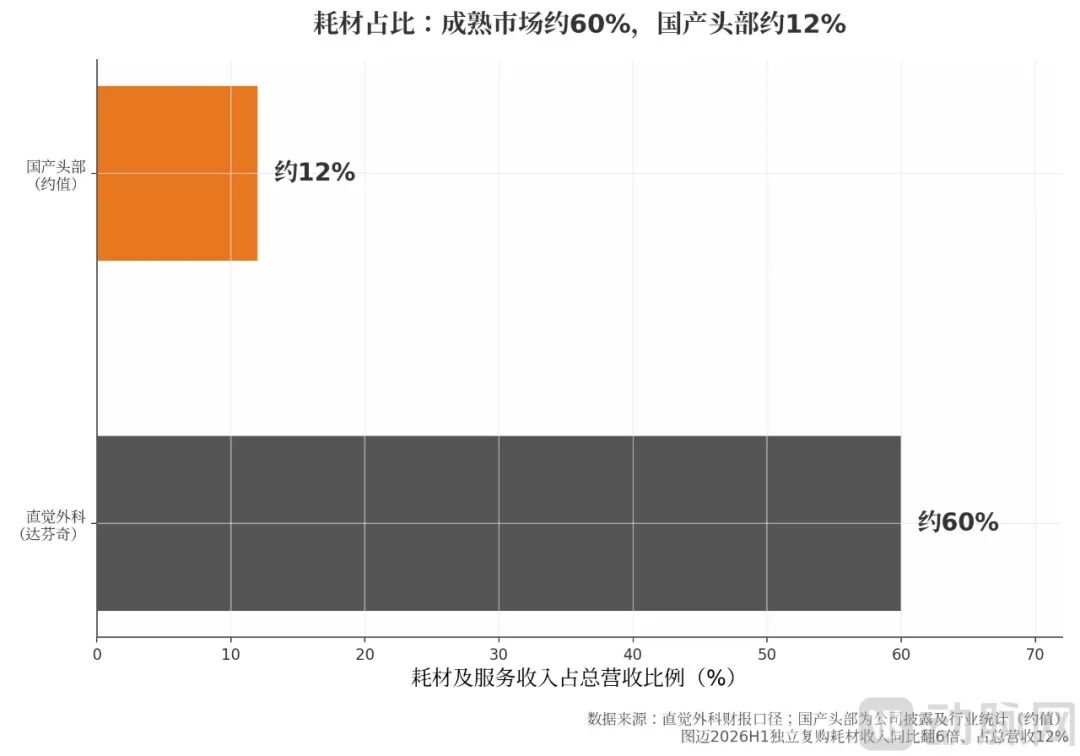
Consumable revenue proportion, mapped based on enterprise financial report data
The annual surgical volume per unit is the most intuitive measurement indicator. The average annual surgical volume per da Vinci unit exceeds 400, and that of Tinavi's flagship series was close to 200 in 2025. The statistical calibers may be different, but the direction is very clear. If a single device is only