With its valuation plummeting by 3.5 trillion, has Anthropic missed the best opportunity for going public?
According to foreign media reports, some investors who attended Anthropic's Investor Day have begun to discuss lowering the company's expected IPO valuation from the previous $2 trillion to around $1.5 trillion — which is equivalent to a one-off reduction of $500 billion (about 3.5 trillion yuan).
The problem lies in Anthropic's latest revenue figures.
Although revenue in the third quarter has reached $168 billion, achieving adjusted profitability for the second consecutive quarter, the quarter-on-quarter revenue growth rate has dropped from over 140% in the second quarter to 45%.
A few months ago, Anthropic was still enjoying explosive growth brought by Claude Code, but now it has begun to face slowing revenue growth, intensifying model competition, and increasing security governance requirements.
Has Anthropic already missed the best time to go public?
01
Growing by 45%, Wall Street still considers it too slow
Across the entire technology industry, 45% quarterly revenue growth is already a fairly astonishing achievement — but Anthropic previously grew far too fast.
In the first quarter of this year, Anthropic recorded revenue of $4.7 billion, which quickly surged to $11.6 billion in the second quarter, with a growth rate of nearly 147%. By the third quarter, although revenue increased by another $5.2 billion, the growth rate has slowed down significantly.
But the valuation expectations that Wall Street previously set for Anthropic were precisely built on this ultra-high-speed growth.
In May this year, Anthropic completed a new round of financing with a valuation of $9.65 trillion. In just a few months, as demand for Claude Code exploded and the company's revenue continued to hit new records, investment banks had already begun to privately discuss an IPO valuation of $2 trillion.
If this goal is achieved, it will mean that Anthropic's valuation doubles in less than half a year, and it will also surpass SpaceX, which went public in June this year with a valuation of $1.77 trillion, setting a new record for IPO issuance valuation.
But the figures disclosed at the Investor Day have led some investors to recalculate the accounts.
Reuters interviewed four people familiar with the matter, including investors who attended the Investor Day, three of whom revealed that some investors have begun to discuss an IPO valuation of around $1.5 trillion.
Jared Carmel, Managing Partner of Manhattan Venture Partners, said in an interview that this IPO must be priced at a level acceptable to investors. He expects Anthropic to eventually go public at a valuation of $1.4 trillion to $1.5 trillion.
If it goes public at the valuation he predicted in the end, Anthropic may not even get the record of "the highest IPO valuation in history".
Even so, Anthropic's valuation is still much higher than the financing level in May.
A simple calculation can be done: if the $168 billion revenue in the third quarter is multiplied by 4 to get an annualized revenue scale of $672 billion, then a $2 trillion valuation is equivalent to an annualized price-to-sales ratio of about 30 times. Even if the valuation drops to $1.5 trillion, this figure is still around 22 times.
Coincidentally, around the time Anthropic held its Investor Day, TSMC also released its latest financial report: net profit in the third quarter was about $23.6 billion, a year-on-year increase of nearly 69%, and the net profit margin reached 51.1%.
The net profit TSMC earns in one quarter is nearly $7 billion more than Anthropic's total revenue in the same period. And TSMC's current market value is only about $2.14 trillion (the valuation calculated based on US stocks ADR is about 10% higher than that calculated based on Taiwan's local shares).
In August this year, Bloomberg disclosed that Anthropic's annualized revenue had reached $65 billion by the end of July, and the market expected this figure to exceed $1 trillion by the end of the year.
But after the release of the latest financial data, market expectations have been challenged: the Financial Times cited estimates from SemiAnalysis that Anthropic's current annualized revenue is about $740 billion.
Regarding Anthropic's slowing growth momentum, The Information proposed that if the company had gone public in June this year when demand for Claude Code was at its peak, it might have been easier to gain recognition from Wall Street.
Recently, AI infrastructure enterprises have begun to face sell-offs in the capital market. On October 14, the share prices of CoreWeave and Nebius fell by about 15% and 10% respectively, and Oracle fell by 8.8%; the bond market is also under pressure, the prices of some CoreWeave bonds once fell below 80% of the face value, and many of Oracle's dollar bonds also declined.
The US IPO market has also cooled down recently. In September, only 5 large-scale enterprises went public, raising $1.9 billion, the lowest level since March. Smart ring company Oura and insurance company Bamboo Insurance have postponed their listing plans. Although SB Energy and Nscale have submitted public prospectus documents, they have not yet launched the official issuance roadshow.
Anthropic is still one of the most anticipated IPOs in the market, but the investment environment it faces is already different from a few months ago.
02
$2 trillion is increasingly out of reach
According to the latest statistics from corporate finance platform Ramp, since the beginning of this year, the comprehensive Token prices of both Anthropic and OpenAI have dropped significantly, with Anthropic's decline being particularly prominent.
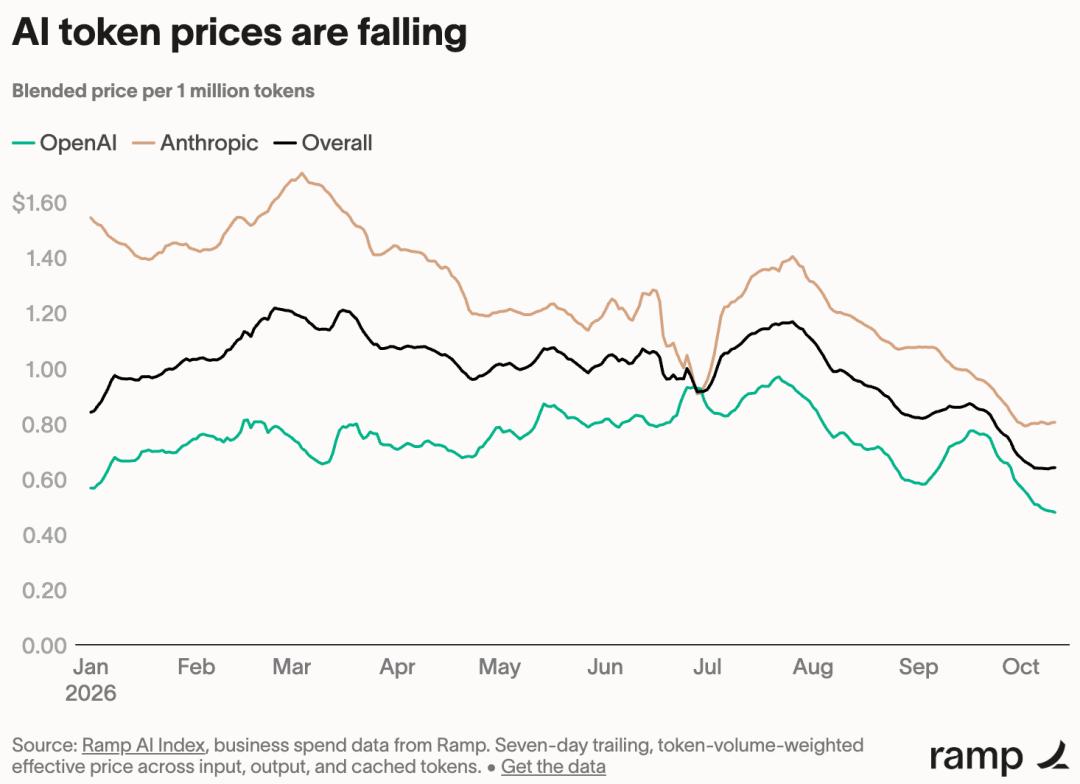
From early July to the end of September this year, Anthropic's Token consumption in Ramp's sample increased by about 90%, but customer spending only increased by 19%.
The number of model calls nearly doubled, but customer spending increased by less than 20%.
Anthropic also faces pressure on the growth of enterprise customers. Ramp pointed out that 55.9% of the sample enterprises in September had paid for AI products, of which 43.8% purchased Anthropic's services, but this proportion only increased by 0.25 percentage points compared with August.
Ara Kharazian, chief economist of Ramp, believes that the growth of enterprise AI paying users may be approaching the top of the S-curve. Going forward, the growth of AI companies will increasingly rely on existing customers to increase usage, rather than continuously acquiring new customers.
But there is no guarantee that customers will continue to increase their spending.
Kharazian also mentioned that according to the enterprise contracts he has come into contact with, the customers of OpenAI and Anthropic are usually in a more favorable negotiating position, and the two companies rarely require customers to commit to a significantly higher purchase amount than the normal level.
Anthropic's own IPO documents also show that in 2025, Anthropic's two largest customers contributed 12% of the full-year revenue respectively, totaling 24%. The company also acknowledged that many large customers are not bound by long-term contracts and can reduce or even stop purchasing at any time.
Moreover, some large customers have begun to reduce the internal use of Claude.
Microsoft previously expected that its annualized spending on internal use of Claude would reach at least $1 billion, but then lowered this expectation by more than one third. The number of Meta employees using Claude Code internally has also dropped from about 60,000 at the beginning of the year to about 30,000 recently.
In addition, The Information disclosed that Anthropic estimated at the Investor Day that about 5% to 7% of its previous revenue came from other companies using Claude for model distillation. Anthropic is stepping up efforts to crack down on such practices and expects related revenue to continue to decline.
On the cost side, Anthropic is also bearing huge computing power expenditures.
In order to pay for these procurement costs, Anthropic is looking for new financing channels. On October 16, the Financial Times disclosed that Anthropic is advancing a chip financing plan of about $600 billion, code-named Project North Star, to support the procurement and leasing of Google TPUs.
Among them, Blackstone intends to participate in about $90 billion of subordinated debt financing with an expected rate of return of more than 10%. The related debt will be supported by Anthropic's chip lease payments in the next five years.
It is worth noting that Anthropic's current credit rating has not yet reached investment grade.
According to foreign media reports, credit rating agency KBRA assigned Anthropic a BB+ rating in June this year, the highest tier in non-investment grade, only one level away from investment grade.
This means that even if Anthropic can obtain an extremely high valuation in the equity market, it still needs to prove its solvency to funders in the debt market.
For Anthropic, the revenue side faces growth pressures such as Token price cuts and the lack of long-term guarantees for customer procurement; the expenditure side is the huge locked-in computing power commitments and high financing costs.
03
Before going public, regulators and investors are putting pressure at the same time
Apart from financial pressure, Anthropic's listing is also facing increasingly prominent security governance issues.
On October 15, Axios exclusively disclosed that the US Federal Trade Commission (FTC) had issued civil investigative demands to Anthropic and OpenAI the day before.
The demand is more than 50 pages long, covering AI security incidents, protection measures, privacy policies and marketing materials. The FTC also plans to require executives of the two companies to be interviewed about related products.
In recent years, with the continuous improvement of AI model capabilities, there have been many incidents where models accessed external systems without authorization and took deceptive behaviors during tests. The FTC's investigation has also brought these security issues into formal regulatory procedures.
Apart from regulatory investigations, Anthropic has also received pressure from investors.

On October 14, New York City Comptroller Mark Levine publicly wrote an open letter to Dario Amodei, asking Anthropic to postpone its IPO and give priority to addressing risks brought by AI safety, corporate governance and the speed of technological development.
Levine is responsible for overseeing the New York City public pension fund with total assets exceeding $3.25 trillion, of which about $7 million is indirectly allocated to Anthropic through private equity investment.
In the letter, he specifically mentioned that Amodei published a long article on September 12, calling on the entire industry to slow down the development of cutting-edge AI capabilities to win time for safety research and regulation. Since Anthropic itself has publicly warned of the serious risks that AI may bring, why is it in a hurry to push for a listing?
Levine's doubts also involve Anthropic's special corporate governance structure.
Anthropic is a Public Benefit Corporation (PBC), which allows the board of directors to take into account the company's public benefit goals in addition to the financial interests of shareholders.
In 2023, Anthropic also established the Long-Term Benefit Trust (LTBT). According to the institutional arrangement announced at that time, the trust is composed of independent trustees, who can gradually obtain the power to appoint and remove some seats on the board of directors, and plans to obtain the power to elect the majority of seats on the board within four years.
Anthropic designed this system to allow the company to not fully prioritize the short-term financial returns of shareholders when facing major AI security issues. But this also means that the independent trust will gradually gain more power to appoint and remove directors, and external shareholders have relatively limited influence on the board of directors.
Levine raised doubts about this and asked Anthropic to clearly disclose the specific scope and implementation schedule of safety audits and risk control measures.
On October 16, Bloomberg disclosed that Anthropic has established a communication channel with Levine. Levine confirmed this progress in an interview, but did not disclose what the two sides specifically discussed, and there is no news that Anthropic has agreed to postpone the listing.
Although the FTC's investigation is still in the evidence collection stage, and the New York City Comptroller's open letter does not have the legal effect of stopping the IPO, these security governance disputes may increase the due diligence and risk assessment pressure of institutional investors, thereby affecting the issuance valuation they are willing to accept.
This article is from WeChat Official Account "Alpha AI", author: Yuan Xinyue, editor: Wang Jing, published with authorization from 36Kr.