Even the seemingly powerful AI cannot escape that iron law of business.

Training a large language model costs hundreds of millions of US dollars,
but the marginal cost of letting it answer one more question is nearly zero.
This is by no means a new discovery.
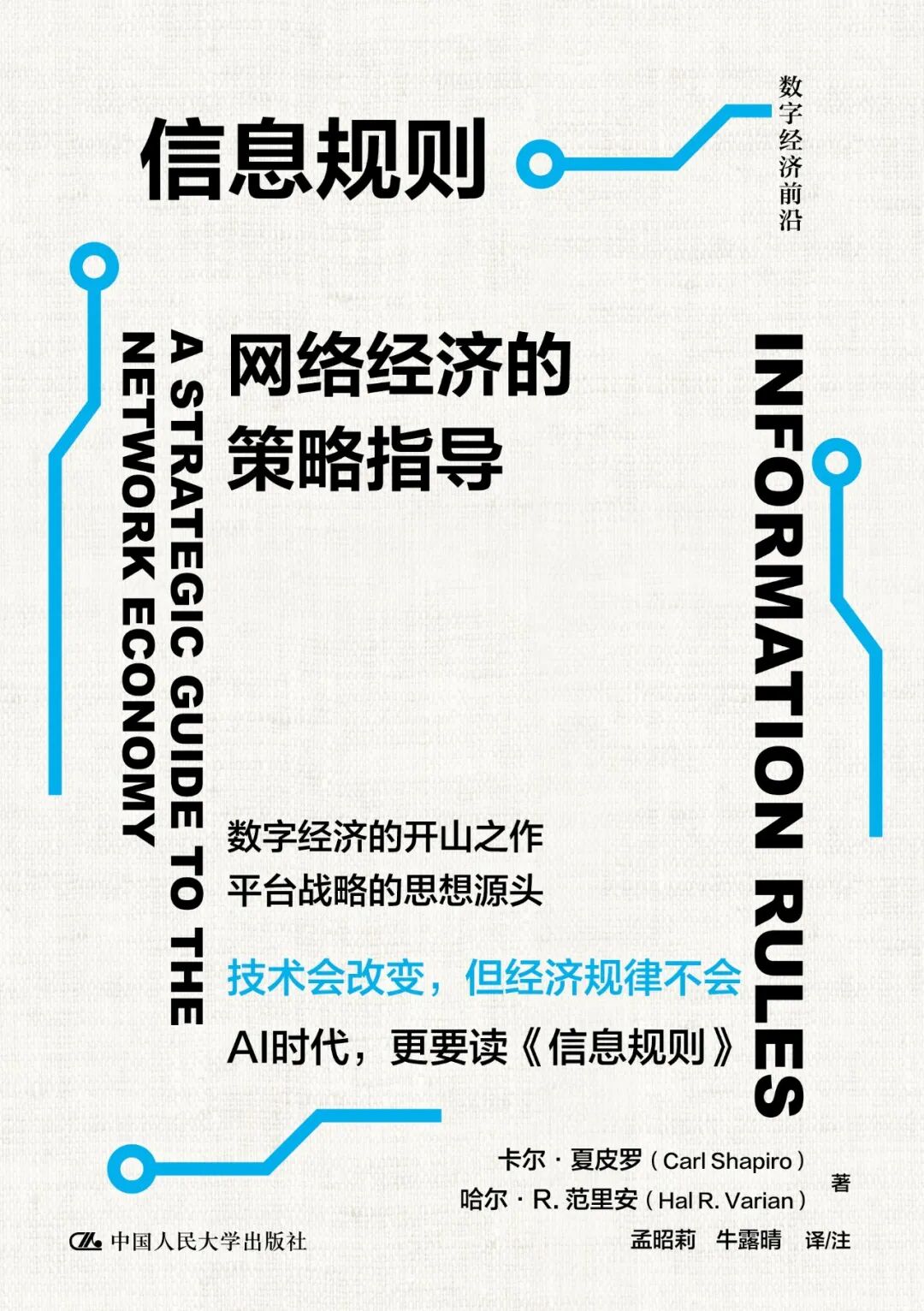
Back in 1998, two economists wrote this iron law of business into a book — Information Rules: A Strategic Guide to the Network Economy.
One of them is Hal Varian, who later served as Google's Chief Economist, and the other is Carl Shapiro, who once served as the Chief Economist of the Antitrust Division of the U.S. Department of Justice.


Hal Varian Carl Shapiro
At that time, the dot-com bubble was at its most rampant, and the whole world was shouting that "the new economy needs new economics". They disagreed. They insisted: technologies will evolve, but economic laws remain unchanged. The cost structure of information products — expensive to produce, cheap to replicate — determines the inherent rules of the information market, including network effects, positive feedback, user lock-in and standard competition, which will not change no matter how many generations of technology are updated.
The bubble burst, and their predictions came true.
Over the next two decades, this book acted as a mirror, reflecting wave after wave of technological tides:
The popularization of PCs, the mobile Internet, the platform economy, cloud computing...
Readers of every era have exclaimed that "it was already written in the book a long time ago".
A highly upvoted comment on Amazon reads: "Rereading it twenty years after the first edition, it is still highly relevant."
A Silicon Valley practitioner put it more vividly: "Most strategic conversations in tech companies today are unconsciously applying the theories of Shapiro and Varian."
Written in the bubble era, deified in the AI era.
The AI era is the era where the logic of this book is most applicable.
Why do AI products adopt "tiered membership" models — free version, Plus version, enterprise version?
Why has free pricing become the most powerful weapon?
Why are winners often not the ones with the best technology, but the ones with the largest ecosystem?
Why do users know there are alternatives, yet still cannot leave the product?
——Because the users' workflows, data and habits have long formed an immovable fortress.
It is not large language models that answer these questions, but this book!
Versioning and personalized pricing, network effects and positive feedback, lock-in and switching costs, standard wars and complementor ecosystems.
The tiered subscription model adopted by large model vendors today is a textbook-level reproduction of "versioning" in the book; the competition between open source and closed source is a contemporary recurrence of the "standard wars" in the book; the four-layer structure of computing power — cloud — model — application is exactly the classic pattern described in the book as "do not only focus on your competitors, but also keep an eye on your partners and complementors".
"Artificial intelligence is reshaping the market, but to understand the power of new technologies, you must grasp the economic laws that govern their diffusion and competition."
"If you haven't read Information Rules, don't talk about the digital economy."
This book is also listed by Forbes as one of the 75 must-read classics. It is written in a fluent style with vivid cases and almost no mathematical threshold — you may not agree with every judgment in it, but after reading it, you will get a pair of "economic glasses" to observe the AI industry.
Trendy tech news is updated every day, but effective economic laws remain unchanged for decades.

This book is a foundational classic in the field of digital economy, listed by Forbes as one of the 75 must-read classics, and called "the field manual on the front line of the information revolution" by scholars. It systematically breaks down core mechanisms including network effects, positive feedback, user lock-in and switching costs, versioning, standard competition, and intellectual property rights. Combining classic cases from the software, hardware and media industries, it analyzes the "winner takes all" dynamic of "the strong get stronger" in the network market, and guides enterprises to design product tiering, pricing strategies, ecological cooperation and standard game plans.
The authors stepped out of the hustle and bustle of the dot-com bubble at that time, stripped off technological gimmicks, and extracted a long-term reusable strategic framework. The book balances rigorous economic theories and industrial practices, which is suitable for teachers and students of economics and management, and researchers of digital economy to study, and also for decision-makers in the platform, content and software industries to analyze business strategies and competition policies. To this day, many discussions on platform economy, digital product pricing and ecological competition still take this book as their ideological origin.
About the Authors
Hal R. Varian
A renowned American economist, Professor Emeritus at the University of California, Berkeley, and Chief Economist at Google. He has long been engaged in research on microeconomics, industrial organization and information economics. His classic textbook Microeconomic Analysis is widely adopted. He once served as the co-editor of American Economic Review, and has made outstanding contributions in the fields of advertising auctions and digital platform economy. His co-authored book Information Rules with Carl Shapiro has laid the classic framework for strategic analysis of the digital economy.
Carl Shapiro
A renowned American industrial organization economist, Professor of Economics at the University of California, Berkeley. He focuses on research on monopoly, network effects, intellectual property rights and technology standard competition. He once served as the Chief Economist of the Antitrust Division of the U.S. Department of Justice, and has great influence in the field of high-tech market competition policy.

The book Information Rules: A Strategic Guide to the Network Economy mentioned in the text is one of the books in the "Frontiers of Digital Economy" series.

Five books in this series have been published so far: Tech Feudalism, New Knowledge Reshapes Global Power, The Pulsing Speed: The Rules of Winning in the Era of Short-Term Advantages, The Argonauts of the New Era: Talent Mobility and Innovation Diffusion, and Information Rules: A Strategic Guide to the Network Economy.
This article is from the WeChat Official Account "crup Economics", and is published with authorization from 36Kr.