Contrary to Common Sense, Microsoft's Latest Research: The "Long Memory" of Agents May Be Poison
Recently, a counterintuitive paper emerged in the AI community. The leading party is Microsoft Research, and the research subject is the most popular Agent at the moment.
via https://arxiv.org/html/2610.07447v1
Conventionally, the more an Agent remembers, the better it should complete tasks. But this paper posted on arXiv on October 5 titled Fork-and-Flush: Escaping Idea Basins in Autoresearch Agents points out that the situation may be exactly the opposite: The longer the conversation goes, the easier it is for the Agent to get into a dead end. To solve this problem, the prescription Microsoft puts forward sounds simple and crude: clear the chat history regularly.
The Same Agent Runs 8 Times, Performing Like 8 Different People
The researchers targeted a type of Agent that "conducts research automatically". Its working mode is: propose a solution, run the experiment, check the score, then propose the next solution based on feedback. Round after round, it runs for several hours or even several days at a time.
They let the same Agent run 8 times independently on the same task. Normally the results should be similar, but the actual final scores range from 68.3 all the way to 100.0, with a median of 81.9, and the gap between the worst and best performance is more than 30 points.
What is more striking is that throwing more computing power does not help. For the several runs with poor performance, even if a large amount of additional computing resources are added, they just keep spinning in place, and the gap can hardly be narrowed.
Why does this happen? The team drew a two-dimensional map of the schemes generated in each operation according to "functional similarity", and found that the schemes of each operation were confined to a small area of the map, hardly moving from beginning to end. They named this kind of area "idea basin". All 8 runs fell into 5 different basins.
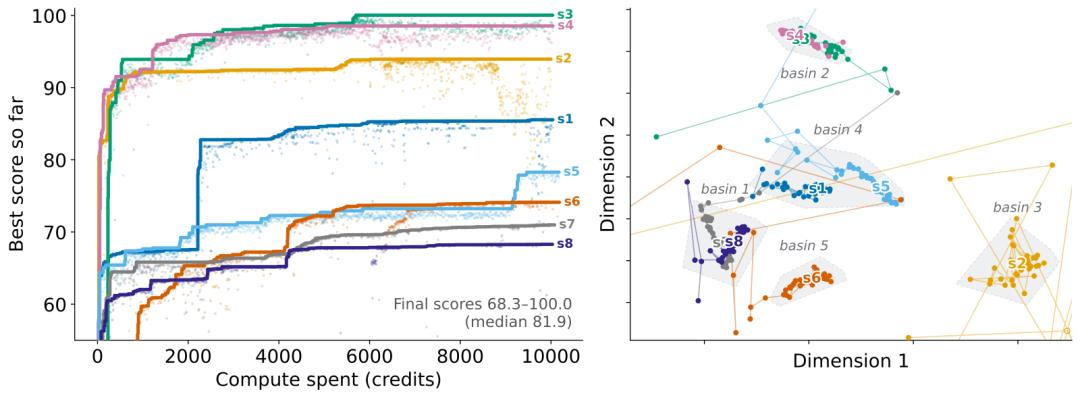
The same Agent runs 8 times on the same task. Left figure: The change of score with computing power input, 8 runs plateau at different heights, and the final scores range from 68.3 to 100.0. Right figure: The scheme map drawn according to functional similarity, 8 runs are confined to 5 "idea basins".
This is like a decoration team: they decide on a Nordic style on the first day, and every piece of furniture they buy afterwards leans towards the Nordic style. Even if the Mediterranean style is actually more suitable for this apartment layout, they can no longer think of other options, because their mobile phones are full of Nordic style reference pictures. The chat history is exactly those reference pictures in the Agent's mobile phone.
It is worth mentioning that these Agents originally have a mechanism of "automatically compressing chat history", which will automatically summarize the conversation and then continue when the chat is too long. But actual tests show that relying only on compressed summaries still cannot jump out of the basin.
Microsoft's Prescription: Memory Clearing
This method is called Fork-and-Flush, which can be roughly translated as "fork and flush", and it has two steps.
Fork: Duplicate the Agent into several parallel branches, each of which inherits the complete "workspace", that is, all the previously written code, files and experimental results, and takes away all the assets without omission.
Flush: Clear the chat history of each branch. All of you, no matter what you thought before, look at the existing materials and rethink how to do it.
After the branches run for a fixed period of time, compare their scores, keep the best one to continue running, and disband the rest. There is a very precise sentence in the paper: The new branch must re-derive its own intention from these files, which is exactly the reason why it can land in another basin.
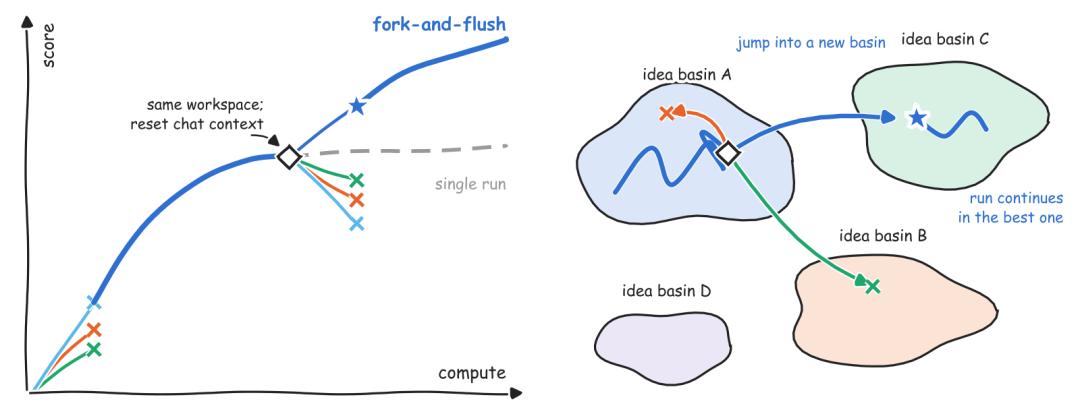
Schematic diagram of Fork-and-Flush. Left figure: After forking, each branch sets off again with the same workspace and blank chat history, and the winning branch continues to move upward. Right figure: The cleared branch has a chance to jump into another idea basin, and those that fail to jump out are disbanded on the spot.
The researchers conducted tests on 13 long-cycle tasks, including polyomino puzzle, workshop scheduling, password cracking, compressing image classifiers, and optimizing VLIW cores. A single run lasts from several hours to more than 100 hours, and the working models are GPT-5.6-terra and GPT-5.5, which are called through the command line tool of GitHub Copilot.
Under the same computing power budget, look at the normalized average scores: single run gets 0.47, taking the best result from 4 runs gets 0.54, and Fork-and-Flush gets 0.78. Converted to relative improvement, it is 66.0% higher than single run, and 44.4% higher than picking the best one from 4 runs. Among the 13 tasks, it has the highest average score on 12 of them. Its performance is also more stable, with the standard deviation dropping from 0.26 to 0.16.
The ablation experiment is also very interesting: only clearing the chat history without forking brings an improvement of about 22%; only forking without clearing also brings improvement; but the combination of the two can achieve the best effect. It seems that "forgetting" and "trying several more times" play their respective roles.
The most dramatic case happened in the puzzle task. When the budget was spent to 71%, the clearing was triggered, and the winning branch jumped a distance of 43 units in its first submission. What is the concept of this? At this stage, the single-run Agent can move at most 4.4 units per step. This jump directly lands in a brand new basin, and finally gets 93.9 points, while the median of the 8 single-run baselines is 84.6. The other 3 branches that failed to jump out moved no more than 1 unit per step, staying in place.
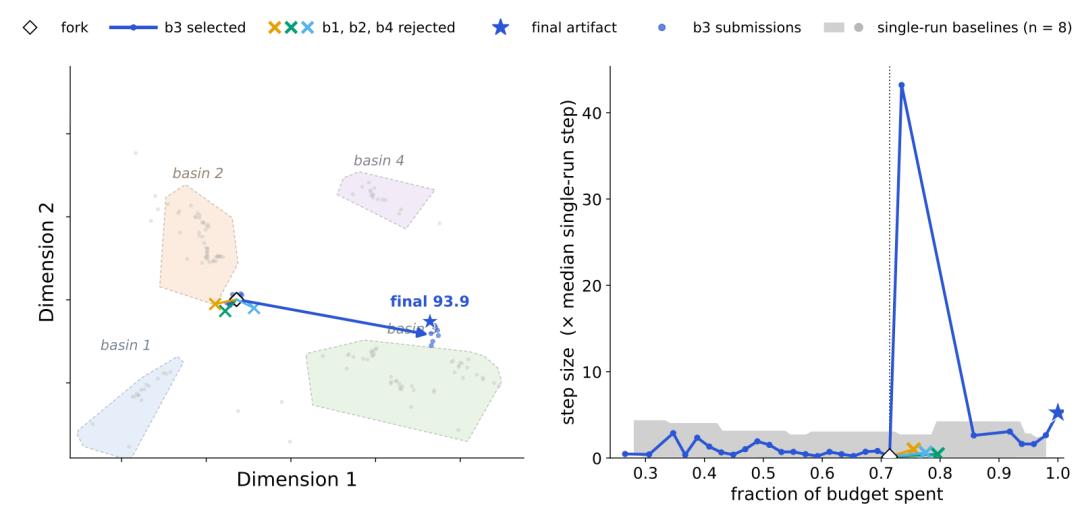
The critical jump on the puzzle task. Left figure: The blue arrow is the winning b3 branch, which jumps directly from the forking point to the new basin, and finally gets 93.9 points. Right figure: Its first step after clearing jumps 43 units, far beyond the conventional step range of single runs represented by the gray area.
No Matter How Powerful the Model Is, This Problem May Still Exist
Some people may think that when the model becomes more powerful, it will probably no longer get stuck in a dead end.
The team used three sizes of Qwen3.5, 4B, 9B and 27B, to conduct verification on problems such as MAX-3-SAT whose difficulty can be precisely adjusted. The results show that the difference between runs presents an inverted U-shaped curve: if the problem is too simple, the model can solve it every time, and the solutions are similar; if the problem is too difficult, the model cannot solve it every time, and the failure patterns are also similar; the position with the largest difference is exactly at the edge of the model's capability, roughly at the point where the model can "get half of the answers right". The fitted peak value is 0.497, which is almost exactly the middle point.
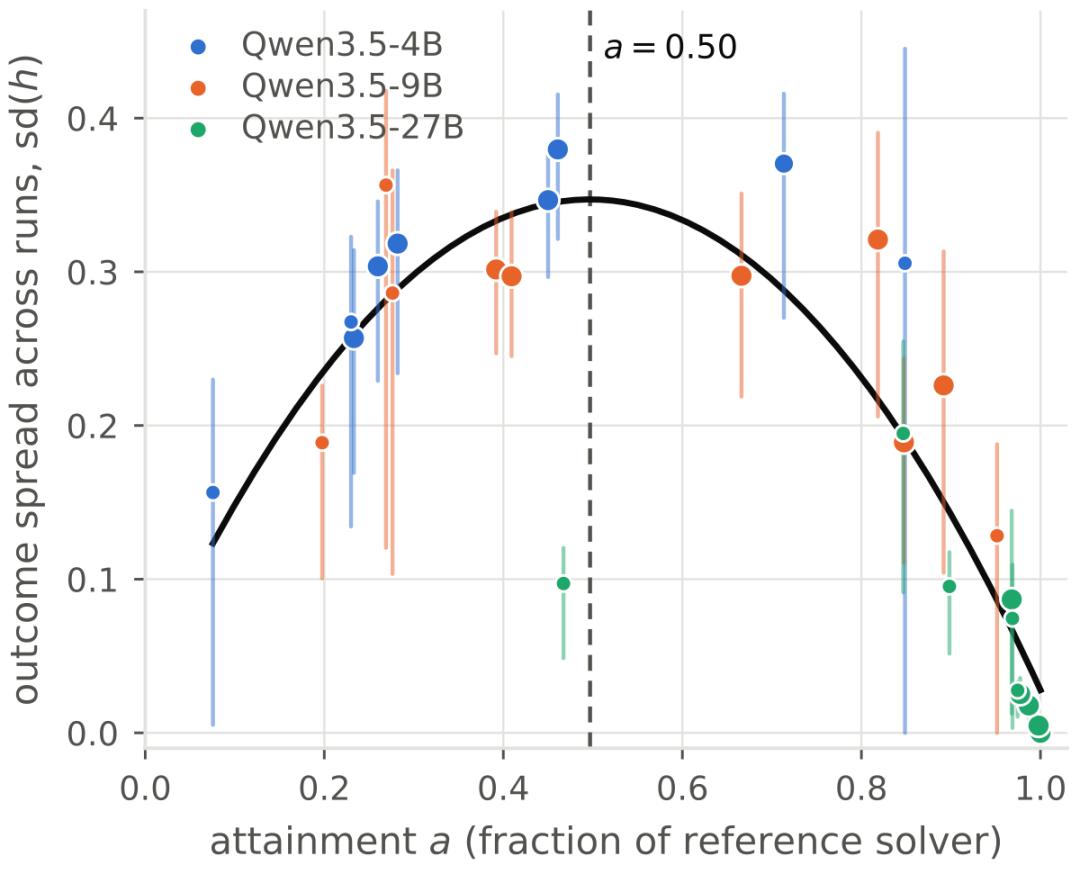
The horizontal axis is the model's achievement relative to the reference solver, and the vertical axis is the difference between multiple runs. The three sizes of Qwen3.5 trace the same inverted U-shaped curve, with the peak near the achievement value of 0.5.
By definition, open-ended research problems are exactly located at the capability edge. Therefore, the authors judge that as models continue to become more powerful, this phenomenon will probably not disappear, and the capability edge will only shift to more difficult problems. The trick of periodically resetting the context may still work for future cutting-edge models.
This research has a very direct reminder for people who develop Agent products: the default assumption that "context is an asset" may be worth questioning. After the accumulated memory exceeds a certain point, it may restrict exploration instead, and early reasoning will anchor the Agent to a suboptimal route.
This article is from the WeChat official account "Big Data Digest", authorized for release by 36Kr.