As the global market share falls below 50%, have the century-old fuel vehicles completely lost their ground?
We are witnessing history.
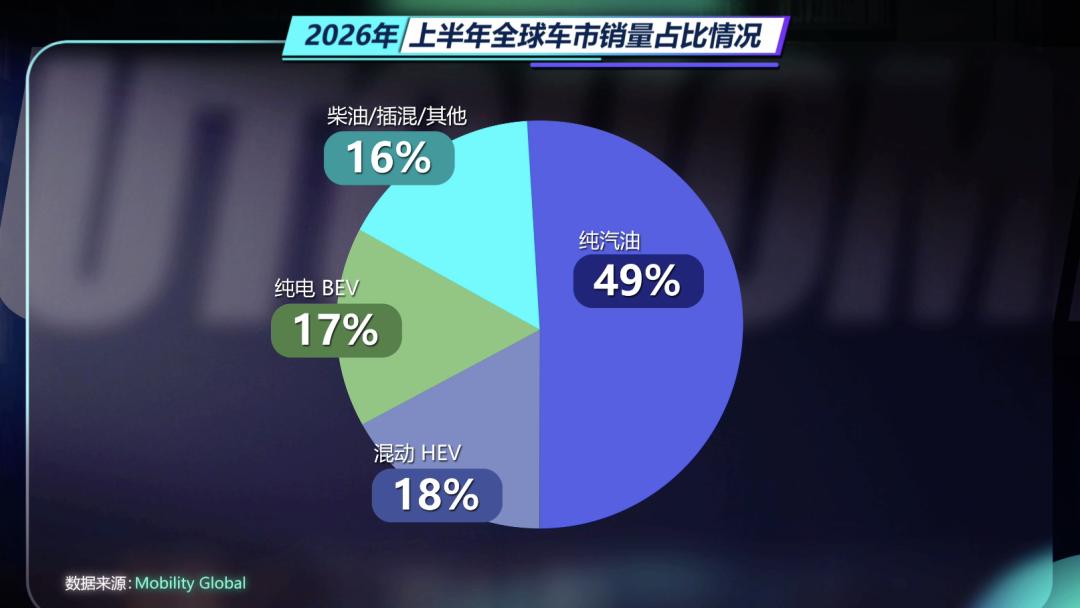
In the first half of 2026, the proportion of pure gasoline vehicles in global new car sales fell to 49%. This means that for nearly a hundred years since automobiles became popular in the 1920s, the market share of gasoline vehicles has dropped below 50% for the first time. It is worth noting that this figure was still 73% in 2021, and it has directly decreased by 24 percentage points in just five years.
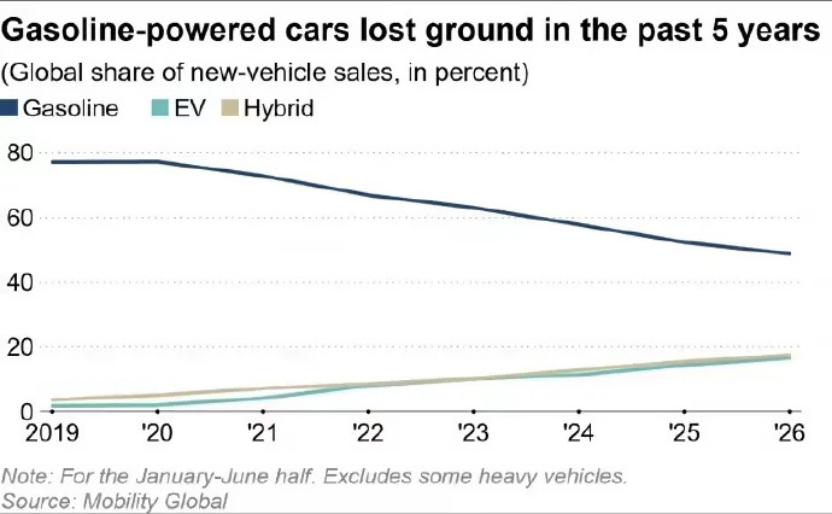
Who exactly has taken over this half of the market share lost by gasoline cars?
Rising oil prices are pushing consumers to make the switch
Many people's first reaction to seeing this set of data is that electric vehicles are selling well. But that is only half the truth.
First, look at the overall market: according to data from the International Energy Agency, the global automobile market shrank by about 5% in the first half of this year. The market is contracting, but the decline of gasoline vehicles is twice that of the overall market. Pure gasoline vehicles sold 20.25 million units globally in the first half of the year, down 10% year-on-year. The worst decline was in China, with a year-on-year plunge of 26%; Europe followed closely, with a 13% drop.
Looking at electric vehicles on the contrary: global sales of pure electric vehicles reached 6.87 million units in the first half of the year, up 12% year-on-year, with the share rising to 17%. The market is shrinking, but it is growing. This scissors gap is the core of the problem.
Then where does the growth momentum come from? There is a counterintuitive detail here.
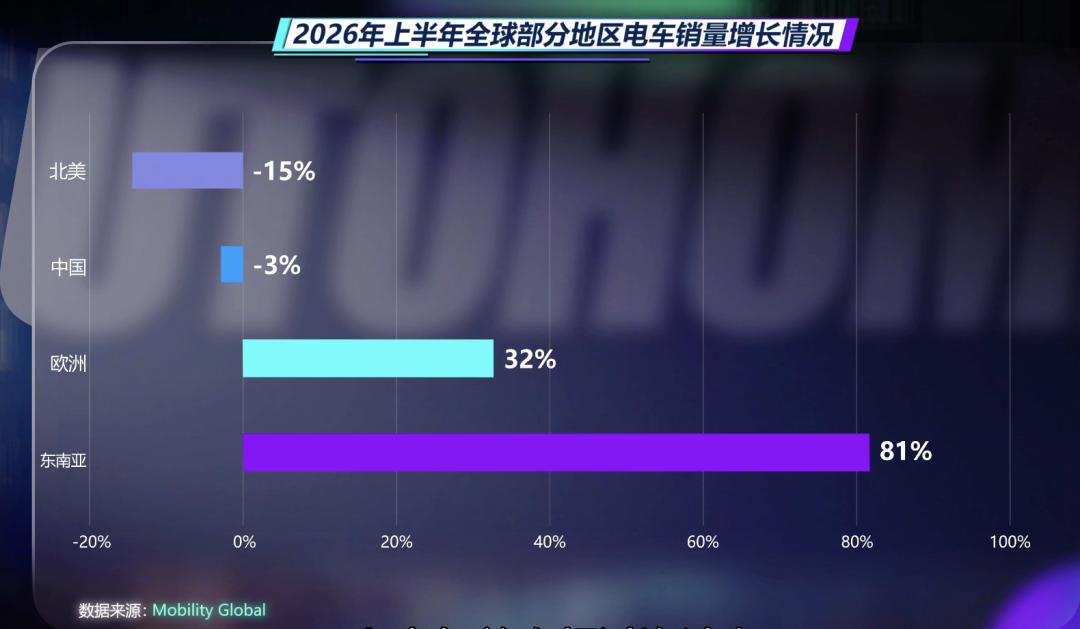
Many people thought that China and North America were the engines of electric vehicle growth, but the opposite was true in the first half of this year. China's electric vehicle sales even dropped slightly by 3% due to the phase-out of subsidies; North America fared worse, with a direct 15% drop, as the US government drastically cut electric vehicle incentive policies.
The real explosion happened in "other regions". Electric vehicle sales in Europe surged 32% to 1.81 million units, surpassing gasoline vehicles for the first time in the first half of the year; Southeast Asia saw a sharp increase of 81%; Oceania was even more exaggerated, with sales doubling directly. The pure electric penetration rate in Australia in July alone hit 22%, while it was only 8.4% in January, rising nearly three times in a few months.
Many insiders believe that what drives this wave of growth is not technological breakthroughs, not increased subsidies, but oil prices. In the past, the biggest doubts about new energy vehicles were range, energy replenishment and reliability; but after the products have become more and more mature in recent years, consumers have found that for daily commuting, why can't I choose a more cost-effective and smarter option?
An analyst at Mobility Global said, "Previously, the popularization speed of electric vehicles slowed down due to the termination of subsidies, but after oil prices soared, the advantage of low vehicle usage costs was re-recognized, and sales went up again."
Who is boosting it behind the scenes?
Who is boosting the fact that "gasoline vehicles' share fell below 50%" behind the scenes? The answer is not unexpected.
Wan Gang, Chairman of the World New Energy Vehicle Congress, pointed out that the cumulative global sales of new energy vehicles reached 94 million units, of which China contributed 64 million units, accounting for more than 68%. This figure itself already explains the problem.
But what is more thought-provoking is another set of data. Data from the China Association of Automobile Manufacturers shows that in the first half of this year, domestic car market sales were less than 10 million units, down 21% year-on-year, which does not look good on the surface. However, exports in the same period surged 65.3% year-on-year to 5.096 million units. Exports in June alone exceeded 1 million units for the first time, and the volume of one month exceeded the total of 2020.
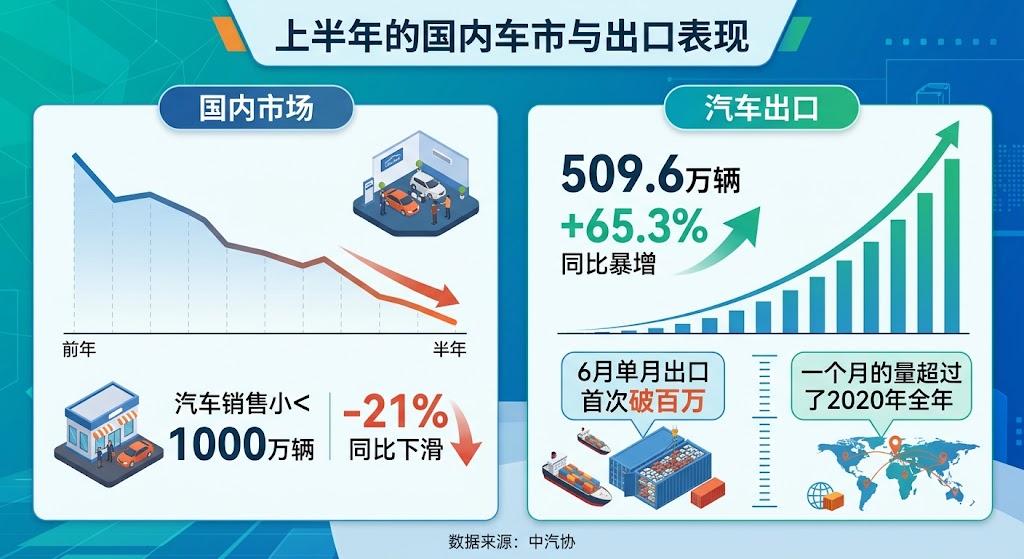
In other words, the domestic market is contracting, while the overseas market is exploding. At this pace, China's automobile exports are expected to exceed 10 million units in 2026. By then, one third of the sales of the entire industry will be completed overseas.
Among the top five enterprises in terms of net profit, no one has an overseas sales share lower than one third. Chery's overseas share accounts for 69.1%, BYD 43.7%, SAIC 35.9%, and Geely 33.3%.
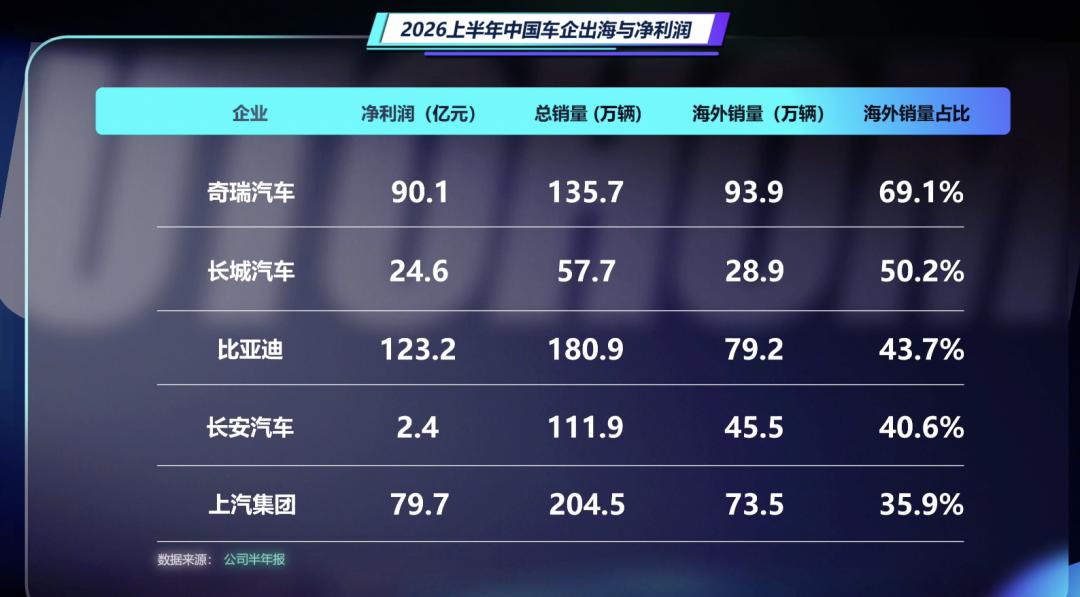
The vast majority of these exported vehicles are new energy. The 32% surge in electric vehicle penetration in Europe and the 81% surge in Southeast Asia all have the presence of Chinese vehicles behind them.
Chinese automakers are directly driving up the global electric vehicle penetration rate with their own export scale.
Why can they achieve this volume? The fundamental reason lies in the industrial chain.
Many people think that the core of automobile manufacturing lies in complete vehicles, but that is not the case. The real moat of the automobile industry lies in auto parts. In the past few decades, this track was almost monopolized by European, American and Japanese enterprises, and Chinese suppliers tried their best but could not enter the front ranks.
However, the release of the 2026 Global Top 100 Automotive Supply Chain list quietly rewrote this pattern. European, American, Japanese and South Korean companies that used to hold steady positions are collectively losing momentum; the number of Chinese enterprises on the list has jumped to 20 at one go, and their revenue share has risen from 14% to 17.2%, surpassing the United States and ranking third in the world.
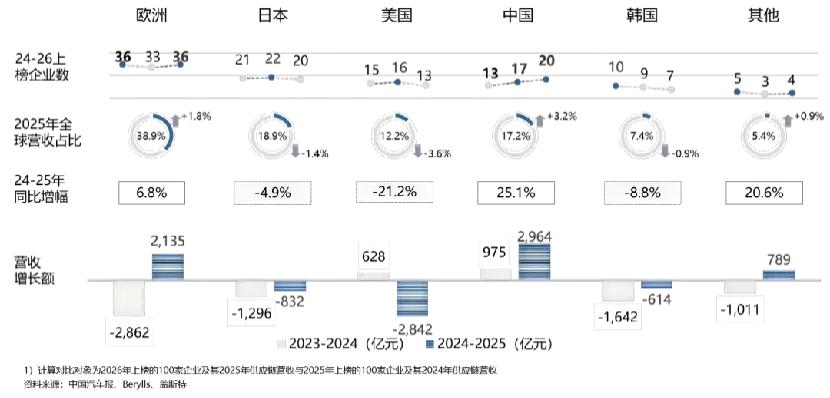
The most representative one is CATL - it jumped directly from 7th to 3rd place, becoming the first Chinese supply chain enterprise in history to break into the global top three. Over the past decade, CATL has ranked first among global battery enterprises with 26,574 patents, surpassing South Korea's LG Energy Solution, which has long dominated the list. Looking at the past three years alone, its number of patent applications is nearly three times that of the second place in China.
Technical accumulation, scale advantages, and complete industrial chain collaboration - the combination of these three elements forms the competitiveness not of a single enterprise, but the systematic advantage of the entire China's new energy industry.
Is the fuel vehicle era over?
After the figure of 49% came out, many people's first reaction was that fuel vehicles are going to decline.
But don't jump to a conclusion hastily.
There is a problem of statistical caliber that needs to be clarified. "Pure gasoline vehicles fell below 50%" refers to pure gasoline vehicles that do not include hybrids. HEVs are counted separately. HEV sales exceeded pure electric vehicles in the first half of this year, and diesel vehicles are not included in this figure. When discussing HEVs domestically, they are usually classified as non-new energy vehicles.
Therefore, only 17% of pure electric vehicles are completely fuel-free. That means that about 83% of new cars sold worldwide this year are still equipped with engines.
Another easily overlooked dimension is: penetration rate is an incremental indicator, while ownership is the stock reality. More and more new energy vehicles are sold among new cars, but most of the cars running on the road are still fuel vehicles. Infrastructure, user habits, and the cycle of stock replacement are not things that can be completely changed overnight.
But none of this prevents us from acknowledging one thing: the ceiling is clearly visible.
On the technical side, Li Ke, Executive Vice President of BYD, recently said: "In China, with the popularization of fast charging technology, fuel vehicles have no future." She also revealed that BYD will launch solid-state battery models in 2027. Once solid-state batteries are actually mass-produced and put into use, the last two remaining concerns, range anxiety and safety worries, will be eliminated one by one.
On the market side, the driving force for consumers to buy new energy vehicles is no longer policies, but the real comparison of vehicle usage costs.
So the answer to the question is: the fuel vehicle era is not over yet, but its growth logic has been broken. The rest is just a matter of time, isn't it?
This article is from the WeChat Official Account "Auto Market Stories" (ID: autostinger), written by Peng Fei, and authorized for release by 36Kr.