September PPI hits a new four-year high, will the Federal Reserve take drastic action in December?
Following Wednesday's CPI that beat market expectations, the PPI data once again confirmed the mounting inflationary pressure.
The U.S. PPI rose 6.3% year-on-year in September, far exceeding the expected 5.3% and marking the largest increase since December 2022; it rose 1.3% month-on-month, also far higher than the expected 0.5%, posting the steepest growth since March 2022.
After excluding food and energy, the core PPI also remained strong. It rose 5% year-on-year and 0.7% month-on-month, both outpacing market expectations.
Energy Drives PPI to Surge
The rise in energy prices is the biggest driver of this round of price hikes, and inflationary pressure is spreading to every corner of the U.S. economy.
Among them, the price of final demand commodities rose by 2.6% in September, the largest increase since the data was first calculated in December 2009.
Energy prices skyrocketed by 10.8%, accounting for more than 80% of the overall increase in commodity prices; gasoline prices rose by 20.3%.
Wholesale food prices rebounded by 1.2% after three consecutive months of declines.
The retail sector is also under pressure. Another report released on the same day showed that retail sales rose by 0.8% in September, higher than economists' expectation of 0.4%, but slower than the growth rate of over 1% recorded in the previous month.
If auto and gasoline sales are excluded, retail sales in the last month grew by only 0.2%.
This indicates that as price pressures intensify, the growth momentum of U.S. consumer spending is weakening, and accelerating inflation is further eroding wage purchasing power and squeezing household budgets.
Will the Fed Raise Rates by 25 or 50 Basis Points in December?
The latest data further confirms the strong resilience of U.S. inflation.
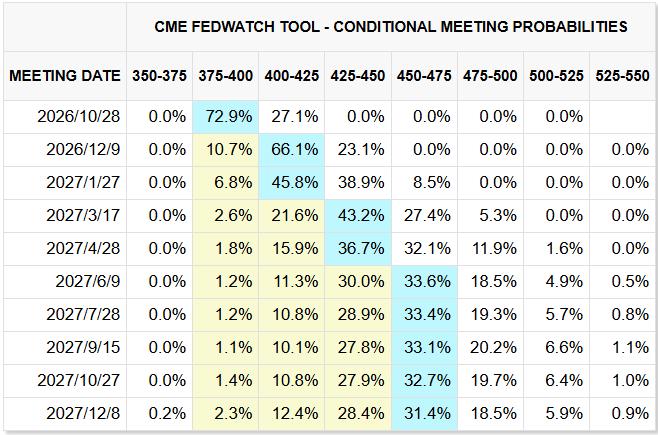
Market expectations for the October rate hike tend to hold rates steady. CME FedWatch Tool shows that the probability of keeping interest rates unchanged in October is 72.9%, and the probability of a 25-basis-point rate hike is 27.1%.
Attention has shifted to December. Most market participants currently believe that a rate hike in December is almost a certainty, and the only disagreement lies in the magnitude: the probability of keeping rates unchanged is only 10.7%, the probability of a cumulative 25-basis-point hike is 66.1%, and the probability of a cumulative 50-basis-point hike is 23.1%.
Chris Zaccarelli of Northern Light Asset Management believes that the Fed will keep interest rates unchanged at the October FOMC meeting, partly because the meeting is close to the U.S. midterm elections.
Jason Schenker, President of market research firm Prestige Economics, also believes that the Fed is unlikely to raise the benchmark interest rate this month.
His rationale is that much of the data released on Wednesday was collected before the Fed's September rate hike, and there is not enough information at the October meeting to support another rate hike decision.
For the judgment on December, institutional differences lie in the magnitude of the rate adjustment. Schenker believes that by December, if inflation has not been more strongly and substantially curbed, the Fed may choose to raise interest rates by 50 basis points to suppress inflation more forcefully.
Citigroup, on the other hand, expects the Fed to raise interest rates by 25 basis points in December 2026, after previously predicting that the Fed would keep interest rates unchanged for the rest of this year.
UBS has pushed back the end point of the rate hike cycle: it expects the Fed to implement the third rate hike in March 2027, compared with its previous forecast that the rate hike cycle will end in December.
The longer-term concern comes from the stickiness of inflation. Chris Rupkey, chief economist at FWDBonds, said that as long as geopolitical risks continue to push up energy costs, companies will be forced to pass on cost pressures, and sticky inflation may force the Fed to raise interest rates further and maintain higher interest rates in 2027.
The latest statements from several Fed officials are generally cautious, emphasizing observing first before taking action.
Fed Chicago President Austan Goolsbee said it is still unclear whether the current interest rate level is sufficient to bring inflation back to the 2% target, he tends to wait for more data to decide whether to raise interest rates further; but if inflation data in the coming months continues to stay at the current level, the Fed cannot sit back and do nothing.
San Francisco Fed President Mary Daly believes that a rate hike may be needed, but there is plenty of time to make decisions prudently. She pointed out that the risk of inflation staying above the target level remains high, while the labor market remains stable, which allows the Fed to focus on maintaining price stability.
Fed Governor Michelle Bowman also said that inflation is still above the target, but she does not think it is necessary to rush to further adjust interest rates. She emphasized that after the last rate hike, it is necessary to take some time to observe the development of financial conditions before taking further actions.
This article is from the WeChat official account "Gelonghui Finance Hotspot" (ID: glh_finance), written by Chashan, authorized for release by 36Kr.