Dan Bin, A Rare Reversal
But Bin's latest views have gone viral in the investment circle.
The core judgment he put forward is:
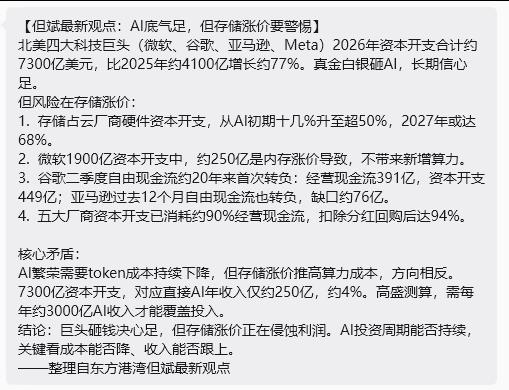
The prosperity of AI requires continuous decline in token cost, but the rising price of storage pushes up the cost of computing power, which is in the opposite direction.
The total capital expenditure of 730 billion corresponds to an annual direct AI revenue of only about 250 billion, accounting for roughly 4%. According to Goldman Sachs' estimation, an annual AI revenue of about 300 billion is required to cover the investment.
The conclusion is that tech giants are fully determined to invest heavily, but the rising storage prices are eroding profits. Whether the AI investment cycle can continue depends on whether costs can be reduced and whether revenue can keep up.
But Bin has been a staunch bull in the storage track this year, and he publicly added positions in SK Hynix during the sharp decline in July.
This time he broke away from the profit perspective of storage manufacturers, and instead started from the cost side of cloud giants to propose that rising storage prices will backfire on AI capital expenditure. This reversal came quite abruptly, which is rarely seen in his previous public views.
The contradictions in But Bin's analytical views are indeed worth pondering.
According to the estimation of CICC, under the erosion of 170% storage price increase, the token generation efficiency per dollar for deploying GB300 has decreased by 37% compared with GB200.
Of Microsoft's 190 billion capital expenditure, about 250 billion is caused by the rise in memory prices, and this sum of money does not bring any new computing power.
According to RBC's calculation, after excluding the memory cost, the capital expenditure growth rate of the giants in 2026 will drop sharply from 80% to around 40%, because the surge in storage prices accounts for about 45% of the total increase in capital expenditure.
In other words, nearly half of the money invested by the giants is not used to buy computing power, but to pay for storage inflation.
Another more severe contradiction is that the cash flow of the giants is already sending out alarms, while the cost of capital is soaring wildly.
At present, the combined free cash flow of the four major cloud manufacturers has plummeted from 60 billion in the fourth quarter of 2025 to only about 70 billion US dollars in the second quarter of 2026, and the coverage ratio of operating cash flow to capital expenditure has dropped from 1.79 times to 1.06 times.
This means that almost all the money earned is immediately invested out, leaving almost no surplus.
Among them, Google's free cash flow in the second quarter turned negative for the first time in about 20 years, with a gap of 5.855 billion US dollars. Amazon's TTM free cash flow is negative 11.6 billion. Meta's free cash flow in the second quarter is only 784 million, plummeting 91% year on year. Some analysts pointed out that it may turn negative in the next quarter.
Microsoft is the only one that still maintains a significantly positive free cash flow, but it has also shrunk by nearly 6 billion US dollars within one quarter.
Now, the capital expenditure of the five major manufacturers has consumed about 90% of operating cash flow, and after deducting dividends and share repurchases, the proportion reaches 94%, which is only one step away from the warning line of 100%.
If they spend a little more, the giants will have to borrow money to maintain expansion.
With insufficient money, they can only rely on bond issuance to maintain operations. Since 2026, tech giants have issued nearly 2200 billion US dollars of bonds, far exceeding the 1080 billion US dollars for the whole year of 2025. Goldman Sachs estimates that the five major cloud manufacturers will issue about 2500 billion US dollars of bonds in 2026.
But the problem is that borrowing money itself is becoming more and more expensive.
Last night, US inflation data for September exceeded expectations, and the expectation of interest rate hikes soared again. Even relatively moderate members of Congress believe that another interest rate hike is needed this year. US stocks plummeted across the board last night, and the tech giants with greater bond financing needs saw the largest decline.
CoreWeave fell by more than 15%, Dell Technologies fell by more than 11%, Oracle fell by nearly 9%, Marvell Technology fell by more than 8%, Arm fell by nearly 7%, SK Hynix fell by more than 6%, AMD, SanDisk and others fell by more than 5%.....
To make matters worse, the runaway long-term bond yields are even more worrying.
Now the yield on 10-year US Treasury bonds has once soared above 5.3%, and the 30-year yield has broken through 5.7%, both hitting the highest level since 2002.
More and more institutions are worried that the 30-year yield breaking through 6% may be "inevitable", and the US will be deeply trapped in a "debt trap" where borrowing costs exceed nominal growth.
The surge in long-term bond yields has a double impact on tech giants.
It will not only cause a substantial increase in financing costs, but also form a systematic valuation suppression on AI tech growth stocks that already have high valuations.
Broadcom CEO Hock Tan and Intel CEO Lip-Bu Tan issued warnings on the same day that financing may become a greater obstacle to AI expansion, and its impact may even exceed the shortage of semiconductors or power supply.
Now, Oracle's bond issuance interest rate has risen to 7.41%, and its CDS spread has reached 215bp. The market is more worried about its solvency, which is why Oracle has been significantly absent from the surge in AI narratives this year.
To put it plainly, the giants' shift from the mode of "investing in AI with profits" to "investing in AI with balance sheets" has taken shape.
Whether this model can continue depends on one thing — whether AI revenue can catch up with the dual expansion of investment and financing costs at a fast enough speed.
According to Goldman Sachs' calculation, the six major cloud giants' AI capital expenditure from 2026 to 2027 will reach 1.73 trillion US dollars. To achieve a 15% ROIC, they need to generate a cumulative revenue of about 1.42 trillion US dollars from 2028 to 2030.
The figure of 1.42 trillion is not so easy to achieve.
Of course, the giants still have cards in their hands. Microsoft Azure's growth rate remains strong, Google's advertising business is still generating abundant operating cash flow, and Meta's advertising revenue has not collapsed.
The combined backlog of orders for Amazon, Google and Microsoft's cloud businesses has reached 1.7 trillion US dollars, but this is income recognized in installments over the next few years, which is far from enough to meet immediate needs. The core problem is not the sudden collapse of the revenue side, but the too fast expansion of the expenditure side, so fast that the operating cash flow cannot keep up.
Of course, But Bin said that AI is the super main line of the next ten years, and this long-term logic is valid.
But in the short term, the rising storage prices push up costs, token prices continue to decline, long-term bond yields remain high, and financing costs are climbing. These four factors are squeezing the profit space at the same time. The current situation is indeed a big test for the giants.
All in all, the market has reached a moment that tests people's faith in AI again.
What the giants need to prove next is no longer just how important AI is, but whether their cash flow can stay healthy and sustain the operation.
The above analysis only represents the personal view of the author, and does not constitute any specific investment advice. Investors need to make independent decisions based on market changes and their own risk tolerance.
This article is from the WeChat Official Account "Gelonghui Mine Detector" (ID: glh-tlq), the author is Yuan Feng, and 36Kr publishes it with authorization.