ASML Executive: Existing Production Capacity Can Hardly Meet Demand, Lithography Equipment Orders Have Been Negotiated All the Way to 2030
On the evening of October 14 Beijing time, Christophe Fouquet, CEO of ASML, stated at the 2026 Q3 earnings call that customers' demand for lithography equipment has extended beyond 2028, and some customers have already begun to express procurement intentions for equipment from 2029 to 2030.
Earlier that day, ASML released its 2026 Q3 financial report. The report shows that ASML's net sales in Q3 reached 11.662 billion euros, a quarter-on-quarter increase of about 25%, hitting a new all-time high for a single quarter; net profit was 4.960 billion euros, a quarter-on-quarter increase of about 70%; gross margin rose to 57.5% from 54% in the previous quarter.
The company expects net sales in Q4 to be between 14.2 billion and 15.2 billion euros, with a gross margin of around 57%; full-year net sales are expected to be between 44 billion and 45 billion euros, with a gross margin of around 56%. Among them, the EUV business is expected to grow by more than 45%, and the installed base after-sales service business will grow by about 50%.
This is already the third consecutive quarter that ASML has raised its full-year performance outlook.
At present, ASML's customer demand has extended beyond 2028. Roger Dassen, Chief Financial Officer of ASML, added that the company needs to assess overall demand and future production capacity first before deciding whether to accept these long-term orders, so as to avoid allocating production capacity too early and affecting the procurement arrangements of other customers.
At the moment, capacity expansion has become a practical problem that ASML needs to solve.
ASML previously planned to increase the production capacity of low-NA EUV and immersion DUV equipment by 30% respectively by 2027, and study further capacity expansion in 2028. However, as customer demand continues to rise, the management believes that the existing plan is still difficult to fully meet the demand in 2027 and 2028, and is evaluating further expansion of the 2028 capacity growth rate.
ASML expects to deliver about 65 low-NA EUV systems this year, an increase of nearly 50% from 44 units last year. The delivery volume of immersion DUV equipment this year is also expected to return to a level similar to last year. The management said that the difficulty of further capacity expansion lies in whether the entire supply chain can increase output synchronously, and related work is still in progress.
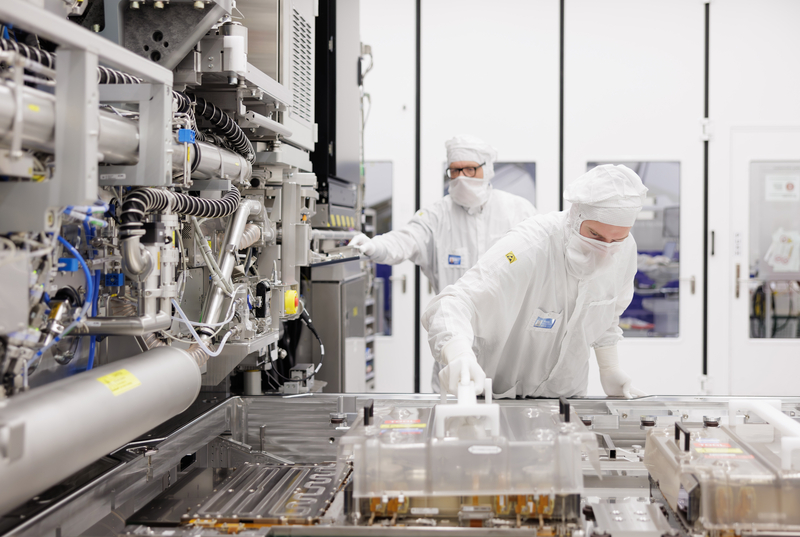
Image source: ASML
From the perspective of customer structure, demand for storage equipment is growing faster. ASML expects that the sales of storage-related systems in 2026 will increase by about 75% year-on-year, and the sales of logic chip-related systems will increase by about 10%, among which the advanced logic business is expected to grow by more than 25%. In the system sales of Q3, logic chips accounted for 54% and memory chips accounted for 46%. The company said that the growth of the memory business mainly comes from DRAM capacity expansion and the increased application of EUV in advanced DRAM manufacturing processes.
The tightening of supply and demand has also made the price of lithography equipment a market focus. South Korean media recently cited reports from industry insiders that ASML plans to raise the price of replacement parts for EUV and DUV lithography machines supplied to the South Korean market by 10% uniformly starting from January 2027, and Samsung Electronics and SK Hynix have accepted this adjustment.
At the earnings call, the management did not directly respond to the related price increase issue, but confirmed that it has completed price increase negotiations with customers around key products. Roger Dassen said that this round of price increases will not affect the 2026 performance, will be gradually reflected in revenue, average selling price and gross margin in 2027, and the impact will be more obvious from 2028 onwards.
He did not disclose the specific possible future increase at the earnings call, but only emphasized that the company does not intend to repeat price increases every year, and hopes to negotiate prices with customers based on the value created by the equipment.
Improving the production efficiency of a single unit of equipment is also a way for ASML to cope with delivery pressure. The company plans to launch the next-generation low-NA EUV system NXE:3800F in small batches starting from 2027, with a wafer processing capacity of 260 wafers per hour, higher than the 230 wafers per hour of the existing NXE:3800E; the target for the new generation of key immersion DUV equipment is 330 wafers per hour. Christophe Fouquet said that the throughput improvement can not only increase customer production capacity, but also affect the value and pricing created by the equipment.
In addition to expanding the delivery capacity of existing equipment, ASML is also promoting the next-generation technology into mass production. It was revealed that Intel has used the High-NA EUV system to expose more than 1 million wafers; Samsung and TSMC plan to use this technology for large-scale mass production in 2028 and 2030 respectively. ASML is also working with industrial partners such as TSMC to promote larger-size EUV photomasks, planning to build a 12-inch photomask pilot line in 2031 and put it into production in 2033.
Image source: ASML
Industry equipment investment is also growing. SEMI, the International Semiconductor Industry Association, estimated in July this year that global semiconductor manufacturing equipment sales will reach 165.9 billion US dollars in 2026, a year-on-year increase of 23.2%; among them, DRAM equipment sales are expected to grow by 39%. This forecast provides industry background for the storage chip capacity expansion mentioned by ASML. For ASML, whether it can increase its own and supply chain output will affect the progress of meeting customer demand.
For the Chinese market, ASML expects the Chinese market to contribute about 20% of total sales this year. Christophe Fouquet said at the earnings call that local demand for mature logic and memory chips in China remains strong. With the construction of more wafer fabs advancing, the company expects that demand in the Chinese market will remain at a relatively strong level in 2027 and beyond.
When talking about local equipment competition in China, he said that as long as ASML can maintain reasonable market access, Chinese customers still have strong willingness to cooperate with it. If some equipment cannot be obtained, it may instead enhance China's motivation to develop alternative equipment.
This article is from "Jiemian News", author: Xu Meihui, authorized for release by 36Kr.