Notching $16.8 billion in quarterly revenue, Anthropic is charging towards its IPO with a solid profitability report.
On October 14 local time in the United States, Anthropic held a pre-IPO investor meeting at its San Francisco headquarters, disclosing its latest financial performance. The company not only maintained its revenue growth momentum, but also announced adjusted profitability in the third quarter.
In 2025, Anthropic recorded full-year revenue of 4.6 billion U.S. dollars, with an operating loss of more than 8 billion U.S. dollars. Now, the company has further shifted from the stage of rapid growth to the test of profitability.
Less than a month before the planned IPO roadshow, the focus of investors is no longer just the growth rate, but also whether this profitability achievement can be sustained.
Revenue Growth Accelerates
Anthropic's revenue in the third quarter reached 16.8 billion U.S. dollars, up 45% from 11.6 billion U.S. dollars in the second quarter, while the revenue in the first quarter was 4.7 billion U.S. dollars. Three consecutive quarters of growth reflect the continuously expanding demand of enterprise customers for its models and services.
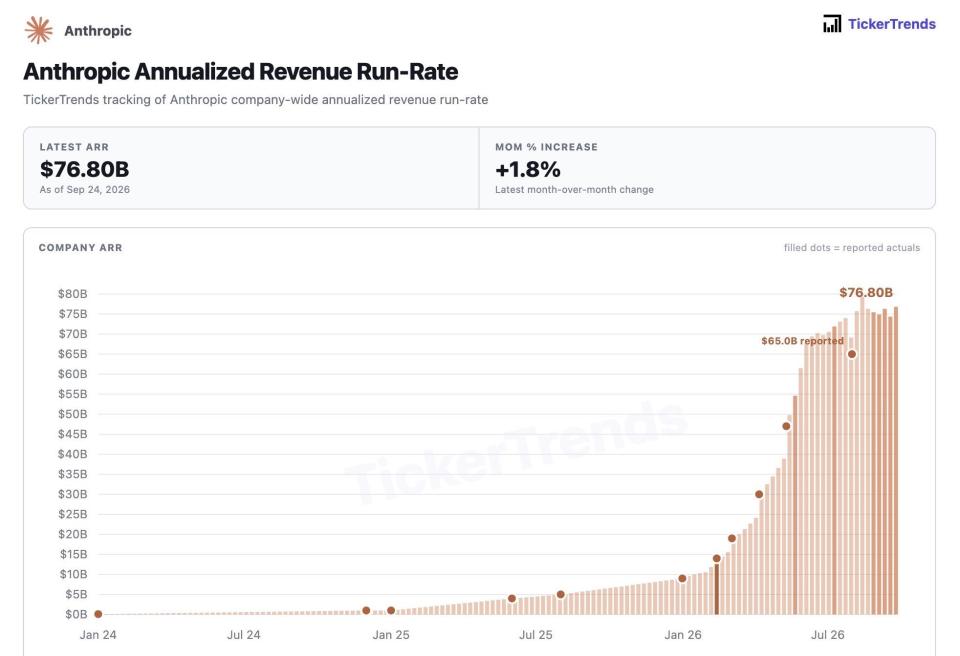
The profitability situation is also under the spotlight. Anthropic stated that the company has achieved adjusted profitability in the third quarter. In contrast, the company's full-year operating loss in 2025 exceeded 8 billion U.S. dollars, and its net loss was nearly 42 billion U.S. dollars.
However, adjusted profit is not the same as net profit calculated in accordance with Generally Accepted Accounting Principles. Adjusted indicators usually exclude part of equity incentives, asset impairment and other specific items, so they cannot be directly equivalent to the fact that the company's overall business has achieved sustained profitability.
Previous reports on Anthropic's financial situation pointed out that the company's huge net loss in 2025 was affected by factors such as the revaluation of financing-related liabilities, and there was a clear gap between the actual operating loss and the net loss. Therefore, to judge whether the company truly has sustainable profitability, it is necessary to combine the full financial report to examine the profit composition and operating cash flow.
Revenue growth mainly comes from the continuous adoption of the Claude series of models by enterprise customers. Demand for models in professional fields such as finance, law and software development is increasing, and generative AI is gradually entering the daily business processes of enterprises.
The product layout has further expanded Anthropic's market coverage. The Claude 4 series launched in May this year has strengthened the model's competitiveness in professional tasks, and the recently released Haiku 5.5 focuses on low-cost applications. This model reduces the price by 75% compared with the previous generation, covers scenarios sensitive to inference efficiency and price at a lower usage cost, and competes with models such as OpenAI's GPT-6 Luna.
Cloud service partners also provide important sales channels for Anthropic. Google and Amazon are not only investors of the company, but also computing power suppliers. Claude can reach enterprise customers through Google Cloud and Amazon AWS, and expand sales scale with the help of the existing customer network of cloud platforms.
This partnership that integrates investment, computing power supply and commercial distribution provides support for Anthropic to expand the enterprise market. As the business scale expands, whether these channels can continue to drive revenue growth and help the company control customer acquisition and computing power costs will affect the sustainability of profitability performance.
OpenAI's Advantage Narrowed
Anthropic's revenue of 16.8 billion U.S. dollars in the third quarter has also made the market re-examine the competitive landscape between it and OpenAI.
According to a report by Yahoo Finance, investors recently lowered OpenAI's annualized revenue expectation from 70 billion U.S. dollars to about 50 billion U.S. dollars. Calculated by a simple quarterly average, it is equivalent to about 12.5 billion U.S. dollars per quarter, which is lower than the 16.8 billion U.S. dollars disclosed by Anthropic in the third quarter.
However, these two sets of figures are not completely comparable. Anthropic announced the actual revenue for a single quarter, while OpenAI's 50 billion U.S. dollars is investors' expectation of annualized revenue, not confirmed quarterly financial data. Relying solely on this set of figures, it cannot be concluded that Anthropic has fully surpassed OpenAI in terms of revenue scale.
Relevant reports also mentioned that the market previously referred to Anthropic's growth rate to estimate OpenAI's revenue, and the resulting annualized figure was about 70 billion U.S. dollars, before the expectation was later lowered. This shows that investors have begun to re-evaluate the growth rate of the two companies, instead of only judging OpenAI's revenue performance based on its previous leading position in the industry.
The business structures of the two companies are also different. OpenAI has a large-scale individual user market, and subscription products are its important source of revenue. Anthropic focuses more on enterprise customers. Enterprise contracts usually have large amounts, and revenue recognition and delivery cycles may also affect quarterly performance.
The number of competitors of Anthropic and OpenAI is also increasing. Meta recently launched Muse Wonder, trying to compete with ChatGPT and Claude on tasks such as programming, finance and law. Chinese manufacturers such as Zhipu and Alibaba continue to launch lower-priced models to compete for the enterprise customer and developer markets.
The gap in model capabilities, inference costs and product pricing are jointly affecting enterprises' procurement choices. The substantial price cut of Haiku 5.5 reflects that while expanding the market, Anthropic also needs to cope with the increasingly fierce price competition.
For Anthropic, the next key is not only to maintain revenue growth, but also to control costs in the process of expanding the user scale and maintain product competitiveness.
2 Trillion Valuation Test
The market's valuation expectation for Anthropic has reached 1.8 trillion to 2 trillion U.S. dollars.
In September, media reports spread about Anthropic's prospectus, in which Anthropic's revenue in 2025 increased 12 times to nearly 4.6 billion U.S. dollars, while the operating loss expanded from 2.98 billion U.S. dollars in 2024 to 8.06 billion U.S. dollars in the same period.
Calculated according to the situation at that time, the price-earnings ratio corresponding to Anthropic's valuation was ridiculously high.
However, according to the revenue of 16.8 billion U.S. dollars in the third quarter, the simple annualized revenue is about 67.2 billion U.S. dollars. If calculated based on a valuation of 2 trillion U.S. dollars, the price-to-sales ratio is about 30 times. For an AI company that is still in the stage of rapid growth, this valuation looks very realistic.
Achieving adjusted profitability in the third quarter does not mean that Anthropic already has the ability to cover all long-term investments.
Profitability also means that the ability to expand investment is guaranteed. Anthropic has committed to invest at least 518 billion U.S. dollars in cloud services, computing power and infrastructure in the next ten years.
At least judging from the Q3 financial report, Anthropic has withstood a wave of tests for its IPO valuation.
This article is from the WeChat official account "Tencent Tech", written by Bo Yang, and authorized for release by 36Kr.