The former head of the world foundational model team at Huawei's Automotive Business Unit embarks on his entrepreneurial venture, and a Hangzhou-based embodied brain company has secured nearly RMB 100 million in financing | Hard Krypton Exclusive Premiere
Author | HUANG Nan
Editor | YUAN Silai
36Kr has learned that embodied intelligence startup GeWu Intelligence has completed a nearly 100 million-yuan angel round of financing, with investors including Peak Investment, Hongfu Assets, Hangzhou Capital, Hangzhou Talent Group, a provincial-level embodied industry investment fund, and multiple leading listed companies. The funds will be mainly used for large-scale pre-training and technical iteration of the physical inversion world model, hardware and ontology construction, accelerating talent recruitment and team expansion, and promoting PoC verification in multiple scenarios and real data collection. Maple Pledge acted as the exclusive private equity financing advisor for this round.
GeWu Intelligence is based in Hangzhou and was established in August 2026. It obtained support from three Hangzhou municipal-level funds in its first financing round, including Hangzhou Runmiao Fund, Hangzhou Disruptive Achievement Transformation Fund and Hangzhou Talent Fund. It is an ecological partner of the national pilot base for embodied intelligent application and a member of the Hangchuang Embodied Intelligence Camp.
The company develops self-evolving dexterous manipulation intelligence for real industrial scenarios. Relying on the real closed loop of multi-modal data dominated by haptics and vision, it builds a technical system of "physical inversion world model + PSI physical self-evolution", providing robots with an embodied brain with a "sense of touch", independently accumulating practical experience during continuous operations, converting "working years" into capabilities, and realizing continuous evolution that is more and more adaptive to scenarios with more use.
Among the investors in this round, Peak Investment, as a leading domestic sports technology footwear industry group, has signed a strategic cooperation agreement with GeWu Intelligence. The company will focus on the requirements of "dual flexibility + one high precision" for footwear manufacturing, namely flexible manufacturing, flexible materials and sub-millimeter precision, to secure large-scale orders in the early stage of the enterprise, and jointly promote technology implementation and industrial verification.
Founder and CEO Dr. CAI Jia graduated from the School of Astronautics of Northwestern Polytechnical University, studied under Professor HUANG Panfeng, a recipient of the National Science Fund for Distinguished Young Scholars, and focused on the in-orbit dexterous operation research of space robots. Later, he joined Huawei 2012 Lab and the Automotive BU 2030 Lab, deeply participated in the core technology R&D and million-level mass production delivery of ADS 2.0 to 4.0, as well as the pre-research of ADS 6.0, serving as the supervisor of a 100-person team and a member of Huawei Scientist Committee.
He has three compound backgrounds in space operation robots, autonomous driving mass production and world models, with engineering experience in incubating cutting-edge AI technologies, breaking through key technologies of complex intelligent systems and million-level mass production, as well as a systematic methodology for 10 million-hour level data governance and nearly 10,000-card cluster training. He is one of the core participants of Huawei's intelligent driving system from technical verification to mass production delivery, and has won Huawei's highest personal technical award.
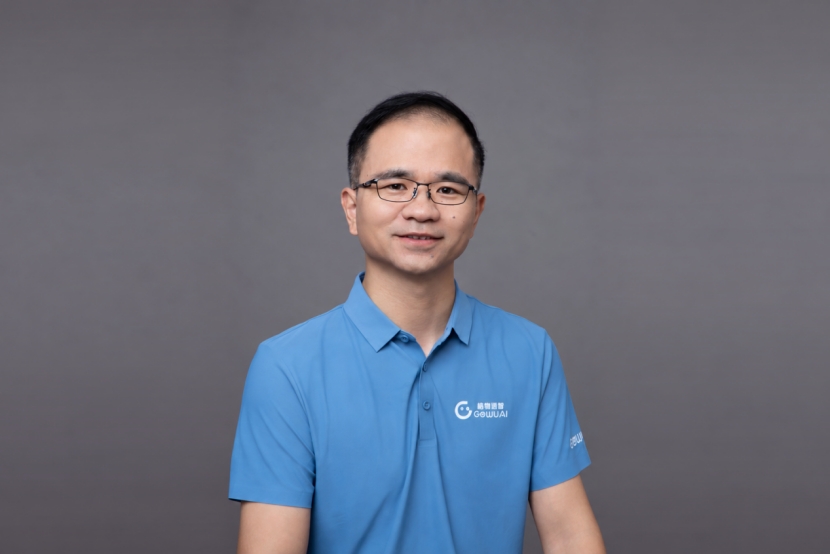
Dr. CAI Jia, Founder and CEO of GeWu Intelligence (Source: Enterprise)
In addition, many core members are from leading industry enterprises such as Huawei, Li Auto, Horizon Robotics and Agibot, and graduated from top universities including Tsinghua University, Zhejiang University, Shanghai Jiao Tong University, University of Science and Technology of China, Fudan University, Harbin Institute of Technology, Northwestern Polytechnical University and Nanyang Technological University, covering the whole chain of cutting-edge AI research, complex system engineering and large-scale delivery. The team has both academic research background and mature industrial implementation capabilities.
In the past two years, embodied intelligence has made substantial progress in technical links such as visual perception and motion control, enabling robots to identify objects, plan paths and reproduce complex limb movements. However, most of these capabilities remain at the level of long-distance, non-contact perception and execution, and it is difficult to deal with fine manipulation problems. Once entering the real production site, facing physical interactions at the contact level such as fabric slippage, part jamming and insertion resistance, relying solely on vision cannot obtain the magnitude, direction and contact state of force, and the shortcomings of perception dimensions will be directly exposed.
Another underlying bottleneck lies in data. Most embodied intelligence enterprises rely on crowdsourced collection or material library data to train models. Such data has structural deviations from real physical working conditions, and conditions such as illumination, process parameters, equipment abnormalities and human intervention are disconnected from the real environment. More critically, the data in real scenarios has a clear causal chain: "what action leads to what result, what abnormality triggers what adjustment. These causal correlations can hardly be obtained from material data separated from scenarios. Intelligence developed out of real scenarios can hardly be truly implemented." said Dr. CAI Jia, Founder and CEO of GeWu Intelligence.
In the view of the GeWu Intelligence team, the entry of robots into factories is only the starting point. The real challenge is whether it can work continuously on the production line, adjust by itself after encountering problems, and bring the experience of this time to the next workstation.
CAI Jia splits this path into three links: Deploy — first place the robot at the customer site to complete a specific process for the customer; Learn — convert the successful experience, failure trajectory, exception recovery and manual correction generated in the operation into training data; Generalize — migrate the operation capabilities accumulated from specific projects to the next workstation, next task, and next robot ontology.
To understand the technical foundation of GeWu Intelligence, we need to return to the core problem of dexterous manipulation: how robots form a "sense of touch".
Traditional robots learn the joint trajectories of human hands. For example, when unscrewing a bottle cap, the robot will imitate the corresponding action by learning the movement trajectory of human fingers. "But this is only 'similar in form'." CAI Jia told 36Kr, "It does not know how much force a person needs to use, what the friction coefficient is, whether to increase the force or adjust the angle when encountering resistance. Once the bottle cap of different materials or the thread with different tightness is replaced, the model may fail."
Aiming at this blind spot, the GeWu Intelligence team first proposed the technical route of "physical inversion world model", allowing robots to infer hidden physical information such as contact and force from visible actions for large-scale pre-training; then combine real force and haptic feedback for calibration, supplementing learnable physical labels for action data.
Haptic data is the core of this path and also a recognized problem in the industry. Since the dimension of haptic signals is low, usually only dozens of dimensions, while an image has millions of dimensions, it is extremely difficult to integrate the two in the same model. At the same time, the collection of haptic data is high-cost and low-speed, and large-scale application has always been a bottleneck.
The solution of GeWu Intelligence is Real to Sim (Reality to Simulation), which uses real physical interaction data to build a simulation environment in reverse, and a series of operation paths have been determined.
The core value of this data pipeline is to convert the massive first-person and third-person videos on the Internet into effective data that can be used for model training. The large-scale collection of haptic signals has long been restricted by high cost and low efficiency, while visual data is naturally easy to obtain. Relying on the Real to Sim solution, the team can reversely deduce and reconstruct the corresponding haptic signals from the visual picture, enabling haptic data to achieve the same large-scale collection capability as visual data.
At the same time, at the level of world model architecture, the solution greatly improves the signal-to-noise ratio of physical information such as force and haptics, realizes native integration with visual information, so as to acquire operation sense beyond human level; and through modeling and prediction of physical causality, the model can understand the underlying laws behind operations, further enhancing the cross-scenario generalization ability.
On this basis, GeWu Intelligence further builds a PSI physical self-evolution system, which can realize the capability iteration closed loop of "physical inversion - planning execution - real feedback - evaluation learning - verification deployment". The successful experience, failure trajectory and manual correction generated by the robot during operation are filtered and evaluated to improve the physical state estimation and operation strategy, and the updated model is verified before entering the next round of tasks.
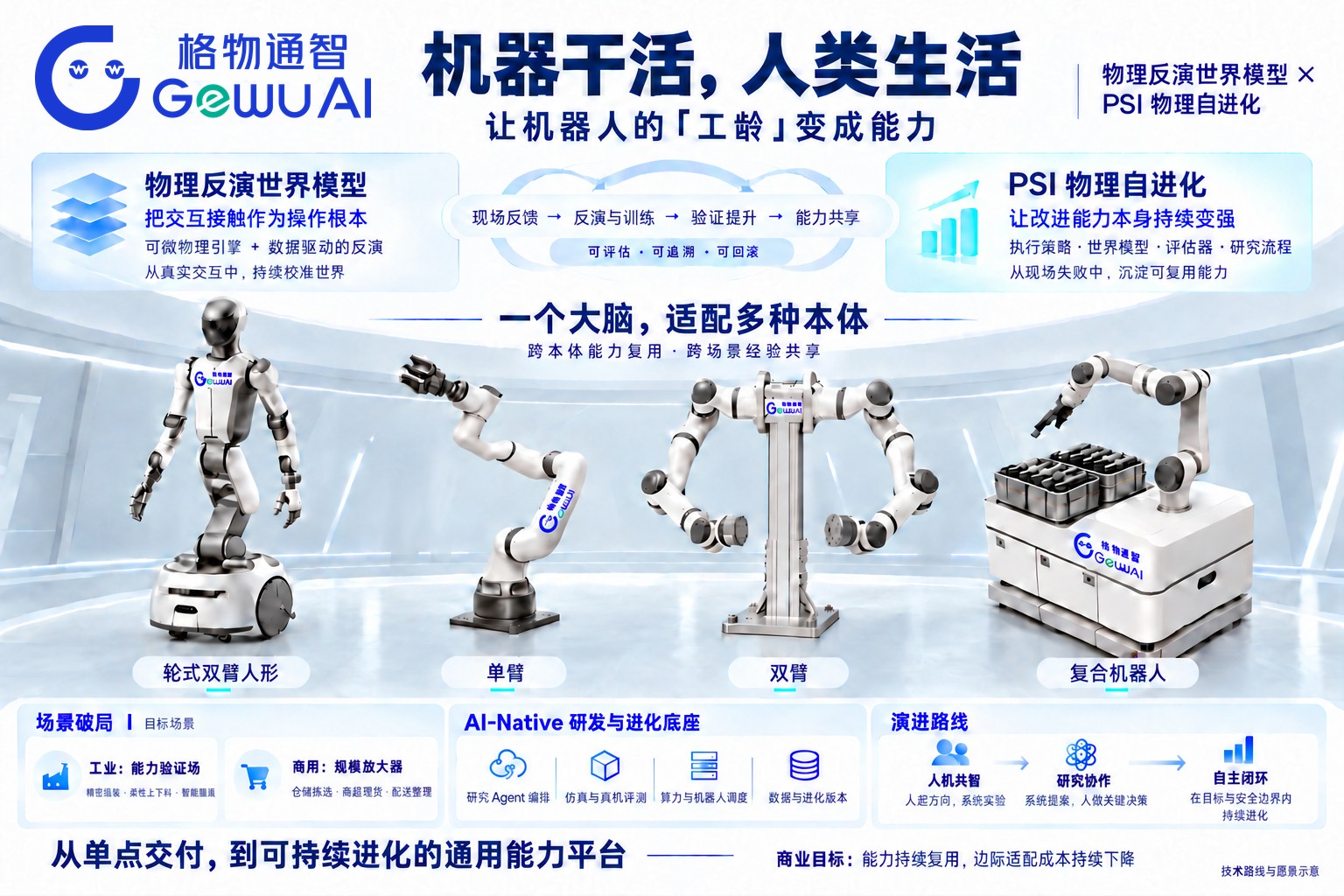
Build the technical system of "physical inversion world model + PSI physical self-evolution" (Source: Enterprise)
CAI Jia told 36Kr that the core of this mechanism is two-way improvement: a more accurate world model helps robots make more effective plans, and more valuable execution feedback helps the model identify its own errors and optimize subsequent learning. At the same time, the system can optimize data screening and improve the efficiency of learning from experience through the model's judgment of failure causes and uncertainty.
This has direct value in industrial scenarios. "When traditional robots are deployed to new workstations, repeated teaching, debugging and trial and error are required; while what we hope to achieve is that the experience accumulated in one site can reduce the migration cost of the next site. When customers add one more application scenario, what we gain is not only business opportunities, but also reusable deployment experience." CAI Jia said.
36Kr has learned that GeWu Intelligence is promoting joint innovation PoC with customers in the fields of textile and apparel, optical modules and auto parts, and is expected to complete the first PoC delivery by the end of 2026. The company chooses to cut in from tasks with clear boundaries and quantifiable acceptance standards, gradually expand the coverage of environments and tasks, break through the Y-axis accuracy success rate first, and then break through the X-axis generalization. After verifying the basic capabilities in real scenarios, the accumulated experience will be migrated to a wider range of tasks and robot ontologies.
The following is an excerpt of the interview between 36Kr and Dr. CAI Jia, Founder and CEO of GeWu Intelligence (slightly edited):
36Kr: Haptic data collection has long faced cost and efficiency bottlenecks. Why did GeWu Intelligence choose the Real to Sim technical path?
CAI Jia: Haptics is the core for robots to realize dexterous manipulation, but haptic data collection itself has always been a difficult problem in the industry. If we only rely on haptic gloves for collection, not only the cost is high and the collection efficiency is low, but even after wearing the gloves, the operators will be affected in their normal daily work. As a result, the volume of data that gloves can obtain is very limited, which is difficult to support the generalization ability required for embodied model training.
The idea of GeWu Intelligence choosing Real to Sim is very clear: video data is the easiest to obtain on a large scale, so we reversely reconstruct haptic signals such as interactive contact from videos. The accuracy of the haptic data reconstructed by the solution is expected to meet the pre-training requirements, and then the accuracy will be further aligned through real on-site data. More importantly, this pipeline gives haptic data the same large-scale potential as visual data. The huge stock of first-person and third-person videos on the Internet can be processed through this process and converted into training samples with haptic labels.
36Kr: You emphasize that quality is better than quantity in data governance. How did this judgment come into being?
CAI Jia: The core lies in whether a quantifiable data value evaluation system can be built to automatically filter out low-value redundant data.
This evaluation system is not a simple manual sampling inspection, but scores data from multiple dimensions, such as the rarity of scenarios, the diversity of actions, the proportion of failure cases, the matching degree with the weak links of the current model, and so on. Low-score data is directly discarded, and high-score data enters the training set. At the same time, after each round of training, a fixed evaluation set is used to test the performance of the model, find out new weak links, and then reversely guide the next round of data screening.
We can take autonomous driving as an example. If uniform random sampling is adopted, more than 90% of the time during human driving is in a steady driving state, and there are almost no scenarios such as emergency avoidance and complex lane changing. This kind of conventional data does not need to be accumulated in large quantities, and excessive stacking will weaken the learning effect of the model in key scenarios. In the past, when we trained the intelligent driving world model, the total amount of 10 million clips did not change much, but its recipe was optimized and refreshed every week. Therefore, it is necessary to score the data and retain high quality and good diversity samples.
We migrated this idea to the development of the embodied world model. From the first day, the team has adhered to the data concept of quality first, and kept the data redundancy at a very low level. Many peers are competing for the data scale of millions of hours, but a large amount of them are redundant data, and the proportion of truly effective samples is not high. In the environment where storage costs continue to rise, this strategy has advantages. We do not need to consume resources for invalid data.
36Kr: GeWu Intelligence chooses to cut in from industrial scenarios. Different customers have significantly different indicator requirements for the embodied operation capabilities of robots. How does the team define the priority of scenario entry?
CAI Jia: The requirements of different factories for capability boundaries are indeed significantly different. The accuracy requirement ranges from plus or minus 0.1 mm to 1 or 2 mm, the cycle time ranges from millisecond level to minute level, the success rate requirement ranges from 90% to 99%, and the reliable working time ranges from 8 hours to 24 hours.
The strategy of GeWu Intelligence is to choose scenarios that match the current capabilities to cut in, and gradually extend to higher requirements. I think the value of a startup lies in identifying and focusing on truly valuable and scalable scenarios, and then expanding scenarios in a step-by-step manner. It may gradually reach the "GPT 3 moment" of embodied intelligence.
For specific scenarios, we mainly look at several dimensions: first, the quantifiability of tasks, whether the acceptance criteria are clear; second, the matching degree with the current model capabilities, whether the accuracy success rate can meet the basic requirements of customers; third, the replicability of scenarios, whether the experience accumulated in one site can be migrated to the next site. At this stage, three points depend on the model, and seven points depend on engineering. For embodied intelligence to become truly practical, it should grow up in this scenario, rather than growing up in collected materials separated from the scenario.
The indicator we value most is not the accuracy success rate, but the customer repurchase rate. No matter how high the Demo accuracy success rate is, if customers are not willing to repurchase, it means that the product does not really solve the problem. Repurchase means that customers think the ROI of this investment is cost-effective, and means that robots are truly integrated into the production process.