The per-vehicle cost is 73,000 yuan higher than that in China, and Europe cannot stop Chinese cars under any circumstances.
The numerous recent news stories emerging between China and Europe are sparks generated by another head-on collision between two automotive industry systems.
The price gap between vehicle models at home and abroad is vaguely perceived by the market. Everyone knows that Chinese cars are cheaper than foreign ones, but consumers do not have a clear idea of how much lower the price is exactly.
Recently, a commercial consulting firm has given the answer to this question.
Data from the US firm AlixPartners shows that Chinese automakers can produce an electric vehicle at a cost of $20,000, while similar competing models in Europe cost $31,000, a difference of $11,000, equivalent to 73,000 RMB.
This is the manufacturing-side cost. The terminal selling price is also affected by factors such as brand, positioning, market, and tariffs. Especially overseas, tariffs can even double the selling price compared to the domestic market.
European politicians hope to close this $11,000 gap with tariffs, but analysts point out that tariffs cannot eliminate the structural cost gap, and can only weaken price competitiveness. Even with taxation, Chinese electric vehicles still retain huge cost advantages. Because this advantage does not come from government subsidies, but is jointly determined by the supply chain cluster, independent R&D of enterprises and economies of scale.
Surge in sales of independent brands, Europe is getting more and more nervous
Driven by the overseas expansion strategy, Chinese independent brands such as Geely, SAIC, BYD, and Chery have continued to make efforts in the European market, with a growth performance that is so outstanding that it catches the eye.
According to Dataforce statistics, from January to August this year, the cumulative sales of Chinese passenger vehicles in the European market reached 913,000 units, a year-on-year increase of 111%, 24 times the growth rate of the overall market; the corresponding market share increased from 5.2% in the same period last year to 9.9%. Looking at August alone, the market share of Chinese brand passenger vehicles further climbed to 11.7%.
The local electrification process in Europe has also accelerated, with the penetration rate of electric vehicles reaching 29% in August, and the average penetration rate from January to August being 23%. There is no doubt that new energy has become the core engine of growth in the European automotive market, and Chinese brands are an important source of incremental growth in this sector.
In the first three quarters of this year, the total sales of electric vehicles in 14 core European countries reached 1.867 million units, a year-on-year increase of 36.15%; among them, the sales of Chinese brand electric vehicles reached 371,300 units, a sharp year-on-year increase of 79.12%, significantly higher than the overall market growth rate.
Looking at the TOP20 list of electric vehicle sales in Europe, the listed Chinese enterprises include BYD, Leapmotor, MG, XPeng, and Geely. Excluding the extreme year-on-year increase of 21296.97% caused by Geely's extremely low base, Leapmotor's sales growth exceeded 5 times, XPeng's growth reached 167%; BYD ranked seventh, and still maintained a growth rate of more than 70% on the premise of a large existing sales base.
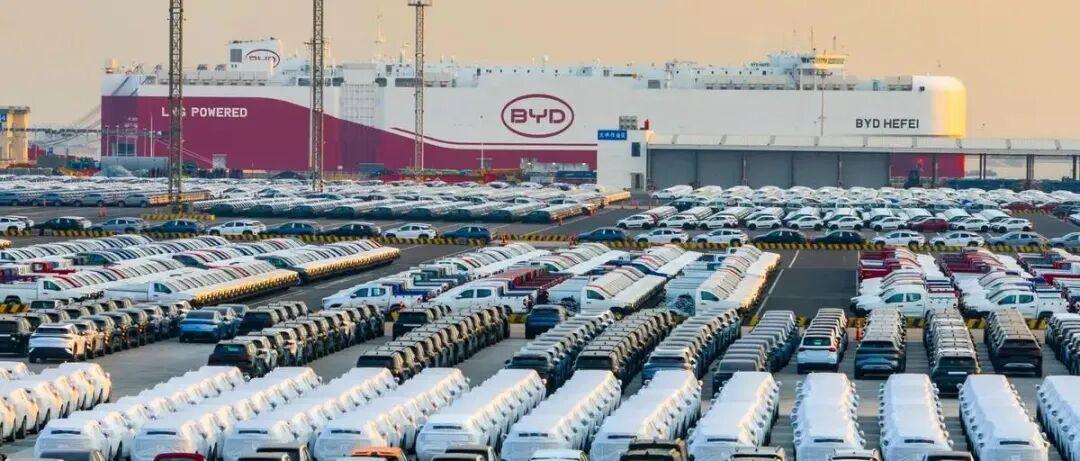
It is worth noting that this round of growth occurred after the European Union imposed a maximum 45.3% tariff on Chinese pure electric models in 2024.
The implementation of tariffs did not block the export growth of Chinese automakers, but only the export structure has changed slightly: the growth rate of pure electric models has slowed down, and the export of plug-in hybrid models has accelerated more rapidly.
Eurostat data shows that the EU imported 107,000 hybrid vehicles from China in 2024, and the figure rose to 302,000 in 2025; as for this year, in July alone, the EU imported 50,400 Chinese plug-in hybrid vehicles, a sharp year-on-year increase of 163.2%.
The rapid rise in plug-in hybrid imports has also become the direct trigger for the EU to recently brew restrictions on the trade of Chinese plug-in hybrid vehicles. Earlier, the EU proposed an agreement requiring China to cut its exports of hybrid vehicles to Europe by more than half within four years, amounting to one million units.
Bloomberg reported that the quota is based on 2025 trade data, allowing 350,000 Chinese hybrid vehicles to be imported in the first year, and the quota will increase by 6% every year from the second year; the policy cycle lasts for four years. Calculated in this way, the total four-year quota is about 1.5 million units.
According to data from the Financial Times, if the growth rate in July is maintained, the total import volume in 2026 will reach 600,000 units, 70% higher than the first-year quota in the report, which shows that there is a clear mismatch between the original quota scheme and the real growth rhythm of the market.
There is no specific quota information in China's response. On the 12th, the Ministry of Commerce stated that China and Europe have reached a consensus on the trade of hybrid and electric vehicles, setting up an incremental arrangement based on the 2025 level to ensure the export space and stable growth of Chinese enterprises, and take into account the actual demands and reasonable concerns of the industries of both sides.
Although trade frictions continue to heat up, and tariff and quota tools have appeared one after another, market data shows that such policy measures have not curbed the expansion momentum of Chinese automobiles in Europe. Trade restrictions can only adjust the export structure, and it is difficult to shake the deep-seated competitive foundation behind it.
Quotas and additional tariffs cannot stop Chinese vehicles
Tariffs and quotas have not stopped the pace of Chinese automobiles.
The rapid expansion of Chinese automakers in the European market is supported by both product power and price.
In terms of product power, Chinese new energy vehicles have indeed established differentiated advantages by virtue of intelligence and electrification in the past.
However, European consumers' demand for intelligence is significantly lower than that of domestic consumers. In addition, in the past two years, local European automakers such as Volkswagen and BBA have accelerated their new energy transformation. Products such as Mercedes-Benz pure electric CLA, GLC, and BMW new generation iX3 have received good responses in the regional market, and the product power of local brands is catching up rapidly.
In contrast, price is still the core competitiveness of Chinese brands. As mentioned earlier, independent brand electric vehicles have a $11,000 manufacturing-side cost advantage over European competing products, and in the terminal sales scenario, the price gap of the same model between China and Europe is further widened.
The average domestic price of NIO Firefly is 126,500 RMB, and the average price in Thailand is 161,000 RMB; in Europe, Norway has the lowest selling price at about 180,000 RMB, and Hungary has the highest average price at 262,000 RMB, which is directly double the average domestic price. The average domestic price of XPeng L03 is 140,300 RMB, Norway is also the market with the lowest average price for XPeng in Europe, at about 257,700 RMB, an increase of 83% over the domestic price; Switzerland has the highest average price, reaching 333,400 RMB.
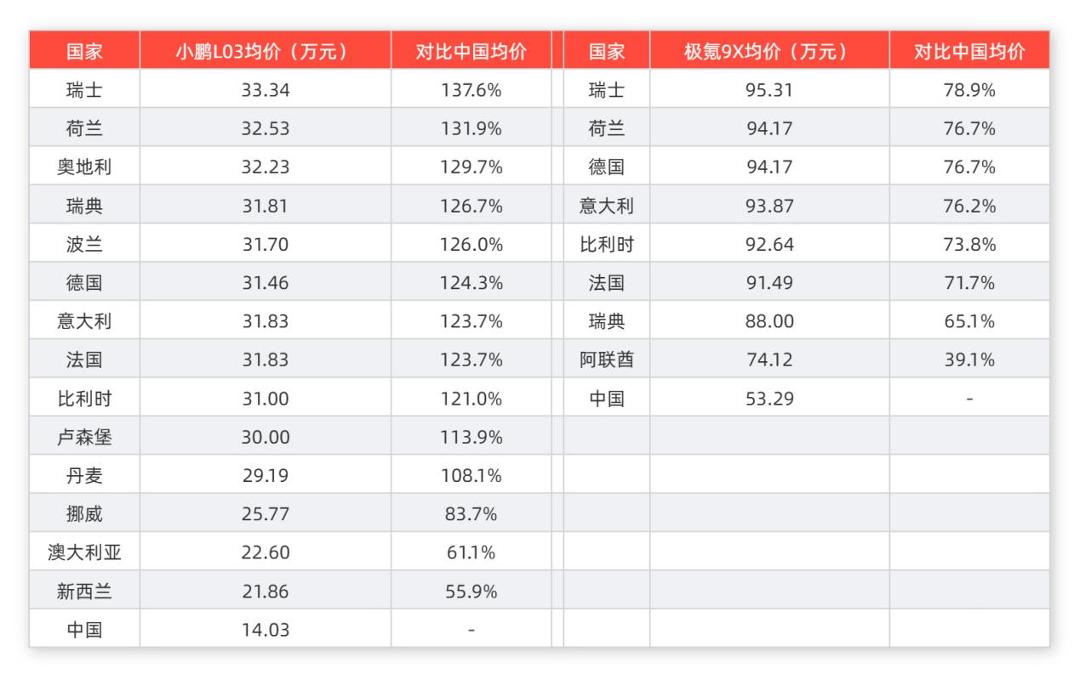
From A0-class small cars under 100,000 RMB to high-end flagship models above 500,000 RMB, there is generally a significant average price gap between models in the domestic and European markets, which is far higher than the 45.3% tariff barrier. Even with cross-border logistics costs added, Chinese models still maintain considerable competitiveness compared with local European products.
A typical example is Denza Z9 GT, whose domestic guide price is less than 400,000 RMB, and the European market is priced at 115,000 euros, directly targeting the Porsche Taycan.
The huge price gap has also made European policy makers misjudge the competition logic of Chinese automakers, which has led to trade intervention measures in the name of "fair competition".
As for the EU quota, the German Association of the Automotive Industry (VDA) evaluates the policy based on whether it contributes to fair competition, creates planning certainty, and strengthens open and rule-based trade. The focus also falls on fairness.
However, protection measures such as tariffs and quotas can only treat the symptoms in the short term, and cannot reverse the pattern fundamentally, because the cost advantage of Chinese automakers is rooted in faster R&D iteration speed, independent software architecture and full-chain supply chain management capabilities.
In terms of R&D cycle, Chinese automakers generally only need 24 months to develop a new model, while similar projects of European automakers often take as long as 60 months; 76%-100% of the sales of Chinese automakers come from new models launched in the past three years, while the proportion of European automakers is only 33%.
In terms of supply chain, the layout of the European supply chain is relatively scattered, and automakers' parts mainly rely on imports. The long-distance transportation of parts pushes up time and capital costs.
On the one hand, Chinese automakers have begun to deploy large-scale independent R&D and production of core components such as batteries, chips, and motors. Data from the International Energy Agency shows that the price of Chinese cells is more than 30% lower than that in Europe; on the other hand, the domestic automotive supply chain cluster continues to iterate, with prominent industrial agglomeration effects, accounting for more than 80% of the global power battery manufacturing and raw material production capacity, and contributing more than half of the global electric vehicle output. Relying on the huge market size, the manufacturing cost per vehicle can be continuously diluted.
Even if additional expenses such as tariffs and cross-border logistics need to be borne for sales to Europe, automakers can still rely on the underlying manufacturing cost advantage, combined with higher overseas terminal selling prices, to hedge the additional cost pressure brought by overseas expansion.
Next stop: system-based overseas expansion
Although tariff barriers can hardly stop the expansion of Chinese automakers, with a large number of independent brands pouring into the European market, the industry needs to cope with more diverse and complex long-term challenges.
The Paris Motor Show has become an important window to observe the European strategies of Chinese automakers. At this Paris Motor Show, 16 Chinese automakers with 25 brands participated in the exhibition, and their booth area accounted for one third of the entire exhibition, exceeding the sum of the participating brands from France and Germany.
However, the attitude of the European industrial sector is not friendly. On the eve of the Paris Motor Show, French President Emmanuel Macron held a closed-door dinner at the Élysée Palace, where vehicle groups, parts giants, battery and rare earth tycoons gathered, but there were no familiar faces for Chinese consumers. The abrupt statement that "Chinese exhibitors will not participate in this dinner" shut Chinese exhibitors out.
Nevertheless, the rejected Chinese automakers have not slowed down their pace. In this ambiguous atmosphere, the Chinese brands participating in this exhibition no longer simply aim to release new cars, but focus on disclosing their European localized implementation strategies. System-based overseas expansion has become a consensus.
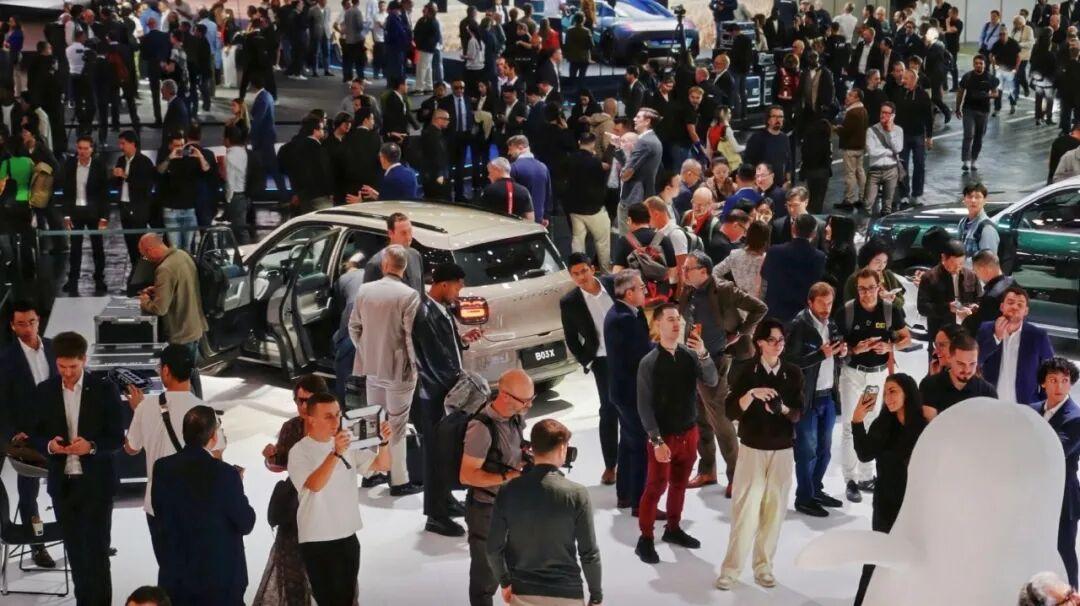
Among new power brands, XPeng is promoting localized production in Europe, and G9L has been put into production at the Magna factory in Austria and opened for European reservations; Leapmotor relies on Stellantis' mature channels to expand the market, will continue to iterate products and deepen localized operations.
Li Auto, which participated in the exhibition for the first time, brought the i6 and also brought Li Auto's restrained European strategy of "small market verification and then replication". In the first quarter of next year, the i6 will be launched in Europe, first entering small markets with high pure electric penetration rates such as Norway and the Netherlands to verify brand capabilities. Li Auto will follow the restrained strategy of "small market verification and then replication" in Europe, and after running through the service closed loop, it will expand to core markets such as Germany, France and the United Kingdom.
Geely Auto Group gathered in Paris with three major brands: Geely, Lynk & Co, and Zeekr. Geely has laid out in Europe for nearly 20 years, and will take Europe as the base of its globalization capabilities in the future, and export R&D, product, channel and manufacturing capabilities together. Recently, Geely has reached a cooperation with Ford in Europe, and the two sides will jointly build a joint venture company and share production capacity.
GAC has also entered a new stage of full-link localized deep cultivation in Europe, accelerating its layout in R&D, production, market and energy.
It is not difficult to see that the consensus of independent brands in Europe in the next stage is "system-based overseas expansion": to open up the complete chain of R&D, production, sales and after-sales, and export system capabilities at the same time.
Although the direction of overseas expansion is clear, automakers still face dual internal and external pressures.
At the domestic level, starting from April next year, the export tax rebate rate for value-added tax on new energy vehicles will be reduced from 13% to 9%. According to calculations, for every 100,000 RMB of ex-factory price excluding tax, the export cost will increase by 4,000 RMB.
The policy adjustment will weaken the cost advantage of pure electric vehicles going overseas at low prices, but it is beneficial to fuel and HEV products, which may in the short term prompt automakers to stock up overseas in advance before the spring of next year. In the long run, this change will force new energy automakers to break away from simple price competition, accelerate overseas localized implementation, and turn to rely on product power and brand value to participate in market competition.
On the overseas side, a large number of Chinese brands are entering the market intensively, and the competition on the European track continues to intensify. The growth mode that simply relies on low prices is unsustainable. At the same time, if automakers build factories in Europe, local production will gradually weaken the original cost advantage of domestic manufacturing.
From price difference to tariffs, from tariffs to quotas, Europe's defense tools against Chinese automobiles are constantly upgrading, but the offensive means of Chinese automakers are also becoming more diverse.
The numerous recent news stories emerging between China and Europe are sparks generated by another head-on collision between two automotive industry systems. Tariffs and quotas are emergency measures for Europe to protect its local industries, and Chinese automakers choose to respond with system-based overseas expansion.
This article is from the WeChat Official Account "Auto Community" (ID: iAUTO2010), author: Sai Jiatong, published with authorization from 36Kr.