Four consecutive limit-up boards, a concept sector in the A-share market has staged a sharp breakout.
Today, the aquatic products sector of the A-share market strengthens again.
Among them, Baiyang Co., Ltd. posts four consecutive 10% daily price limit hikes, Kaichuang International hits the daily limit, while other stocks including Drive, Oriental Marine, Yuehai Feed, Zhangzidao rise in tandem.
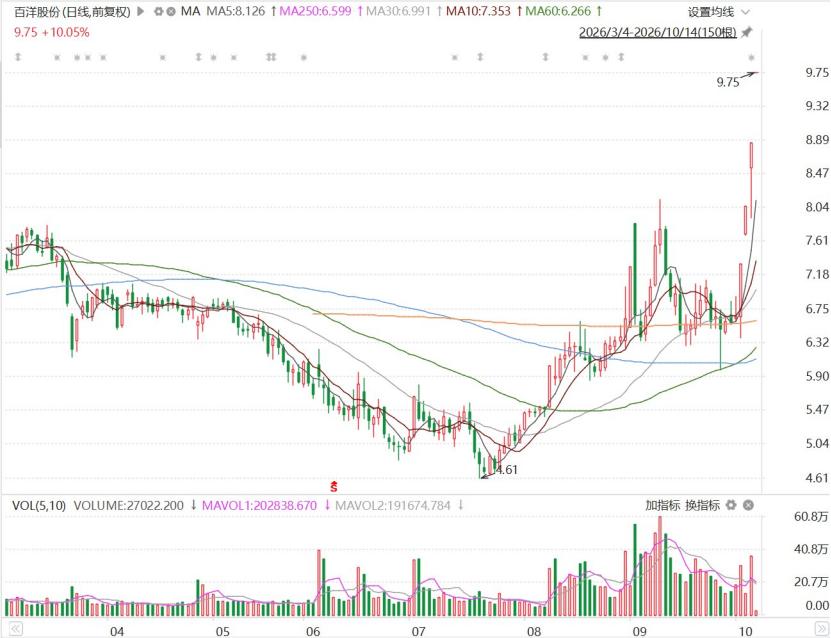
The direct trigger of this round of market rally is the severe contraction of global fishmeal supply, while the core driving factor is the El Niño phenomenon.
Affected by the continuous evolution of El Niño, the seawater temperature off the coast of Peru rises abnormally, leading to scattered distribution of anchovy resources, a high proportion of juvenile fish, and a drastically shortened fishing window.
The Peruvian Ministry of Production has confirmed the cancellation of the second anchovy fishing season in the north-central region of 2026, with the annual fishing quota down by about 36% year on year, hitting a low level in the past decade.
The drastic contraction on the supply side is directly reflected in prices.
According to data from institutions such as ING, the current global fishmeal price has skyrocketed by more than 75% year on year. The quotation of Peruvian super fishmeal once exceeded USD 2,800 per ton, and the spot price at domestic ports is close to RMB 20,000 per ton, hitting a new all-time high.
As the core protein raw material of aquatic feed, fishmeal accounts for 30% to 50% of the cost of special aquatic feed. Its price surge is reshaping the cost and pricing expectation of the entire aquatic industry chain.
This logic is exactly the same as the previous frenzied speculation of the agriculture concept.
Baiyang Co., Ltd. has become the leader of this round of market rally, which is driven by multiple superimposed factors.
The company is one of the few aquatic enterprises in China that has overseas fishmeal production capacity layout. Its ocean-going base in Mauritania, Africa can produce fishmeal, fish oil and other products, directly benefiting from the rise in fishmeal prices.
At the same time, the company's feed business covers the South China market, with fishmeal inventory and alternative protein resources, and has strong bargaining power in the environment of raw material shortage.
In addition, the controlling shareholder of Baiyang is Qingdao Guoxin Group, and its state-owned background is in line with the recent market preference for the local state-owned enterprise concept.
Kaichuang International is mainly engaged in ocean-going tuna fishing and aquatic product processing, with rich marine fishery resources. Against the backdrop of tightening global aquatic product supply, the dual prosperity linkage of fishing volume and product price brings direct benefit expectations to the company.
However, investors need to take the lessons of the agriculture concept seriously.
Despite the skyrocketing fishmeal price, downstream feed enterprises are generally cautious and wait-and-see towards high-priced fishmeal, focusing on replenishing inventory based on rigid demand, and their willingness for bulk procurement has dropped significantly.
If terminal farmers reduce fry stocking due to excessively high costs, the shrinking demand side may reversely suppress fishmeal prices.
In addition, Baiyang Co., Ltd. recorded a net loss of RMB 82.5364 million in the first half of 2026, down 800% year on year, and its fundamentals have not been substantially improved; Kaichuang International also recorded a loss of RMB 30.31 million in attributable net profit in the mid-term.
The current stock price rise is more of an expectation game driven by events, rather than performance realization.
In the short term, the tight supply pattern of fishmeal is expected to continue until the start of the new fishing season in 2027, and the high price operation is highly certain, which gives speculative funds reasons and space for speculation.
However, whether the sector rally can continue depends on whether the price increase can be smoothly transmitted to the prices of terminal products, and whether enterprises can effectively pass on cost pressures.
To put it plainly, it all boils down to the realization of corporate performance.
The agriculture concept was also wildly speculated at that time, with many stocks posting consecutive daily limit hikes, and many even doubling their share prices, but what happened later?
Once market sentiment recedes, the stock price will hit the limit down before performance falsification even happens.
The most typical and representative example is Wanxiang Denong.
It is not an ordinary agricultural stock, but the most standard "demon stock sample" in this El Niño theme: it doubled in the early stage driven by sentiment, then its performance, valuation and logic were all debunked, and its stock price collapsed rapidly from the high level.
Why it?
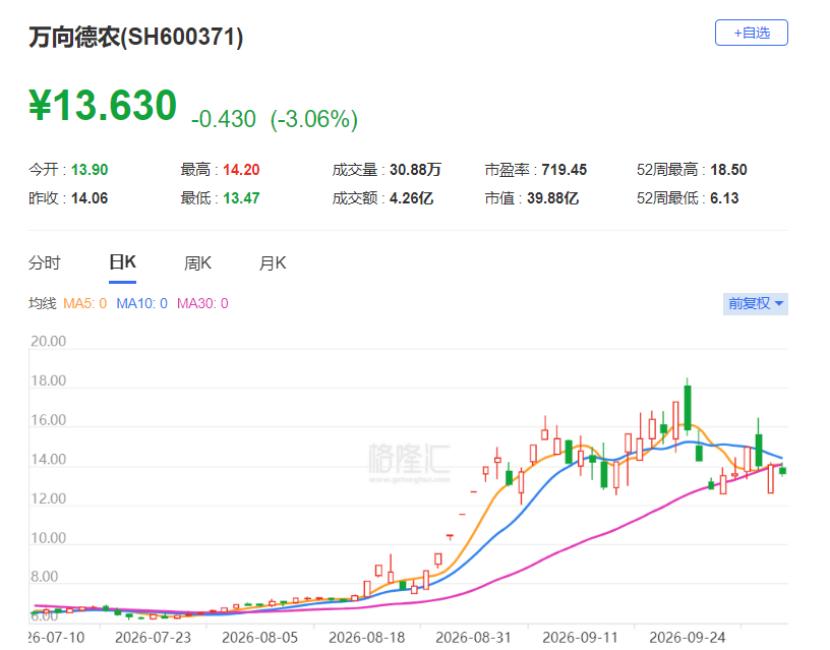
From August 17 to September 8, 2026, Wanxiang Denong's cumulative increase reached 122.64%, with 9 daily limit hikes during the period, triggering abnormal trading fluctuations for many times.
By September 24, the stock price opened more than 4% higher, hitting a high of 18.5, but soon turned downward, closing down 8.28% sharply.
After that, it experienced multiple limit downs. As of press time, the latest price is RMB 13.63, with a 27% drop in 3 weeks.
The reason is that the market was speculating on "El Niño driving up corn prices", but the company's main business is corn seeds, which belongs to the upstream of the industrial chain and does not directly benefit from the price rise of commodity corn.
What is more awkward is that the corn seed industry was in a stage of oversupply at that time, with prices under pressure, and the gross profit margin of the company was still declining.
In the first half of 2026, the company's operating revenue was RMB 99.47 million, down 15.14% year on year; the attributable net profit was RMB 13.8 million, down 44.47% year on year; the non-recurring profit and loss deducted net profit was RMB 11.47 million, down 52.19% year on year.
By October 13, the dynamic P/E ratio was still around 149 times, and the rolling P/E ratio was still negative, indicating that the earnings quality is still very weak.
From the perspective of capital structure, this kind of speculation is dominated by hot money. Its high turnover, consecutive daily limit hikes, Dragon Tiger List appearance, and multiple abnormal fluctuation announcements are all typical characteristics dominated by short-term funds.
The turnover rate on October 13 was still as high as 20.69%, indicating that the chips are not stable.
Wanxiang Denong is not "a callback after fundamental reversal", but a valuation kill after the theme recedes.
Its most typical feature is: it was wildly speculated in the early stage driven by El Niño expectations, the company repeatedly warned that its stock price deviated from fundamentals, its performance was still declining, its valuation was not low, the stock price repeatedly fell from the high level, and the rebound was mostly sentiment-driven game.
This also shows that event-driven market rallies often come and go quickly, and investors need to be cautious when chasing high prices.
This article is from the WeChat official account "Gelonghui Finance Hotspot" (ID: glh_finance), written by Max, and authorized for release by 36Kr.