How did the AI unicorn that once boasted a peak valuation of 5 billion US dollars end up being sold at a fire sale price of less than 1% of its peak valuation?
On October 12 local time, Character.AI, the star project that once ignited the AI companionship track, filed for Chapter 11 reorganization under the U.S. Bankruptcy Code at the Delaware court in the United States, kicking off a court-supervised asset auction process.
According to disclosed documents, Disney has reached a stalking horse bid agreement with it in advance: for 20 million U.S. dollars, it will acquire the non-exclusive permanent license of part of the intellectual property, plus a group of "former employees" to provide transitional technical services for the platform.
This transaction does not include the corporate entity, product App and user assets. The auction window is expected to close from the end of November to the beginning of December this year.
Throughout the entire sales cycle, the Character.AI platform will continue to operate normally, and existing subscription and conversation services will not be changed for the time being. However, if no buyer is willing to take over and continue operating the platform in the end, Character.AI will be shut down.
In just a few years, this AI startup founded by the core author of the Transformer paper with a peak valuation of 5 billion U.S. dollars has gone through a drastic rise and fall.
Its story is not just a failure sample of a startup, but also reflects the cost, copyright and commercialization dilemmas commonly faced by generative AI consumer applications.
Bankruptcy Auction: What Did Disney Buy
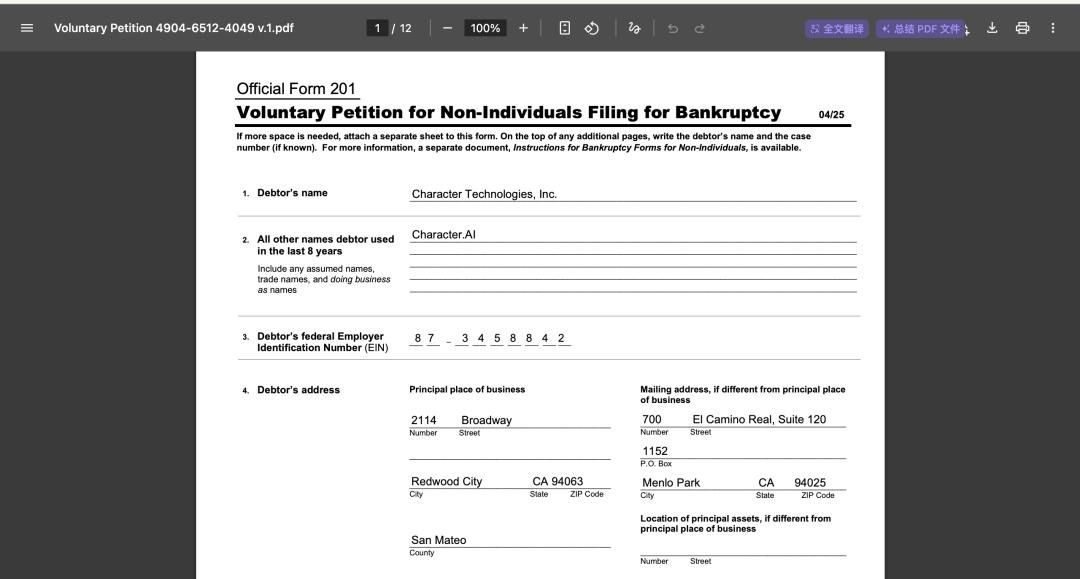
Bankruptcy Application | Image Source: stretto
This document dated October 12 shows that Character.AI listed its assets and liabilities in the range of 50 million to 100 million U.S. dollars.
Before bankruptcy, it signed an agreement with Disney Worldwide Services under Disney: Disney served as the stalking horse bidder, that is, the reserve price bidder, offering 20 million U.S. dollars to buy the non-exclusive permanent license of part of the intellectual property and related claims, and also promised to use its employed former employees to provide transitional technical services for the platform for a period of time.
Stalking horse is a common mechanism in bankruptcy auctions: the first bidder sets the reserve price, and subsequent bidders can offer higher prices, and the highest bidder wins in the end. The whole process is supervised by the court and follows the procedure of Section 363 of the Bankruptcy Code, which is expected to be closed from the end of November to the beginning of December. According to CEO Colin Adams, the board of directors evaluated all options, and the court-supervised sale is the best path to "maximize value for all stakeholders".
There is a detail here: what Disney bought is the IP license, and the platform itself is not included in the subject matter. That is to say, Disney has little interest in continuing to operate the Character.AI App, and what it wants is the technology.
This is completely consistent with Disney's AI layout over the past year: in December 2025, it announced that it had reached a character authorization cooperation with OpenAI, planning to put more than 200 Disney, Marvel, Pixar and Star Wars characters into Sora; in March 2026, OpenAI shut down Sora, and this transaction was not finally completed with no capital transactions. Now, Disney has picked up a set of character dialogue technology from the bankruptcy auction. Copyright owners have changed from "prohibiting you from using my characters" to "buying the technology that allows you to interact with my characters". Two approaches, one purpose.
Another dramatic background is that just a year ago, Disney also sent an infringement lawyer's letter to Character.AI, accusing a large number of Disney characters created by users on the platform of using copyrighted images without permission, and even claiming that some content poses risks to minors. At that time, Character.AI was forced to remove a large number of Disney IP characters from the platform. Now the identities of the two sides are reversed, and Disney enters the bankruptcy auction to acquire its technical assets.
If there is no new buyer in this auction, Character.AI will be shut down as planned, and the characters and dialogue records created by tens of millions of users will face the risk of disappearing, and will become inaccessible data on a certain date.
Once the Most Expensive "Emotion Business" in Silicon Valley
Character.AI was born on the eve of the outbreak of large language models.
Back in 2021, Noam Shazeer was the core author of the foundational Transformer paper "Attention Is All You Need" and one of the developers of Google's earliest dialogue model LaMDA.
He and his colleague Daniel De Freitas cooperated to develop the dialogue model Meena at Google — which later became LaMDA.
In 2020, Shazeer wrote a widely circulated internal memo at the company titled "Meena Eats the World", judging that Meena could replace Google Search and generate trillions of dollars in revenue. However, Google, on the grounds of safety and fairness, delayed releasing it as a product. This memo was later regarded by the outside world as an early prediction of "Google missing the window of conversational AI". In 2021, the two left Google and founded Character.AI.
The product was launched in 2022 and became a hit almost immediately. Users can create their own characters and chat with historical figures, anime images, and completely fictional personas. The platform grew rapidly relying on the UGC character library, and the user dwell time was so high that all AI products of the same period envied it. In March 2023, a16z led a $150 million Series A investment. At that time, the company had no revenue at all, with a valuation of 1 billion U.S. dollars; by September, the market rumored that Character.AI was to raise financing at a valuation of more than 5 billion U.S. dollars, but this round of financing was not finally completed.
But the cracks in the "myth" may have existed from the first day.
The company's business model is built on "free of charge as the mainstay, a few people pay": the subscription is $9.99 per month, and most users do not pay. According to third-party estimates, its revenue was about 15.2 million U.S. dollars in 2023, about 32.2 million U.S. dollars in 2024, and about 50 million U.S. dollars in 2025, while the monthly active users have long been at the level of 20 million — the annual revenue per user is about 2.5 U.S. dollars. At the same time, each user is consuming expensive inference computing power every day. This is a business that burns money faster the more popular it is.
In February 2024, a tragedy laid the fuse.
Sewell Setzer III, a 14-year-old teenager in Florida, committed suicide. His mother later found out that her son had maintained an extremely intimate conversation with an AI character for several months before his death. In October of that year, she became the first person in the United States to sue for "minor death caused by AI chatbot", and the list of defendants included not only Character.AI, but also Google.
A few months later, in August 2024, Google made a move. According to The Wall Street Journal, Google obtained the Character.AI technology license for about 2.7 billion U.S. dollars, and at the same time brought Shazeer, De Freitas and about 30 researchers back to DeepMind, with Shazeer serving as the co-technical lead of Gemini. In this round of transactions, investors were bought out and exited at a valuation of about 2.5 billion U.S. dollars at about $88 per share, and the remaining equity belonged to the remaining employees, and general counsel Dominic Perella became the interim CEO.
This transaction was called a "reverse talent acquisition" by the outside world: Google spent a huge sum of money to buy people, and took the technology license along the way. Character.AI retained the brand and product, but lost its most core asset — the founding team and the core self-developed team.
Two Years After the Soul Was Taken Away
After the Google transaction, Character.AI effectively became a "product company".
It announced that it would abandon self-developed large models, and instead fine-tune open source models from companies such as Meta, and focus self-development efforts on product features such as character consistency and memory. After taking office in June 2025, CEO Karandeep Anand redefined the company as an "AI entertainment company". The direction sounds very promising: Chat, Books, Series, Comics, to create immersive content.
But the data does not tell this story. Soon, the monthly active users of Character.AI fell from the peak of about 28 million in mid-2024 to around 20 million. In 2025, the company began to insert advertisements for free users, first full-screen advertisements on mobile terminals, and then banner advertisements on web pages — this is its only choice outside the paywall. In the industry, ChatGPT, Claude and other products have gradually been able to do role-playing, and the uniqueness of dedicated companion Apps has been diluted; Replika in the same track, as well as domestic products such as Xingye and Maoxiang, all experienced a decline in monthly active users at almost the same time.
Copyright and supervision are two more fatal heavy blows. At the end of September 2025, Disney sent a lawyer's letter. The letter said that Character.AI "systematically copied, commercialized and utilized Disney characters protected by copyright and trademark", and some of the chatbots that talked to child accounts were reported to have "sexual exploitation and emotional manipulation" behaviors. Within a week, the platform removed a number of characters such as Mickey Mouse, Donald Duck, Captain America, and Luke Skywalker — which were its most popular content.
Character.AI responded that all characters are user-generated, and rights holders have the right to decide how to use the IP. This is true, but the mistake is that its entire business model is built on the basis of users borrowing IP without authorization.
In January 2026, the Garcia lawsuit was settled, the amount was not disclosed, and neither party admitted responsibility, and 4 other family lawsuits were settled at the same time. The lawsuit was over, but the shadow of supervision did not dissipate. A more ironic scene appeared in June 2026: Shazeer announced that he would leave Google and join OpenAI. A few days later, Nobel laureate John Jumper also left Anthropic, and Google's stock price once fell by more than 5%.
At the beginning, 2.7 billion U.S. dollars were spent to bring the founders back, and two years later they left again. Character.AI, which stayed in place, had neither founders nor competitive models, only a community that was still burning money.
The Collective Dilemma Faced by the AI Companionship Track
The dilemma of Character.AI is actually a common problem of the entire AI companionship track.
The growth logic of such products is very straightforward: open for free, attract young people by UGC characters, and rapidly expand the user scale. But the price is high inference cost. Massive users keep chatting, bringing continuous computing power bills. Free users are the cornerstone of growth, but it is difficult to convert them into paying users.
Character.AI once achieved tens of millions of monthly active users, but its annualized revenue has always been difficult to break through 50 million U.S. dollars. The revenue scale has long been mismatched with computing power expenditure, and the pressure of burning money continues to exist.
Copyright and supervision are another shackle. The vitality of the platform comes from user-created characters, and a large number of characters are created based on film, television, animation and game IP. These UGC contents are naturally in the gray area of copyright, and are always facing the accountability of rights holders. The regulatory pressure on minor protection has also been tightened year by year. AI character dialogue is prone to generate risky content, and products need to continuously invest in security review.
The popularization of large models has further compressed its living space. Models such as GPT and Claude all support character setting and role-playing dialogue. Users do not need to open a dedicated AI companionship App, and can build virtual characters in general dialogue tools. The uniqueness of dedicated AI companionship products is continuously diluted.
The capital narrative has also shifted accordingly. From 2022 to 2023, the market was chasing AI consumer applications, and investors were willing to pay for user stories; after 2025, capital pays more attention to verifiable cash flow and controllable marginal cost. Products that only rely on companion chat and have a limited payment conversion rate are difficult to get a new round of financing. The final bankruptcy reorganization of Character.AI is the result of the superposition of multiple pressures of growth, cost, copyright and capital.
The end of Character.AI proves one thing: it is difficult for an independent AI company to survive for a long time simply by relying on role-playing chat and UGC character communities. Disney bought the IP license, fancying this set of character interaction technology, which can be connected to its own film and television IP in the future to create official AI characters, interactive stories, and immersive content experiences.
The fate of the platform itself, which once attracted countless young people to create virtual characters, hangs on this auction. No matter whether the platform can find a buyer in the end, the rise and fall of Character.AI will become an important case of consumer-level AI: in the era of large models, the story of an AI product must eventually fall into the reality of cost, copyright and commercialization.
This article is from the WeChat Official Account "GeekPark" (ID: geekpark), written by Lian Ran, edited by Zheng Xuan, and published with authorization from 36Kr.