Alibaba, ByteDance and META are on a rampage, the personal Agent track is gaining explosive momentum, and no player without a high-quality model is qualified to get a seat at the table.
At the end of September, Alibaba announced at the Cloud Summit that Qwen would accelerate the development of personal Agents, building new product forms based on the capabilities of the Qwen 3.8 series.
On October 13, Qwen officially announced the exclusive personal assistant "Qwen Go!" and launched a limited-time invitation test on the Qwen App.

Not only Alibaba, but ByteDance is also conducting internal testing of the personal Agent project codenamed Spell for its Doubao assistant, and is currently accelerating its integration with Doubao's existing products. Tencent is also not absent, as there are currently two personal Agent projects: TX Handy Bot and Yuanbao Assistant.
Meta's launch of Muse is the "fuse" of this round of personal Agent boom. It allows users to hand over daily affairs and long-term goals to an Agent with an independent cloud computer and browser, making personal Agents completely the focus of the industry. Even OpenAI launched dots after Muse.
However, the explosion at the application level is only one side of the coin, and the other side is the changes at the model level.
On October 12, Meta released the Muse Wonder series, including two models: Muse Wonder and Muse Wonder Full. In addition to capabilities in coding and professional tasks, there are two key terms this time — Active Memory and Active Focus. The former emphasizes retrieving useful information across conversations, while the latter emphasizes continuing to advance goals after encountering obstacles.
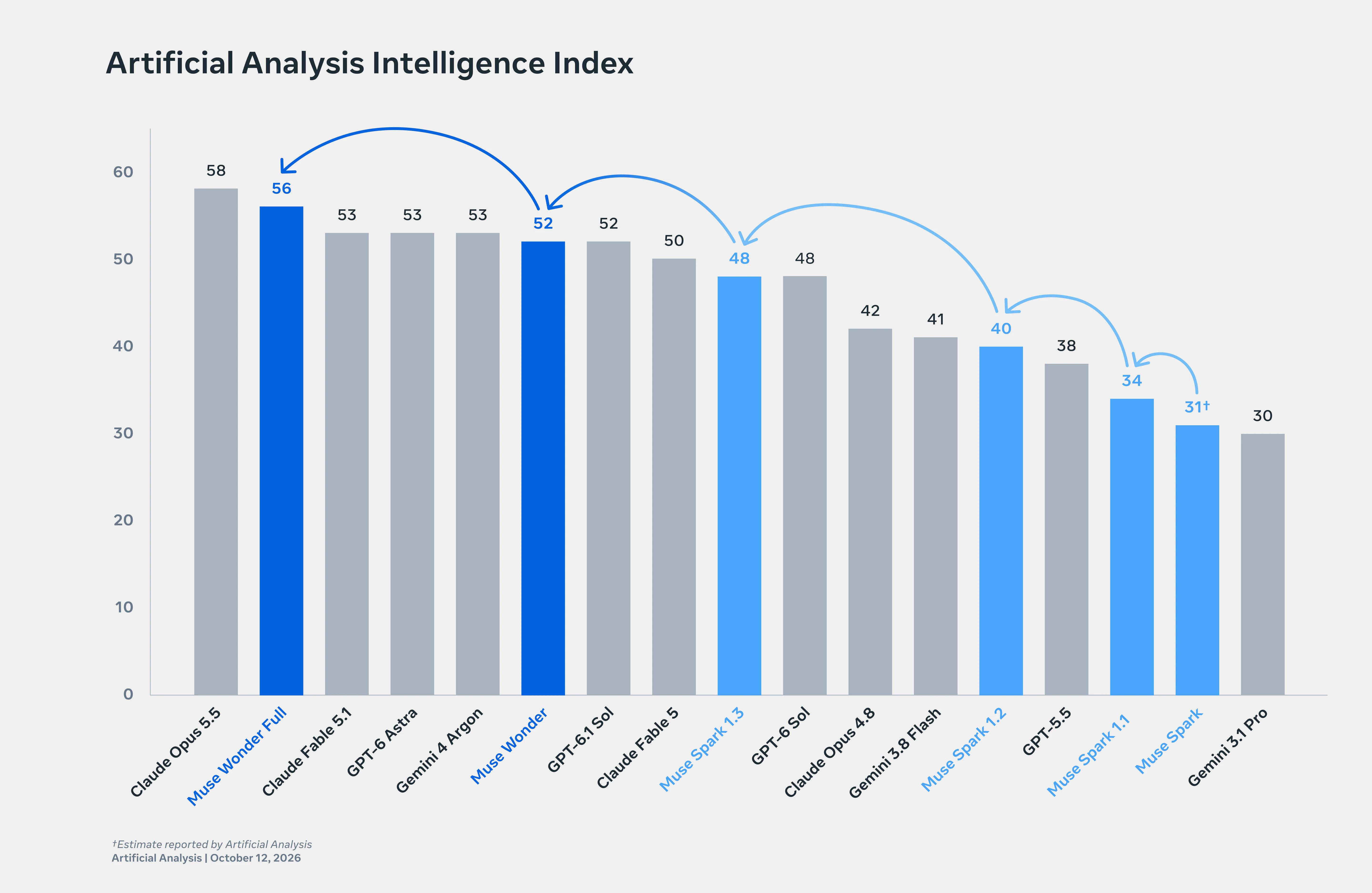
Wonder Full ranks second only to Opus 5.5 on the AA benchmark. Image source: Meta
Meanwhile, the Qwen team also announced QwenGyre, an online reinforcement learning framework for ultra-long-horizon Agent tasks. The relevant paper was submitted to arXiv on September 27. The core research question is: when an Agent works for several hours at a time and interacts with the environment hundreds of rounds, how can the training system make use of these experiences, and how to reduce unnecessary idling of expensive computing power:
All parties are preparing for the explosion of personal Agents.
Models That Are Not Good Enough Are Not Qualified to Talk About Personal Agent Experience
Personal Agents, or personal assistants, are not a new concept. We have been shouting to our mobile phones for many years, hoping that they can remember things, arrange schedules, and handle troubles for us.
At the beginning of this year, the "lobster" craze brought by OpenClaw allowed many people to get their first exposure to AI that can read files, call tools, and keep working continuously on the computer. Natural language understanding, tool execution, personal context and background operation have finally begun to be integrated in the same product.
Then came Instinct and Muse, which transformed Agents from task-centric to person-centric, from PC to mobile phones, from office work to trivial daily life.
Image source: Meta
But precisely because of this, the shortcomings of the model will be exposed in another way. Suppose you ask a personal Agent to prepare for a family trip, and specify the budget, the free time of family members, and the preference of not having to catch an early morning flight. A few days later, the flight is canceled, and it needs to reconsider transportation and accommodation.
At this point, it is not enough to list ten travel strategies. It must know which arrangements have become invalid, which restrictions are still valid, and which things need to come back to ask you. If all these backgrounds have to be re-explained every time, the so-called personal Agent will face a major challenge — personal Context.
The Active Memory of Muse Wonder is precisely targeted at this type of problem. For an Agent that follows one person for a long time, storing information is only the starting point, and the ability to retrieve relevant content when in use is what matters. A small thing mentioned yesterday may become important only next week. Conversely, a revised plan cannot always have the highest priority just because it was recorded first.
Information disclosed by Meta shows that the internal MemoryBench test uses complex dialogues of 64,000 to 100,000 tokens, adding interference information, as well as content that conflicts with the original information or is updated subsequently. This is closer to the problems that personal Agents need to handle than simply checking whether the model can repeat an old piece of information.
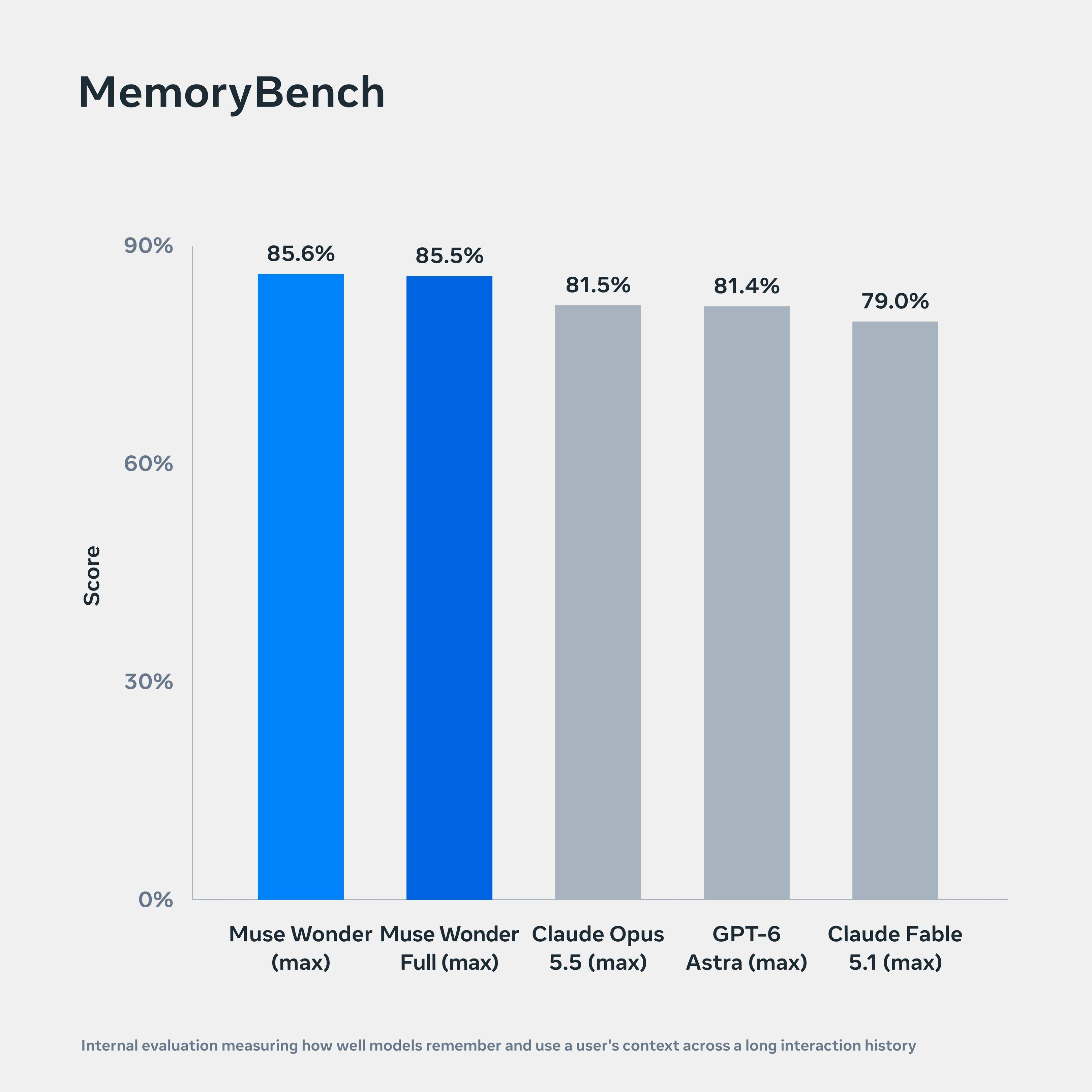
Image source: Meta
However, the memory performance in a long conversation still cannot directly prove that the product has reliably understood a person for several months. How information is stored, when it is retrieved, and how users correct or delete it, all rely on the joint completion of product design beyond the model. A million-token window can hold more content, but it will not automatically tell the model which old arrangement should no longer be executed today.
There is also the capability of Active Focus.
According to Meta's description, Muse Wonder will try alternative methods, deal with obstacles, and adjust actions according to new information. The official product page also lists long-task planning, sub-Agent division of labor, parallel tool calling and failure recovery as key capabilities. This is very important for personal Agents.
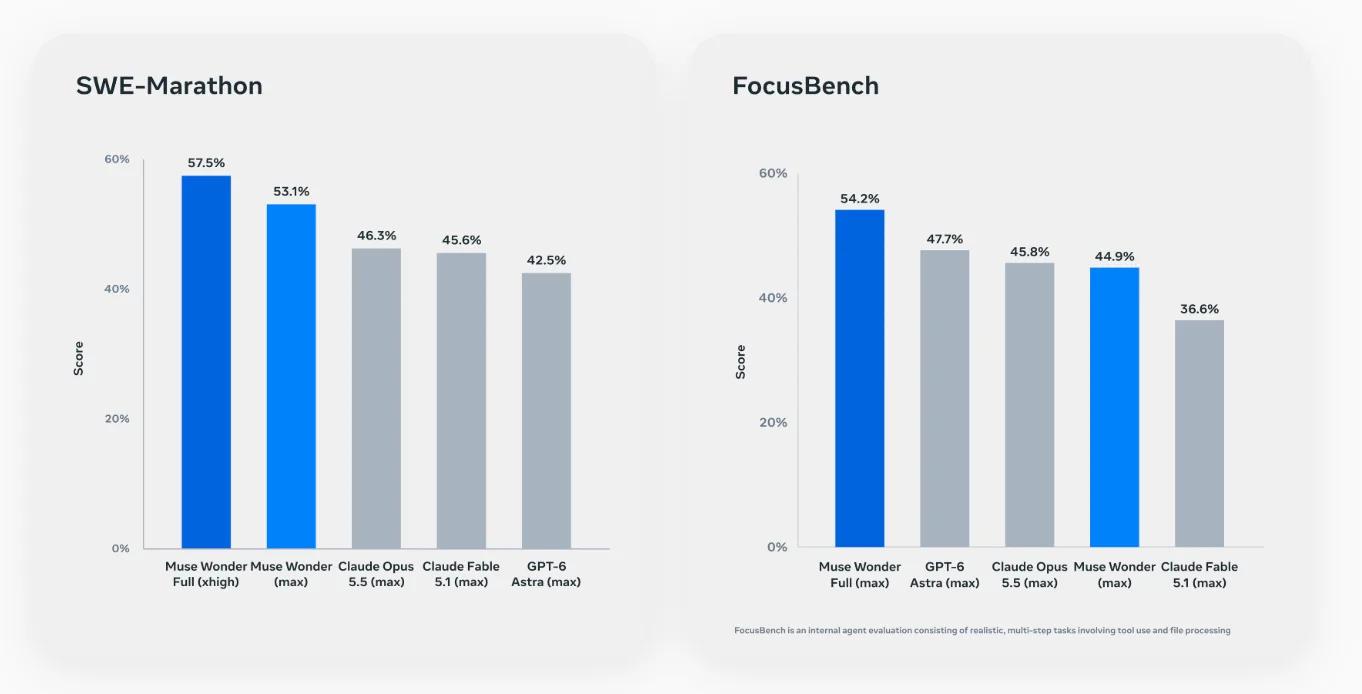
Image source: Meta
What users hand over is a single matter, not a series of instructions that they have to supervise one by one. For example, when a web page cannot be opened during information collection, a truly useful assistant should be able to judge whether there are other sources. Continuing to work sometimes means changing to another method, and sometimes means stopping to ask the user for supplementary information, instead of moving forward blindly no matter what.
Meta's internal FocusBench has also begun to conduct tests around this continuity, focusing on practical obstacles and dynamic changes in tasks such as housing, travel, and IT. Both Muse Wonder models have also undergone diverse long-duration task training to maintain the capability of continuous advancement.
In other words, personal Agents can split the requirements that used to be collectively called "smarter" in the past: information must be remembered correctly, changes must be kept up with, problems must be solved properly, and users must be called back when important decisions need to be made. These requirements have been included in the capability description and evaluation system of the model.
According to the arrangement announced by Meta, Wonder will be used for the personal Agent product Muse, and will be launched to subscription users first.
The Direction of Model Iteration Is Adjusted, and Training Must Also Change Accordingly
If the model wants to learn to work for a long time, it must be allowed to actually work during training. As an online reinforcement learning framework for ultra-long-horizon Agent tasks, QwenGyre aims to solve the problem of how to make this process more efficient.
In online reinforcement learning, the model executes tasks, obtains feedback, and then uses newly generated experiences to update parameters. However, the more complex the Agent's work is, the more likely the training will encounter two problems:
The first is waiting. In the same batch of tasks, some have ended, while others are still calling tools and modifying plans. If the computing power can only wait for the entire batch of tasks to finish before entering training, or is fixedly divided into execution and training parts, it may happen that part of the GPUs are already idle while the tasks are still running.
The second is repetition. The Agent will compress the context, assign subtasks, and may retry by taking another path after failure. These processes will generate different branches, but contain a large number of common experiences. If each path is fully used for training, the same content will be calculated repeatedly.
QwenGyre has correspondingly made two improvements: reallocates GPUs between execution and training according to the task progress, while keeping unfinished tasks running; then organizes the branched execution records into a trajectory tree with shared prefixes to reduce repetition and control the scale of training samples. Even if the task times out, as long as the retained partial results can be evaluated, it can provide useful feedback.
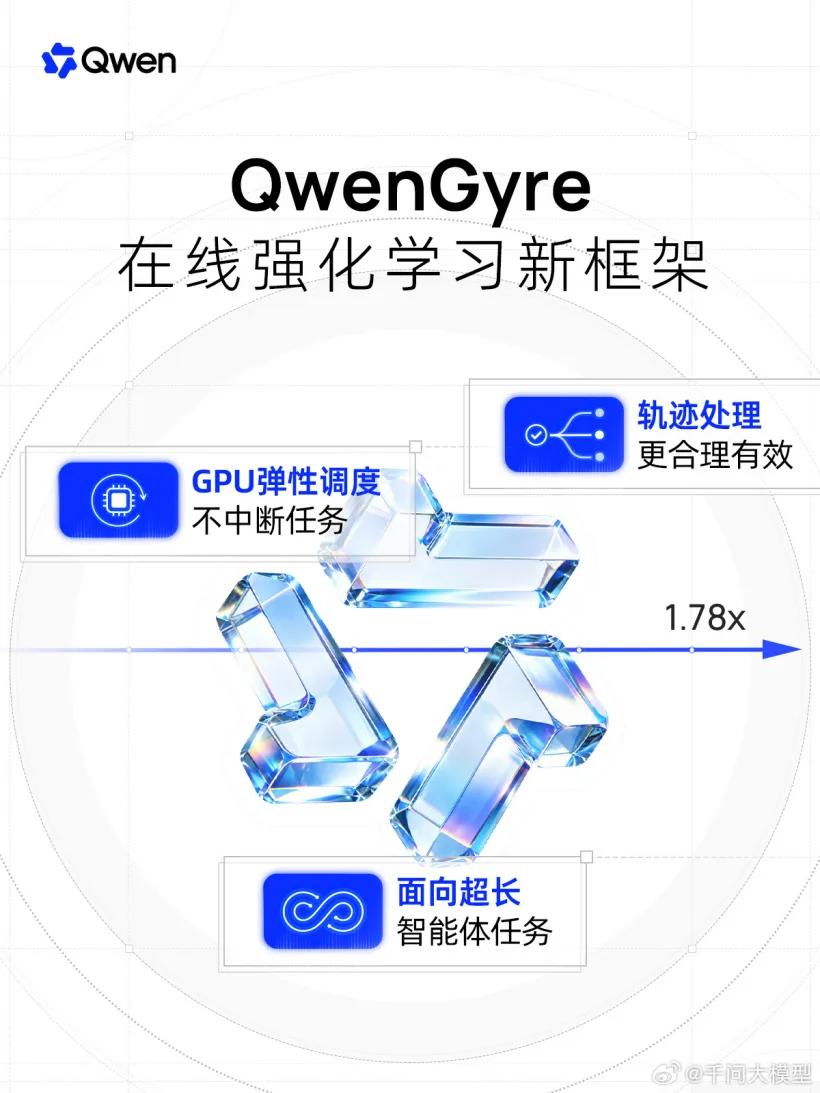
Image source: Qwen
In the experiment announced by Qwen, Qwen 3.8 2.4T processes a total of about 700,000 tokens in a single execution. After 48 steps of reinforcement learning, the NL2RepoBench pass rate increased from about 52.5% to 58.5%. Under the same GPU budget, QwenGyre saves about 44% of training time compared with the Async scheme, with a close training score.
These are also what personal Agents need.
The family trip mentioned earlier, once it is necessary to re-arrange flights, accommodation and transportation, will also involve multiple rounds of operations, tool calls and adjustments after failures. The model must continuously observe the external environment, adjust actions according to new information, and sometimes even overturn the original plan. This is no longer just the capability of tool calling, but also involves long-term planning, state maintenance, dynamic decision-making, failure recovery and other capabilities.
QwenGyre is precisely aimed at the complexity existing in this task execution process, trying to solve the corresponding model training problems.
For Alibaba, this path is very natural.
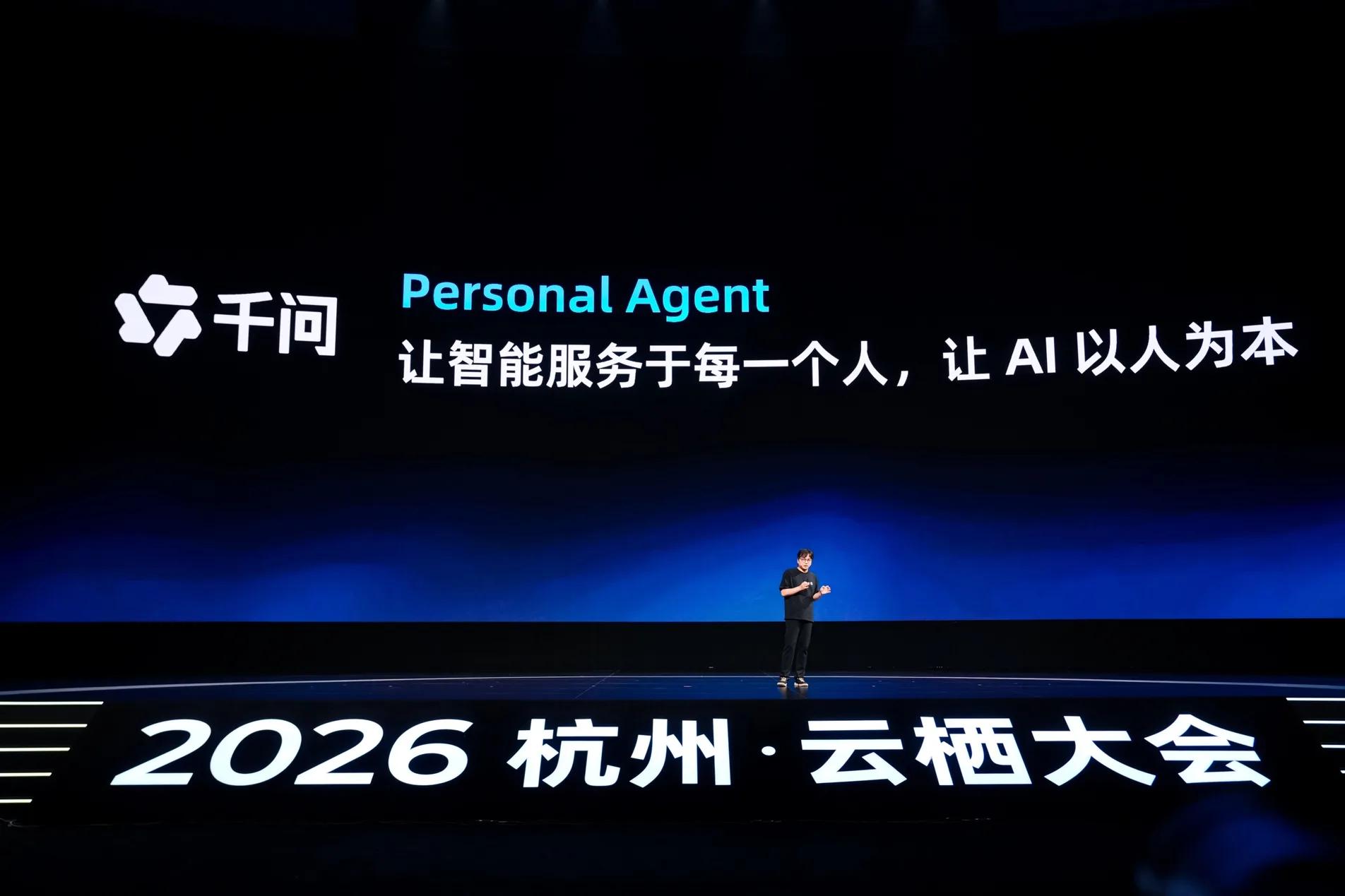
Image source: Alibaba
Qwen has clearly stated that it will build personal Agents and develop related capabilities based on the Qwen 3.8 series. QwenGyre has been used in the long-horizon training of the flagship model of the same series, and the team also said it hopes to further expand the task scope and training scale. Applications require the model to keep working, and the training framework has begun to reduce the overhead of long tasks, so there are specific reasons for subsequent integration.
Therefore, it is very likely that Alibaba will continue to use QwenGyre for Agent training of subsequent Qwen models, and explore personal assistant scenarios. This may be reflected in the new generation of models, or achieved by continuing post-training on existing models.
After Coding, Personal Agents Redefine "AI"
The impact of applications on models has been verified once in the stage of Coding Agents. In the early days, AI programming mainly helped people complete code, but later users began to hand over the entire project to Claude Code and Codex, requiring it to understand the relationship between files, modify code, run tests, and continue to fix according to error reports.
As the things AI needs to do change, the optimization goals of the model also change accordingly. The long-time execution, parallel tool calling and file memory emphasized when Claude 4 was released, as well as the optimization of GPT-5-Codex for Agent-style programming, all respond to such demands.
The improvement of model capabilities allows applications to undertake more complex work. The requirements and failures in applications in turn provide direction for the next round of model training. Personal Agents will continue to promote this round of iteration, except that the work object becomes a more specific person, not just specific tasks one by one.
For example, when the user says "let's skip this week", the model needs to understand whether he is suspending the current arrangement or the entire long-term goal. For things explained in private chat, it is also necessary to judge whether they can be written into external emails. These choices are difficult to judge right or wrong with a fixed test script like code, but they will directly affect whether users are willing to continue to hand over tasks to it.
Take OpenAI dots driven by GPT-6 Astra as an example. As the most cutting-edge top model at present, GPT-6 Astra has unquestionable capabilities, but compared with Instinct, Muse, Grok Bot and others, dots does not currently show a stronger personal Agent advantage.
It can be said that the next-generation GPT will continue to optimize for personal Agents like dots, which is a matter of course. Similarly, for Qwen, Doubao and Yuanbao, as personal Agents are gradually implemented, the models will also face different requirements, so it is necessary to appropriately adjust the training and iteration direction of the models.
This kind of "customization" certainly does not come at the expense of the general capabilities of the model. There are too many situations in personal life that cannot be listed in advance, and broad knowledge, reasoning and the ability to handle unfamiliar tasks are still important. Personal Agents just give these capabilities a clearer use goal: to understand the situation of this person, and continue to do the tasks that have been explained.
Wonder has begun to adjust its capabilities around memory and continuous execution, while QwenGyre provides a more efficient way for long-task training. In the end, the progress users expect is very specific — less need to repeatedly explain the background, less need to correct arrangements that have been modified, and less need to wait in front of the window for the next step.
The model needs to prove that it is stronger, and also make people willing to hand over the next task to it.