After nearly two years of suspension, is the approval of subway projects about to be unblocked?
The much-followed 5th phase Chengdu metro planning has witnessed a landmark progress.
A few days ago, the detailed planning for Chengdu Rail Transit Line 12 was released, which means the line is one step closer to the start of construction. It is worth noting that Line 12 is one of the longest lines in the 5th phase Chengdu metro planning. Its advancement is not only related to the overall progress of Chengdu's 5th phase planning, but also regarded as one of the vane to observe the development trend of national rail transit.
As is known to all, The 5th phase Chengdu rail transit planning approved at the end of 2024 is the last approved urban rail transit construction plan in China before the tightening of metro approval in the last round.
Nearly two years have passed since then, no new metro construction plans have been approved across the country. With the continuous spread of rumors that approved lines need to be rechecked, the launch of construction of Chengdu's 5th phase is undoubtedly endowed with strong symbolic significance.
So, does this progress mean that the metro approval window that has been "frozen" for nearly two years is expected to reopen? Which cities are most likely to take the lead in breaking through?
01
At present, the operating mileage of Chengdu rail transit has exceeded 700 kilometers, ranking fourth in China, second only to Beijing, Shanghai and Guangzhou.
Being able to get the approval of the 5th phase planning first reflects the long-term steady style of Chengdu's rail transit construction. Although the final approved scale is smaller than the declared version, getting the approval at the key node of policy tightening is already a remarkable achievement.
However, after the planning was approved, no substantial construction has started so far, which has always attracted wide public attention. Of course, the relevant preliminary work has actually been advancing all the time.
For example, earlier this year, Chengdu Municipal Bureau of Planning and Natural Resources disclosed that: in 2025, we will efficiently promote the planning management and element guarantee of rail transit, and make forward-looking layout for the 5th phase rail transit construction planning.
It only took 1 month to complete the dossier compilation, preliminary examination, transmission and approval, and certificate collection for land pre-examination and site selection opinions of the first batch of 4 lines with a total length of 53.7 kilometers, and accelerate the compilation of detailed plans for the first 4 projects. The four lines are respectively: Phase IV of Line 10, Phase I of Line 12, Phase IV of Line 18, and Phase II of Line 27.
Among them, Phase I of Line 12 is the only brand-new line and also the largest project. Its advancement rhythm naturally becomes an important sign to observe the implementation progress of the 5th phase. The public release of this detailed plan is an important progress, which may lay an important foundation for the start of construction within this year.
02
The 5th phase of Chengdu is about to enter the substantial construction stage. Does it mean that the new round of metro planning in other cities is also expected to accelerate?
As is known to all, in the past few years, the state has continuously raised the access threshold for rail transit construction, and the approval pace has slowed down significantly. The current "empty window period" that has lasted for nearly two years should be the longest "zero approval" stage for planning since 2010.
Looking back at history, from August 2017 to the middle of 2018, affected by factors such as the suspension of Baotou metro project and the prevention and control of local debt risks, the National Development and Reform Commission once suspended the approval of urban rail transit construction plans. After the approval was restarted in mid-2018, the rail transit plans of cities such as Xi'an, Zhengzhou and Changchun were all approved intensively from the second half of 2018 to the beginning of 2019.
But this time, the signal to restart the approval has not been clearly released. Moreover, compared with the previous round of cycle, the current rail transit construction is facing multiple practical constraints.
First, the real estate sector is undergoing in-depth adjustment, and local finance is under pressure.
For a long time, urban rail transit construction and real estate development have empowered each other and complemented each other. But now, with the reshaping of the logic of the land market, the cost account of metro construction must also be re-measured.
After all, metro construction not only requires huge one-time investment, but also needs to bear long-term operation subsidies in the follow-up. This means that when evaluating new projects, we should not only consider the current construction cost, but also predict the future burden.
Second, the basic population situation and passenger flow demand have changed.
At present, the total national population has experienced consecutive negative growth, and even the population growth rate of central cities has slowed down significantly. At the same time, the operating scale of metro in many cities continues to expand, but the passenger volume has not increased synchronously, and the passenger flow scale in some cities has even shrunk.
For example, in August this year, the average daily passenger volume of national rail transit decreased by 63,000 person-times month on month, down 0.1%, and the passenger transport intensity decreased by 3.0% year on year; the passenger volume of 31 cities decreased year on year. Under this background, for most cities, they must be more cautious to continue expanding the rail network.
Third, the overall scale of the national rail transit has reached a high level, and the incremental space has narrowed significantly.
By the end of 2025, a total of 54 cities in China have opened and operated urban rail transit, with a total operating mileage of 11,710.3 kilometers, ranking first in the world in scale. By August this year, 9 cities have had rail transit operating mileage exceeding 500 kilometers.
It is certain that the window period for large-scale expansion of domestic rail transit has passed. The rise of approval threshold and the slowdown of construction speed are inevitable.
03
Of course, some cities still have opportunities for expansion.
According to previous media statistics, the new phase metro construction plans of at least 17 cities including Nanjing, Hefei and Shenyang have entered the national or provincial government approval process as early as last year. In addition, the new round of metro plans of 17 cities including Changchun, Shanghai and Tianjin have also entered the compilation or preparation stage.
However, with the passage of time and dynamic policy adjustment, the uncertainty of rail transit expansion plans in these cities continues to increase, and the possibility that all of them will be approved as expected is extremely slim.
At the same time, the actual situation of each place is different, and the approval probability is obviously differentiated.
Some media have predicted the approval probability of some cities based on multiple main indicators:
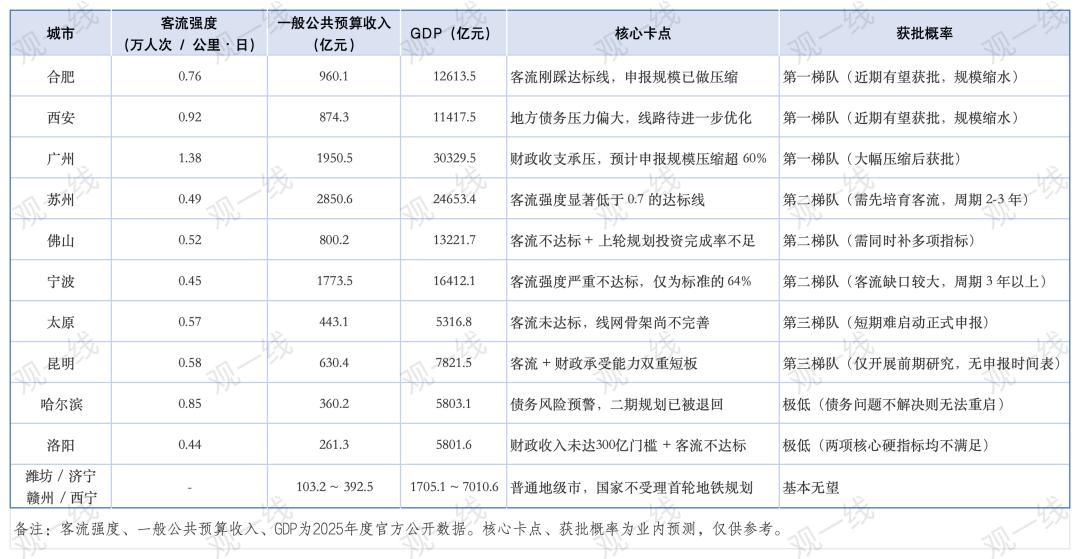
It can be seen that Hefei, Xi'an and Guangzhou are in the first echelon. While some non-central cities have basically no hope. For quite a number of cities, there are really not many opportunities to expand the metro network.
This article is from WeChat official account "Western City Events", author: Xibu Jun, published by 36Kr with authorization.