The tripartite cooperation among FAW, Toyota and GAC almost fell through.
The *Book of Changes* states: "When you reach an impasse, you make adjustments; adjustments lead to unobstructed progress, and unobstructed progress sustains long-term development."
But what is the purpose of these adjustments? It is not change for change's sake, but to find a new state of balance.
The biggest news in China's automotive industry in 2026 lies in "achieving balance through collaboration". While most people only see the superficial "collaboration" on the surface, the far more critical core behind it is the "balance".
On October 8, China FAW, Toyota Motor, and GAC Group signed a strategic cooperation framework agreement in Guangzhou. GAC plans to acquire the 50% equity stake in FAW Toyota held by China FAW through share issuance. FAW Toyota will remain as an independent operating entity, and China FAW will become an important strategic shareholder of GAC Group.
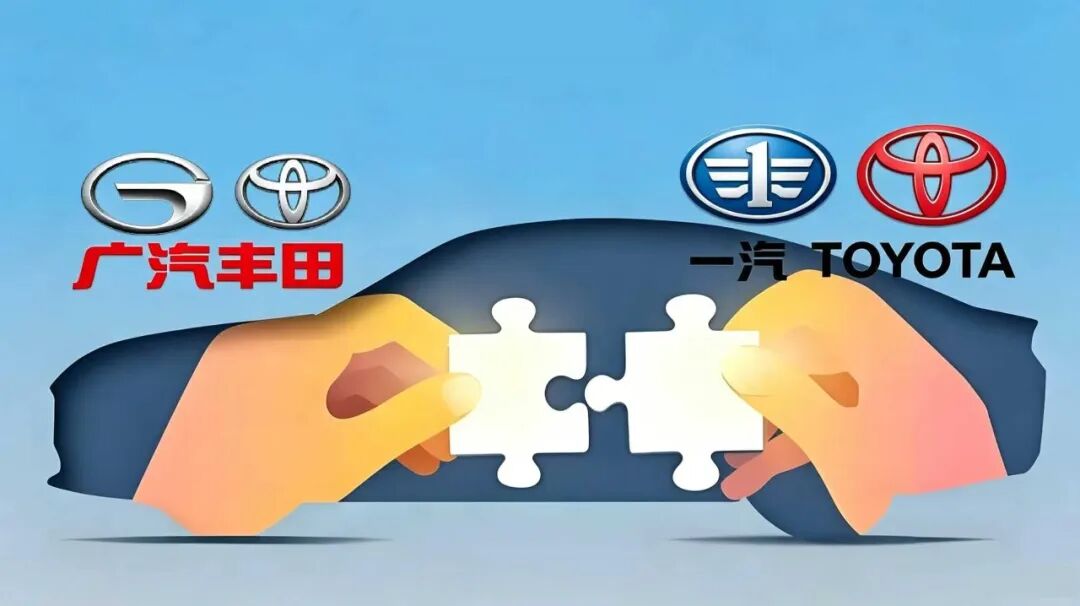
The restructuring of FAW and GAC, with Toyota participating in the integration of the northern and southern Toyota joint ventures, essentially represents the three roles of automotive groups, joint ventures and overseas giants seeking a viable path forward.
No one denies that the manufacturing industry is the most critical locomotive driving China's rise; the most important pillar of the manufacturing industry is the automotive industry, the bright pearl on the crown. China's automotive industry has come to today by walking on two legs: independent brands and joint ventures.
Independent brands have been advancing rapidly, with a market share reaching 64.6% in 2025, while the share of joint ventures dropped to 35.4%, hitting an all-time low. In March this year, the share of joint ventures further shrank to 20.2%. According to the trend, it is only a matter of time before the penetration rate of independent brands rushes to 70% or even higher.
However, the core task of China's automotive industry is not to measure the gap between independent brands and joint ventures, but to achieve overtaking in the new track, take the global lead in electrification and intelligence, and then return to the traditional right track with rationality: quality, standardization, balance and sustainability.
One leg cannot run out of a healthy industrial ecosystem. Without a brake on price wars, no one sticks to the bottom line of quality, and there is no buffer for globalization, the consumers and the entire industrial chain will eventually suffer. Joint ventures are not a burden, but a balancer. The problem is that joint ventures must find a new way out.
Who will set the "example" for the future of joint ventures? FAW has taken the first step, GAC has accelerated its pace, and Toyota has extended a helping hand.
"I arrived in China the day before yesterday, and this is also my first visit to China since I took office as president," Kenta Kon said, and he rated the plan he participated in during his first visit to China as "the optimal solution under the current conditions".
The northern and southern Toyota have shifted from competition to collaboration, and the new structure is named "China ONE TOYOTA". It is not about one party swallowing the other, but about allocating resources to places with higher efficiency. This step sets a referential model for the future of joint-venture automakers in China.
"It is estimated that the deal will fall through" VS "Integration is inevitable"
No one expected that the biggest industry news of 2026 would almost get stranded.
"In the past process of promotion, sometimes everyone felt that it was very difficult to move forward, and even estimated that the deal would fall through," Kenta Kon frankly admitted the difficulties at the media exchange meeting, "But no one gave up. We still made up our minds to make one more effort, and see what we can achieve with our own efforts."
After more than two years of negotiations, the three parties each carry a huge asset system, personnel structure and local interests. FAW is a central state-owned enterprise, GAC is a local state-owned enterprise, and the two were competitors in the market in the past.
Tatsuro Ueda added that the difficulties encountered and efforts made by FAW and GAC are far greater than those of Toyota. Both enterprises have their own strength and strong self-esteem, and it is really not easy to finally reach a cooperation agreement.
This "never give up" spirit is the embodiment of "resilience" in Eastern philosophy. It is not passive endurance, but persistence after recognizing the correct direction. On the negotiation table, it means understanding the difficulties of the other party and finding a common direction, instead of playing a zero-sum game.
Then, why is integration absolutely necessary?
In 2025, FAW Toyota sold about 805,500 vehicles, GAC Toyota sold about 772,700 vehicles, and the total sales of the two reached about 1.578 million units. Adding the more than 180,000 units sold by Lexus in China, Toyota's overall scale in China is close to 1.78 million units, making it the only Japanese brand with positive growth in that year.
According to the caliber of China Association of Automobile Manufacturers, the northern and southern Toyota together account for 17.03% of the total sales of joint-venture passenger vehicles. With this volume, it has ranked third on the sales list of Chinese automakers, surpassing FAW-Volkswagen, second only to BYD and Geely.
However, large scale does not equal high efficiency. FAW Toyota's 800,000 units and GAC Toyota's 770,000 units are not small when viewed separately, but in front of BYD's 3.485 million units and Geely's 2.606 million units, they are just two medium-sized players.
Procurement bargaining power is scattered, R&D expenses are shared by two sets of systems, and channel resources are consumed mutually within the same brand. Corolla and Levin, RAV4 and Wildlander, Sienna and Granvia, sharing the same platform, the same power system and the same group of users, are forced to undercut each other at the terminal. This is not market competition, but redundant construction.
In the first half of 2026, FAW Toyota sold 273,700 units, a year-on-year decrease of 27.4%; GAC Toyota sold 341,100 units, a decrease of 6.3%. In the era of stock competition, two sets of R&D systems, two sets of supply chains and two sets of channels no longer serve as market coverage, but become internal friction.
Why can FAW and GAC come together? The answer lies in complementarity.
FAW is a central state-owned enterprise with the brand heritage of Hongqi and a complete R&D and manufacturing system, but its market-oriented iteration is not fast enough, and the implementation of electrification is relatively slow. In 2025, the new energy output of FAW Group was about 446,000 units, accounting for only 13.5%. The new energy output of its joint venture brands was only 61,000 units, while the domestic new energy penetration rate has exceeded 60%.
GAC is a provincial state-owned enterprise in Guangdong Province, located in the most concentrated area of the new energy industry in South China. It has accumulated experience in three core electric technologies, electrification and C-end user understanding, but it faces difficulties in brand upward breakthrough, with a net profit attributable to shareholders of 4.467 billion yuan in loss in the first half of 2026.
FAW has brand resources and complete systems, while GAC has technology resources and market advantages. Bestune needs technology injection, and Hyper needs brand empowerment. With resources interconnected, many problems do not need to be solved from scratch.
The transaction design is also worth studying. FAW uses 50% equity of FAW Toyota to exchange for shares of GAC's listed company, becoming a strategic shareholder of GAC; GAC obtains 50% equity of FAW Toyota to further integrate Toyota's business system.
FAW Toyota achieved a net profit of about 4.234 billion yuan in 2025, and the 50% equity corresponds to an annual profit share of more than 2.1 billion yuan, which is a real stabilizer for loss-making GAC. For FAW, giving up the equity of the joint venture company to concentrate resources on Hongqi and Bestune, the concentration of resources is more critical than the scale of the joint venture.
For Toyota, in the newly proposed unified sales company, Toyota holds 50% of the shares, FAW and GAC each hold 25%. Toyota has changed from a minority shareholder in two separate systems to the leader of the sales channel.
This follows a general principle: merger and restructuring is not to expand assets blindly, but to improve efficiency, avoid redundant construction, eliminate internal friction, improve business efficiency and increase profit margin. Scale is only a result, while efficiency is the real goal.
The underlying background of Eastern philosophy
The reason why the integration of northern and southern Toyota can reach the signing stage is that Toyota's own business philosophy is a key variable.
If the power balance of the global automotive industry is tilting towards the East, Toyota is exactly one of the phenomena that Eastern culture and philosophy return to the center of the industrial stage.
Toyota's business management is inherently rooted in the Eastern philosophy that integrates Confucianism, Buddhism and Taoism. It does not pursue the extreme efficiency of "exerting all potential", but emphasizes "leaving room for potential", overcoming rigidity with softness, and advancing quietly with profound accumulation. Specifically for this integration of northern and southern Toyota, this set of philosophy provides at least three layers of wisdom.
The first layer of wisdom is the on-site doctrine of "genchi genbutsu (go and see for yourself)".
In Toyota's philosophy, the "on-site" is where the answers to all problems lie. When you are confused, you do not have to be trapped in the PPT in the office. Only by going to the production line, going to the market terminals, and going to the side of users can you discover real demands and solve fundamental problems.
Akio Toyoda set the annual keyword for 2026 as "field", and endowed it with four connotations: the "field" rooted in the origin of values, the "field" that breeds organizational vitality, the "field" that expands industrial boundaries, and the "field" that bridges industrial division.
The underlying logic of the integration of northern and southern Toyota is exactly this kind of "field" thinking: turn competition into collaboration, turn dispersion into unification, and make the real demands of the Chinese market the starting point of product definition, instead of deduction across the ocean in the meeting room of the Japanese headquarters.
The remarks Kenta Kon made at the media exchange meeting are actually an extension of the "on-site doctrine". He said that more than 600 new car models are launched in China every year, with fierce competition and diverse market players, a structure that is rare in the world.
He said that Toyota has had a lot of experience and lessons of failure in China before, and is willing to contribute these to China's automotive industry. The logic behind these words is: since the Chinese market is the most complex "on-site", we must respond to it in the way closest to the scene.
The ONE R&D system transfers core decision-making power from the Japanese headquarters to China, and the RCE system gives product definition power to local engineers who know Chinese users better. This is not passive "localization", but active "genchi genbutsu".
The second layer of wisdom is the long-termism of "making products is cultivating people".
Toyota never regards the enterprise as a machine that pursues short-term profits, but a field that cultivates and achieves people. Akio Toyoda said "I hope to hand over the field of challenge and practice to the next generation", and Koji Sato said that it is impossible to talk about challenging the future without "profitability".
This kind of thinking is particularly evident in the integration of northern and southern Toyota. Tatsuro Ueda clearly stated at the exchange meeting that the cooperation documents require more efforts to give play to the strength of local Chinese talents, reduce the number of personnel dispatched by the three parties, and let the talents independently cultivated by the joint venture have a real say in planning and operation.
One of the biggest problems of joint-venture automakers in the past was the long decision-making chain, a large number of expatriate personnel, and the local team only had execution power but no definition power. Now Toyota wants to reverse this order, which is the implementation of the "making products is cultivating people" philosophy in the joint venture system.
The philosophy dominated by Confucianism, Buddhism and Taoism in China essentially emphasizes frugality, diligence and waste elimination. The core of Toyota Production System (TPS) is exactly to eliminate all links that do not create value.
The parallel operation of two sets of R&D systems, two sets of supply chains and two sets of channels for the northern and southern Toyota is exactly the biggest "waste". The philosophical basis of integration does not lie in the worship of scale, but in lean thinking - making resources flow to places with higher efficiency, and eliminating redundant construction invisibly.
The third layer of wisdom is the collaborative view of "harmony in diversity".
Kenta Kon told a story at the exchange meeting: when Toyota closed its Australian factory, Akio Toyoda said that when making decisions, we must imagine the affected people in front of us, and think about the expressions of the people who are in the most pain. Later, he personally went to the Australian factory to announce the news.
A few months ago, Akio Toyoda went to Australia again, and Kenta Kon finally understood that we should not only think about those people when making decisions, but also keep them in mind all the time after the decision is made. This underlying background of "benevolence" is completely different from the cold ROI calculation in Western management.
Interestingly, Kenta Kon himself has a financial background, but he said "it is meaningless to only look at the numbers, we must trace back to the people and processes behind the numbers". We should often go to the scene, encourage continuous improvement, help employees solve problems, and create an environment where they can work comfortably and achieve good performance.
A person with a financial background saying such words shows that Toyota's philosophy is not the preference of a certain individual, but the gene of the entire organization. This gene is being injected into the new architecture of the joint venture system through the integration of northern and southern Toyota.
Joint-venture automakers: balancer, not burden
The market share is declining, but it does not mean that joint-venture automakers will die out.
Li Yunfei, General Manager of BYD Brand and Public Relations Department, once frankly pointed out at the Tongji Alumni Association that the automotive industry is a highly globalized industry, and independent automakers cannot completely drive joint-venture automakers out of the market; therefore, the market share of joint venture brands in China will stop declining when it drops to a certain level.
The role of joint-venture automakers in China's automotive industry has never been just "car sellers". They are cultivators of the supply chain, maintainers of industry norms, and co-builders of technical standards.
Volkswagen and Horizon Robotics jointly established Core Intelligent Mobility, Toyota, Honda and Nissan collectively chose Momenta as their intelligent driving solution supplier, Audi adopted Huawei Kunlun system, BMW connected to DeepSeek large model, and Volkswagen and CATL cooperated to develop 6C ultra-fast charging