1GW of computing power, one year's time, Meta's closed-source models have dominated all benchmark leaderboards, is Mark Zuckerberg not selling APIs?
Meta is re-entering the core battlefield of cutting-edge large model competition.
In the early hours of October 13 Beijing time, Meta's Superintelligence Lab officially released two new models, Muse Wonder and Muse Wonder Full.
This is the first frontier flagship (Frontier Model) model launched by Meta since it acquired Scale AI for $14.3 billion last year and appointed its founder Wang Tao (Alexandr Wang) to lead the AI R&D work.
In an in-depth video interview aired after the model launch, Meta CEO Mark Zuckerberg and Wang Tao revealed that these two models, codenamed "Watermelon" internally, were trained on the 1+ GW "Prometheus" supercluster located in Ohio, which embodies more than a year of high-intensity R&D efforts from the team.
Only about six weeks after the release of the previous generation Muse Spark 1.3, the new model has made significant progress in comprehensive intelligent evaluation.
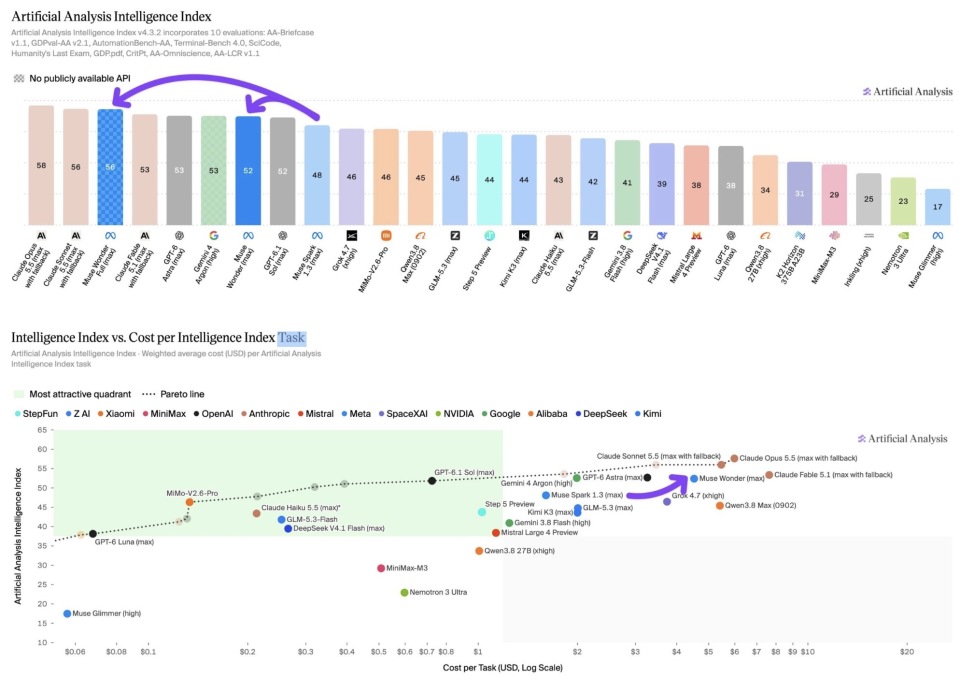
Benchmark data provided by Artificial Analysis
Data from third-party evaluation agency Artificial Analysis shows that at the maximum inference intensity, the comprehensive Intelligence Index v4.3 of Muse Wonder and Muse Wonder Full reached 52 points and 56 points respectively, 4 points and 8 points higher than the 48 points of Muse Spark 1.3.
Among them, Muse Wonder Full matches Anthropic's Claude Sonnet 5.5, surpasses OpenAI's GPT-6 Astra and Google's Gemini 4 Argon (both scoring 53 points), second only to Anthropic's flagship model Claude Opus 5.5 (58 points).
In addition to performance improvements, Meta's release this time also sends another important signal: this tech giant that once promoted the popularization of large models with the open-source Llama series is introducing a closed-source hosting mechanism for its top cutting-edge models.
Neither of the two Muse Wonder models has open model weights available for users to download. The higher-performance Muse Wonder Full is currently only open to paid subscribers of the Muse Code programming assistant, with no public API calls available.
01 Improved Comprehensive Intelligence, Targeting Long-cycle Agents
Over the past period of time, Meta's Muse Spark series has mainly emphasized cost and practicality, while the newly released Muse Wonder series shifts the focus of competition to the more complex long-cycle agent execution capability.
Artificial Analysis' evaluation shows that Muse Wonder Full ranks in the top three in 6 out of 10 assessments of the comprehensive Intelligence Index. In the long-cycle programming test SWE-Marathon, Muse Wonder Full scored 57.5 points, higher than Claude Opus 5.5's 46.3 points and GPT-6 Astra's 42.5 points, demonstrating its ability to continuously advance development and self-correct in long-cycle software projects.
In the terminal automation test Terminal-Bench 4.0, the score of Muse Wonder Full increased from 33% of Muse Spark 1.3 to 57%, and the standard version of Muse Wonder also increased to 52%, indicating that both new models have made significant progress in agent tasks such as tool calling and command execution. In addition, Muse Wonder Full scored 13.1 points in the Harvey legal agent test, higher than GPT-6 Astra's 8.6 points and Claude Opus 5.5's 4.2 points, and topped the list with a 33% score in the CritPt scientific reasoning test.
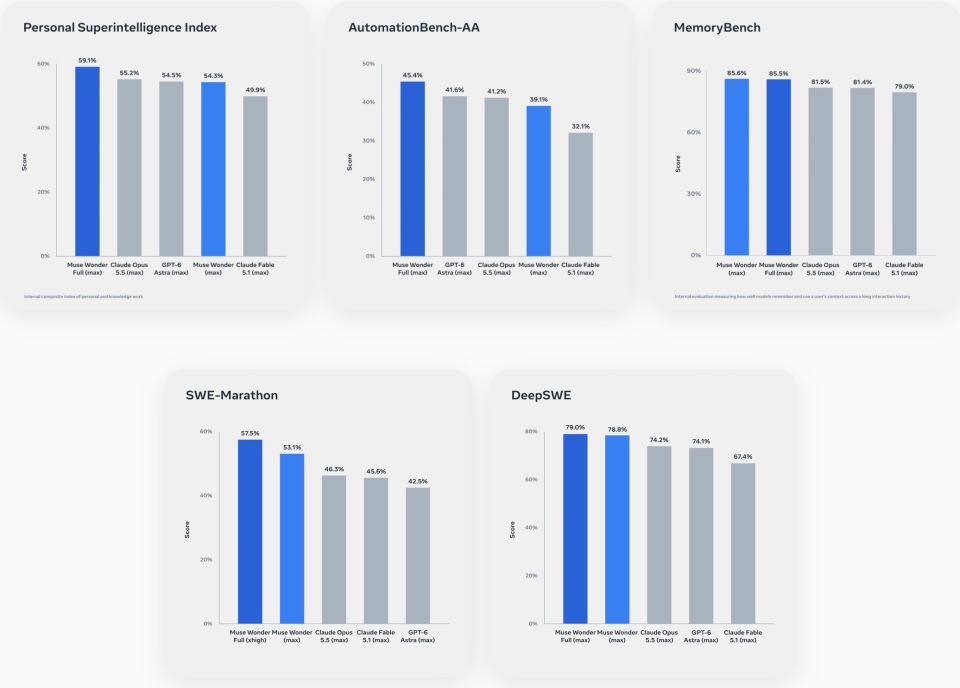
Comparative performance of the Muse Wonder series in multiple key indicators such as personal superintelligence, long-cycle programming (SWE-Marathon) and agent memory (MemoryBench)
To support long-cycle complex tasks, Meta has focused on introducing two core mechanisms: Active Memory and Active Focus.
Wang Tao emphasized in the exclusive interview that Active Memory enables the model to retain users' personal and professional backgrounds across sessions, and actively retrieve and use historical details in new tasks, significantly improving the long-standing "poor memory" problem of traditional agents.
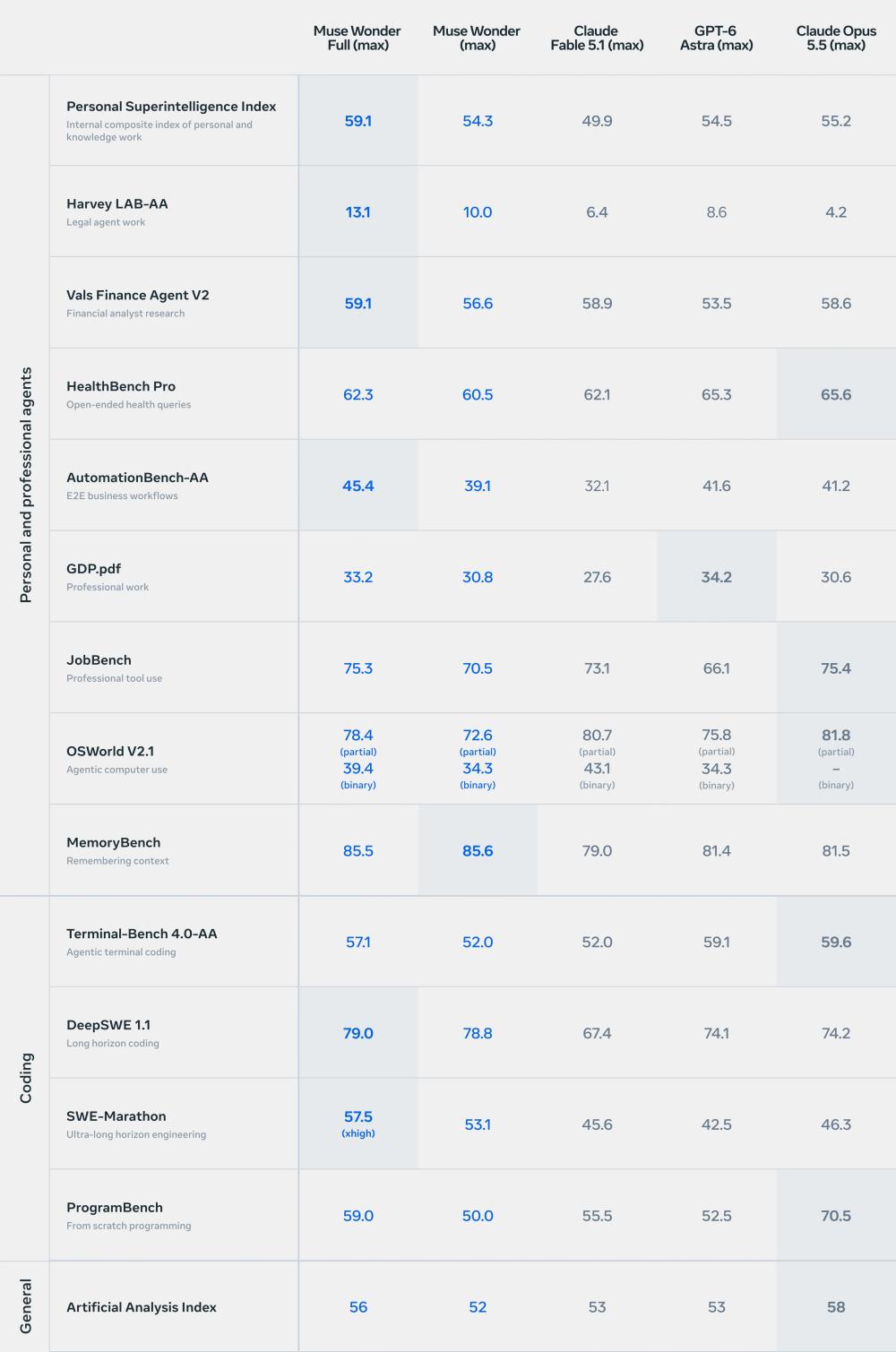
Comprehensive comparison data of the Muse Wonder series and mainstream flagship models in personal/professional agents, programming and various sub-indicators of comprehensive evaluations
However, the new model does not lead across the board.
In the comprehensive Intelligence Index, Muse Wonder Full still lags behind Claude Opus 5.5's 58 points. In the HealthBench Pro medical test, its 62.3 score is also lower than that of Opus 5.5 and GPT-6 Astra. A more objective judgment is that Muse Wonder Full has successfully entered the cutting-edge tier, but has not yet formed absolute dominance in all types of capabilities.
02 Improved Inference Efficiency, Single Task Cost Remains Relatively High
In addition to intelligence improvement, data from Artificial Analysis also shows that the Muse Wonder series has reduced output Token consumption when completing evaluation tasks.
In the comprehensive Intelligence Index task, Muse Wonder and Muse Wonder Full consume an average of about 54,000 output Tokens per task at the maximum inference intensity, about 10% less than the about 60,000 of Muse Spark 1.3.
This consumption is lower than Gemini 4 Argon's 62,000 and Claude Fable 5.1's 78,000, but higher than GPT-6.1 Sol's 38,000 and GPT-6 Astra's 27,000.
In terms of input Tokens, Muse Wonder Full consumes an average of about 6.44 million input Tokens per task, about 16% less than the standard version Muse Wonder's about 7.69 million, which means that the flagship version has higher Token usage efficiency while improving intelligence.
However, in terms of commercial pricing, Meta set the API price for the standard version of Muse Wonder at $4 per million input Tokens, $20 per million output Tokens, and $0.20 for cached inputs, directly matching the standard API pricing of Claude Opus 5.5.
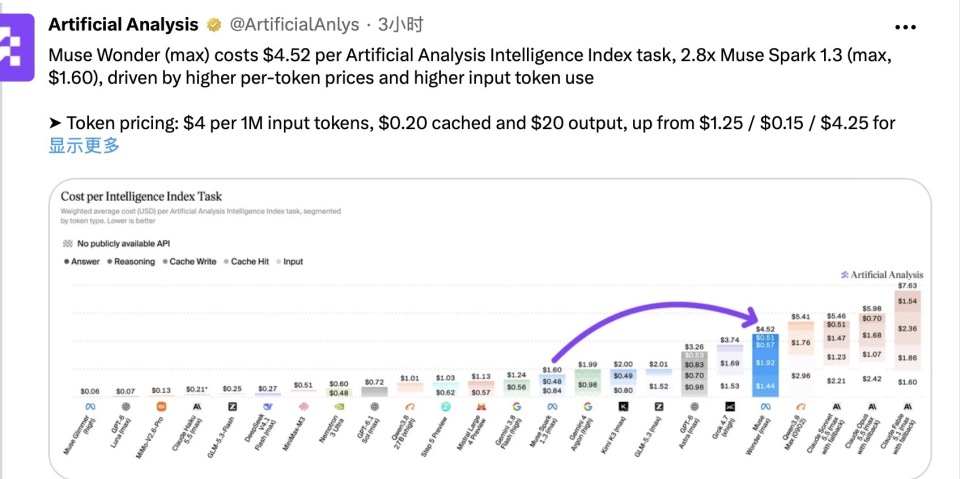
Artificial Analysis single-task cost comparison chart shows that Muse Wonder (max) has an average cost of $4.52 per task, much higher than the previous generation Spark 1.3 ($1.60) and GPT-6 Astra ($3.26), but lower than the Claude series flagship model
Artificial Analysis estimates that the cost of Muse Wonder completing a comprehensive Intelligence Index evaluation task is about $4.52. Although this single-task cost is lower than Claude Opus 5.5's $5.98 and Claude Sonnet 5.5's $5.46, it is higher than GPT-6 Astra's $3.26, Gemini 4 Argon's $1.99, and Muse Spark 1.3's $1.60.
03 Flagship Models Move to Closed Source, Tighten Deployment Permissions
Compared with technical performance, Meta's shift in model opening methods and commercial deployment this time has aroused more industry attention.
The standard version of Muse Wonder is open through the Meta Model API and Muse Code, while the flagship version Muse Wonder Full is currently only available to Muse Code users and does not support public API calls.
Currently, Muse Code offers two tiers of subscriptions for Muse Wonder Full, the $50 per month Power tier and the $200 per month Maximum tier. Both tiers have usage limits and do not provide unrestricted developer API access. This means that enterprises can test the flagship model in Meta's programming assistant, but cannot deploy it directly to their own production systems or customer-side applications.
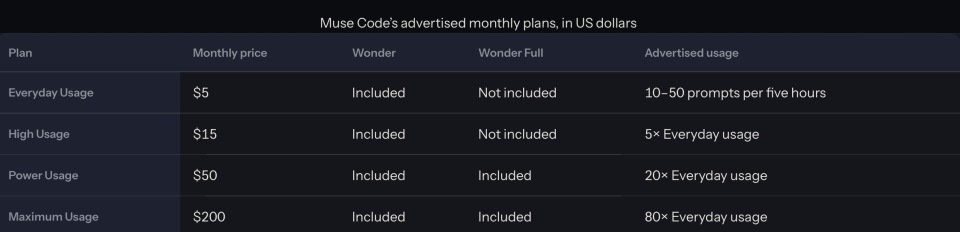
The public table of Muse Code monthly plans, the flagship version Muse Wonder Full is strictly limited to the high-level subscription tiers of $50 (Power) and $200 (Maximum) per month
Data governance and privacy policies are also worthy of attention for enterprise buyers.
On the one hand, the pay-as-you-go Muse Wonder API is only provided in Standard mode (submitted content will not be used for model training), while the Muse Code subscription enables Contributor mode by default (allowing Meta to use submitted prompts, code and files to improve the model).
On the other hand, although enterprise customers can apply for Zero Data Retention (ZDR) guarantee, after enabling it, functions such as server-side session status, background requests, file upload and built-in web search will not be available.
For agents that rely on context and long-cycle execution, the contradiction between privacy protection mechanisms and functional availability requires enterprises to make careful trade-offs during procurement.
04 Shift to Agent Implementation, Commercialization Test Has Just Begun

Zuckerberg and Wang Tao in the exclusive interview
The release of Muse Wonder means that Meta is fully entering the cutting-edge intelligence and professional agent market from its previous model route that emphasized lightweight and cost-effectiveness.
As Zuckerberg said in the interview, Meta is not satisfied with being a simple application company. Instead, through in-depth control of underlying gigawatt-level data centers, self-developed chips and cutting-edge model architectures, it is building personal superintelligence that can truly change human work and life.
The competition among Silicon Valley giants has extended from simply comparing comprehensive evaluation scores to programming capabilities, professional task completion, tool calling efficiency and long-cycle execution performance. Since last year, when Wang Tao was introduced to lead the AI team and build the Prometheus data center, Meta's huge investment is being translated into tangible model competitiveness.
But the test of commercial implementation has just begun. The single-task cost of the standard version of Muse Wonder has not achieved absolute advantage, and the strongest Muse Wonder Full is still in a closed-source state with restricted API calls.
Going forward, Meta not only needs to prove that its models can bring stable automation value in real enterprise environments, but also needs to find a long-term balance between the open-source ecosystem and closed-source commercialization.
Special translator Wu Ji also contributed to this article
This article is from "Tencent Tech", written by Su Yang, edited by Xu Qingyang, published with authorization from 36Kr.