From half a year to just two months, the time taken for world model startups to secure their first round of financing has been fast-forwarded.
Recently, there are rumors in the market that a world model company founded by Tian Keyu, a Peking University PhD and young researcher who previously worked at ByteDance, has not yet officially announced its company name, but its first round of financing has already reached tens of millions of dollars, with investors including 5Y Capital, IDG Capital, Zhongding Capital, etc.
Projects of this kind that "get financing before having products or even formally establishing the company" were almost unthinkable three years ago.
I also noticed that since the beginning of this year, startups including Pragmatic Tech founded by Lin Junyang and Hidden World Tech founded by Hu Yucheng have completed their first round of financing less than 3 months after their establishment. This is already rare in the current venture capital circle, but it is not uncommon in the world model track.
This article reviews the financing situation of the entire track through data from IT Juzi, trying to answer one question:
What is the pace of the first round of financing for companies in the world model track, and is there a systematic trend of acceleration?
If so, how much faster is it specifically?
Data Caliber and Screening Process
As of October 9, 2026, IT Juzi has included a total of 156 companies under the "World Model" tag. This is a thematic tag with a relatively broad coverage, including not only startups focusing on world models, but also tech giants that take world models as one of their business lines, as well as content generation tools and robot body manufacturers with adjacent technical routes but different positioning.
Direct statistics will lead to distorted conclusions, so a round of relevance screening is carried out first. The analysis sample after screening is defined as independent world model companies established after January 2024 that have completed the first round of financing, totaling 79. (The main reason for choosing companies founded after 2024 is that this track did not truly gain investment popularity until 2024, and world models should be the core main business of the companies)
The 77 companies excluded in this analysis fall into two categories: the first category is large technology enterprises, complete vehicle manufacturers, and robot embodied hardware companies, such as Huawei, Alibaba, ByteDance, Li Auto, etc., whose world model is only one of their new business lines and is not an independent financing entity; the other category is fields with weak conceptual relevance, such as AI video, image and 3D content generation tool platforms, which focus on AIGC content generation.
The core indicator used in this article is "time spent on the first round of financing", which is calculated as the year and month of the first publicly disclosed financing event minus the year and month of the company's establishment, in months. If the financing disclosure time and the establishment time fall in the same month, it is recorded as 0 months.
This indicator measures the speed of capital decision-making, and has a low correlation with the amount of financing.
It should be noted that the "establishment time" of a company is subject to the industrial and commercial registration. Founders can choose the registration time after the entrepreneurial intention is determined, and there is a small amount of adjustable space for this time point itself.
Conclusion: A Step Change Occurred in 2026
After grouping 79 sample companies by their founding year, the final statistical results are as follows:
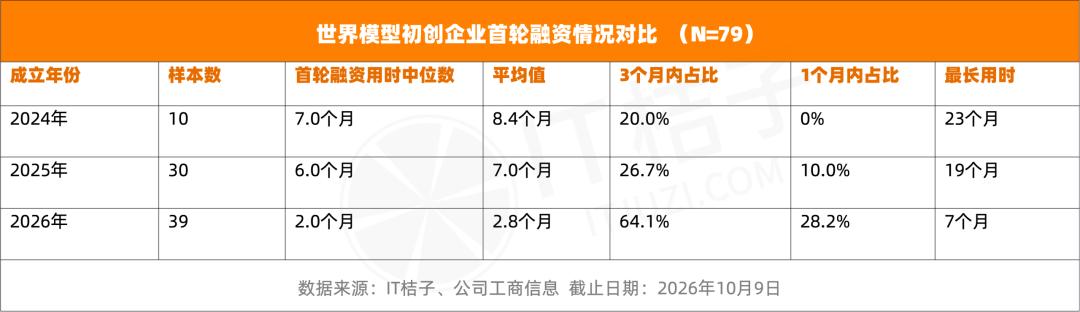
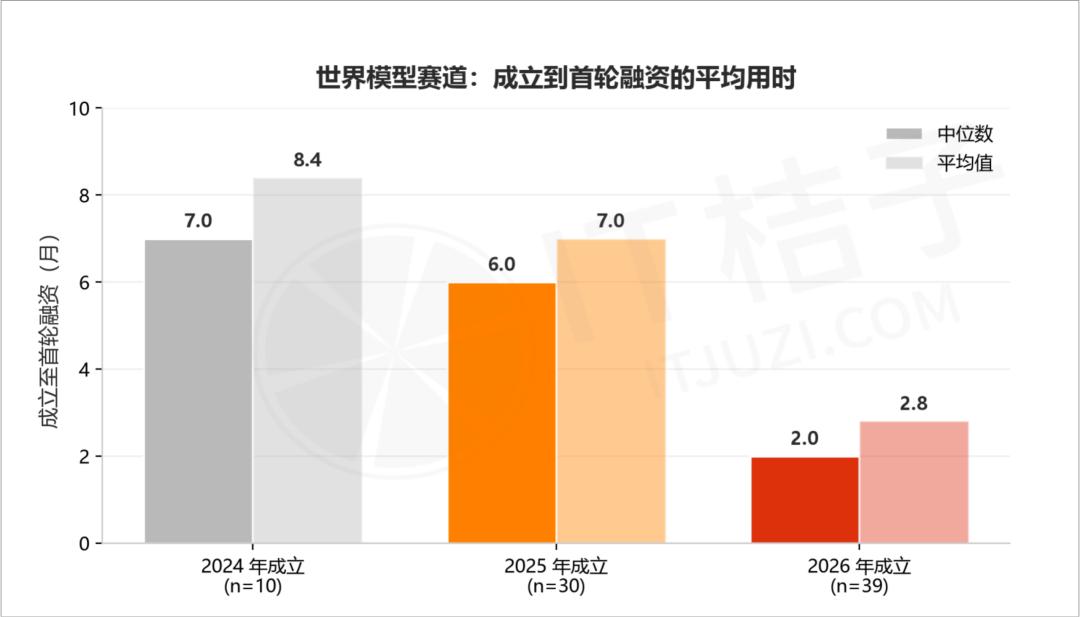
Figure note: Comparison of the median and average time from establishment to the first round of financing for 79 world model companies founded from 2024 to 2026.
There are four noteworthy changes in this table:
First, the median dropped from 7.0 months in 2024 and 6.0 months in 2025 to 2.0 months in 2026. The median means that half of the companies completed their first round of financing within two months.
Second, the proportion of companies that completed the first round of financing within 3 months rose from 20.0% in 2024 and 26.7% in 2025 to 64.1% in 2026.
Third, the proportion of "flash investment" cases where the closing was completed in the same month or the next month after establishment rose from 0% in 2024 and 10.0% in 2025 to 28.2% in 2026. In 2026, one out of every four world model startups received funding within one month.
Fourth, the longest time spent among the 2026 samples is only 7 months, while the maximum values in 2024 and 2025 are 23 months and 19 months respectively. The overall distribution of the first round financing duration this year has been significantly shortened.
A reasonable explanation is that the earlier a company is established, the longer it is observed, and the easier it is to "record" a slow financing in the data; for companies established in 2026, the observation window is at most seven to nine months as of the statistical date, and slow cases have not yet had time to occur.
This data deviation will partially amplify the apparent effect of "faster in 2026", but it is difficult to say that this variable can completely dominate the results.
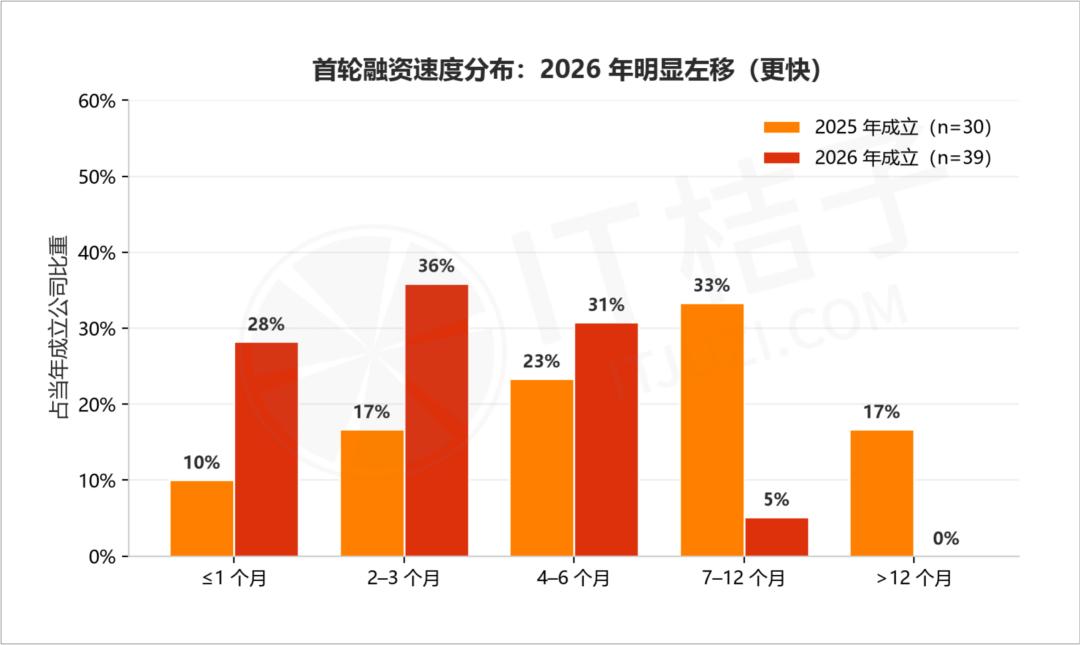
Figure note: Comparison of the distribution of the first round financing speed of companies established in 2025 and 2026. The 2026 data is obviously concentrated on the "faster" side.
It should be noted that the establishment time is subject to the industrial and commercial registration time of the main company, and the financing time is the time when the invested enterprise officially announces the financing. Both are variables that can be slightly adjusted.
Founders can choose the time of industrial and commercial registration after the entrepreneurial intention is determined, and arrange the financing announcement time just before the financing is about to be closed, which will directly shorten the "time spent" under the statistical caliber. This effect may account for a difference of one to two months in individual cases, but it is not enough to explain the overall step-like leap.
Every Year of Delay in Establishment Shortens the Time for the First Round of Financing by About 5.4 Months
For the 69 companies established in 2025 and 2026, a scatter plot is drawn according to the month of establishment and the time spent on the first round of financing, and linear fitting is performed. The slope is -5.4 months/year. In other words, every one year later the company is established, the time from establishment to the first round of financing is shortened by an average of about 5.4 months.
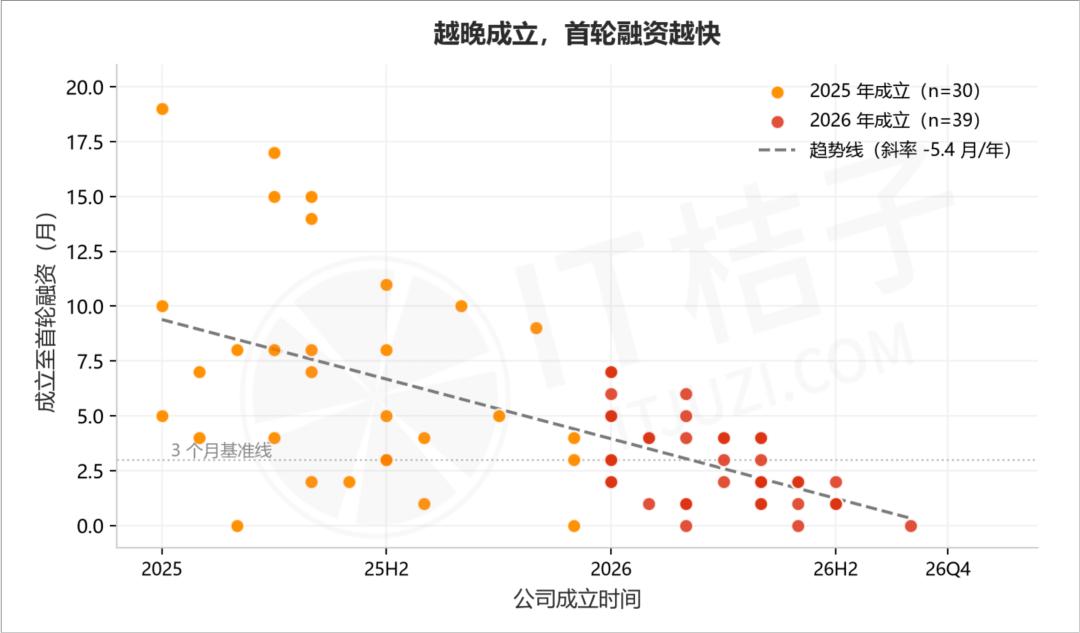
Figure note: The horizontal axis is the company establishment time, the vertical axis is the number of months from establishment to the first round of financing, and the dotted line is the linear trend line of the combined sample.
It should be pointed out that the observation window of the 2026 sample is less than 10 months at most, and the upper end of the distribution is truncated, which may lead to data deviation. The real shrinkage range may be less than 5.4 months.
However, the trend and direction shown by the data are relatively certain, and the magnitude is far greater than the noise level. It has become an intuitive judgment that the first round of "financing pace" of world model startups is accelerating.
List of Companies That Completed the First Round of Financing Within 3 Months
According to the filter of "the time from establishment to the first disclosed financing is less than 3 months", a total of 35 world model companies established from 2024 to 2026 meet the conditions, accounting for 44.3% of the 79 samples.
The following is the complete list, sorted in ascending order of time spent.
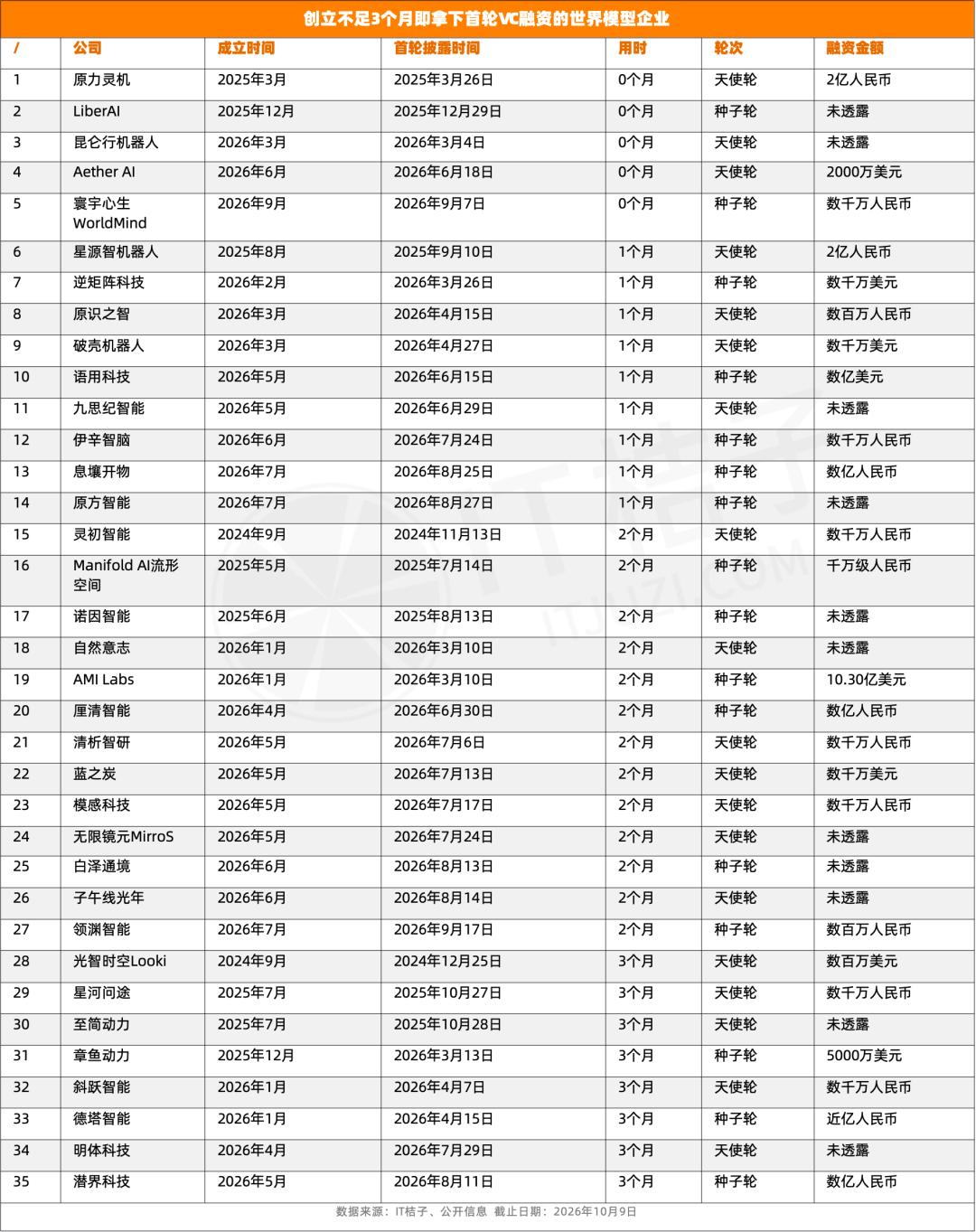
There are three observations in the list that are worth pointing out separately.
First, there is no specific relationship between the time spent on the first round of financing and the financing amount.
The first round of financing pays more attention to speed, and the project valuation is significantly differentiated, and some enterprises quickly obtain investment at a very small cost.
Second, large first-round financings are concentrated in the intersection of embodied intelligence and world models.
AMI Labs completed its seed round at USD 1.03 billion, Pragmatic Tech completed its seed round with hundreds of millions of dollars and directly entered the unicorn list, and the first round financing amount of Xirang Kaiwu, Clear Intelligence, and Hidden World Tech are all at the level of hundreds of millions of RMB.
The common feature of these companies is that they directly bind the world model capabilities to the perception and decision-making of robots, enabling AI systems to have the systematic ability to understand the physical world, rather than just staying at content generation, and they are more endorsed by top teams.
Third, most of the fastest-financing companies have identifiable backgrounds from large factory teams.
AMI Labs was founded by Yann LeCun, former chief AI scientist of Meta. Lin Junyang, founder of Pragmatic Tech, comes from the "Alibaba" Qwen large model team. Hu Yucheng, founder of Hidden World Tech, is a former member of ByteDance's Seed team. The company was established in May 2026 and completed a seed round financing of hundreds of millions of RMB in August 2026. Xu Huazhe, founder of Shell Breaking Robot, used to be the chief scientist of Star Atlas, a unicorn company.
Investors make first-round investment decisions in a very short period of time, often based not on business plans, but on the team's previous performance in public technical achievements.
Why Is It Getting Faster
Looking at the essence through the phenomenon, these three reasons can provide support for the data results.
First, the verifiability of the technical narrative has improved.
The world model was still in the debate around 2024 about "whether there is a feasible path", and investment decisions needed to rely on long-term judgment of the technical route; after 2025, public achievements in directions such as interactive video generation and robot operation generalization have turned the path problem into an engineering problem.
Now investors do not need to wait for product revenue to appear, they only need to judge the team's execution on the established route. The nature of the judgment object has changed, and the decision-making cycle is naturally shortened.
Second, the spillover of talents from large factories has formed teams that can be priced.
Researchers from leading AI teams such as Alibaba and ByteDance have long demonstrated their technical achievements in public, and their capabilities have been repeatedly observed in the circle. The essence of the first round of financing for startups has changed from "due diligence on a company" to "confirming an individual". When the pricing basis changes from the company to the team, the time required for due diligence will be greatly compressed.
Third, behind the accelerated pace is the forward shift of screening pressure, and the competition of early capital advances the whole process.
For early-stage funds investing in cutting-edge technology, "meeting the founder at the first time" is a means of competition in itself. The communication between investors and founders takes place before the company officially starts financing, even earlier than the industrial and commercial registration. In this case, the signing time point is often pushed forward continuously.
IT Juzi data shows that the top 5 institutions that have made high-frequency first-round investments in world model startups are GL Ventures, Inno Fund, HSG, Baidu Ventures, Shunwei Capital, etc., all of which are well-known first-tier institutions, and they have made 5 or more investments respectively.
In particular, GL Ventures has reached 12 investments, becoming the most aggressive and bold investor in this wave of world model entrepreneurship.
However, when it becomes the norm to complete the first round of financing within two or three months, the information that investors have when signing is necessarily less than in the past. For entrepreneurs, this is both recognition and test. The meaning of getting the first round of financing quickly is to get the admission ticket for subsequent financing, but the actual differentiation of projects will appear more in the second round and later stages.
Finally, "faster signing" does not mean "higher success rate", and the risk of early investment has not been reduced as a result.
This article is from the WeChat official account "IT Juzi" (ID: itjuzi521), the author is Wu Meimei, and 36Kr is authorized to release it.