Just now, Meta's most powerful flagship has completely outclassed GPT-6 and Opus! It has stormed back into the world's top three overnight.
Mark Zuckerberg has truly caught up this time!
Late at night, Meta released two large models in one go: Muse Wonder and Muse Wonder Full.
The official did not hesitate to define it as Meta's strongest model to date, as well as a historic leap toward the full realization of "personal superintelligence".


In all benchmark tests, Meta's "two new heavyweights" are finally able to compete head-on with Claude and GPT.
The current top-tier models Claude Fable 5.1 and GPT-6 Astra are almost completely outperformed by Muse Wonder.
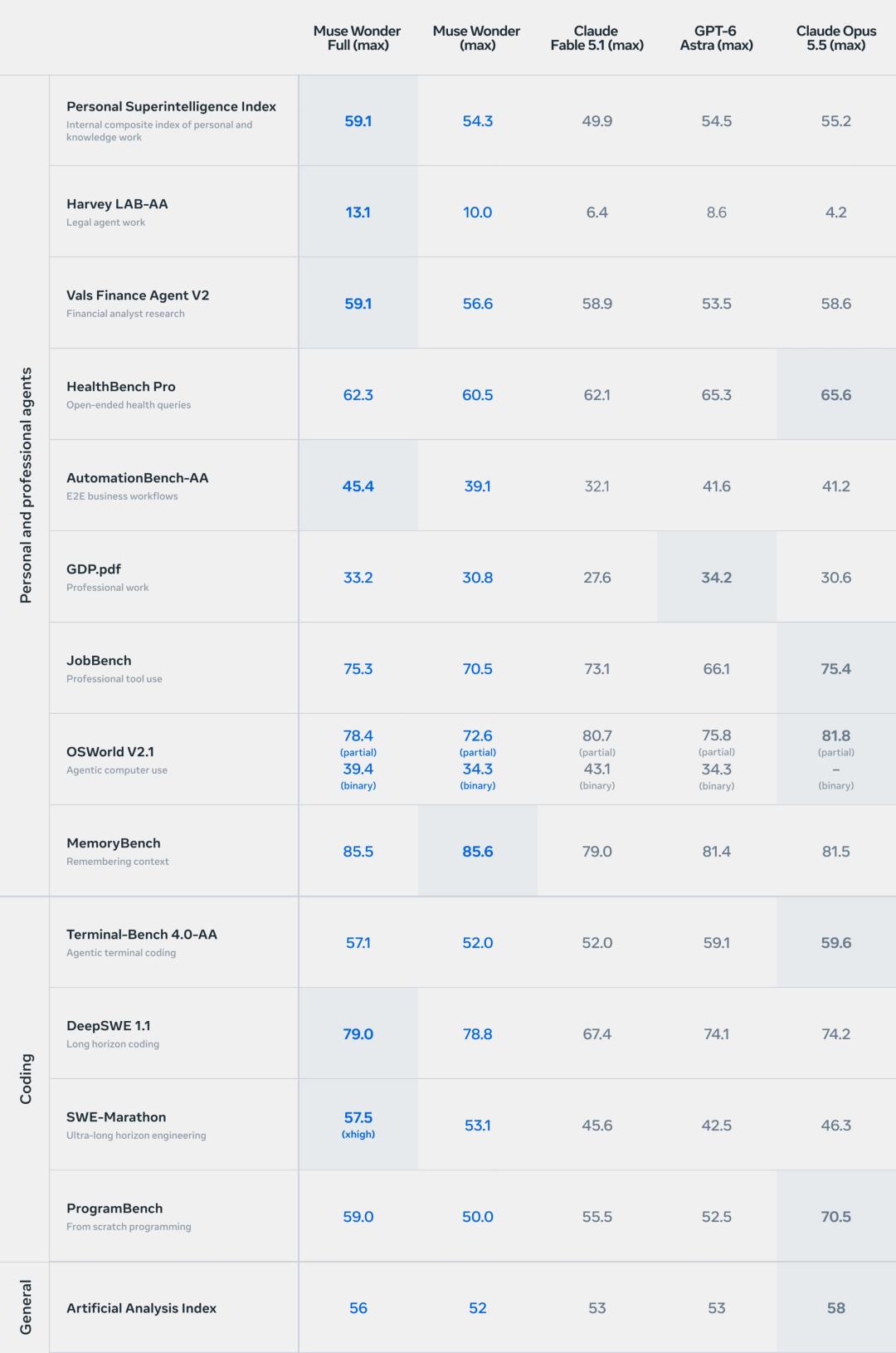
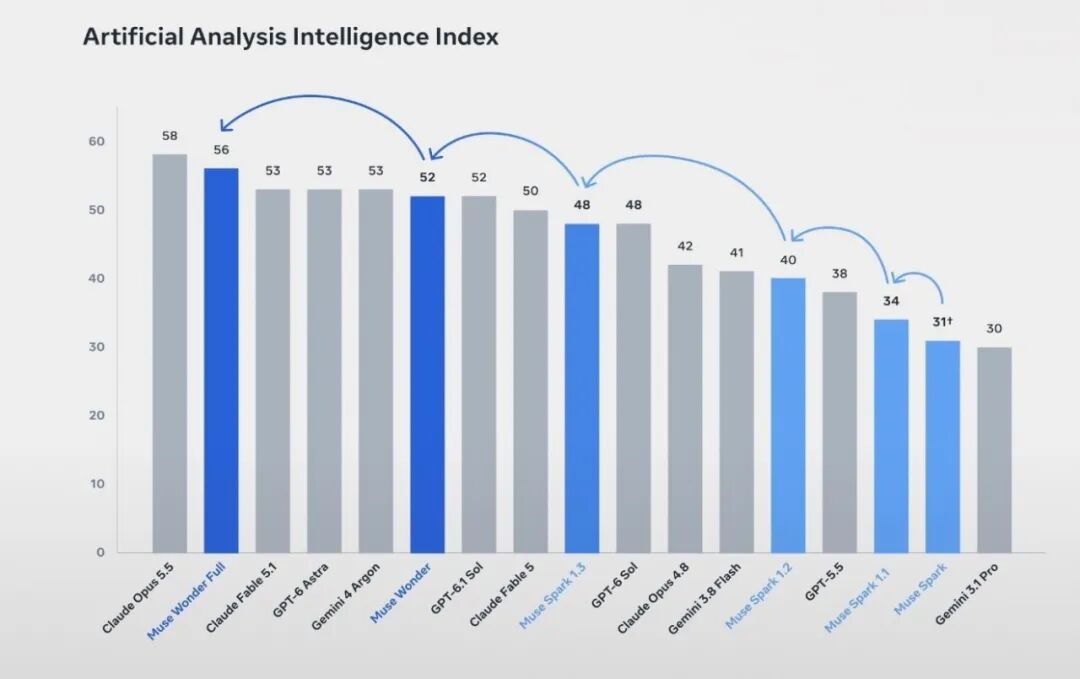
On Artificial Analysis, Muse Wonder Full scored 56 points, firmly ranking in the global first echelon, keeping pace with Sonnet 5.5 and outperforming GPT-6 Astra.
Muse Wonder also scored 52 points, comprehensively surpassing the previous generation Muse Spark 1.3.
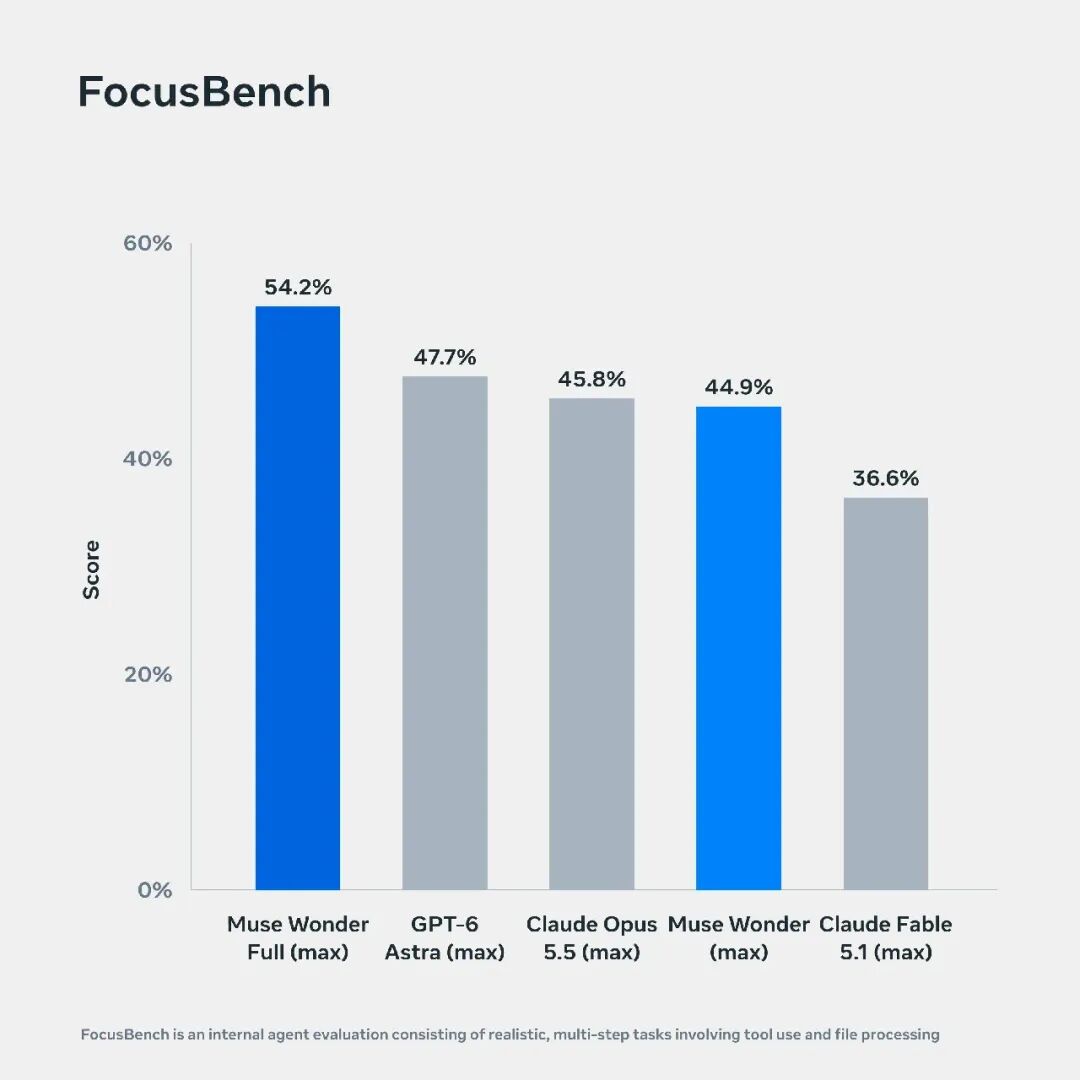
When it comes to long-task programming, Meta even directly surpasses Opus and Astra. Not only the top-tier Full version wins, but the regular Wonder version also wins!
It holds two biggest aces in its hand: Active Memory + Active Focus.
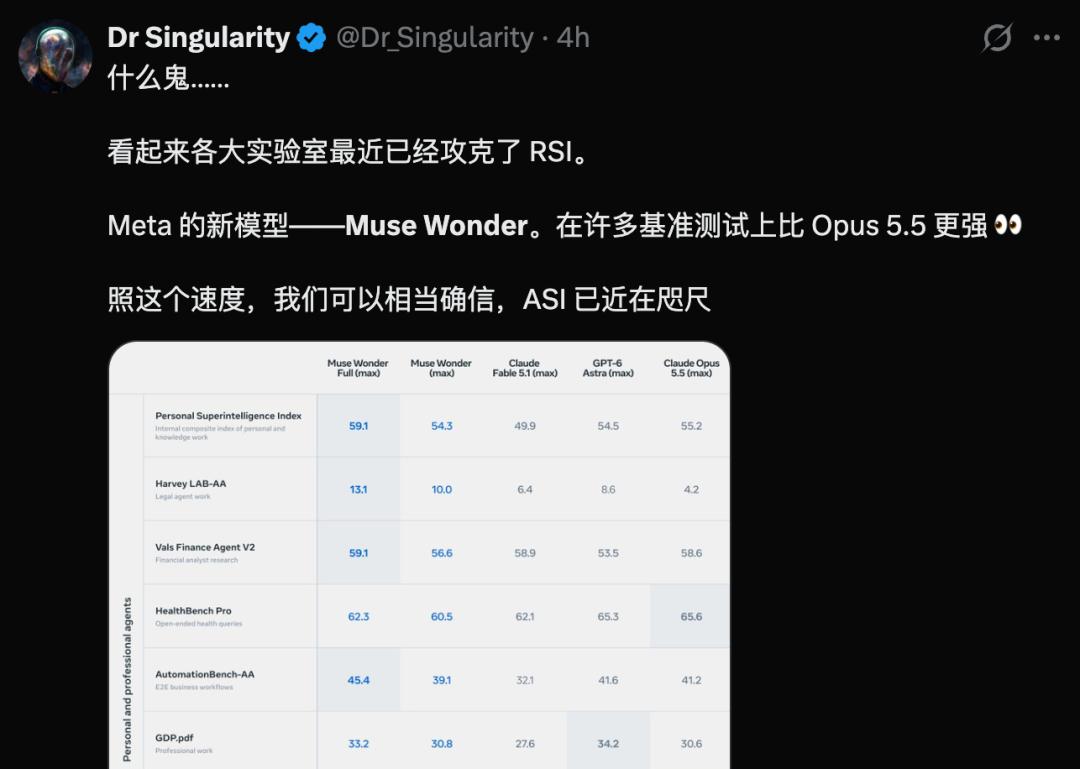
For a moment, many people marveled that it seems that major labs have already overcome RSI.
All capabilities are upgraded this time, here are the key points —
Programming capability enters the first echelon: Muse Code equipped with Full ties with Claude Sonnet on the AA Programming Agent Leaderboard; both Wonder versions outperform Opus and Astra in long-task tests.
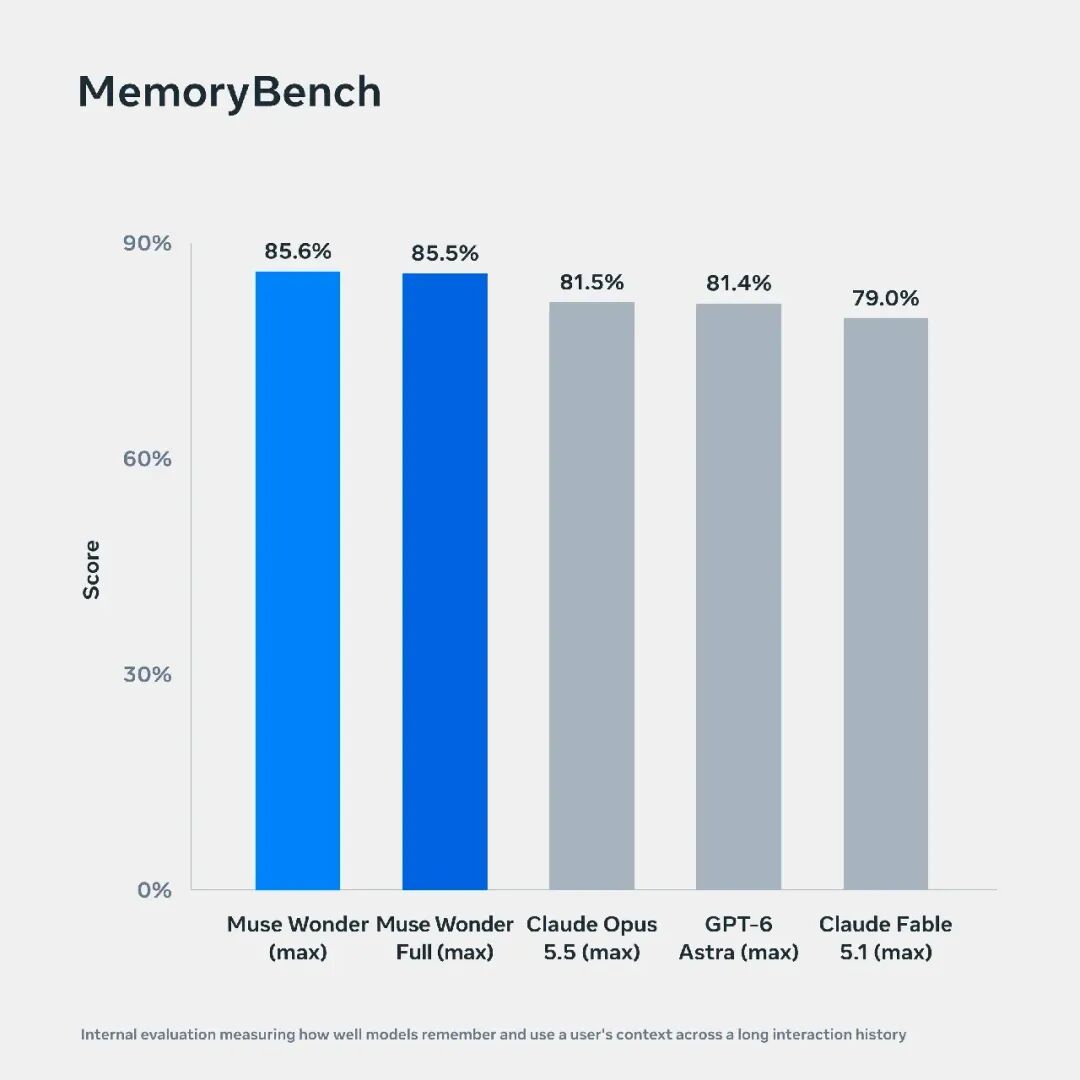
Remember you across conversations, continue long tasks: Active Memory retains your important information; Active Focus allows the model to change methods when encountering obstacles, check after making errors, and adjust plans when receiving new requirements.
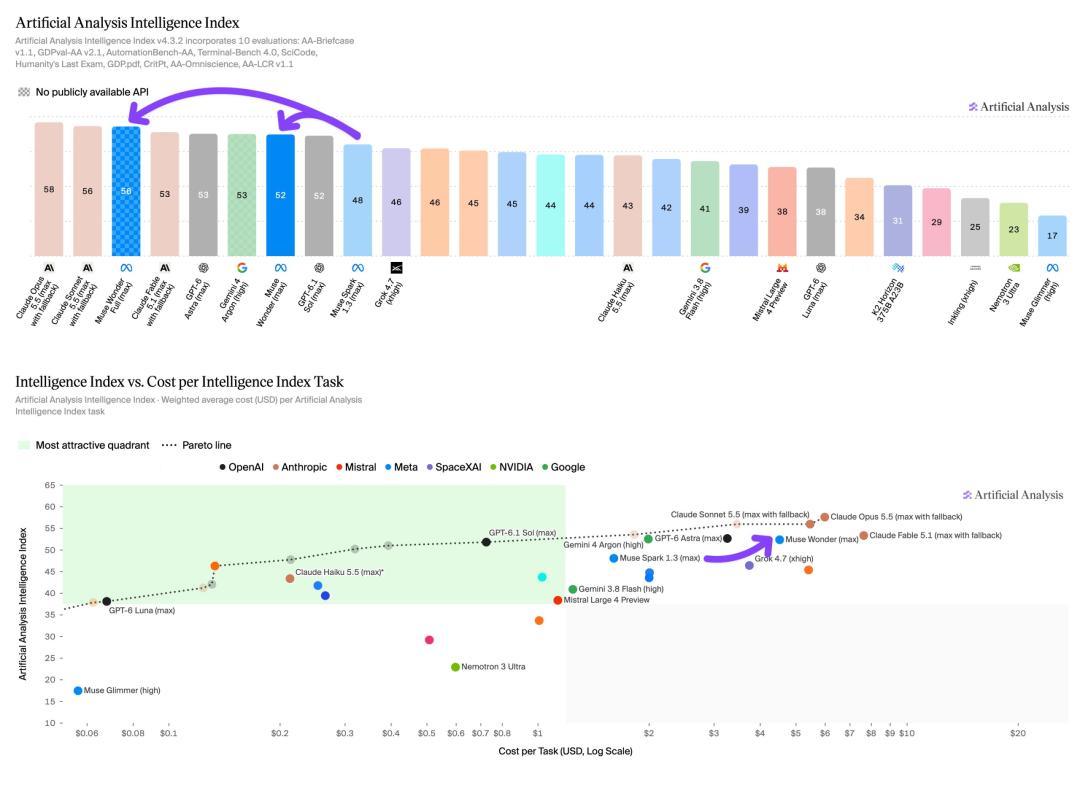
Professional work capabilities also catch up: 14 tests cover capabilities including law, finance, memory and continuous execution. Full outperforms Opus 5.5 in 8 items and GPT-6 Astra in 11 items.
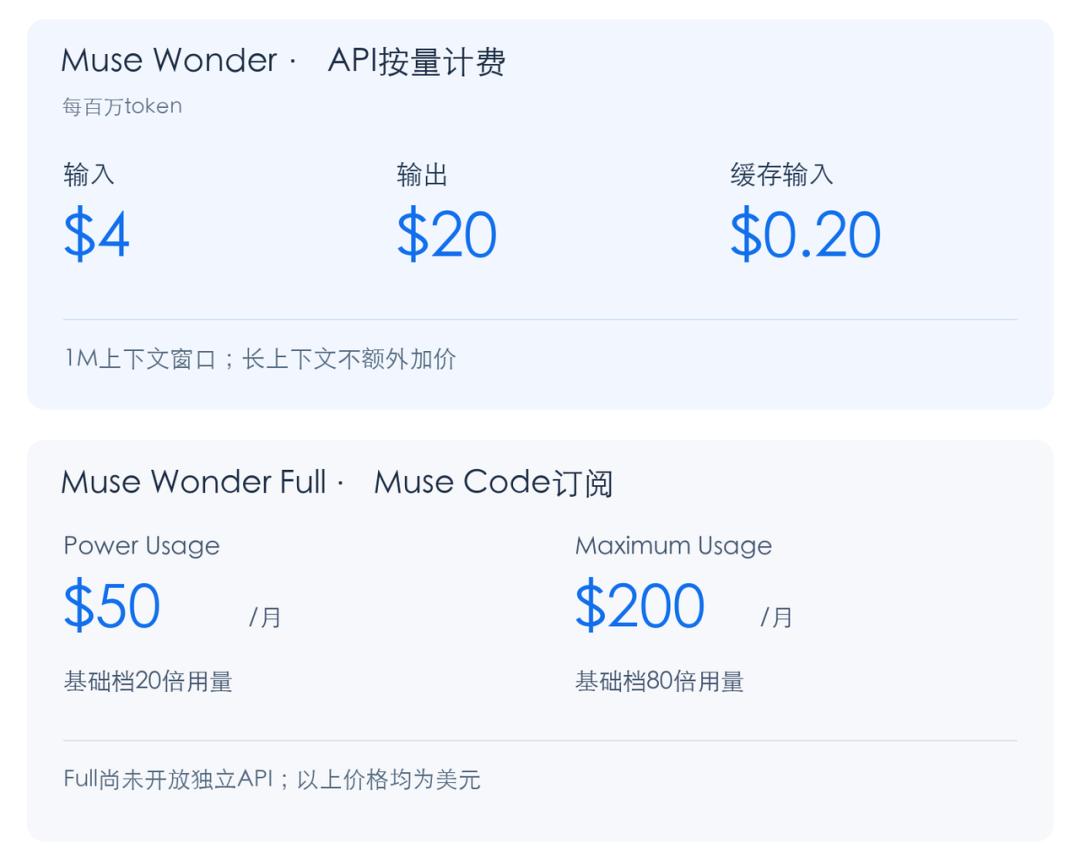
Pricing: The regular version API costs $4 per million input tokens and $20 per million output tokens; Full is opened through Muse Code subscription, with a monthly fee of $50 or $200.
8 points surge in 6 weeks, winning all 10 tests against the previous generation!
According to statistics from Artificial Analysis, there is only a 6-week interval between the release of Muse Spark 1.3 and the new model.
The intelligence index has jumped from 48 points to 56 points, a full 8-point increase!
All 10 tests outperform Spark 1.3; 6 tests rank top 3, 2 tests take first place!
In the scientific reasoning CritPt and professional document GDP.pdf tests, Full got 33% in both, ranking first on that AA leaderboard! In the professional knowledge work test GDPval-AA v2.1, Full got 1857 Elo, ranking second.
The other three third-place results are from Knowledge Work AA-Briefcase, business process automation AutomationBench-AA, and scientific programming SciCode respectively.
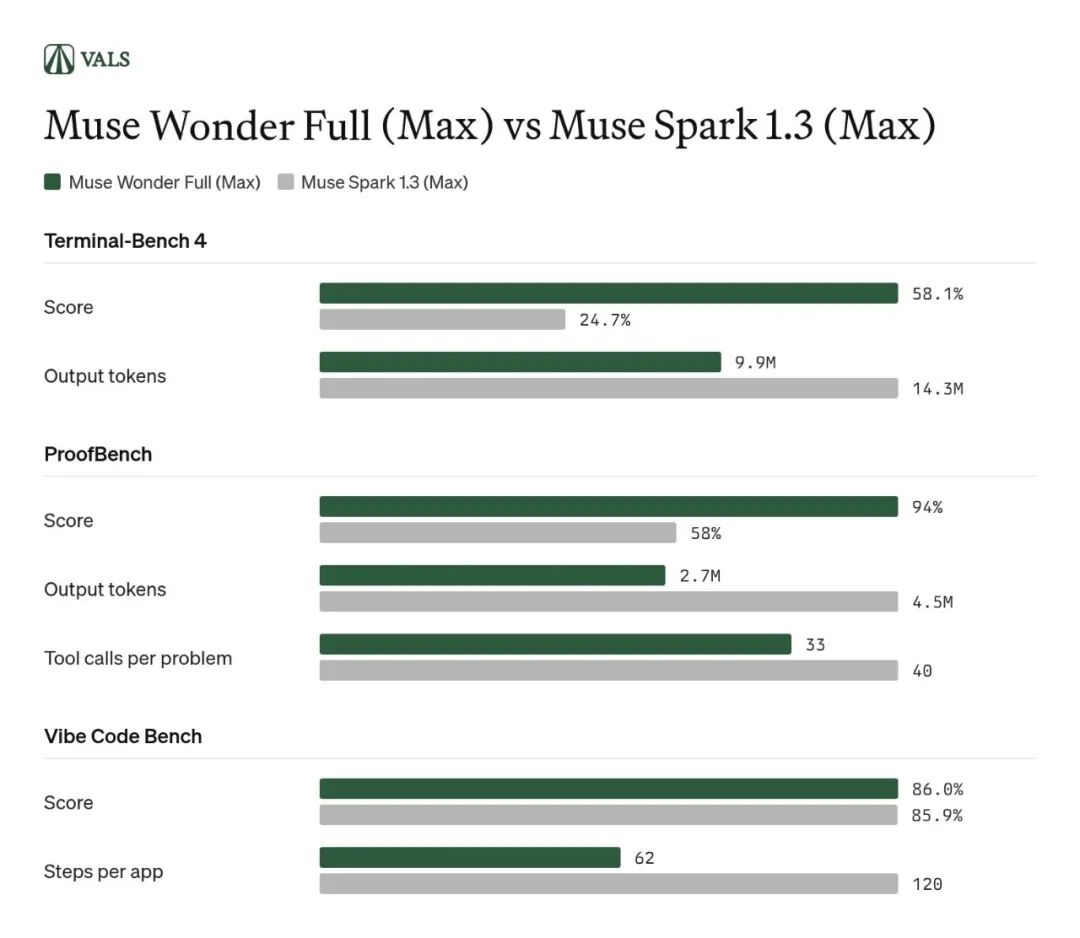
Terminal-Bench 4.0 requires AI to read files, enter commands, and handle errors by itself. Spark can only complete 33% of the tasks, while Full has achieved 57%, a 24-percentage-point increase in one go!
Another evaluation agency Vals also released new results.
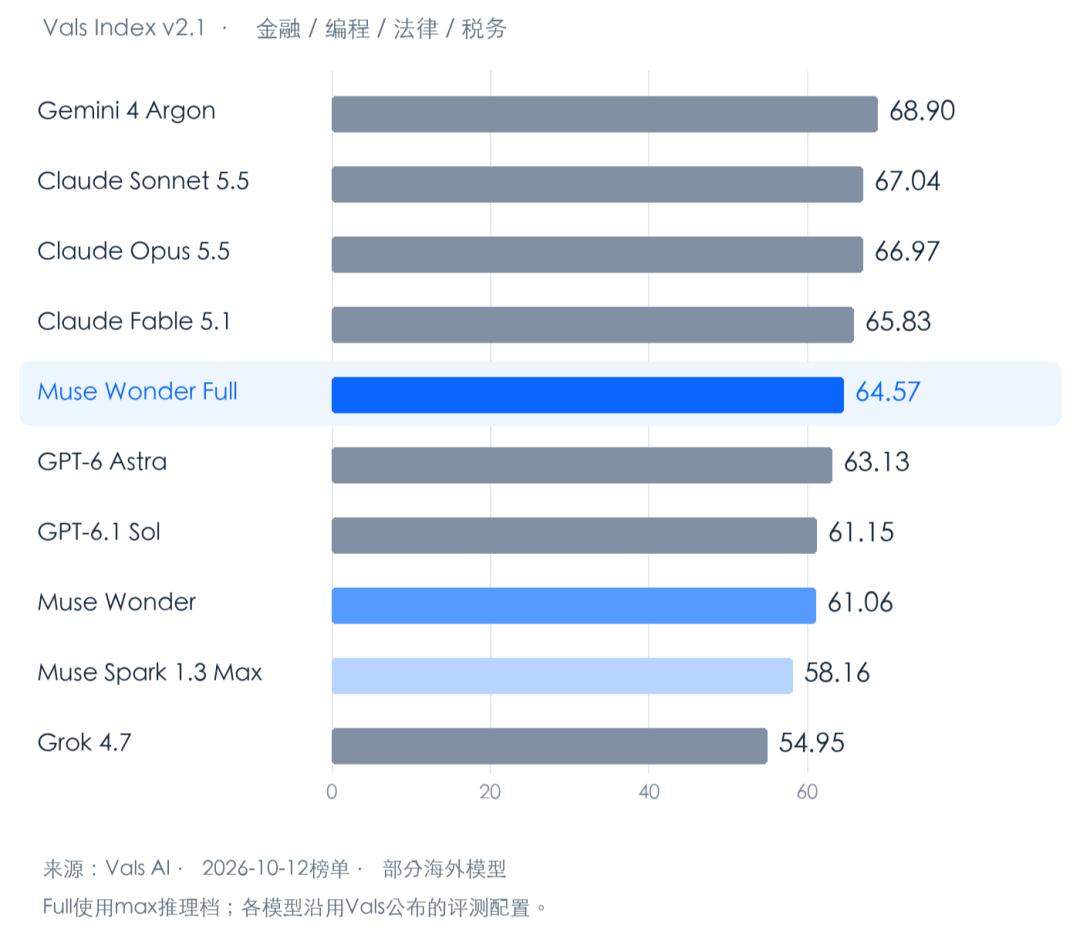
In the comprehensive Vals Index covering finance, programming, law and tax work, Wonder Full rushed to 5th place with 64.57 points, outperforming all OpenAI models on the list!
Apart from benchmark scores, Conductor developer Charlie Holtz has already integrated Wonder into his own codebase.
Unexpectedly, Muse found a real security vulnerability in one attempt, which all other agents missed before.
He even praised its design and visualization effects, CLI speed and voice mode, and said bluntly that "Meta is already at the cutting edge now"!

In another test, developer Yair conducted a side-by-side comparison of the same task, asking Wonder and Opus 5.5 to develop a first-person 3D game respectively.
Claude Code equipped with Opus 5.5 took 11 minutes and 40 seconds, while Muse Code equipped with the regular Wonder only took 3 minutes and 42 seconds, less than 4 minutes!
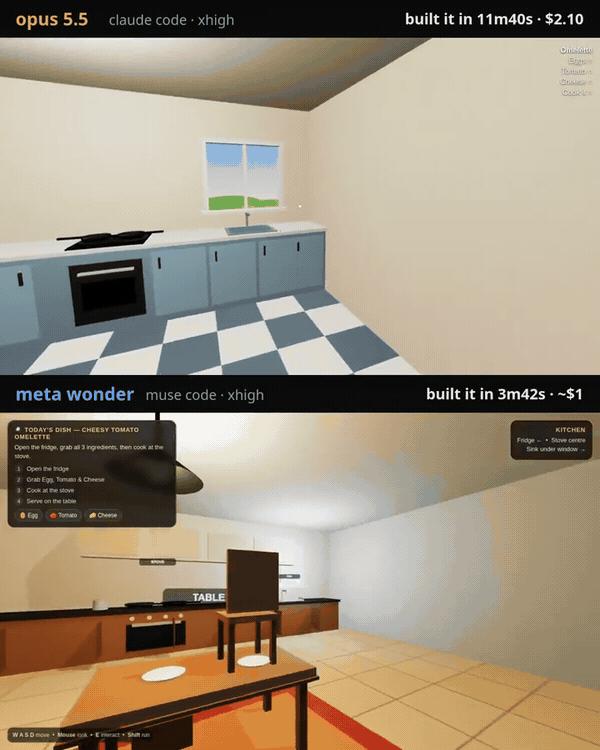
Outperform Opus in long tasks, fully beat Astra in programming
On the SWE-Marathon benchmark for evaluating long-horizon tasks, Full got 57.5%, Opus 5.5 got 46.3%, and Astra got 42.5%.
The leading margins reached 11.2 and 15 percentage points respectively!
Even without the Full version, the regular Wonder got 53.1%, also surpassing these two flagship models.
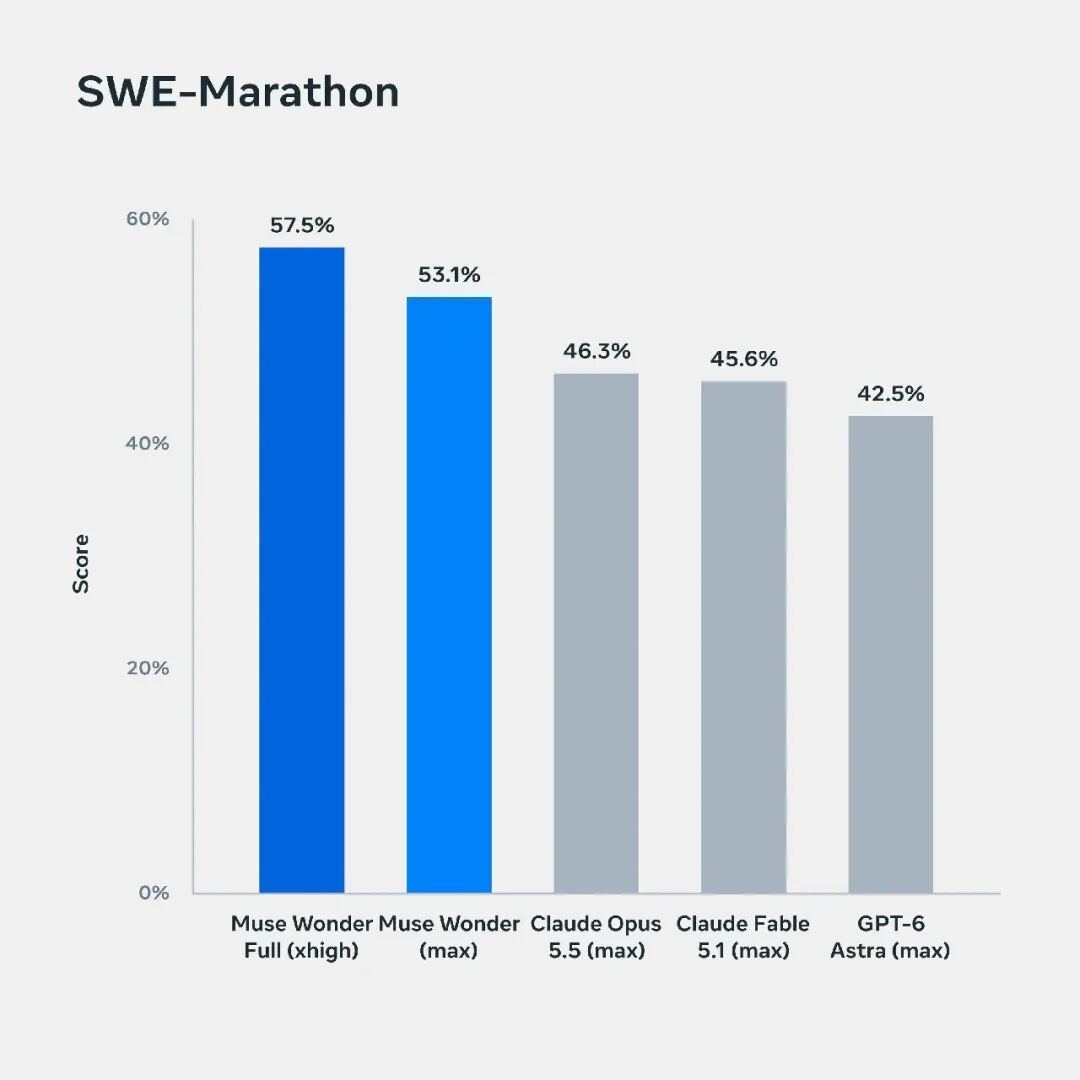
SWE-Marathon requires AI to continuously complete software projects: read requirements, modify multiple files, run tests, and find the causes of errors on its own after failures, then continue to modify.
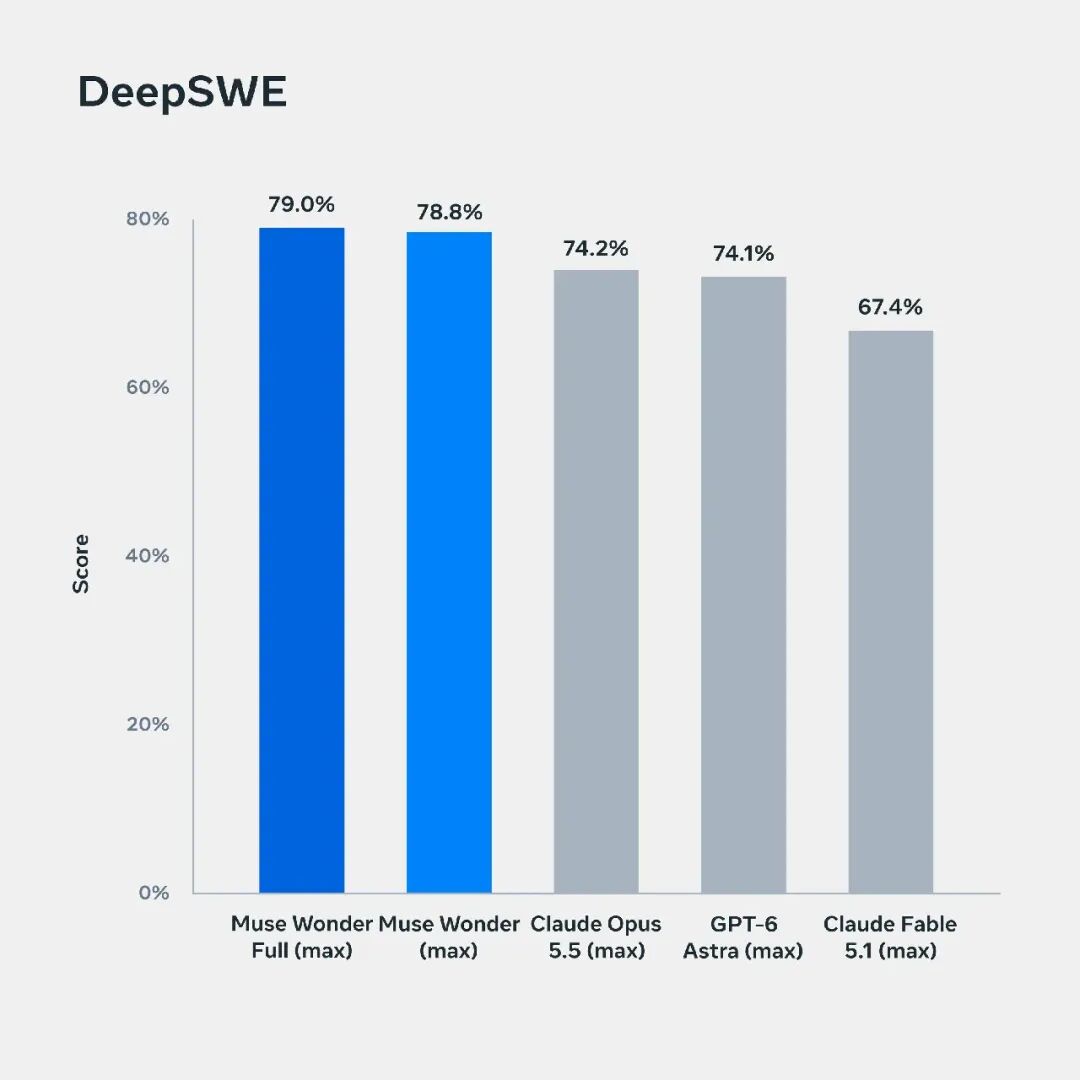
DeepSWE v1.1 contains 113 tasks, involving 91 code repositories and 5 programming languages.
In Meta's aggregated results, Full got 79.0%, Wonder got 78.8%, while Opus and Astra got 74.2% and 74.1% respectively.
Looking at AA's Coding Agents Index, Muse Code equipped with Full got 68 points, tying the score of Claude Code equipped with Sonnet and surpassing the 66 points of the Opus-equipped version.
The previous generation Muse Code paired with Spark 1.3 only got 54 points. Equipped with Full, the score directly increased by 14 points! The regular Wonder-equipped version also got 63 points.
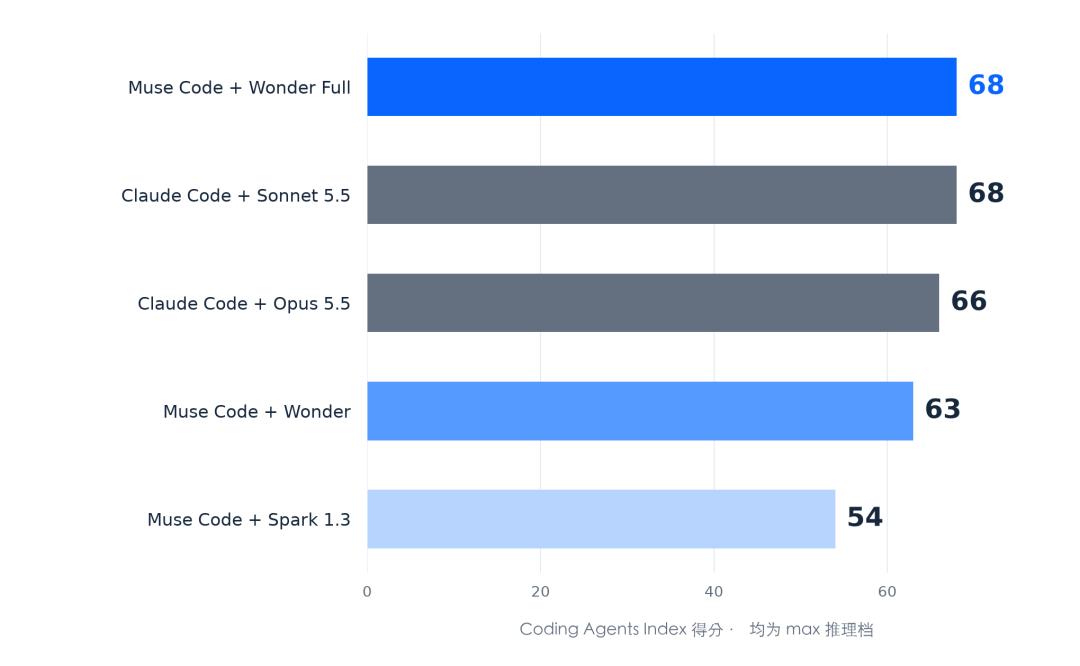
Partial results of Muse Code and Claude Code in the Artificial Analysis Programming Agent test
In the zero-base programming ProgramBench, Full got 59.0, higher than Astra's 52.5, while Opus got 70.5.
In the terminal programming test, Full got 57.1, while Astra and Opus got 59.1 and 59.6 respectively.
In addition, larger-scale vulnerability tests also have results.
The maintainer of VulnPR-100 arranged 100 code changes with known vulnerabilities for Wonder 1.0, with a one-hour time limit for each.
It found 46 vulnerabilities, tying with GPT-6 Astra. The whole round cost $284.88, with an average of $6.19 per vulnerability.
36 more correct math problems, 40% fewer tokens
In Vals AI's ProofBench, Full correctly solved 94 mathematical proof problems, 36 more than the previous generation; on the same list, Opus got 100 correct answers and Astra got 99.
More problems are solved, but the output tokens dropped from 4.5 million to 2.7 million, a 40% reduction! When applied in real scenarios, the score remains at around 86%, and the average number of steps is reduced from 120 to 62.
8 out of 14 items outperform Opus, legal score reaches 3.1 times of Opus
In the legal task Harvey LAB-AA, Full got 13.1 points, Opus got 4.2 points, the former reaches 3.1 times of the latter! It also got 59.1 points in financial tasks, surpassing Opus's 58.6 and Astra's 53.5.
When doing professional work, it also generates fewer hallucinated answers. In AA's 6000 knowledge questions, Full's hallucination rate is 23%, Astra's is 51%, and Opus's is 59%; this statistic refers to the proportion of incorrect answers given for questions that are not answered correctly.
Full is less likely to force an answer, but its knowledge index is still 30, lower than Astra's 43 and Opus's 46.