Muse Wonder elbows Astra, Meta makes a strong comeback to the forefront of the model field.
More than a year later, Meta has finally rolled out a large model capable of competing head-to-head with OpenAI and Anthropic.
On October 12, Mark Zuckerberg announced that Meta Superintelligence Labs (MSL) has officially released Muse Wonder and Muse Wonder Full. This is the first flagship model that claims to reach the cutting-edge level launched by MSL since its establishment more than a year ago.

Previously, as OpenAI and Anthropic took turns refreshing the model leaderboards, Meta did not release a new generation of flagship model for a long time. We once thought that Zuckerberg had given up the competition for state-of-the-art performance.
Now it seems that Meta has been working on a big move.
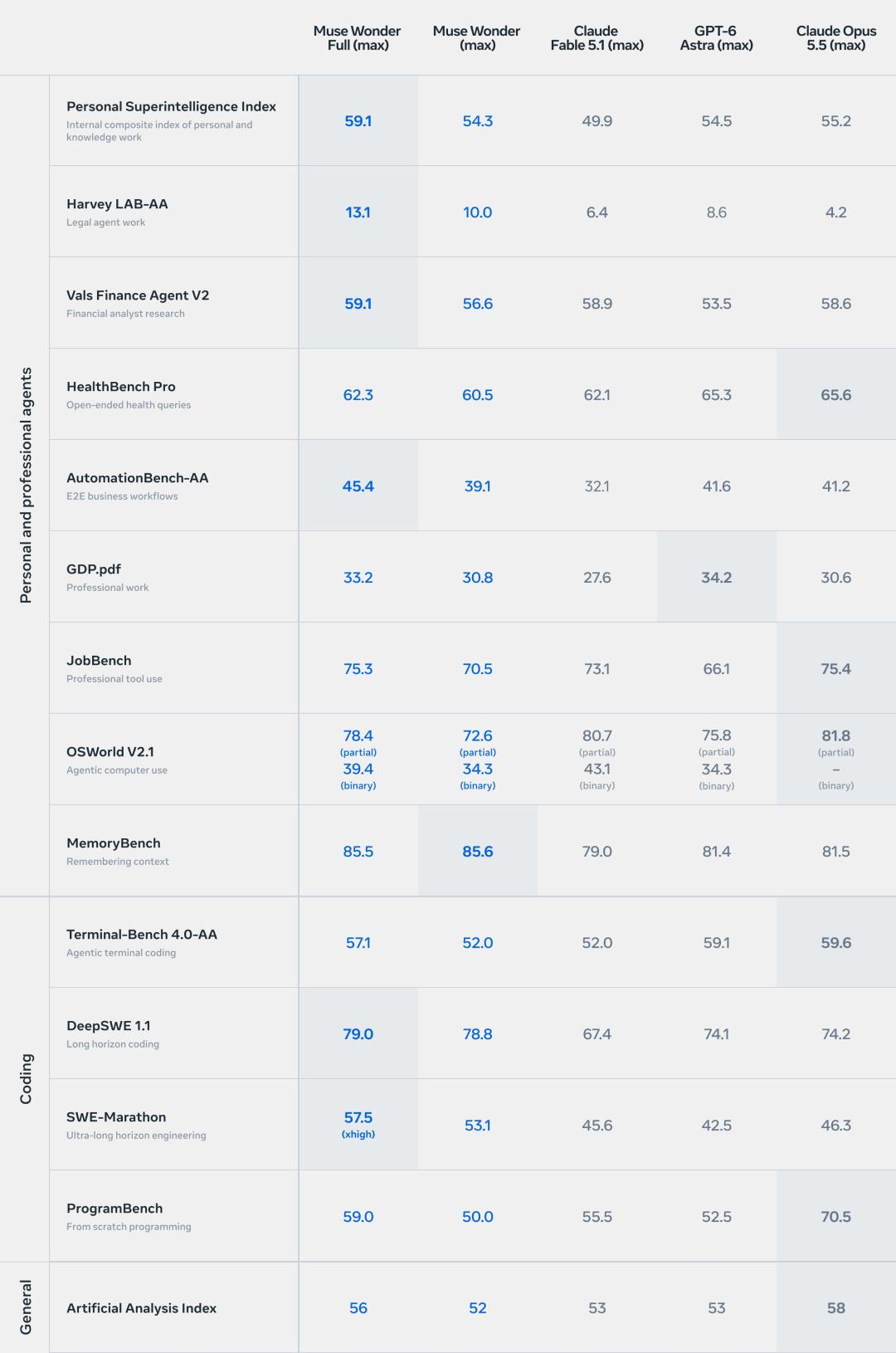
In tests such as programming, long-cycle Agent tasks and memory capabilities, Wonder Full has delivered quite impressive results, and some items even outperform GPT-6 Astra and Claude Opus 5.5.
In April 2025, Llama 4, which Meta placed high hopes on, was released, but it failed to continue its previous momentum, and instead fell into controversies over performance and benchmark gaming. Later, Zuckerberg personally stepped in, poured huge funds to recruit talents, and rebuilt the AI R&D team.
Now Zuckerberg has finally got this report card. So how competitive is Meta's new model?
Meta Finally Has a Top-Tier Model Again
This time Meta has launched two models: Muse Wonder and the more powerful Muse Wonder Full. Both support a 1 million token context window, focusing on programming, long-term Agent tasks and professional knowledge work.
According to the official benchmarks released by Meta, Wonder Full has already had the strength to compete head-on with the flagship models of OpenAI and Anthropic in multiple items.
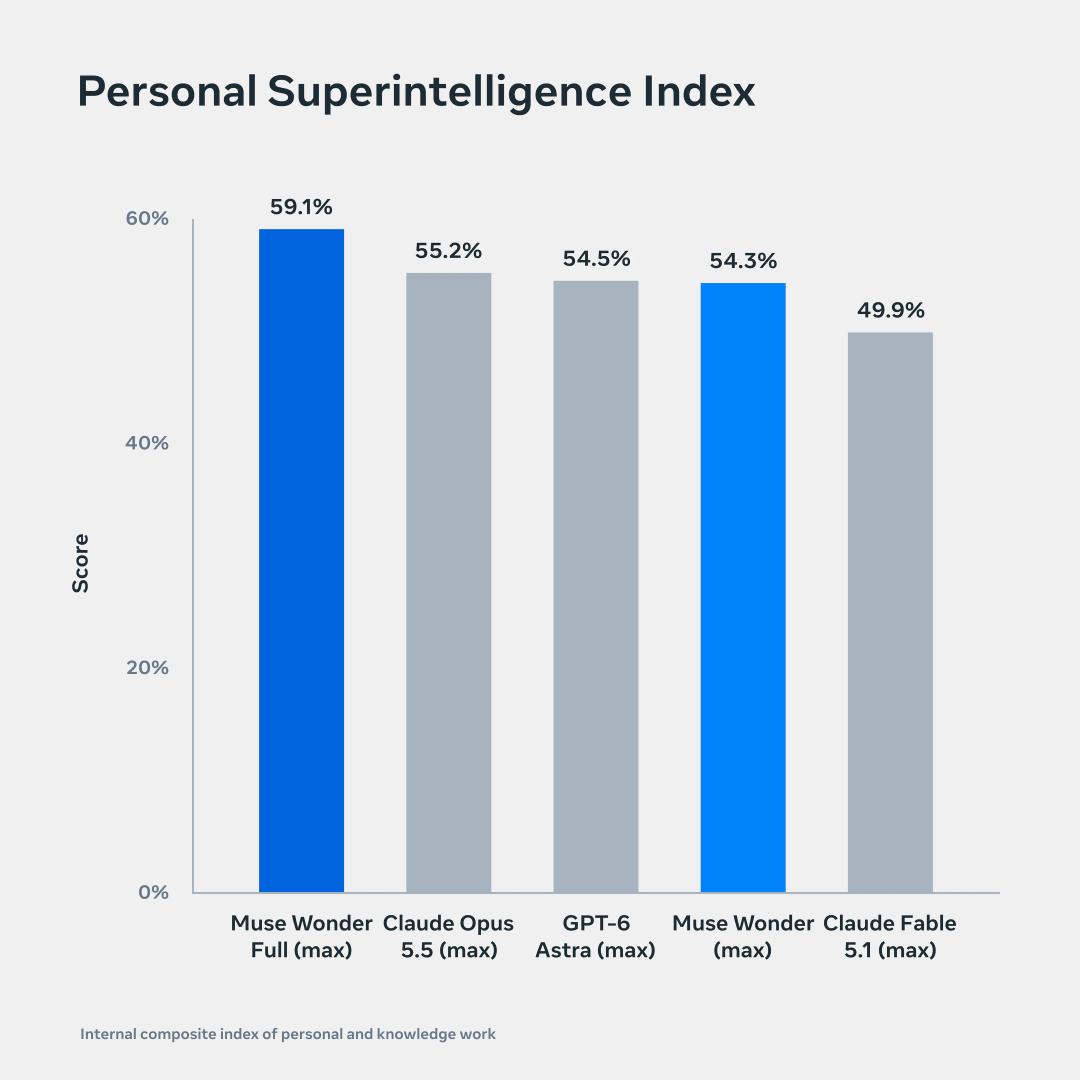
The most noteworthy is an indicator called Personal Superintelligence Index.
This is a comprehensive indicator formulated internally by Meta, consisting of seven tests related to personal affairs and knowledge work, covering scenarios such as professional work, automated workflows, and web operations.
In this test, Wonder Full ranked first with a score of 59.1%, Claude Opus 5.5 and GPT-6 Astra scored 55.2% and 54.5% respectively, and the standard version of Wonder achieved 54.3%, which also surpassed Fable 5.1.
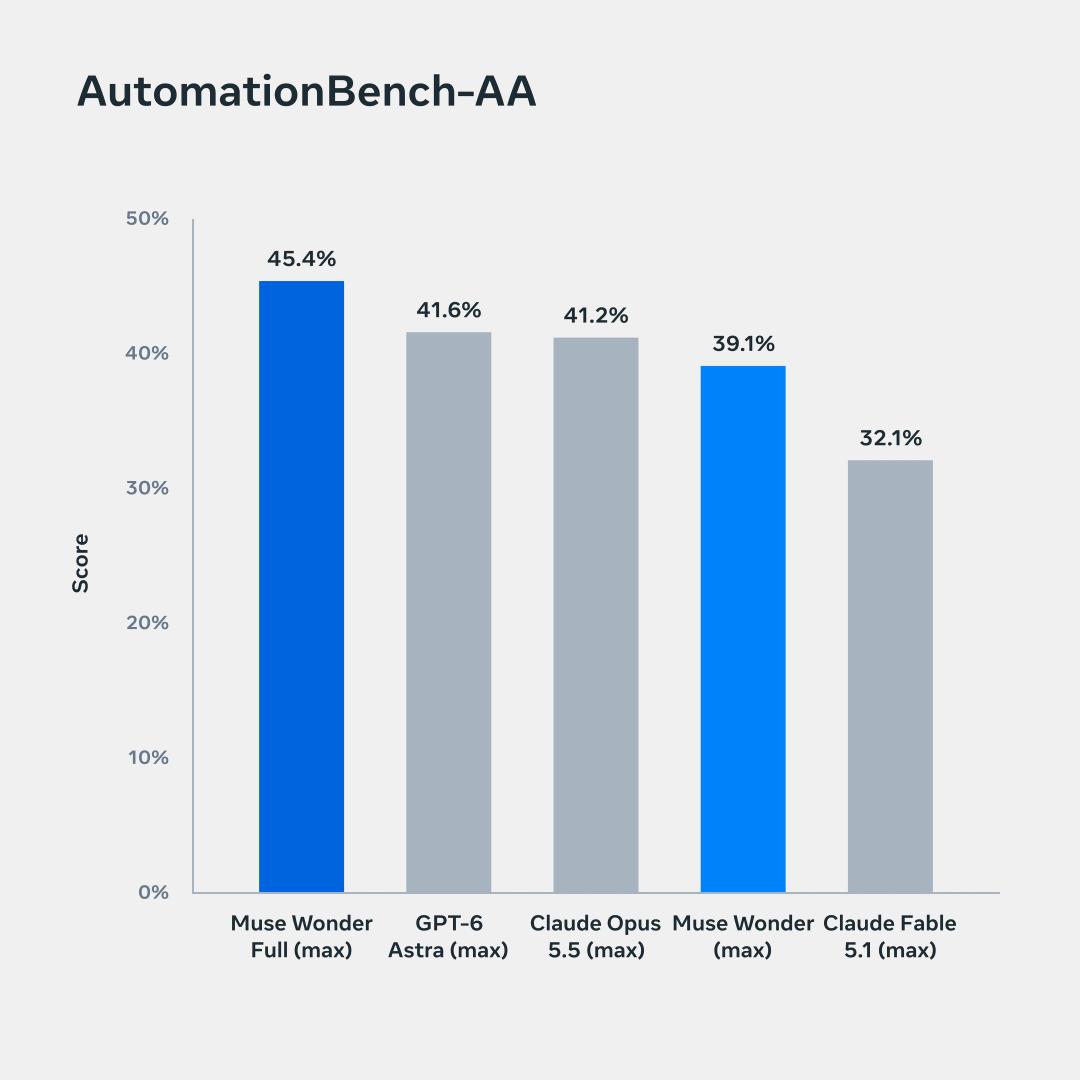
Meta also specifically demonstrated the automation and memory capabilities of the model.
In AutomationBench-AA, which measures the end-to-end business process automation capability, Wonder Full achieved a score of 45.4%, higher than Astra's 41.6% and Opus 5.5's 41.2%.
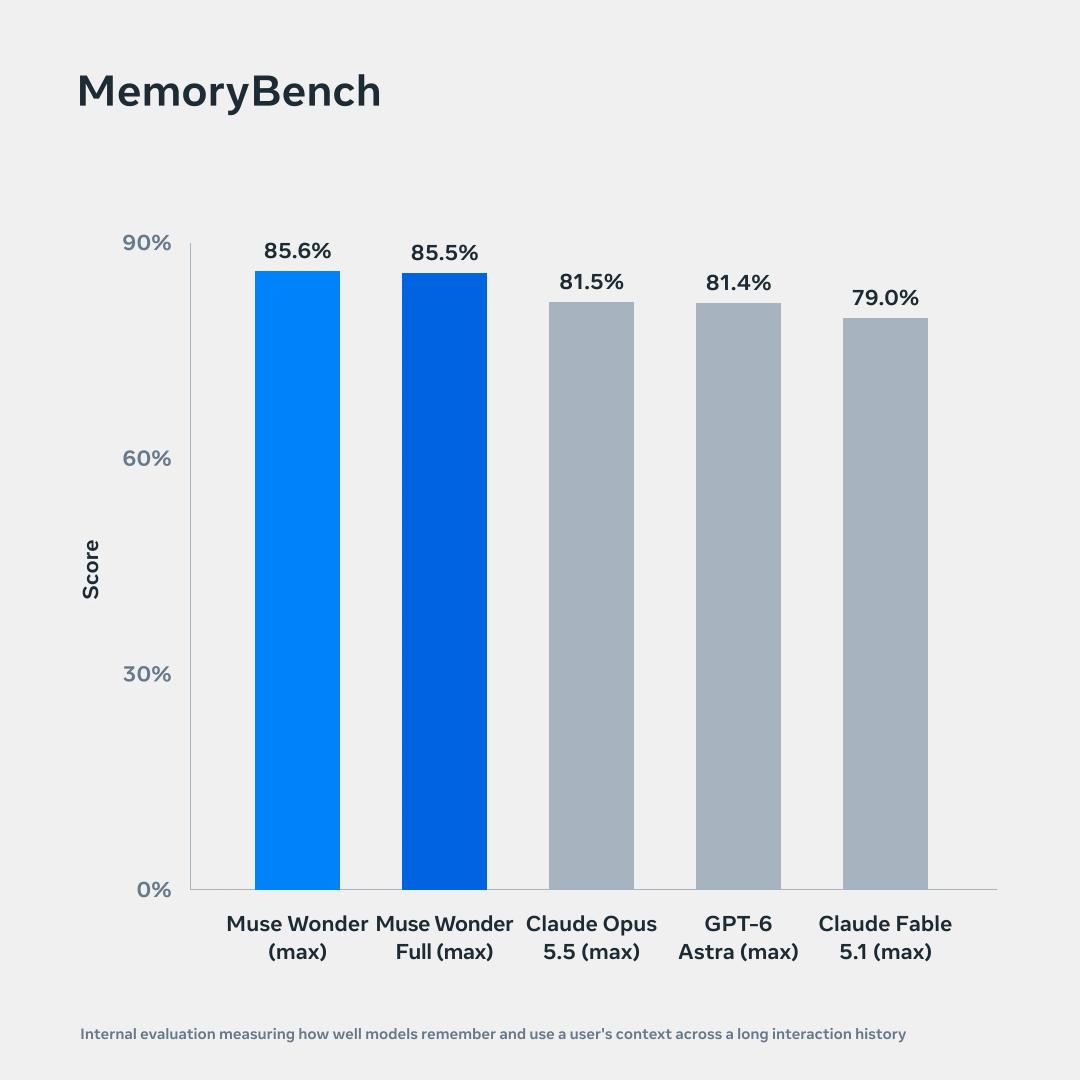
In MemoryBench, which tests long-term conversational memory capabilities, the standard version of Wonder even slightly surpassed Wonder Full's 85.5% with a score of 85.6%, while Opus 5.5 and Astra scored 81.5% and 81.4% respectively. This test was developed internally by Meta, mainly to examine whether the model can accurately retrieve key content from long conversations containing a large amount of interference and information updates.
From personal and professional tasks, to process automation, to information extraction in long conversations, these three tests have clearly reflected Meta's emphasis on Agent capabilities.
In addition, Meta did not abandon the competition with OpenAI and Anthropic for coding capabilities just because it focused on personal Agents.
In DeepSWE 1.1, which tests long-term software engineering capabilities, Wonder Full achieved a score of 79.0%, surpassing GPT-6 Astra's 74.1% and Claude Opus 5.5's 74.2%; in SWE-Marathon, which has a longer task cycle and requires the model to continuously modify and maintain software projects, the success rate of Wonder Full reached 57.5%, compared with 42.5% for GPT-6 Astra and 46.3% for Claude Opus 5.5.
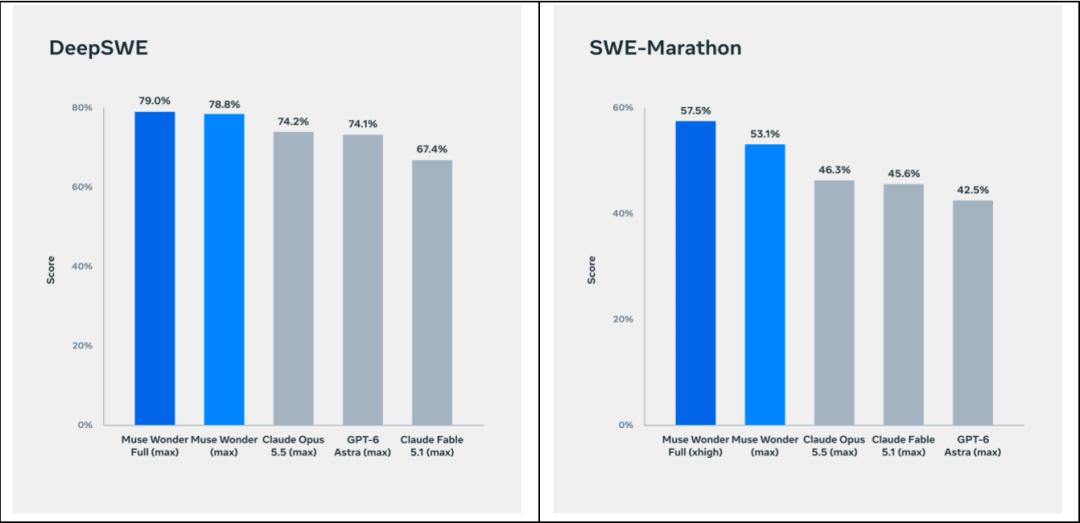
In the five key tests demonstrated by Meta, Wonder Full all leads the flagship models of the two competing companies. Even the standard version of Wonder is quite competitive in programming and memory tests.
Of course, this does not yet prove that Meta has comprehensively surpassed OpenAI and Anthropic. The above results include evaluation indicators formulated internally by Meta, and different tests adopt different operation configurations, which cannot be simply equated with real user experience.
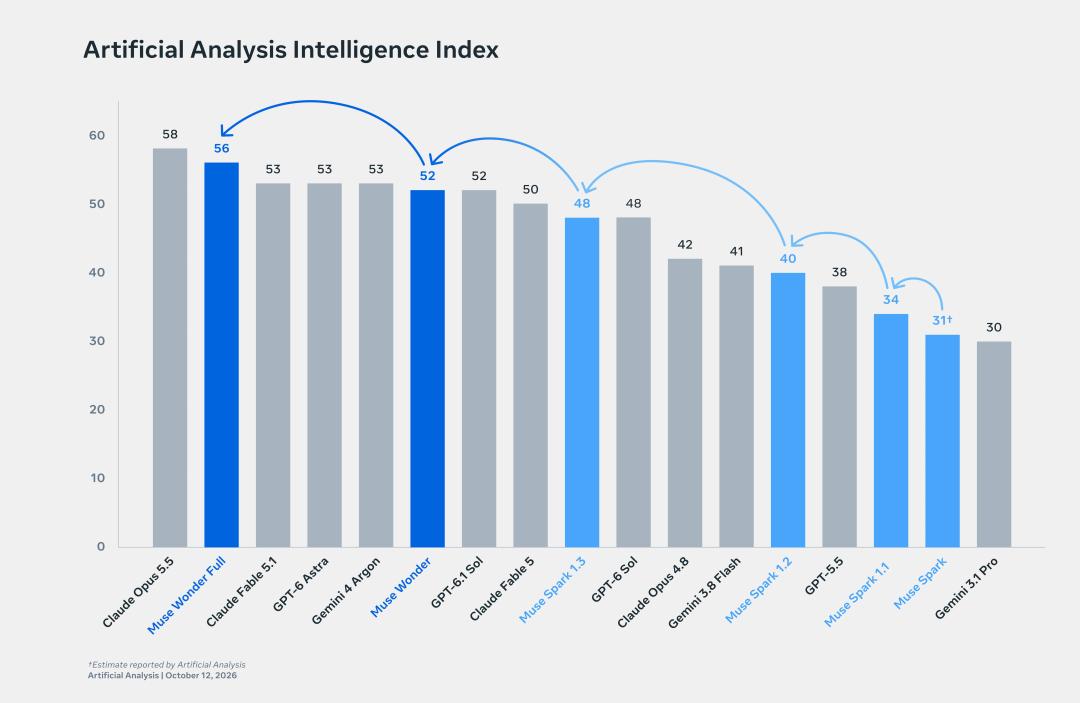
In addition, in the third-party comprehensive evaluation Artificial Analysis Intelligence Index, Wonder Full scored 56 points, leading GPT-6 Astra's 53 points, but still lower than Claude Opus 5.5's 58 points.
Apart from performance results, the pricing is also worth noticing.
Currently, the standard version of Muse Wonder is available through Meta Model API and Muse Code. The API input price is $4 per million tokens, output $20 per million tokens, and cached input is $0.2 per million tokens.
For comparison, the standard API price of Claude Opus 5.5 is exactly $4 for input and $20 for output; GPT-6 Astra is $10 for input and $50 for output.
Considering that the performance of the three models is very close in some tests, Wonder's pricing is quite competitive.
Moreover, Meta also stated that Wonder will not charge extra for using longer contexts.
However, Wonder Full, which has stronger benchmark performance this time, cannot be purchased separately via API for the time being.
It is currently only open to Power Usage and the newly launched Maximum Usage subscription users of Muse Code. The former costs $50 per month, and the latter costs $200 per month. The usage quota of the new plan is 80 times that of the basic Everyday Usage plan.

As for Muse, Meta's personal Agent product, it has not been synchronously upgraded to Wonder yet.
Meta said that Wonder will be gradually connected to Muse, opening first to subscription users, and a special version for the general public will be launched in the future. No specific schedule for Wonder Full to enter Muse has been announced yet.
Therefore, although the flagship model has been released, for most users, this update currently remains in the stage of developer products and upcoming feature previews.
Aiming at the Consumer-Grade Agent Market
In addition to demonstrating benchmark scores, Meta also spent a lot of space discussing the generalization ability of the model in its official technical blog.
Two terms were specifically mentioned: Benchmaxxing and Big model smell. The former can be understood as "benchmark gaming", which refers to models that are over-trained specifically for popular benchmarks; the latter is a more abstract expression, literally translated as "large model peculiar smell".
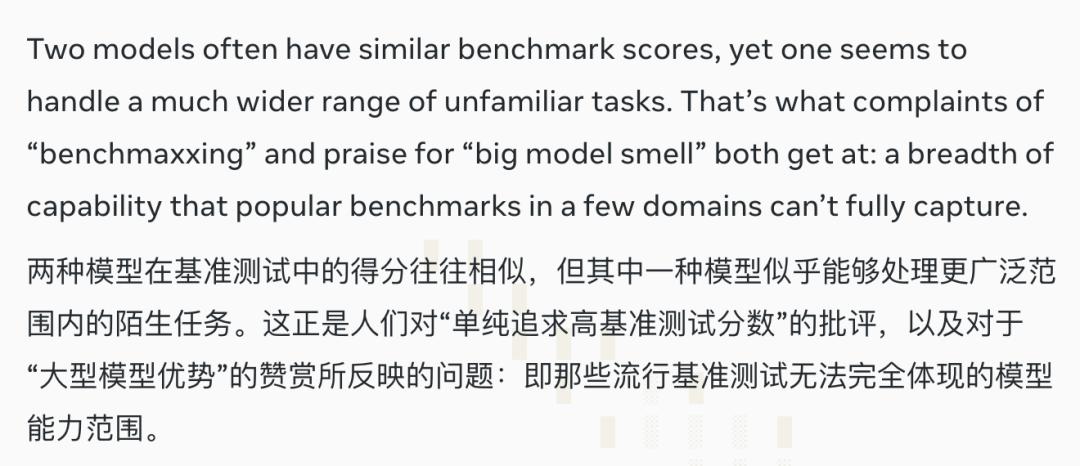
Meta believes that even if two models have similar benchmark scores, their actual capabilities in handling unfamiliar tasks may vary greatly. Some models have capabilities beyond the coverage of popular benchmarks, which users can perceive in actual use.
To verify this, Meta specifically compared Muse Spark 1.3 and Wonder Full.
The researchers put two types of tasks together: one type of tasks that were heavily optimized during the post-training process, and the other type of unfamiliar tasks that were not specifically optimized, and observed the performance of the two models under different inference intensities.
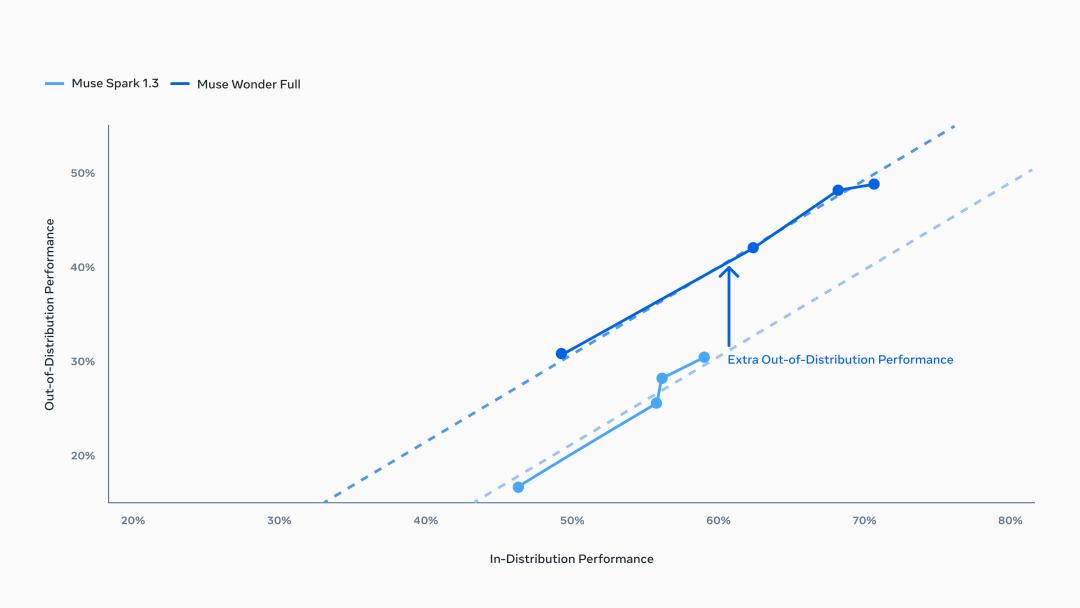
The results show that with similar scores on heavily optimized tasks, Wonder Full performs better on unfamiliar tasks, exceeding the prediction made based on the test trend of Spark 1.3.
Meta believes that this is because Wonder is built on a larger and stronger base model. The stronger the base model's capabilities, the more likely the improvements brought by post-training can be transferred to tasks that have not been specifically trained.
Compared with those numbers, the series of official cases demonstrated by Meta may better illustrate the R&D direction of Wonder.
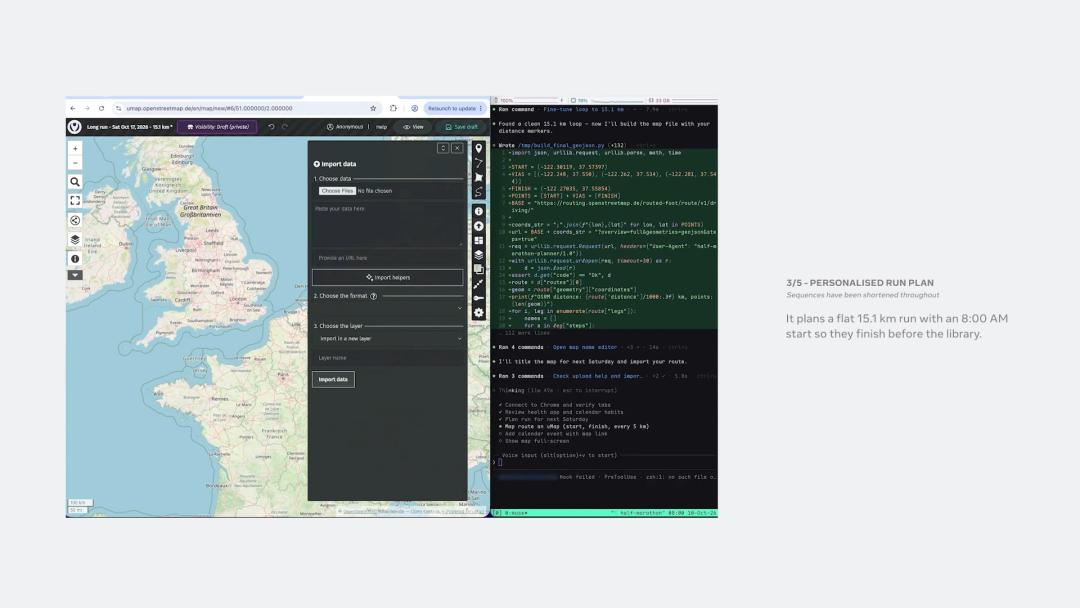
For example, let Wonder arrange a running session on Saturday.
Wonder can operate between the browser and multiple applications according to the user's personal preferences and actual situation, and formulate a running plan.
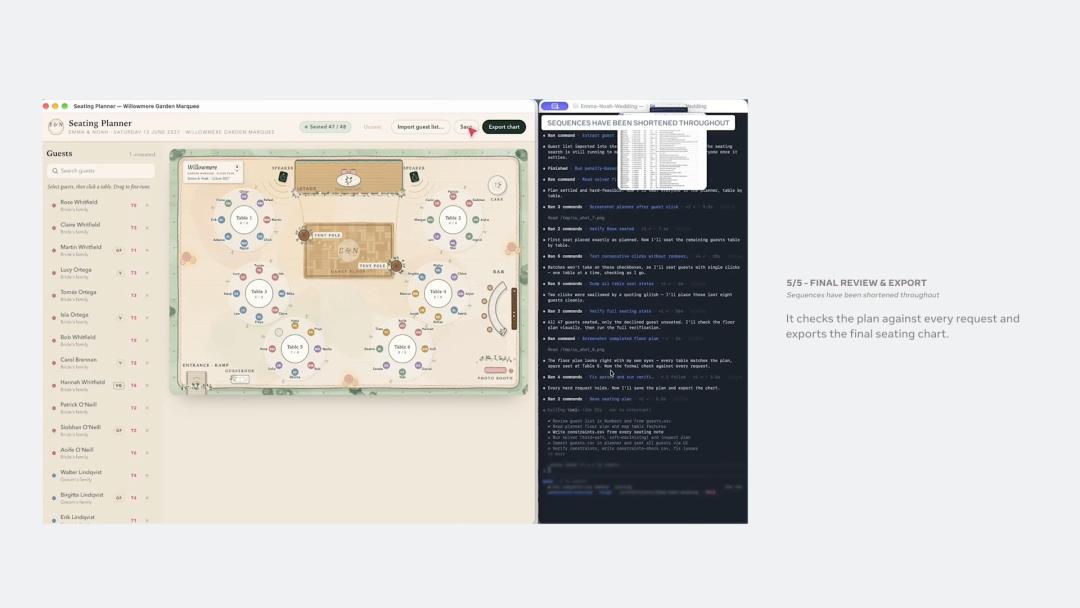
Another example is to let Wonder arrange wedding seating.
The user puts forward a series of complex requirements, including the relationship between guests, seat allocation restrictions, etc., and Wonder generates a customized wedding seating chart based on these conditions.
Meta also demonstrated how Wonder can read real photos from users' Instagram accounts, design personalized souvenirs, and further complete the order.
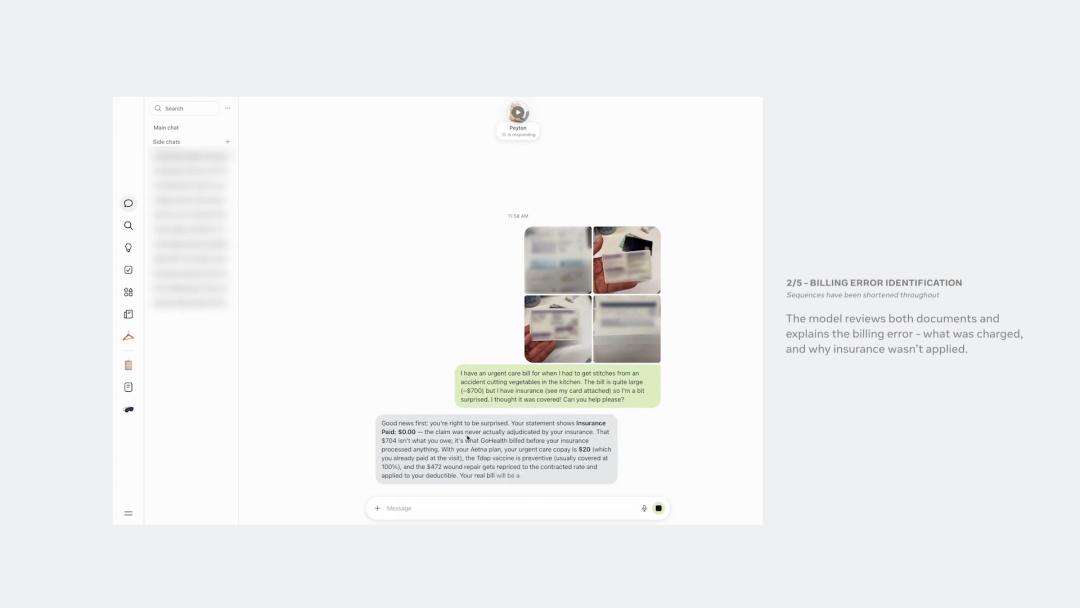
Of course, Wonder can also do more professional things. For example, directly generate a playable 3D kitchen game based on the image provided by the user; or process insurance claims, understand lease contracts, analyze personal finances, and so on.
To complete these tasks well, Meta also specially emphasized two capabilities of Wonder: Active Memory and Active Focus.
The former enables the model to retain important information across conversations and actively retrieve relevant content when needed; the latter allows the model to try other methods when encountering difficulties, handle obstacles, continue to advance the task, and ask or confirm with the user when necessary.
For consumer-grade personal Agents, the tasks users may assign are varied, and the tools, goals and restrictions involved are even more diverse. Developers cannot anticipate all situations in advance, let alone train the model specifically for every task in life.
Compared with getting the highest score on several fixed tasks, Meta obviously prefers Wonder to be able to handle a sufficiently wide range of problems, even those that are not anticipated in advance.
The day before Wonder was released, Meta's Chief AI Officer Alexandr Wang talked about why Meta chose to bet on consumer-grade personal Agents in an interview with David Senra.
He recalled that earlier this year, Claude was far ahead in the programming field, and the industry once believed that Coding Agent was the most important product form of AI, and almost everyone wanted to enter this market to compete with Anthropic.
But Meta chose another path.
Alexandr Wang believes that Meta's natural advantage lies in the consumer market. It owns products such as Instagram, WhatsApp and Facebook