Neuromorphic computing is heating up again: Flourish has raised $500 million in financing, betting on the next-generation AI paradigm with brain science.
In June 2026, Flourish, a New York-based neuro AI startup, officially ended nearly two years of stealth operation and unveiled its technical roadmap and capital layout to the market.
With no product launches, no revenue data, no published papers, no measured benchmark results, and only a technical concept of "reverse-engineering the human brain's computational logic", Flourish has completed a $500 million financing (approximately RMB 3.6 billion), with a post-money valuation fixed at $2.5 billion.
The investor lineup is top-tier: Amazon founder Jeff Bezos personally invested about $100 million to lead the round, with Google Ventures (GV), top tech venture capital firm Lux Capital, and life sciences specialized investment institution Catalio Capital Management participating jointly.
This is one of the most high-profile financing cases in the AI hard technology track in 2026.
Capital has skipped all traditional metrics for product validation, revenue validation, and technical validation, and directly bet on an answer to the "essence of intelligence".
A two-page "future press release"
Flourish's story began with a two-page "future press release".
This is a methodology that co-founder Rob Williams brought out from Amazon.
As a former member of Amazon's top management S-Team, he led core businesses such as the Alexa voice assistant and is well-versed in the "Working Backwards" methodology advocated by Bezos: before launching a project, write the press release for the successful product launch, then work backwards to figure out every step that needs to be taken now.
After leaving Amazon, Williams has been searching for the breakthrough point of next-generation AI. Introduced by a co-investor, he met Thomas Reardon, another cross-disciplinary figure who is quite legendary in both the tech circle and the neuroscience community.
Reardon's life trajectory is like a parabola spanning two different fields.
As a teenager, he was recruited by Microsoft as a genius programmer, was a core developer of Internet Explorer, and participated in the formulation of early web standards.
But at the peak of his career, he suddenly left the tech circle, went to Columbia University to pursue a doctorate in neuroscience, and plunged from the world of code into the neuronal circuits of the brain.
In 2015, Reardon founded the neural interface company CTR-Labs, which focused on non-invasive electromyographic neural interfaces, capturing neural signals through wrist devices to predict human movement intentions in advance.
In 2019, Meta acquired CTR-Labs for approximately $500 million to $1 billion. Its technology later became the core underlying layer of Meta Neural Band, supporting gesture control for smart glasses. Reardon then joined Meta Reality Labs to lead the development of neuromotor interfaces.
One is a tech executive with a deep understanding of products and business, the other is a serial entrepreneur spanning computer science and neuroscience, plus Jacob Vogelstein from Catalio Capital. He once led the MICrONS project of the US intelligence system during the Obama administration, which aimed to reverse-engineer one cubic millimeter of the brain at single-neuron resolution.
The three formed Flourish's founding team. That two-page future press release was their initial business plan.
It only set two goals: to solve the two core problems of current AI — energy efficiency and continual learning; to build a synthetic intelligence system called Cortex AI that aligns with the human brain in computing power, learning efficiency and power consumption budget.
In December 2025, Williams met Bezos with this document.
After the meeting, Bezos immediately decided to invest $50 million; as subsequent institutions including GV and Lux Capital joined one after another, he increased his personal investment to about $100 million, becoming the largest single investor in this round.
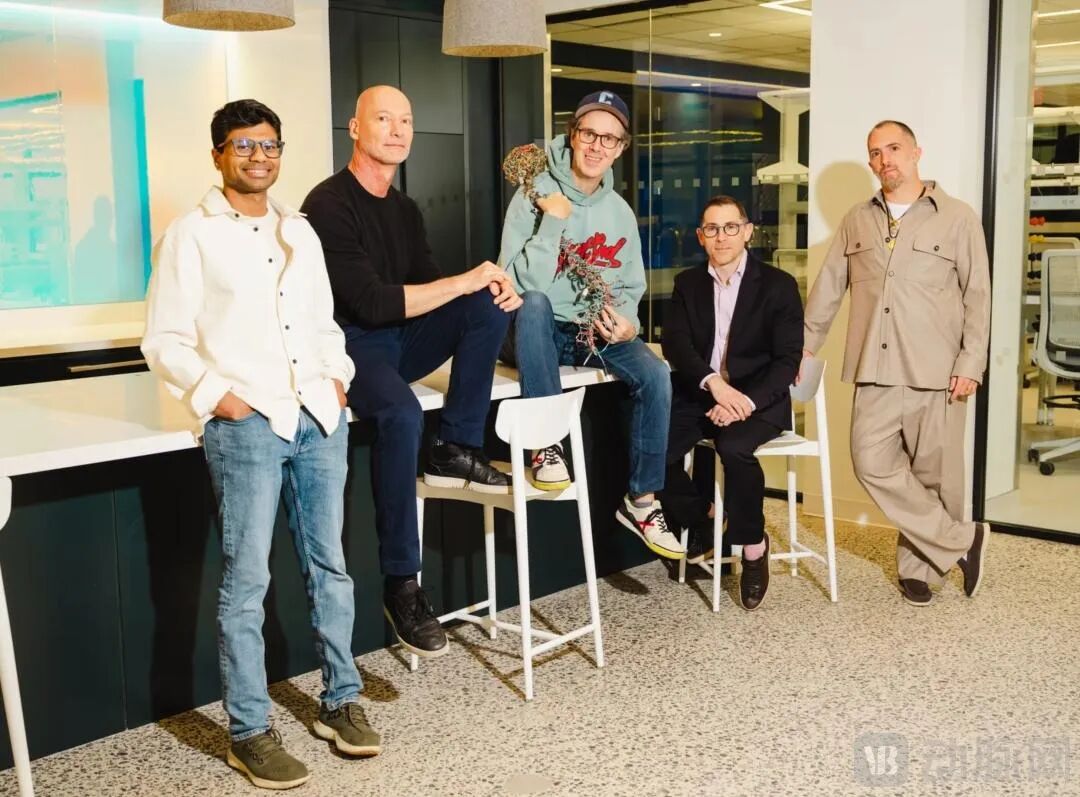
Picture of Flourish's core team and investors Source: wired, photographed by LANNA APISUKH
20 Watts for the Human Brain, Megawatts for AI
In the brain-computer interface and neuro AI track, Flourish took a completely different path from the mainstream from the very beginning.
Star companies in the market, from Neuralink to Synchron, are all following the "connect the brain" path. Through invasive or minimally invasive devices, they establish signal channels between the brain and machines, with the core goal of solving input and output problems.
Flourish's direction is exactly the opposite: it does not want machines to control the brain, but wants the brain to teach machines how to think.
Its core project, Cortex AI, is essentially a reverse engineering of biological intelligence.
Flourish's underlying logic is very straightforward: humans have spent decades designing artificial neural networks, but current large models still rely on massive amounts of data and megawatt-level computing power to achieve the learning, reasoning and adaptation capabilities that the human brain can complete with only 20 watts of power consumption.
This shows that the current AI architecture is fundamentally taking an inefficient path. The human brain, which has evolved for hundreds of millions of years, has already provided the optimal computing paradigm, and people only need to find it.
To this end, Flourish has built its own neuroscience wet lab, using high-resolution electron microscopy and high-throughput electrophysiological recording to reconstruct the complete structure of the brain cortical column, revealing the biological principles that enable the human brain to achieve extremely high energy efficiency.
Cortical columns are columnar tissue structures with a diameter of about 300 to 500 micrometers in the cerebral cortex. Since their discovery by Mountcastle in 1957, they have been regarded by neuroscientists as the basic computing units of the neocortex.
What the team needs to do is to map all the neural connections and synaptic weights within it at single-neuron resolution, which is connectomics research, to extract reproducible computing rules from it.
Different from traditional artificial neural networks, what Flourish aims to do is not gradient descent and backpropagation, but to build a brand new non-gradient learning algorithm based on the spike coding of biological neurons, local synaptic plasticity and lateral inhibition mechanisms.
According to the vision, this algorithm can eventually be implemented on traditional digital chips. Without relying on new types of hardware, the operating power consumption of general intelligence can be compressed to 20-50 watts, which is only equivalent to the level of an ordinary laptop, and it has human brain-like continual learning and few-shot learning capabilities at the same time.
Flourish is currently in commercial negotiations with the world's leading semiconductor chip manufacturers, and plans to solidify its self-developed neuro-algorithm directly into dedicated silicon-based chips.
In addition, the company plans to build its own neuroscience laboratory, equipped with high-resolution electron microscopes, and develop a five-year deep technology research roadmap.
Why Does Capital Dare to Bet on a "Castle in the Air"?
A company with no products, no revenue, and no public technical achievements receiving a $2.5 billion valuation is already rare in the field of hard technology investment. Placed in the AI track that always emphasizes implementation and verification, it seems even more out of place.
But from the perspective of top-tier capital, this bet has clear logic.
First of all, the industry has reached a bottleneck.
The current large model competition has fallen into an arms race of parameters and computing power. Training costs are rising exponentially, the energy consumption of data centers is rapidly approaching the load limit of the power grid, and the physical boundary of Moore's Law is getting closer and closer.
The growth model that simply relies on stacking silicon chips has clearly hit a ceiling. The entire industry is searching for the next-generation computing paradigm, and brain-like computing is one of the recognized potential directions.
Secondly, the team has verifiable execution capabilities.
Reardon is no stranger to cutting-edge cross-disciplinary entrepreneurship, and Williams has rich experience in large-scale product implementation. For investors, this is a team that knows how to turn science into products.
More importantly, the essence of this investment is a bet on the shift of the AI computing paradigm.
Lux Capital and GV were Reardon's old investors and participated in the Series A financing of CTR-Labs; Jacob Vogelstein from Catalio Capital led the MICrONS project, which accumulated early technical foundations for Cortex AI.
Bezos has long been deployed in the neurotechnology track. He previously invested in the brain-computer interface company Synchron. This bet on Flourish extends his reach from "interfaces" to "the underlying layer of intelligence".
Therefore, the $2.5 billion valuation is never paying for the present of a company, but for a possibility that "if it succeeds, it will reconstruct the entire AI industry".
Once the core computational logic of the brain is deciphered and engineered, it will bring a revolution to the entire computing power system. All terminal devices will be able to run general intelligence, the energy consumption pressure of data centers will be completely alleviated, and the implementation form of AI will be completely rewritten.
A Long Run That Requires Patience
Of course, doubts have never disappeared.
Neuro-inspired AI is not a new concept. From the artificial neural network born decades ago, to the subsequent spiking neural network and brain-like chips, academia and industry have been shouting "learn from the brain" for many years.
However, except for deep learning evolved from artificial neural networks, other neuro-inspired routes that are closer to real brain mechanisms have never come out of the laboratory and become the mainstream computing paradigm.
Connectomics itself is a huge project. Only one cubic millimeter of brain tissue contains tens of thousands of neurons and hundreds of millions of synapses, and the difficulty of complete mapping is comparable to that of the Human Genome Project. Even if the neural connection map is fully drawn, it is still unknown whether the core computable algorithm can be extracted from it.
The industry generally expects that Flourish's R&D cycle will be at least 5-10 years, and commercialization is far from in sight. Before that, the company will not have any revenue and can only continue to burn money. $500 million in financing sounds like a lot, but in the field of basic research, it may only be the starting price.
There is no shortage of competitors on the track. IBM's TrueNorth and Intel's Loihi have been exploring the field of brain-like chips for many years, and major tech companies also have internal brain-like computing research teams.
Flourish's advantage lies in its more extreme reverse engineering route, which also means higher technical risks.
But capital is obviously willing to pay for this "craziness".
In an era when the AI industry is frantically stacking computing power, parameters and power, a synthetic brain with 50 watts of power consumption sounds like science fiction.
But when the marginal benefit of the parameter competition continues to decline, and when energy consumption becomes an unavoidable hard constraint, someone will always look back at the answer that biological evolution has given over billions of years.
This article is from the WeChat Official Account "Artery Network" (ID: vcbeat), written by Chen Maoyu, and published with authorization from 36Kr.