AI short dramas are not a "predatory hunt", but the daily life of 800 million people
On October 9, a college freshman posted on Xiaohongshu: "AI manhua dramas have ruined my dad." She wrote that her father's dark circles from watching manhua dramas are even more prominent than when he took care of her during her senior year of high school; after working out after work, he skips showering first to watch until past 10 p.m., and even after being urged to take a shower, he continues watching until the wee hours of the morning, then gets up at around 5 a.m. to keep watching; he watches while using the toilet at home, and even broke his midday nap habit at work just to watch manhua dramas. When he ran out of mobile data, he secretly used her phone to add data to his own line. Later, this story was reconstructed and reposted by media outlets.
On October 12, which is today, the topic "AI short dramas are hunting down middle-aged men" hit the Weibo hot search list. But the so-called "hunting" targeting middle-aged men is actually more like an entry point that fits public sentiment. Because almost at the same time, the topic "AI manhua dramas are everywhere" also made it to the hot search list.
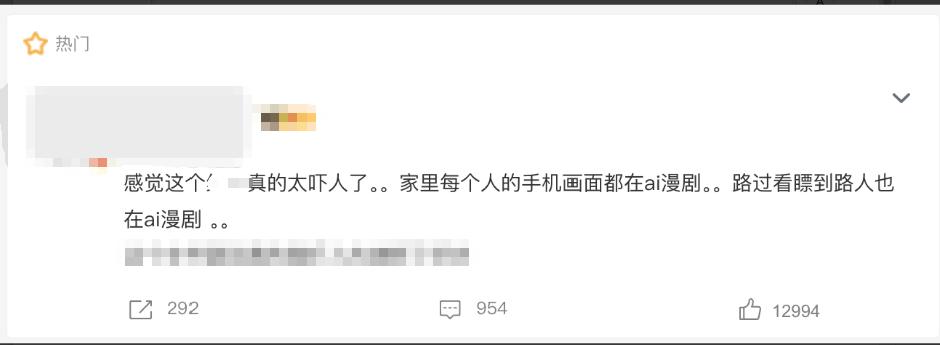
One netizen said: I feel this AI manhua drama thing is really scary. Everyone in my family is watching AI manhua dramas on their phones. When I walk on the street and glance at passersby, they are also watching AI manhua dramas.
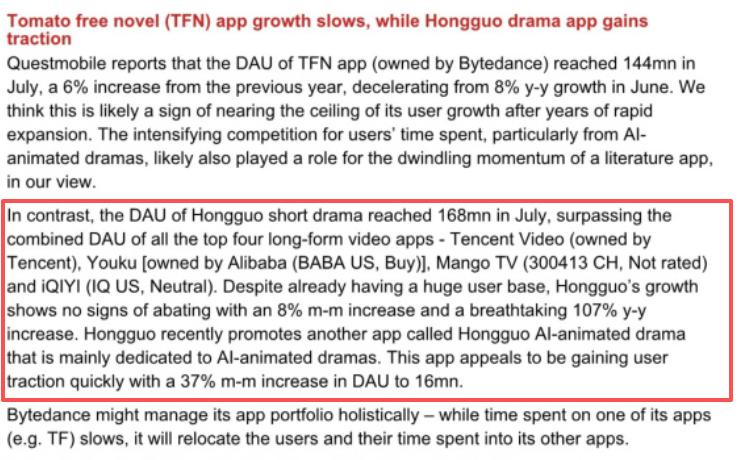
Data also proves this point. According to data from QuestMobile cited by Nomura Securities: As of July 2026, the daily active users of Hongguo Short Drama have risen to 168 million, a year-on-year increase of 107%, with the per capita daily stay duration reaching 125 minutes.
Right after that came the third hot search: "China makes short dramas with AI, while the United States focuses on technology development." It cites investor communication materials from Chinese Online: Among all domestic Token consumption, AI short dramas and video generation account for 55%, e-commerce and marketing account for 24%, and software development accounts for only 15%. In comparison, 58% of Token consumption in the United States is used for programming development and enterprise automation. (It should be noted that regarding the part where Chinese Online claims AI short drama and entertainment video generation accounts for 55%, the author found the original data in an investor relations activity record form disclosed on CNINFO, but as for the widely spread figure of 58% in the US, the author has not found any reliable source that released this data.)
Although the data of the third hot search has major flaws, these three hot searches seem to be talking about three different things, but in fact they are referring to the same thing: AI short dramas have already become part of many people's daily lives.
It is not a targeted hunt, but the daily routine of 800 million people
First, let's look at the scale.
The National Radio and Television Administration released figures at a State Council Information Office press conference on September 17: In the first 8 months of 2026, 430,000 micro short dramas were launched nationwide, 13 times the total number of last year, of which AI-generated dramas accounted for more than 90%. The number of national micro short drama users has exceeded 800 million; as of May 2026, the scale of micro short drama users reached 851 million, accounting for 66.7% of the total number of internet users. In 2025, the market size of the micro short drama sector exceeded 100 billion yuan.
During this year's Spring Festival, from Little New Year to the 7th day of the first lunar month, Hongguo Short Drama accumulated 600 million viewing person-times, contributing a total of 193 billion views; by comparison, the total number of moviegoers during the national Spring Festival film schedule in the same period was 187 million.
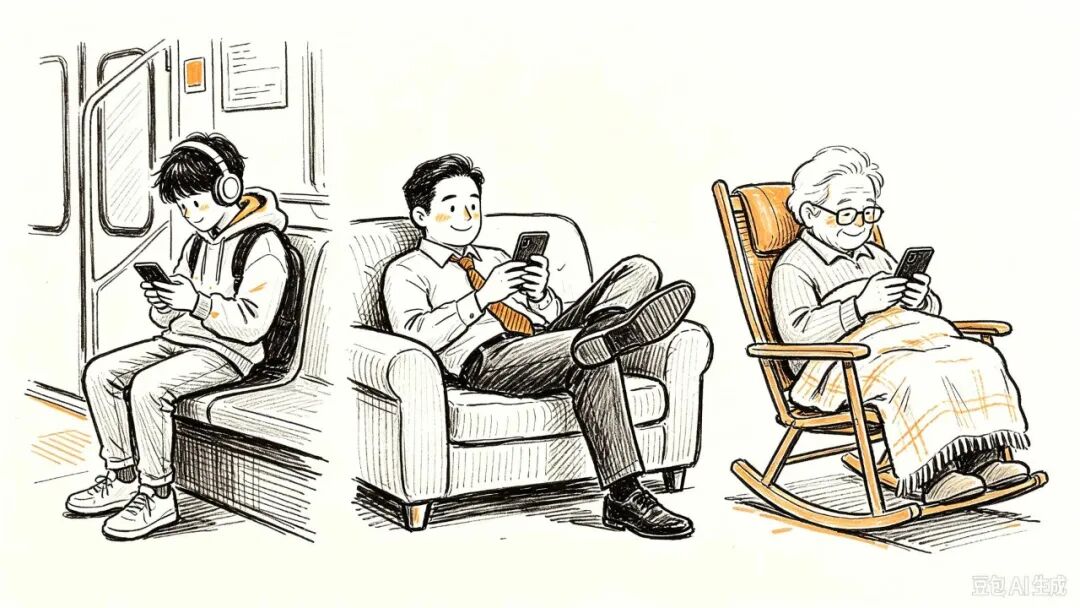
This is obviously not a usage habit of "a specific group". Young people use it to kill time during commutes, middle-aged people use it to relieve the tiredness from work, and the elderly use it to fill their afternoons after retirement. Therefore, interpreting the 168 million daily active users as "hunting middle-aged men" is just like interpreting short videos as "hunting young people". It captures the most communicative aspect, but this aspect is not the full picture.
If the narrative of "hunting middle-aged men" exaggerates a partial view into the whole, then the narrative of "China makes short dramas while the US makes technology" reduces the whole to a partial view, and it does so with a set of untenable figures.
In the widely circulated figures: in China, AI short dramas and video generation account for 55% of Token consumption; in the US, 58% is used for programming development and enterprise automation. 55% versus 58%, at first glance, the conclusion seems self-evident.

The problem is, it omits the only figure that can make this comparison valid: what is the total amount of Token consumption in China and the United States respectively.
Proportions are meaningless without reference to the total volume. Let's take a demonstrative calculation: if China's annual total Token consumption is 5 times that of the United States, then the absolute amount of China's "15% for software development" is about 0.75 of the total US volume; while the absolute amount of the US's "58%" is 0.58. In this case, China's absolute computing power input for software development is actually higher than that of the United States. When the sizes of the two pools are unknown, all such comparisons are essentially rhetoric, not facts.
More critically, there is an obvious misalignment in statistical calibers. One side refers to the Token consumption of C-end short dramas in China, while the other side refers to the computing power input in the US scientific research and enterprise sectors. One is divided by content type, the other by activity nature, which are not in the same dimension at all. Multiple tech bloggers have publicly pointed out that this comparison "directly equates China's C-end short drama Token consumption with the US's scientific research computing power input, which in itself is a deliberate misrepresentation of concepts".
More importantly, up to the time of publication, the author has not found any authoritative source for the claim that 58% of Token consumption in the US is used for scientific research.
Moreover, even if we only focus on the figure that 55% of China's tokens are used for AI short dramas and video generation, there is a key point to note: this material comes from Chinese Online, a company that has included AI drama copyright acquisition in its private placement plan and has heavily invested in AI short dramas itself, and it just terminated its Hong Kong IPO on October 8. It is an interested party of the "55%" figure, not a neutral statistical institution.
Finally, there is the preset value judgment. This narrative presupposes that "only writing code and doing scientific research count as technological value", but the content industry itself has its own value: 800 million users, a market size of hundreds of billions of yuan, and Chinese micro short dramas account for more than 80% of the overseas micro short drama market. More importantly, the video models such as Seedance can also be used as visual models for autonomous driving on the other side.
Therefore, these two hot searches are actually two sides of the same rhetoric: taking the part as the whole, replacing facts with emotions. One narrows the daily life of 168 million people down to "the pleasure points of middle-aged men"; the other narrows one side of China's AI applications down to "only capable of making short dramas", and then puts forward a distorted value judgment along with it.
The only truly accurate conclusion that can be drawn from these three hot searches is probably that AI short dramas have been integrated into thousands of households and become an important part of daily life.
This article is from the WeChat official account "Entertainment Capital Theory" (ID: yulezibenlun), written by Luo Lan, and republished with authorization from 36Kr.