From the rollout of 14 new AI tools to the full coverage of AI training across all teachers, what is the underlying strategic plan of the National Smart Education Platform?
Following the concentrated launch of a batch of AI teaching tools in the first half of the year, the Smart Education in China Platform has ushered in another major update.
This time, the upgrade focuses on teachers.
On October 10, the fully upgraded Teacher Development Center of the Smart Education in China Platform was officially launched, with new functions including AI literacy assessment, intelligent course recommendation, and electronic teacher development files, as well as upgraded Master Teacher Studios and a co-creation teaching research office. On the same day, the Ministry of Education officially launched the full-coverage AI literacy training program for teachers.
Previously, the National Smart Primary and Secondary School Education Platform has successively accessed AI applications such as intelligent lesson preparation, subject tutoring, virtual experiments, and comprehensive evaluation. The upgrade of the Teacher Development Center this time further supplements services in teachers' AI capability cultivation and teaching research collaboration.
Four major upgrades: What's new in the Teacher Development Center?
In this upgrade of the Teacher Development Center, the Ministry of Education has clearly put forward four directions: shifting from the management perspective to the teacher perspective, from resource retrieval to precise recommendation, from scattered applications to full-stack empowerment, and from individual use to group co-creation. The specific changes involve multiple aspects including platform layout, teacher growth data, AI teaching applications, and collaborative teaching research.
The first is the adjustment of the homepage layout. The new version of the Teacher Development Center reorganizes resources according to the needs of teachers' teaching and professional development, and sets up functional areas such as teaching quality improvement, master teacher guidance, spiritual casting, collaborative teaching research, and research and training capability enhancement. Among them, the teaching quality improvement module gathers resources including primary and secondary school curriculum teaching, reading platforms, language and character museums, and digital technology resources; the master teacher guidance module mainly displays local master teacher studios and their teaching achievements; the research and training capability enhancement module includes national training demonstration programs, teacher development resource accounts and other contents. Some columns and resources already existed before, and this update mainly adjusts their organization methods and access entrances.
Compared with the page layout, the change in the resource recommendation method is more noteworthy. In the past, teachers found training courses mainly through classified browsing and active retrieval. The new version of the platform proposes to build an "e-portfolio" for teacher development, which collects online and offline, pre-service and post-service data related to teachers' personal information, learning and training, and professional development. At the same time, it enriches resource tags and optimizes the AI recommendation algorithm to match resources according to teachers' characteristics, interests and needs. According to official introductions, this adjustment aims to realize the transformation from "people looking for resources" to "resources looking for people", so that different teachers can obtain more targeted learning support.
In this update, the newly opened AI Literacy Zone is the most direct part for improving teachers' AI capabilities. The zone gathers AI learning resources, intelligent tools and research communities in one single entrance, and provides AI literacy assessment and related course resources. According to the platform experience materials, the assessment covers theoretical cognition, tool skills, scenario application, ethical security and other contents; the learning resources cover basic courses, special-topic courses and case courses, including basic AI knowledge, tool operation, teaching application and practical cases of different subjects. Teachers can choose courses according to their own abilities and teaching needs, and the relevant operations will be further introduced below.
Apart from course learning, the platform is also expanding the application scope of AI. This upgrade proposes to integrate AI recommendation, AI application and AI collaboration into links including teachers' lesson preparation, classroom teaching, academic evaluation, learning situation analysis and research and training improvement. At the on-site meeting on October 10, the Ministry of Education also carried out demonstration training focusing on five links: efficient lesson preparation, classroom teaching, academic evaluation, teaching research reflection and governance empowerment.
In terms of teaching research, the new version of the platform has upgraded the Master Teacher Studio and launched the co-creation teaching research office. The former mainly gathers master teachers and their research resources to provide channels for teachers to learn and communicate; the latter further supports teachers to carry out resource co-construction and collaborative research around teaching themes. At the same time, the platform has set up relevant entrances such as the AI Literacy Guidance Team Studio to incorporate AI application experience exchange into teacher research and training services. Compared with traditional individual course learning, these functions highlight the interaction and joint participation among teachers more.
Overall, this upgrade mainly changes the way teachers access resources and participate in research and training: the platform reorganizes entrances according to teaching needs, uses teacher development data for resource recommendation, provides courses and tools through the AI Literacy Zone, and expands collaborative learning via studios and co-creation teaching research offices. Among them, the e-portfolio, intelligent recommendation, AI literacy assessment and co-creation teaching research office are several key functions to understand this update.
For front-line teachers, the most direct question is still how to use these functions. In particular, for the AI Literacy Zone, teachers need more detailed guidance on where to enter the assessment, what courses are available to learn, and what application cases can be found for different subjects.
From AI literacy assessment to teaching practice: How to use the new version of the platform?
The new version of the Teacher Development Center has been launched. Teachers can directly visit https://jiaoshi.smartedu.cn, or find the "Teacher Development" column through the National Smart Education Public Service Platform (www.smartedu.cn) to enter. After logging in with the account of the Smart Education in China Platform, you can access the new version of the homepage.
The homepage gathers multiple columns such as teaching quality improvement, master teacher guidance, collaborative teaching research, and research and training capability enhancement. The most worthy part to experience in this update is "AI Literacy Zone", where teachers can enter functions including assessment, course learning and teaching cases.
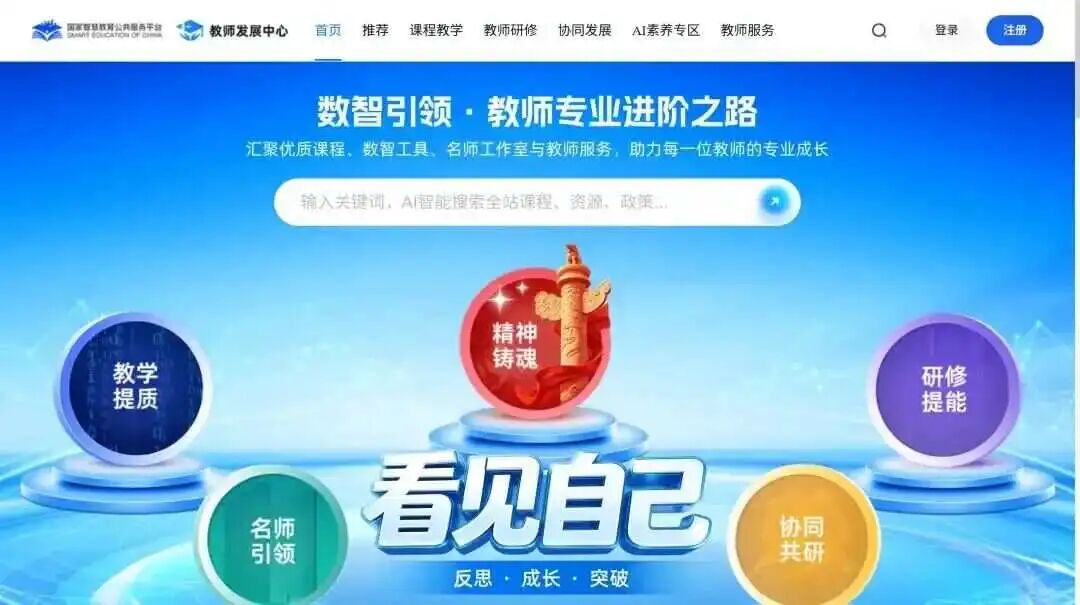
After entering the zone, you may start with "Learn AI".
Different from directly selecting courses in the past, the new version of the platform adds an AI literacy assessment. According to the existing platform experience materials, the assessment is carried out around four dimensions: theoretical cognition, tool skills, scenario application and ethical security. The questions include scale questions, knowledge questions and situational questions. The scale questions mainly understand teachers' AI usage and self-evaluation, the knowledge questions examine AI-related knowledge, and the situational questions put the problems into actual teaching scenarios to examine how teachers choose and use AI tools.
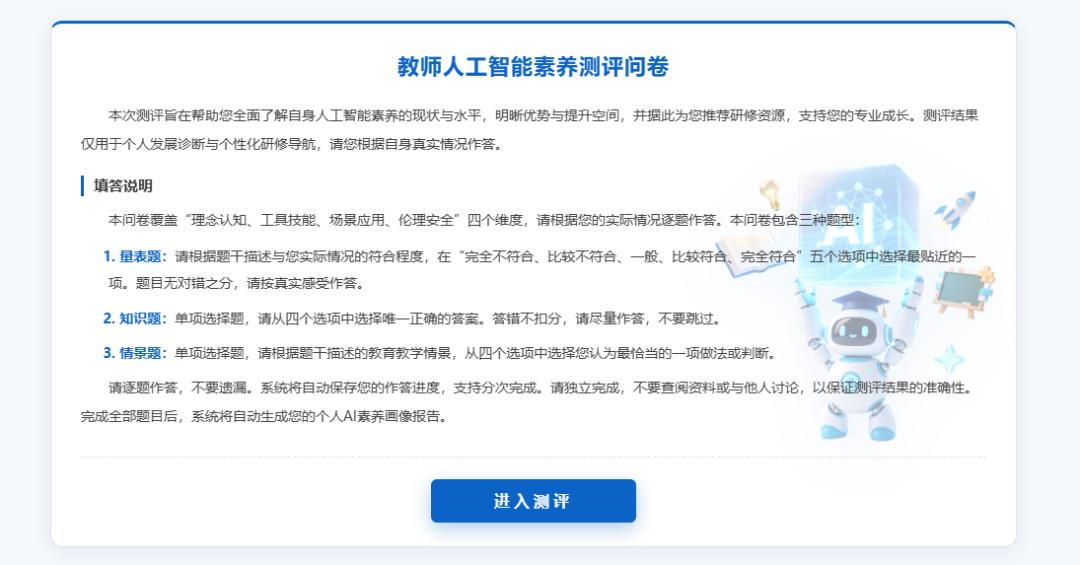
After completing the assessment, the platform will recommend learning courses according to the results. Teachers can first check their own ability level, and then decide where to start learning. For teachers who have less contact with AI before, they can prioritize basic knowledge and tool operation courses; for teachers who already have certain usage experience, they can directly find relevant contents such as instructional design and learning situation analysis.
Next, you can proceed to course learning.
At present, the courses in the zone are mainly divided into basic courses, special-topic courses and case courses. The basic courses cover conceptual cognition, tool operation, scenario application, ethical security and general AI knowledge, involving prompt design, operation of commonly used AI tools and teaching scenario application. The special-topic courses focus on the intelligent application of the Smart Education in China Platform and the improvement of teachers' digital literacy, and some courses are connected with previous teacher research and training special topics.
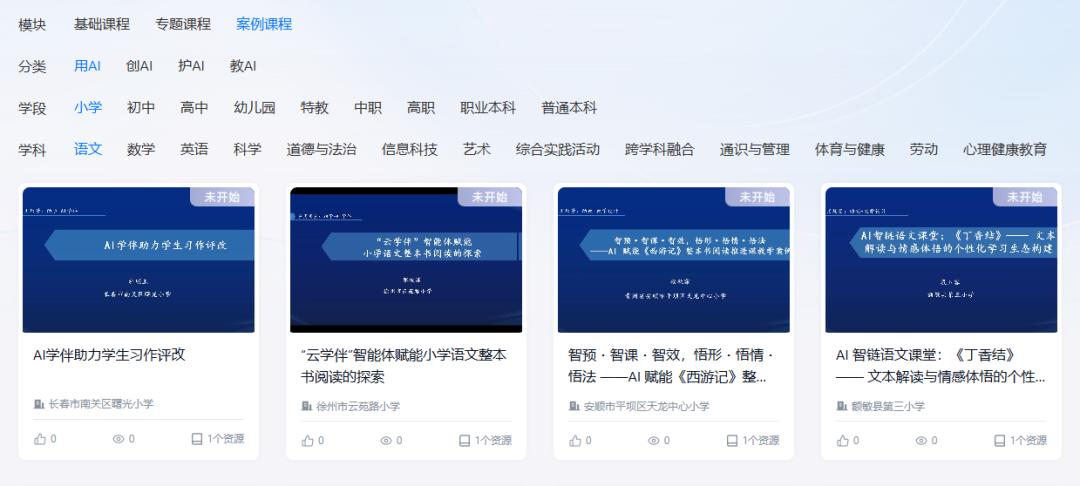
If you want to learn more specific operation methods, you can continue to enter the case courses. The resources here are classified by school stage, subject and application theme, covering different scenarios such as AI-assisted lesson preparation, classroom teaching, homework evaluation and learning situation analysis.
For example, if a math teacher wants to know how AI analyzes students' wrong answers, he or she can find courses related to adaptive assessment and wrong answer diagnosis, learn how to identify weak knowledge points through students' answer situations, and assist in designing targeted exercises. For teachers who want to integrate AI into classroom teaching, the platform also provides practical cases for different subjects, including the content of "Traveling through Time and Space to Explore the Origin of the World" by Chen Shuxia, a teacher from Zhangzhou No.3 Middle School, Fujian Province.
In addition to searching according to course categories, teachers can also select resources according to their own teaching tasks. This upgrade further extends AI applications to links such as lesson preparation, classroom teaching, academic evaluation, learning situation analysis and research and training improvement. At the on-site meeting held by the Ministry of Education on October 10, the first demonstration training also focused on five application scenarios: efficient lesson preparation, classroom teaching, academic evaluation, teaching research reflection and school governance, providing reference for teachers to understand how AI enters daily work.
After finishing the courses and reading the cases, if you want to further communicate with other teachers, you can return to the homepage and enter the "Master Teacher Guidance" or "Collaborative Teaching Research" column.
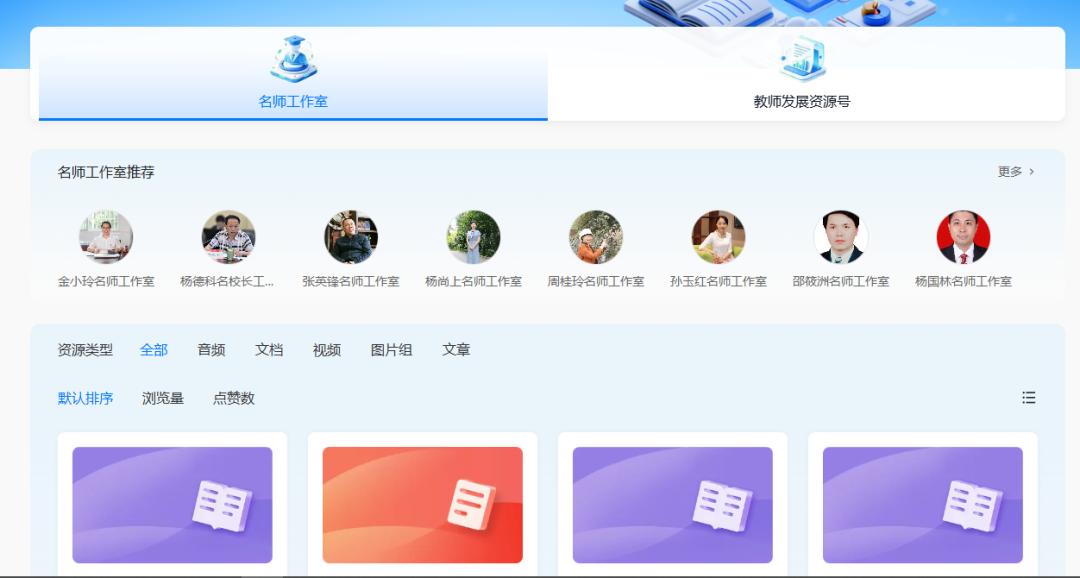
In the Master Teacher Studios, teachers can view teaching resources and research results released by master teachers across the country, and learn about the participation methods of relevant studios. The newly launched co-creation teaching research office provides a channel for teachers to jointly build teaching resources and exchange application cases. According to the platform experience materials, teachers can submit applications through relevant entrances, and participate in teaching research activities after passing the review.
For school teaching research groups, these resources can also be used around a specific theme. For example, first organize teachers to participate in the AI literacy assessment, then select courses according to the common ability shortcomings, then carry out collective research and training combined with subject cases, and bring the problems encountered in actual teaching back to the teaching research office for discussion.
In this way, teachers can complete a relatively coherent learning process on the new version of the platform: first understand their own AI capabilities, then learn courses according to recommendations, refer to subject cases to try teaching applications, and finally participate in communication and co-creation through the studios. What the platform provides is no longer just training videos for teachers to watch, but also the connection between assessment, learning and practice.
Continuous expansion of AI tools: The national platform completes the teacher application link
The upgrade of the Teacher Development Center this time is another move of the Smart Education in China Platform to continuously expand AI services this year.
In the first half of this year, the "AI Education" zone of the National Smart Primary and Secondary School Education Platform continued to expand, adding 14 new AI applications, involving products developed by enterprises such as iFlytek, Tencent, Yuanfudao, TAL and universities, covering scenarios such as intelligent lesson preparation, classroom interaction, subject tutoring, virtual experiments and comprehensive evaluation. Some tools are open for trial across the country, and some are still mainly for base schools.
After multiple rounds of updates, the national platform is no longer just a collection place for courses and teaching resources. Teachers can use AI to generate courseware, design teaching activities and analyze learning situations, students can carry out intelligent Q&A, variant training and virtual experiments, and schools also have more teaching evaluation and management tools to choose from.
Tools solve the problem of "whether we have them", while teacher training needs to solve the problem of "whether we know how to use them and whether we can use them well". The Teacher Development Center upgraded in October integrates AI literacy assessment, course recommendation, subject cases and collaborative teaching research into the same system, providing continuous support for teachers to master and apply AI.
The two rounds of updates also present the layout direction of the national platform: one end gathers AI products developed by enterprises, universities and educational institutions, and the other end improves teacher training and professional development services, gradually connecting tool supply, teacher learning and teaching practice.
This change also affects the supply mode of educational AI products. Lesson preparation assistants, subject tutoring and intelligent evaluation products from different enterprises have entered the national platform in a centralized manner, and some are put into trial use in base schools first. Schools can access different products through a unified entrance, and enterprises need to provide applications that are closer to subject teaching and can stand the test of actual classrooms, rather than just demonstrating technical functions.
The same goes for teacher training. With the national platform providing basic courses, tool operation and teaching cases, the access threshold for general knowledge training is further lowered. Carrying out instructional design around specific textbooks, adjusting AI applications in combination with learning situations, organizing school-based teaching research and evaluating actual teaching effects will become more targeted service contents.
The national platform is completing both ends of educational AI applications: not only making tools enter schools, but also enabling teachers to have the ability to use the tools. Judging from the continuous updates this year, the construction focus of educational AI is further extended to real teaching scenarios. Whether products can be put into use and whether teachers can use them well is becoming a more specific requirement.
This article is from the WeChat Official Account "Duojing" (ID: DJEDUINNO), written by Xie Qi, and published with authorization from 36Kr.