Can keeping silent for three seconds immediately after answering a phone call prevent fraud?
On October 11, the official WeChat account of the Ministry of State Security released a reminder that when receiving an unfamiliar call, do not respond immediately, and you can stay silent for three seconds first.
After the criminals get through the call, they may deliberately keep silent to induce the receiver to respond with words like "Hello" or "Who is it". A voice sample of only a few seconds may be used for AI voiceprint cloning, and then the criminals will impersonate the identity to commit fraud. Therefore, when answering a call, you can wait for the other party to speak first. If the other party also remains silent continuously, hang up the call in time.
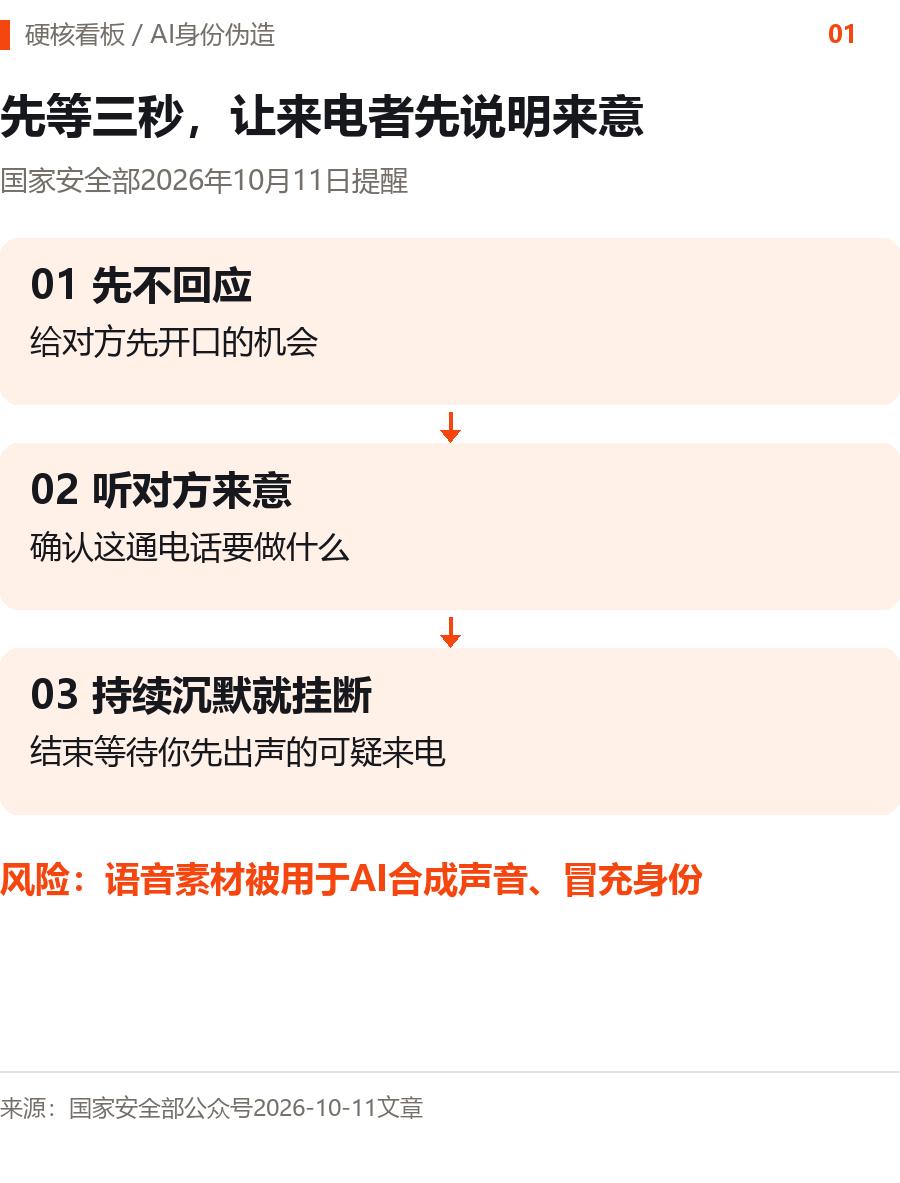
The specific practice reminded by the Ministry of State Security: let the caller state their intention first, and hang up in time if the other party keeps silent.
Voices are worth collecting because AI can already use a person's voice to generate new sentences that the person has never said before.
These materials may also come from publicly available audios and videos long ago. The words spoken online and the videos recorded may all be collected to impersonate identities.
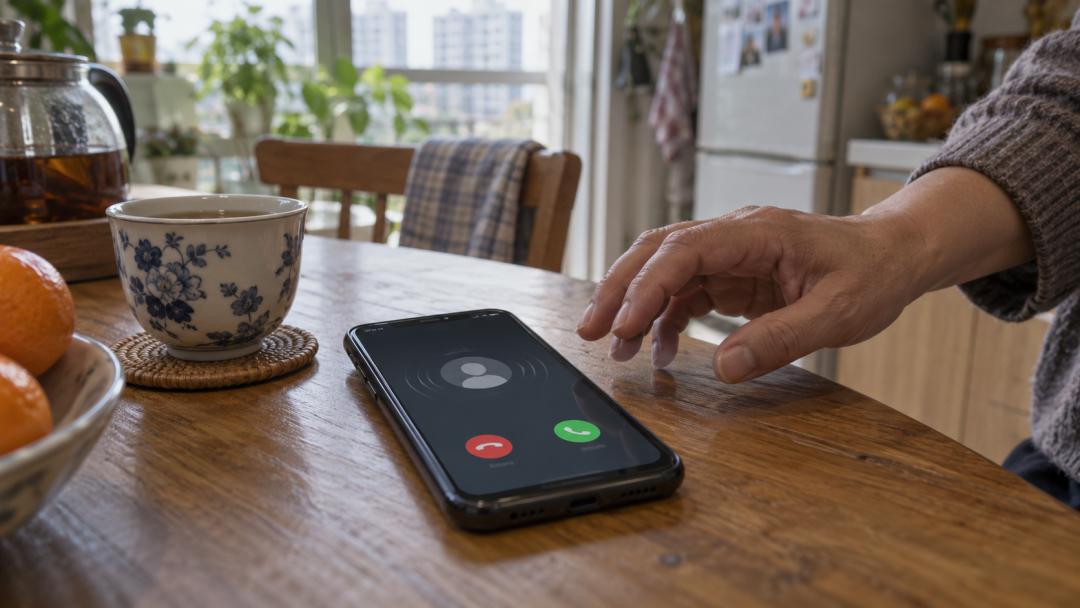
Schematic diagram of AI generation scenario: when an unfamiliar call comes in, listen to the other party state their intention first.
In the disclosed cases, scammers will combine synthetic voices, face swapping and real videos. A fictional person, equipped with voice, face and life photos that match the identity, can even appear in a company meeting.
AI voices can really deceive people
In April 2025, Aunt Ding in Huangshi, Hubei received a phone call. The other party impersonated her grandson, saying that he had a fight at school and needed money for compensation, and someone would be arranged to collect the money at her home.
She withdrew 20,000 yuan. The person who came to collect the money came to her home, then called the "grandson" again to let her confirm again. The scam was not discovered until her real grandson came home that night.
AI forged the voice of her grandson here. Aunt Ding had confirmed once, but the second call was still connected to the scammer, and the familiar voice again guaranteed for the person who came to collect the money.
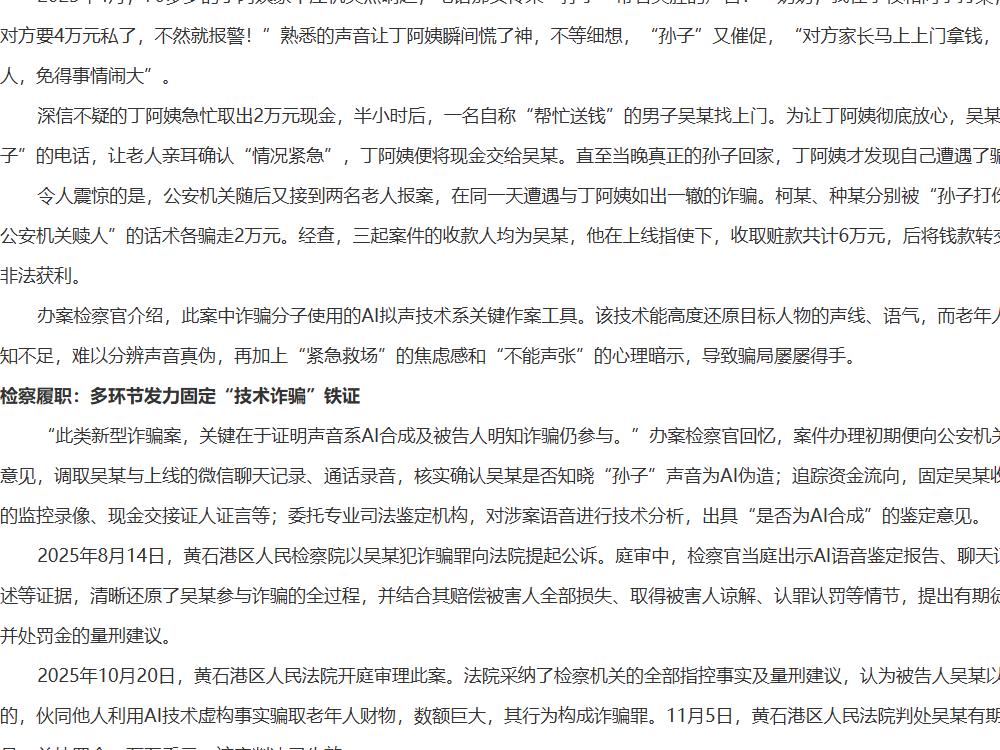
Screenshot of report from Huangshigang District Procuratorate: AI impersonated the grandson to defraud pension money.
In June 2026, researchers from Wrocław University of Technology in Poland processed the real recordings of 9 speakers and AI-cloned voices through simulated transmission of traditional mobile calls, high-definition calls and network voice respectively, and let 95 participants distinguish between true and false, collecting a total of 1710 judgments.
The overall accuracy rate was only 54.8%. Among them, the accuracy rate of traditional mobile calls was 63.7%, while that of high-definition calls dropped to 44% instead.
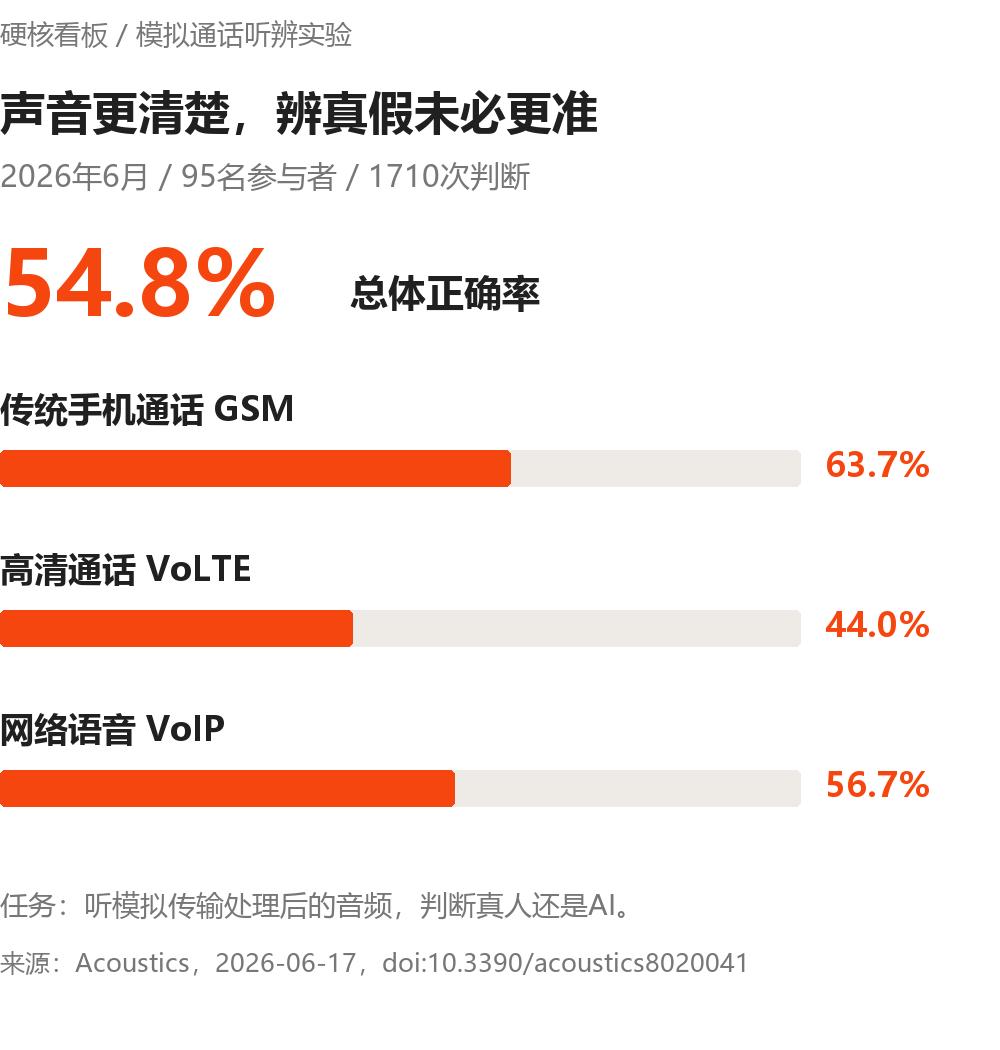
2026 simulated call listening and discrimination experiment: 95 participants judged real human voices and AI-cloned voices, with an overall accuracy rate of 54.8%.
High-definition calls were supposed to make people hear more clearly, but in this experiment, it was more difficult for the audience to distinguish between true and false.
When there is an emergency help call on the phone, or a payment instruction in a meeting, and the scammer is constantly urging, people's attention is easy to fall on "how to deal with this matter", leaving less time to identify the voice.
In the fake military officer case in Laixi, Shandong, AI made the identity more complete.
The scammer showed the victim the military uniform training video, and also showed the military camp environment through video call. The military camp scene was edited from public materials, AI replaced the face in the real soldier's image, and the speech synthesis software generated the voice. These materials were used to build emotional connections and induce investment.
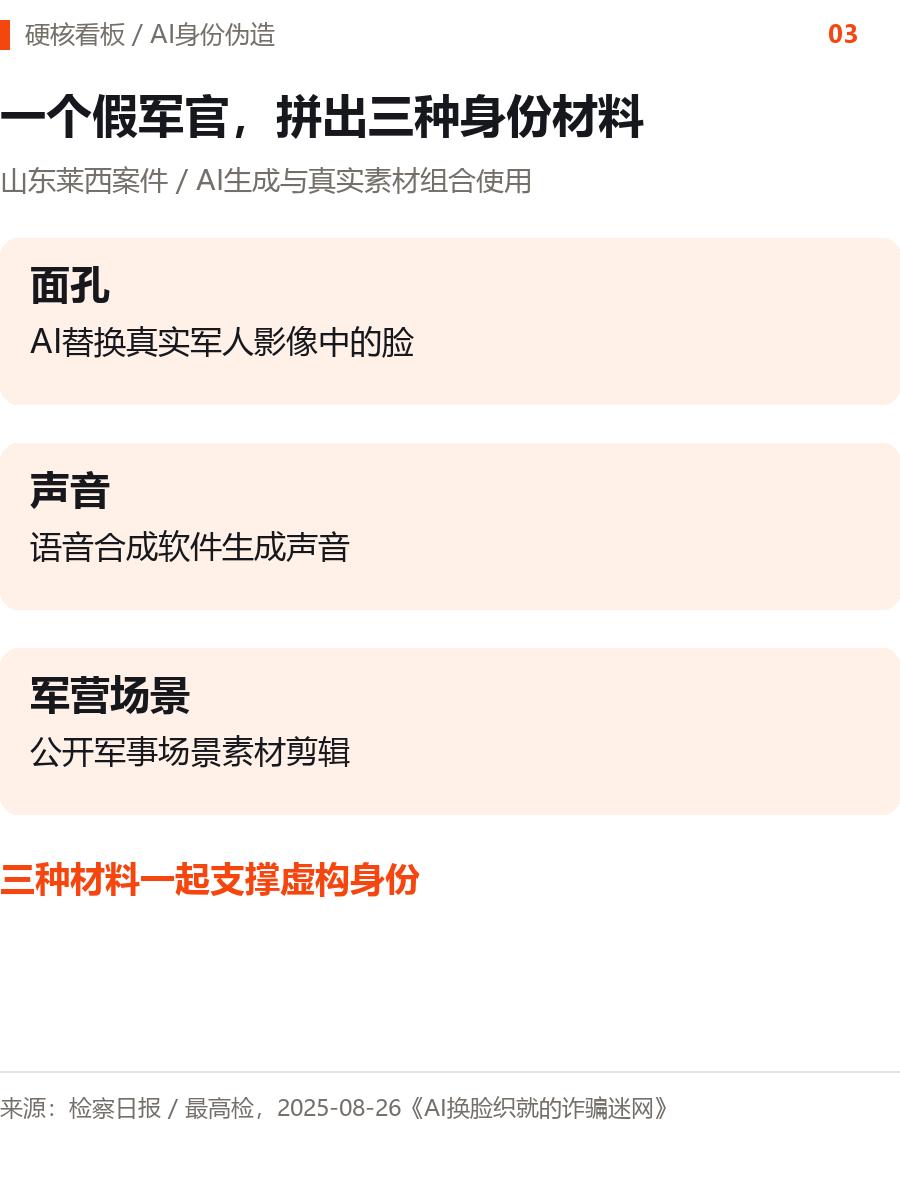
In the Laixi case, AI-generated faces and voices, together with public military scene materials, supported the fictional identity.
A corporate fraud case in Hong Kong even fictionalized a video conference.
According to the reply of the Hong Kong Government in June 2024, the police believed that the scammers used public videos and voices to produce pre-recorded meetings with deepfake technology to impersonate company managers. The victim did not have actual dialogue and interaction with the characters in the video. After the meeting, the scammers continued to instruct payment through instant messaging. According to the disclosure at that time, the loss was about 200 million Hong Kong dollars.
The scammers put familiar managers into the same meeting, making the payment request seem to have been collectively confirmed.
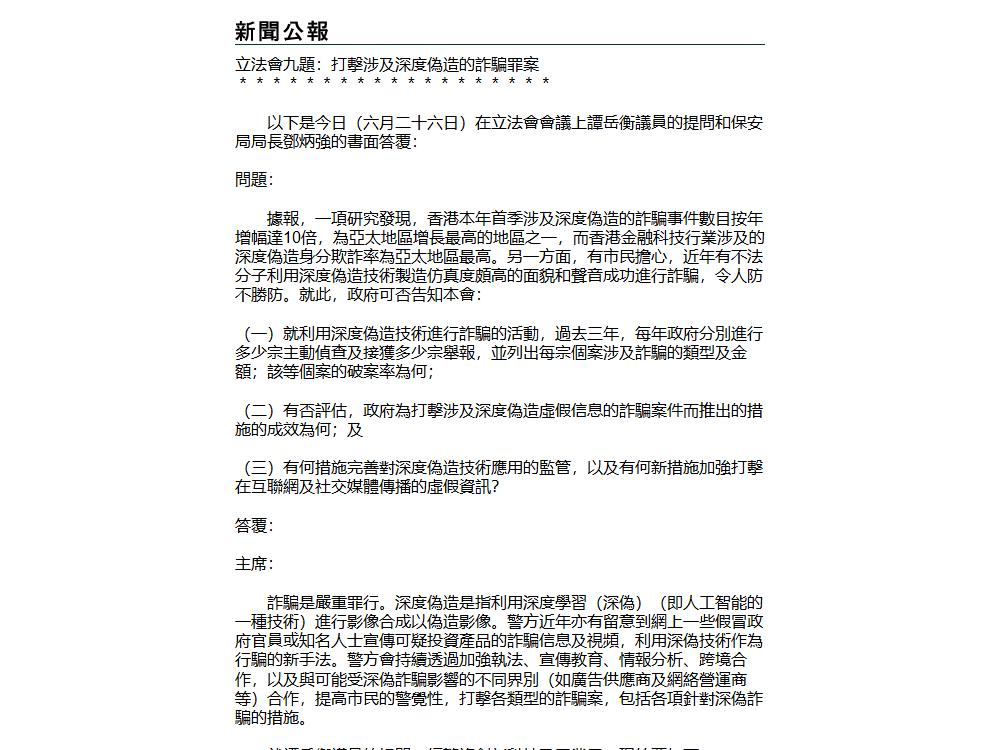
Screenshot of the reply of the Hong Kong Government on June 26, 2024: public videos and voices were used to produce pre-recorded meetings.
Voice cloning starts at 9 yuan, and face videos can be supplied in batches
An investigation by Xinhua News Agency in April 2026 found that voice cloning software, tutorials and production agency services exist on second-hand trading platforms. Customers provide the original voice audio and the text to be synthesized, and can get the finished product in as fast as 15 minutes, usually taking half an hour to an hour.
Some shops charge 9 yuan for 200 characters or 10 yuan per minute, and some even help find sound sources for free. If the computer performance is not enough, some merchants also provide cloud platform leasing solutions.

Part of the store quotations and delivery time recorded in the Xinhua News Agency investigation, collected in April 2026.
In the past, to customize a person's voice, it was often necessary to collect recordings specially and train the model. Now, some speech models have learned the rules of language and pronunciation from a large amount of data. When using them, just provide a reference recording to make them imitate new speakers. Technically, it is called "zero-shot voice cloning", which means there is no need to retrain the model separately for this person.
How long does it take to collect the recording? The sample requirement in Alibaba Cloud's voice cloning document is 10 to 20 seconds. The open-source project GPT-SoVITS lists 5-second voice samples as the input for zero-shot synthesis, and there is also a route to fine-tune with 1-minute recording to improve voice similarity. A video of tens of seconds may already contain enough reference voice.
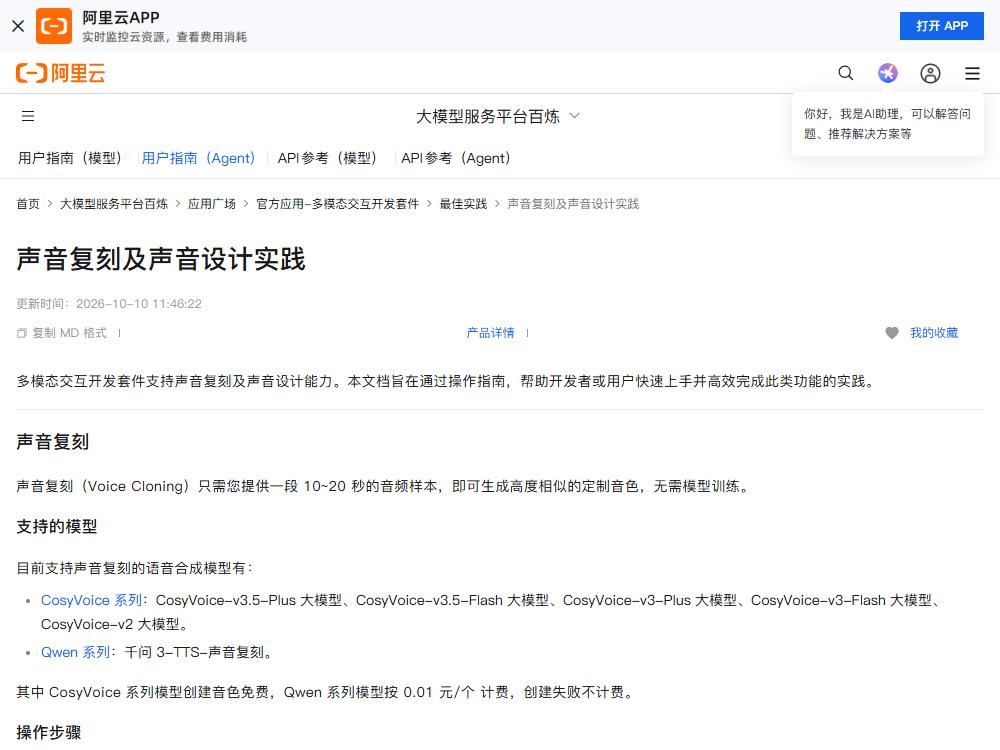
Screenshot of Alibaba Cloud voice cloning document: the reference recording requires 10-20 seconds, no separate training is required.
The F5-TTS project disclosed by the research team clearly divides the input: reference recording, the text corresponding to the recording, and the new text that needs to be generated. The recording text can also be automatically supplemented by speech recognition.
The model obtains the speaker's voice features by comparing the recording and the text, and then generates an acoustic representation according to the new text. It can be understood as a digital description of the voice, which is then restored to playable audio by a vocoder.

Taking the public F5-TTS project as an example: the reference recording is used to imitate the voice, and the new text determines the generated content.
Can an ordinary computer run it? The test environments listed by the official GPT-SoVITS include CPU, Apple chip and NVIDIA graphics card, and a Windows integration package is also provided. A set of v2 ProPlus inference tests it announced used RTX 4060 Ti, RTX 4090 and Apple M4 CPU.
How fast is it? The "real-time factor" given by the GPT-SoVITS project is the generation time divided by the audio duration. The value of 4060 Ti is 0.028, and that of M4 CPU is 0.526. Converted according to this ratio, generating one minute of voice takes about 1.7 seconds and 32 seconds respectively.
There are also ready-made solutions for software installation. The CosyVoice from the Alibaba team and the F5-TTS from the research team have both disclosed models and web interfaces. After one person configures the dependencies and models, others can submit materials in the interface. CosyVoice also supports streaming output, where text is continuously fed in and the voice can be output in segments.
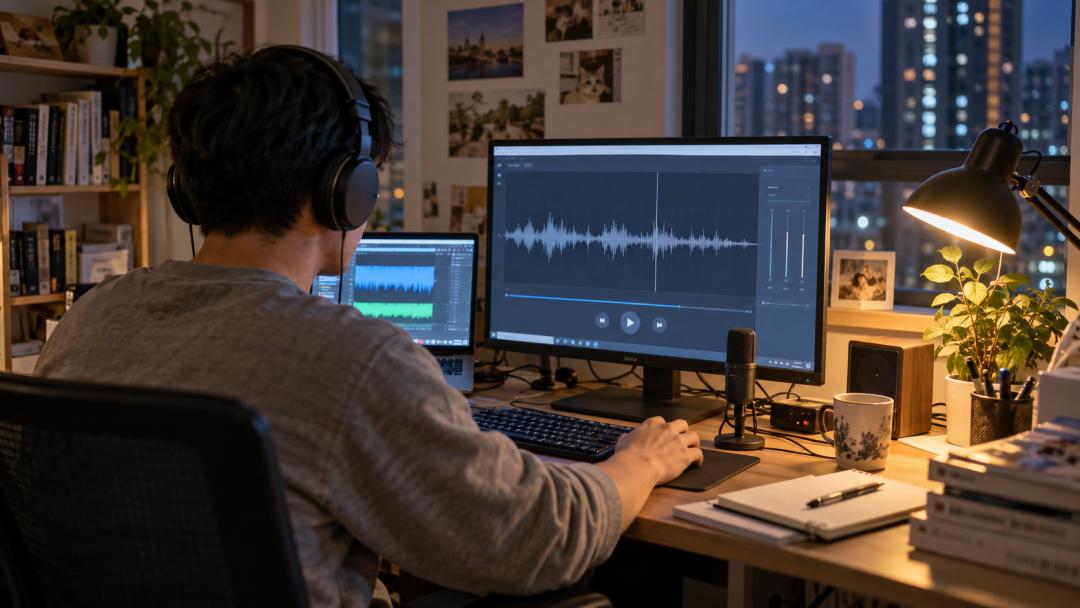
Schematic diagram of AI generation scenario: an ordinary workstation composed of computer, headphones and microphone.
If you use the cloud solution, the calculation is handed over to the service provider, and the computer is only responsible for submitting recordings and texts. The cost is divided into two parts: creating the timbre, and synthesizing new speech with this timbre.

Screenshot of the official GPT-SoVITS project: inference tests for consumer-grade graphics cards and Apple M4 CPU are announced.
As of October 12, 2026, the Alibaba Cloud document indicates that creating timbres for the CosyVoice series is free of charge. The original price of CosyVoice-v2 speech synthesis in the Beijing region is 2 yuan per 10,000 characters; calculated based on 200 billing characters, the synthesis fee for a piece of speech is 0.04 yuan. The Qwen series charges 0.01 yuan separately for creating cloned timbres, and subsequent synthesis is charged according to the corresponding model.
The 9 yuan for 200 characters in the Xinhua News Agency investigation is the production agent quotation of the merchant; 0.04 yuan is the text synthesis fee of the above cloud model. The merchant will also process materials, debug and deliver the finished products.
Local deployment is a different accounting method: the model runs on your own machine, and you do not pay the cloud service fee for each voice, but you still have to bear the cost of graphics card, memory, electricity and configuration time. Public models and integrated interfaces lower the development threshold, and criminal groups can also find people to complete the deployment, and then sell the generation capability to downstream users.
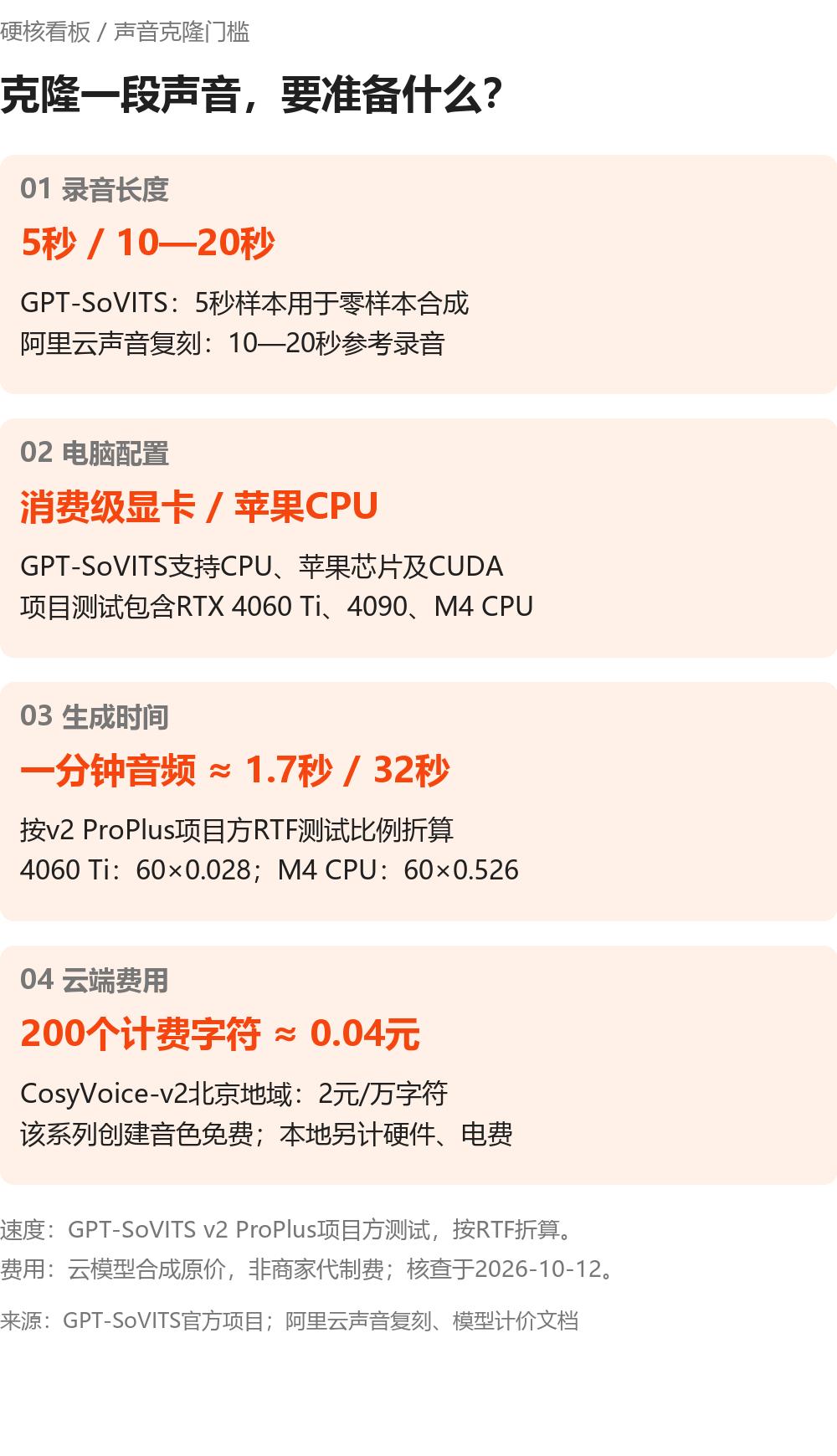
Threshold and cost of voice cloning: reference samples, test equipment, generation speed and cloud pricing.
LivePortrait, publicly released by the Kuaishou team, is a portrait animation technology. It takes the portrait photo as the appearance reference, and then extracts motion information such as expression and head posture from the driving video, so that the person in the photo can move accordingly.
The project provides model weights, web operation interface, and has also released a Windows integration package.
