Comparison of the detailed rules for sales of ready-to-occupy residential properties, which city has greater flexibility?
After the new policy issued on August 28, as of October 11, a total of 5 cities across China have released implementation opinions to carry out the Notice on Improving the Commercial Housing Sales System: Beijing (September 24), Shanghai (September 28), Guangzhou (September 30), Wuhan (October 1), and Tianjin (October 10). The detailed rules of the 5 cities present clear gradient advancement features: first-tier cities (except Shenzhen) took the lead in rolling out relevant policies, Wuhan made a breakthrough among second-tier cities, while third- and fourth-tier cities have not yet issued corresponding detailed rules, mostly setting existing-house sales conditions in the land auction session for implementation.
From the perspective of institutional design, the 5 cities have consistently grasped three main lines: first, smooth transition under the principle of "separating new and old cases by a clear cutoff date", uniformly taking August 28 as the demarcation point and setting a transition period for ongoing projects; second, "raising the threshold plus strengthening supervision", the pre-sale threshold is uniformly raised to the capping of the main structure, and pre-sale funds are subject to full-amount and full-process supervision; third, "offering support and reserving space" to hedge against pressure, to ease the capital pressure of real estate enterprises through supporting arrangements such as installment payment of land transfer fees, optimized guarantee letter replacement, phased completion acceptance, and pre-registration. The differences are mainly reflected in the granularity of the new-old demarcation, the scope of key supervision quota, and the abundance of supporting tools.
Pre-sale Conditions: Most ongoing projects implement the original policy during the transition period, and differences exist in the caliber of legacy projects
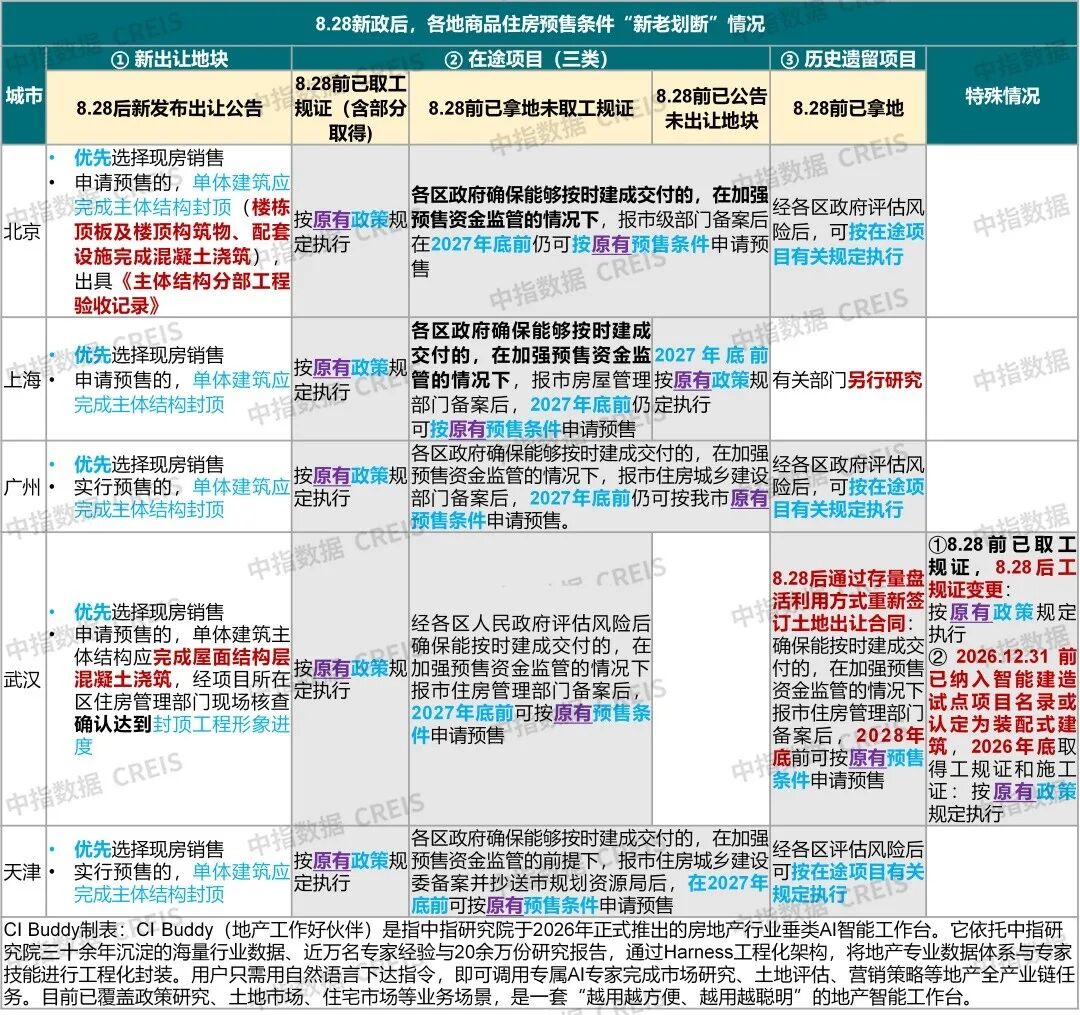
The common bottom line is taking August 28 as the cutoff point for "separating new and old cases", and the pre-sale threshold for new projects is uniformly raised to the capping of the main structure.
First, the pre-sale conditions for newly transferred land parcels are comprehensively improved. For commercial housing projects with new transfer announcements released after August 28, existing-house sales are preferred; for projects that implement pre-sales, the main structure of single buildings shall be fully capped. Beijing specifies that the capping of the main structure requires the completion of concrete pouring for the top slab of the building, roof structures and supporting facilities, and the Completion Acceptance Record of Sub-project of Main Structure signed and sealed by five responsible parties including the construction, survey, design, construction and supervision entities; Wuhan clarifies the capping recognition standard of "concrete pouring of roof structural layer", which needs to be verified and confirmed on site by the housing management department of the district where the project is located according to the project's physical progress.
Second, classified policies are applied to ongoing projects. The 5 cities all implement the original policy for projects that have obtained (including partially obtained) the Construction Project Planning Permit before August 28; for projects that have obtained land but not the construction planning permit, the new policy will be implemented in principle. However, after the district government assesses the risks, ensures the project is completed and delivered on time, strengthens the supervision of pre-sale funds and submits for filing, all 5 cities can still apply for pre-sale under the original pre-sale conditions before the end of 2027. Shanghai, Guangzhou and Tianjin list a separate category of "land parcels announced before August 28 and with land use right obtained after August 28", clarifying that the pre-sale conditions will be implemented in accordance with the original policy before the end of 2027.
Third, there are substantial differences in arrangements for legacy projects. Beijing, Guangzhou and Tianjin follow the same caliber: for legacy projects that have obtained the state-owned construction land use right before August 28, they can be implemented in accordance with the relevant provisions for ongoing projects after the district governments assess the risks. Shanghai stipulates that such projects "will be studied separately by relevant departments", and the subsequent supporting caliber remains to be clarified. Wuhan sets additional requirements for stock revitalization projects: if the land transfer contract is re-signed through stock revitalization and utilization methods, after risk assessment and filing with the municipal housing management department, the deadline for applying for pre-sale under the original pre-sale conditions can be extended to the end of 2028, with a one-year grace period.
Fourth, Wuhan has the most abundant special flexibility arrangements. In addition to the above classifications, Wuhan adds two more rules: first, for projects that have obtained the construction planning permit before August 28 and whose construction planning permit is changed after August 28, the original policy shall be implemented; second, for projects that have been included in the intelligent construction pilot list or recognized as prefabricated buildings before December 31, 2026, and have obtained the construction planning permit and construction permit before the end of 2026, the original policy shall be implemented, to incentivize new construction methods through transition period preferences.
Pre-sale Fund Supervision and Deposit: Large differences in fund supervision, and a gradient of deposit ratios is formed
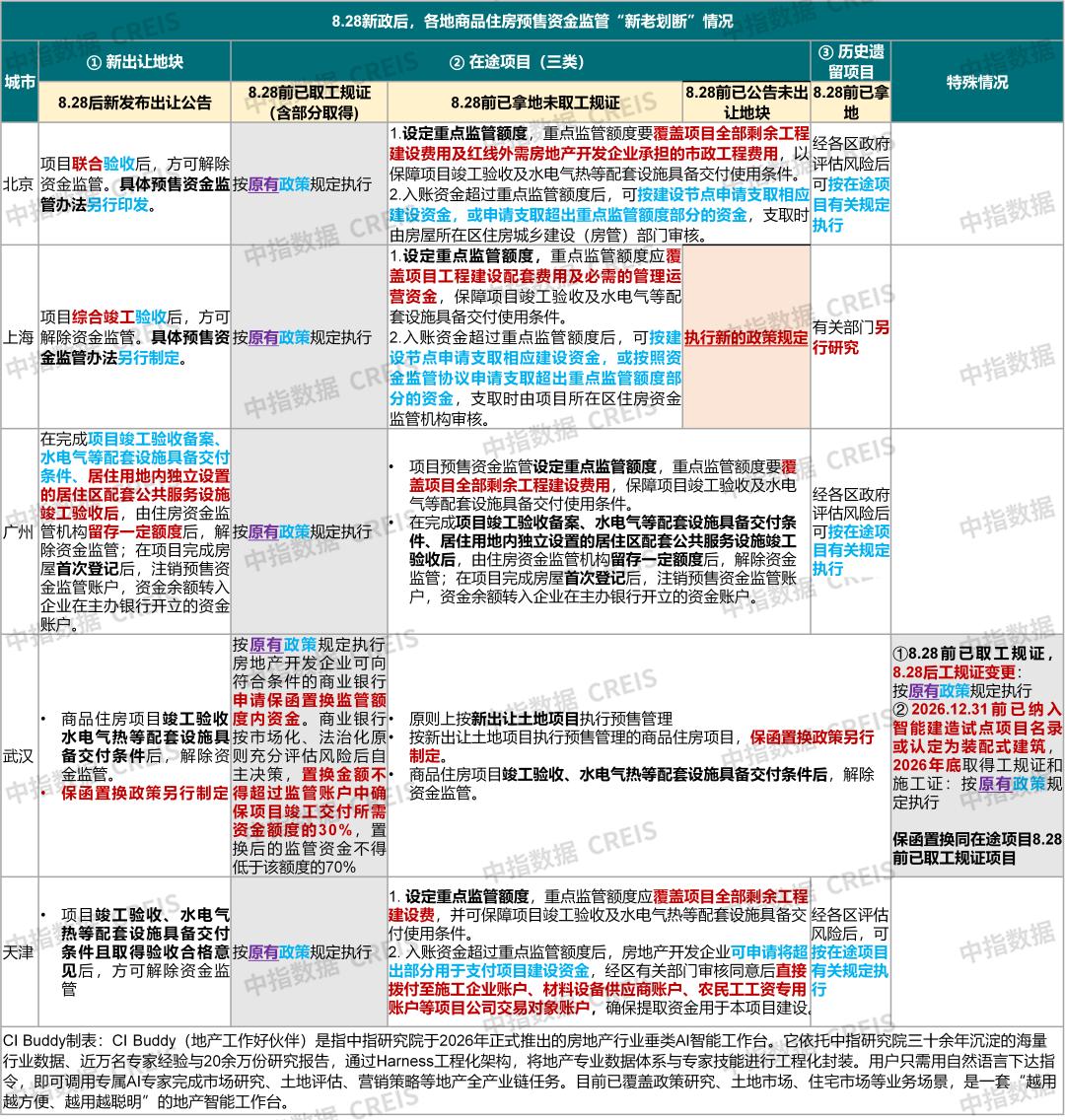
(1) The calibers of pre-sale fund supervision are different. Newly transferred land parcels are subject to full-amount and full-process supervision, and the current difference lies in the release time point: the supervision of Beijing projects can only be lifted after the joint acceptance of the project; the supervision of Shanghai projects can only be lifted after the comprehensive completion acceptance, which is slightly later than Beijing; Guangzhou has the most detailed release conditions: the supervision can be lifted only after three conditions are met at the same time, including the completion of completion acceptance filing, water, electricity, gas and other supporting facilities meeting delivery conditions, and the completion acceptance of supporting public service facilities in residential areas, and the housing fund supervision agency will retain a certain amount of funds before releasing the rest, and the supervision account will be cancelled after the first registration of the house; the supervision of Wuhan projects is lifted after the completion acceptance, and supporting facilities such as water, electricity, gas and heating meet the delivery conditions; the fund supervision of Tianjin projects can be lifted only after the project completion acceptance, supporting facilities such as water, electricity, gas and heating meet the delivery conditions, and the acceptance qualification opinion is obtained.
For ongoing projects, the situation of "following the original policy" and "setting key quota" coexist: for projects that have obtained (including partially obtained) the construction planning permit before August 28, the original policy will be followed uniformly; for projects that have obtained land but not the construction planning permit, some cities set a key supervision quota, but the scopes are different — the quota in Beijing covers the remaining project construction costs and the municipal project costs outside the red line that shall be borne by real estate enterprises, the quota in Shanghai covers supporting costs for project construction and necessary management and operation funds, the quota in Guangzhou and Tianjin covers all remaining project construction costs. The optimized guarantee letter replacement policy of Wuhan is unique among the 5 cities: for projects under supervision in accordance with the original policy, real estate enterprises can apply for bank guarantee letter to replace the funds within the supervision quota, commercial banks make independent decisions, the replacement amount shall not exceed 30% of the capital amount required for completion and delivery, and the supervision fund after replacement shall not be less than 70% of the said amount; the scope of application covers three scenarios: projects with obtained construction planning permit, projects with changed construction planning permit, intelligent construction pilot projects and prefabricated building projects.
In addition, Shanghai implements the new fund supervision regulations for land parcels "announced before August 28 and with land obtained after August 28", which is the only city among the 5 cities that explicitly classifies this scenario as applying the new policy; the handling of legacy projects will be studied separately by relevant departments.
(2) A gradient of deposit ratios is formed. The deposit ratios of the 5 cities form a clear gradient: 5% in Guangzhou, Wuhan and Tianjin > 3% in Shanghai > 1% in Beijing. The model text of the housing purchase deposit contract in Shanghai is formulated by the municipal housing management department in conjunction with other parties. Both Guangzhou and Wuhan specify that all existing-house deposits paid by home buyers shall be deposited into the deposit supervision account, and the deposit shall not be used during the supervision period. Wuhan additionally requires that if the real estate enterprise and the mortgagee agree to sell the mortgaged house, the certification document issued by the mortgagee agreeing to the sale shall be submitted when applying for the existing-house sales filing certificate.
Financing Support and Land Supply Management: Obvious differences in financing channels and land payment terms
Taking the lead bank system as the common basis, the fund supervision agencies are different: the Beijing Municipal Housing Fund Management Center opens the fund supervision account at the lead bank; the district-level real estate transaction centers in Shanghai, acting as the housing fund supervision agency, open the fund supervision account at the lead bank for projects located in their respective districts; Guangzhou Housing Transaction Supervision Center and Wuhan Real Estate Transaction Center act as the housing fund supervision agencies; Tianjin Real Estate Market Service Center (for projects in Binhai New Area, the Binhai New Area Housing and Construction Affairs Service Center is responsible) opens the pre-sale fund and existing-house deposit supervision accounts at the project lead bank.
In terms of financing support, Shanghai supports qualified real estate development enterprises to carry out project-based financing through bonds, stocks, asset-backed securities and real estate investment trusts. Wuhan focuses on stock bailout and mortgage innovation: for projects that have signed development loan contracts before August 28, the financing needs can be met through negotiation by means of new financing, extension, and repayment plan adjustment; in addition, Wuhan carries out the pilot of collective mortgage setting for divided land use rights.
In terms of land supply management, the down payment ratio of land transfer fees in the 5 cities is practically consistent, most of which require no less than 50% to be paid within 30 days, while Wuhan allows payment within half a year with a more relaxed rhythm. The real difference lies in the payment term of the remaining balance: Shanghai, Guangzhou, Wuhan and Tianjin all adopt the "1+1" two-stage mode, which means the remaining balance shall be paid within 1 year in principle, and can be extended for another 1 year after decision-making; Beijing requires the full balance to be paid off within 2 years in a lump sum. In addition, Wuhan does not mention the "interest-free" arrangement.
For the divided mortgage, both Guangzhou and Wuhan have relevant provisions but in different chapters: the provision of Guangzhou is set in the land supply management chapter, the core of which is to calculate the land share according to the proportion of the building area of each real estate unit after obtaining the Construction Project Planning Permit, and set up collective mortgage with the shares; the provision of Wuhan is set in the financing coordination chapter, the core of which is to adopt the divided collective mortgage when the development company applies for development loan with land use right mortgage, and the specific measures will be formulated separately. Guangzhou focuses on the setting rules of land share, while Wuhan focuses on the mortgage financing mechanism.
Other Support: Phased completion acceptance and pre-registration go first to optimize the approval process
First, phased and staged completion filing. Guangzhou supports handling the filing for planning, construction, civil air defense construction, pre-sale, existing-house sales and completion acceptance by phases and by individual buildings, requiring that the buildings have independent use functions, and the supporting construction sequence and delivery time of each phase are clarified. Wuhan supports phased completion acceptance by the minimum unit, and implements staged completion acceptance: the building is divided into underground and above-ground two stages with ±0 as the boundary, and for full-decoration projects, the completion acceptance can be handled separately for the rough housing stage and the interior decoration stage.
Second, pre-registration goes first for approval handling. Guangzhou supports handling the formalities of planning permit, construction permit and surveying and mapping in advance after obtaining the pre-registration certificate of land real estate, and selling the corresponding part of houses whose land transfer fees have been fully paid. Wuhan stipulates that relevant formalities can be handled in advance after obtaining the real estate advance notice registration certificate, and allows real estate enterprises to handle the advance notice registration of land real estate mortgage when applying for development loans to ensure the project starts construction on schedule.
Third, approval optimization and "delivering the property together with the property right certificate". Guangzhou implements the notification and commitment system and the tolerance for missing materials system in the administrative approval link, promoting the simultaneous acquisition of real estate right certificates upon property delivery; Wuhan promotes the simultaneous application and parallel handling of sales plans and pre-sale permits with "instant application and instant approval", promoting "starting construction immediately after land acquisition" and "delivering the property together with the property right certificate"; Shanghai continuously optimizes the whole-process approval, and Beijing supports starting construction immediately after land acquisition; Tianjin can launch the public notification of the general layout plan of the construction project planning and design after signing the land transaction confirmation, enterprises can apply for the construction planning permit with the transfer contract, support the project to implement the notification and commitment system for construction drawing design quality and handle the construction permit in stages, and support the project to carry out joint acceptance by phases, promote the forward shift of acceptance services, and carry out technical pre-verification services in advance upon application.
Fourth, quality supervision and market order regulation. Shanghai does a good job in the whole-process management from planning and design to delivery and use, strengthens the quality and safety management of the construction site, and strengthens the supervision of the real estate market; Beijing continuously standardizes the market order; Wuhan strengthens the supervision of the real estate market; Guangzhou does a good job in whole-process management and strengthens the quality and safety management of the construction site; Tianjin improves the whole-process quality supervision system.
Fifth, the conditions for existing-house sales are slightly different. The precondition for existing-house sales in the 5 cities is "first registration of house/real estate", and the differences lie in: Shanghai, Beijing, Wuhan and Tianjin all need to compile and submit the existing-house sales plan for filing after the first registration; Guangzhou sets the pre-links of completion acceptance filing and supporting facilities acceptance qualification, and needs to file the existing-house sales plan and relevant certificates proving that the houses meet delivery conditions, and encourages enterprises to apply for existing-house sales after the first registration of the houses.
Summary: Smooth transition with strict fund supervision
First, stability is the top priority. All 5 cities take August 28 as the cutoff point and the end of 2027 (Wuhan extends the deadline to the end of 2028 for stock revitalization projects) as the transition period, and implement classified policies for newly transferred projects, ongoing projects and legacy projects. For legacy projects, Shanghai stipulates that "relevant departments will conduct separate research", leaving policy space to be clarified.
Second, strict implementation is guaranteed. The pre-sale threshold of new projects is raised to the capping of the main structure, the pre-sale funds are subject to full-amount and full-process supervision, the individual mortgage loans are disbursed "after completion acceptance filing", and all deposits are included in the supervision accounts, which strengthens a number of hard constraints.
Third, the supporting policies are more flexible for adaptation. The existing-house sales deposit in Beijing shall not exceed 1%, Shanghai has wide financing channels and adopts prudent caliber for legacy projects, Guangzhou has relatively detailed operation rules (three conditions for lifting supervision, phased and individual building completion acceptance), Wuhan has the most supporting tools and greater flexibility