The three giants are "teaming up", and the counterattack of the leading provincial capital has begun.
Less than a month after the National Advanced Manufacturing Conference was held, Guangdong took the lead in following up. On October 9, Guangdong held the provincial advanced manufacturing conference.
During the conference, Guangzhou unveiled its development path: it will make efforts in six major tracks covering "land, sea and air" as well as "chips, displays and pharmaceuticals" to strengthen the advanced manufacturing industry. At present, the total scale of these six tracks has exceeded 1 trillion yuan, and it is expected that the total industrial output value of Guangzhou will exceed 3 trillion yuan by 2030.
Among the six tracks, the "land" sector carries the most weight. Guangzhou's goal is to build a "trillion-yuan smart vehicle city" by 2030, realizing the transformation from a traditional automobile production base to an industrial highland of intelligent connected new energy vehicles.
Just one day before the conference (October 8), FAW Group Corporation, Toyota Motor and GAC Group signed a new strategic cooperation framework agreement in Guangzhou.
The core of the agreement is: GAC Group plans to purchase 50% equity of FAW Toyota held by FAW Group Corporation by issuing shares. After the transaction is completed, FAW Toyota will still exist as an independent operating entity, and FAW Group Corporation will become an important strategic shareholder of GAC Group.
As a result, GAC Group will become the common Chinese shareholder of the two "North and South Toyota" joint ventures, and coordinate the R&D, procurement, production, sales and other related work of the two joint ventures.
The automobile industry is the largest pillar industry in Guangzhou, but in the critical period of reshaping the global automobile market, this city has truly experienced the growing pains of transformation.
This joint move by the three giants with Guangzhou as the strategic fulcrum is expected to form a multiplier effect of "1+1+1>3". Can this former "No.1 Automobile City in China" fight a beautiful counterattack with this opportunity?
Cross-regional Integration
The trend of cross-regional integration of automotive groups is becoming clear.
On September 11, nine departments including the Ministry of Industry and Information Technology released the "15th Five-Year Plan" for the Development of Intelligent Connected New Energy Vehicle Industry, which clearly proposes to "strengthen early warning and regulation of production capacity" and emphasizes "increase the intensity of law-based merger, reorganization and cross-regional integration of automobile enterprises".
Only three days later, the trading suspension announcement of GAC Group disclosed that it planned to purchase part of the equity of "a certain complete vehicle joint venture" held by the latter by issuing shares, and then it was spread that the joint venture was FAW Toyota.
This is the first case of integration of central and local automobile enterprises across the country, with extraordinary signal significance.
"At present, the concentration of China's automobile industry is not high, there are a large number of automobile enterprises and the resources are relatively scattered, (this integration) conforms to the development trend of the industry." Zhang Xiang, a researcher at the Automotive Industry Innovation Research Center of North China University of Technology, analyzed to Urban Evolution Theory that GAC and FAW are not merging, but forming a strategic alliance. According to the restructuring plan, the "North and South Toyota" pattern that has lasted for more than 20 years will be broken.
FAW Toyota was established in 2000, and GAC Toyota was established in 2004. Both are still top players among joint-venture automobile enterprises. Data shows that Toyota's total sales in China exceeded 1.78 million vehicles in 2025, of which FAW Toyota sold 805,500 vehicles and GAC Toyota sold 772,700 vehicles.
In the next stage, FAW Toyota and GAC Toyota will jointly undertake the functions of R&D, procurement, production, sales and other related work of the joint ventures. FAW Group Corporation, Toyota Motor and GAC Group will jointly support FAW Toyota and GAC Toyota to promote each other and continuously improve their competitiveness.
In Zhang Xiang's view, this will enhance the overall competitiveness of the Toyota brand, further reduce costs and increase market share.
Of course, the integration between FAW and GAC is not limited to Toyota. Some analysts pointed out that if the restructuring plan is truly implemented, FAW and GAC will complete equity binding and become a community of interests, and Guangzhou's auto parts enterprises and R&D platforms are also expected to expand their market radius with the help of North and South Toyota and FAW.
In Zhang Xiang's view, FAW has strong commercial vehicles, and its Hongqi brand in the passenger vehicle sector also has advantages in the luxury car field, while GAC's self-owned passenger vehicle brands perform well in the market, and GAC AION and other new energy technologies are leading. Based on the cooperation framework, the R&D resources and supply chains of the two major auto enterprises are expected to be further integrated.
As a result, Guangzhou's role in the national automotive industry chain is expected to shift from an "important manufacturing base" to a "resource allocation hub". As the local media said ——
Inspection and testing, certification services and quality assurance are typical high value-added links. The settlement of more cross-regional R&D and manufacturing projects will open up a larger market space for local institutions. The accumulation of such capabilities will not only serve Guangzhou, but also may become the starting point for it to export professional services to the whole country and even the world.
Structural Transformation
Back to 2023, Guangzhou's automobile output was 3.1792 million vehicles, ranking as China's No.1 Automobile City for five consecutive years. However, after going through the "darkest hour" in 2024, Guangzhou's automobile output dropped to 2.5398 million vehicles, and both the titles of "No.1 Automobile City" and "Fourth Largest Economy City" were replaced by Chongqing.
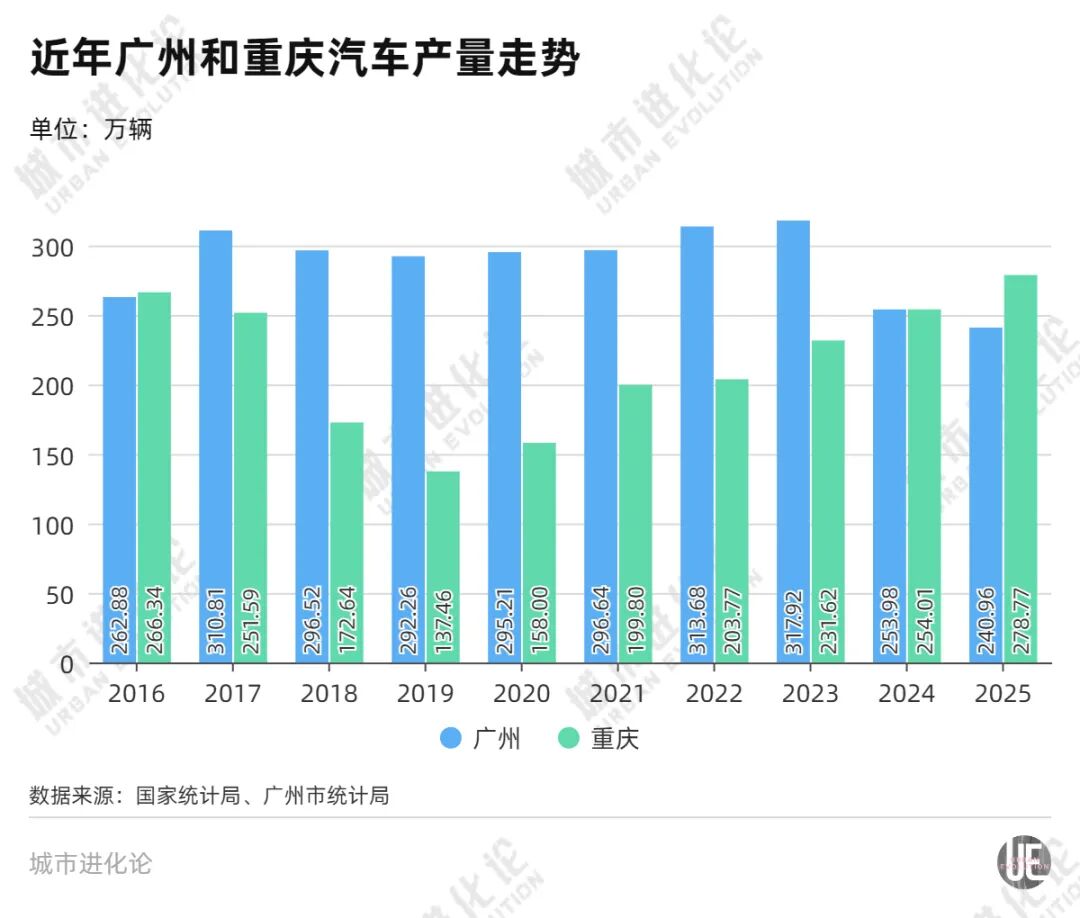
As the largest pillar industry in Guangzhou, the development of the automobile industry affects the whole situation with one single move.
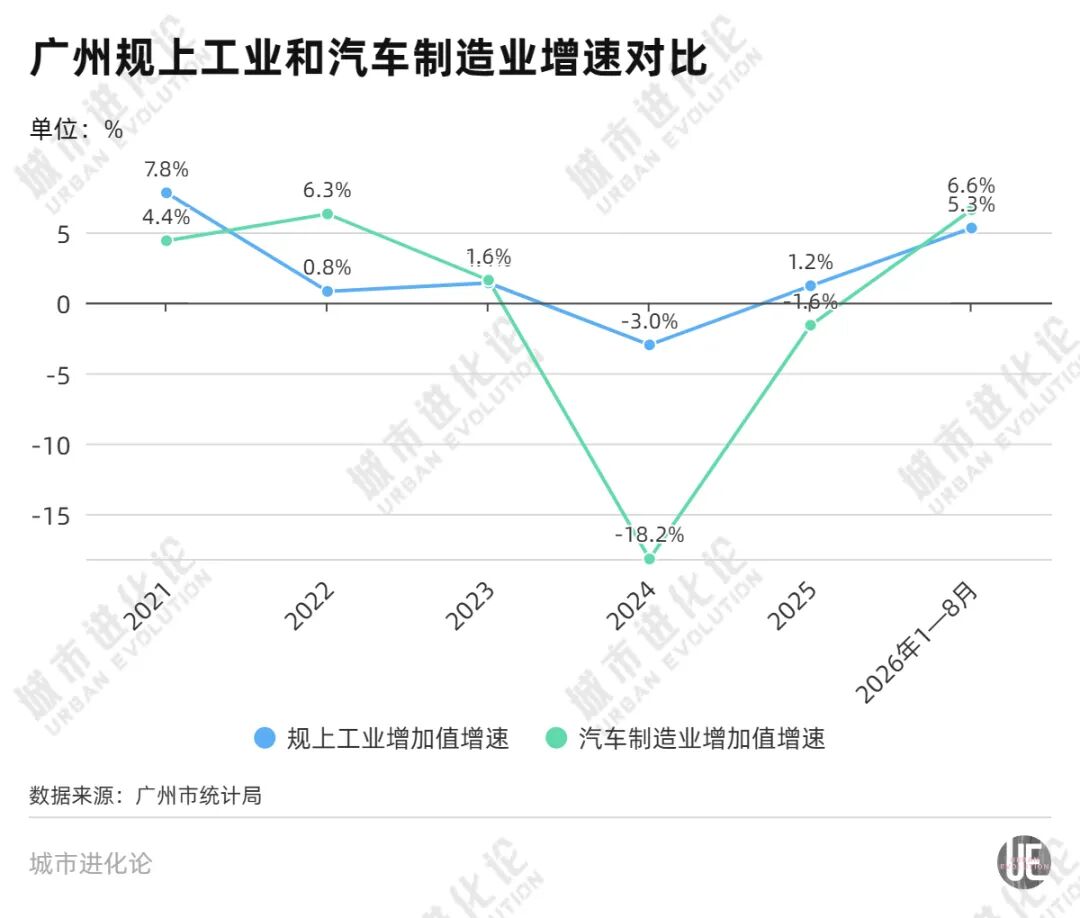
From 2021 to 2025, the added value growth rate of Guangzhou's automobile manufacturing industry was 4.4%, 6.3%, 1.6%, -18.2% and -1.6% respectively, while the added value growth rate of industries above designated size in the whole city was 7.8%, 0.8%, 1.4%, -3.0% and 1.2% respectively in the same period.
It is not difficult to find that the two curves hit the bottom at the same time in 2024, and are still in the process of recovery. It was also in this year that GAC Group announced the implementation of the three-year "Panyu Action", to fully transform to the C-end market, with the goal that the sales volume of self-owned brands will account for more than 60% of the group's total sales volume by 2027, challenging 2 million vehicles.
Two years later, initial results have been achieved. In the first 8 months of this year, the added value growth rate of Guangzhou's automobile manufacturing industry rebounded to 6.6%, and the added value of industries above designated size in the whole city increased by 5.3% year on year.
Among them, the production capacity of new energy vehicles was released faster, with the output increasing by 48.9%. In the same period, the sales volume of new energy vehicles of GAC Group reached 368,200 units, a year-on-year increase of 63.06%, accounting for 36.36% of the total automobile sales volume.
Behind this, Guangzhou's automobile industry is ushering in the "counterattack moment". It was revealed at the Guangdong Provincial Advanced Manufacturing Conference that by 2030, Guangzhou will build a "trillion-yuan smart vehicle city" to realize the transformation from a traditional automobile production base to an industrial highland of intelligent connected new energy vehicles.
Guangzhou's confidence comes not only from its huge complete vehicle scale, but also from its perfect supporting ecosystem. As one of the three major automobile industry bases in China, Guangzhou has gathered 10 complete vehicle manufacturing enterprises and more than 1200 parts and components and trading enterprises, forming the most complete industrial chain ecosystem in China.
Zhang Xiang believes that "software-defined vehicles" has become a trend. Guangzhou has a developed electronic industry and concentrated innovation resources. In the future, its role in the automobile industry may increase the proportion of parts supporting and services, extending to the direction of intelligent connection.
With years of accumulation, Guangzhou's automobile industry has 1 national enterprise technology center, 1 national testing center, and 69 provincial-level innovation platforms of various types, building a R&D network with GAC Research Institute as the core and radiating the whole world.
In 2025, GAC released 12 vehicle-level domestic chips; in April 2026, the first intelligent new energy vehicle with 100% domestic chip design in China — the Hyper GT Climbing Edition was unveiled, and the path for Guangzhou to build a "trillion-yuan smart vehicle city" is becoming clearer and clearer.
Strong Manufacturing City
Facing the "15th Five-Year Plan" period, Guangzhou proposed to build a trillion-yuan automobile industry cluster. Strive to make the annual output value of automobiles exceed 1 trillion yuan, and raise the output value ratio of parts manufacturing industry and complete vehicle manufacturing industry to 0.7:1.
This means that Guangzhou has raised the supporting parts industry to a new height, and further implemented it in the allocation of spatial resources.
According to the latest plan, Guangzhou will optimize the spatial layout of the automobile industry, expand and strengthen 4 automobile industry clusters focusing on complete vehicle manufacturing in Panyu, Nansha, Huangpu and Huadu, and lay out and build a number of core parts industrial parks in Zengcheng, Baiyun, Conghua and other regions.
This also provides an opportunity for the integration of the automobile industry with low-altitude economy, semiconductors, display and other industries. Intelligent connected new energy vehicles have a high degree of overlap with the low-altitude economy and embodied robots in the supply chain, and intelligent accessories such as displays and sensors provided by semiconductors, display and other industries can also find new space in local industrial integration.
During the Guangdong Provincial Advanced Manufacturing Conference, Chen Jin, Chairman of Guangdong Xinyuan Semiconductor Technology Co., Ltd., told local media that the dilemma of "the company's capacity utilization rate just exceeded 60%" three years ago made Xinyuan determined to focus on connecting the upstream and downstream links in the province and integrating terminal applications. In the past two years, not only the capacity utilization rate has exceeded 90%, but also a large number of future orders have been reserved.
Data shows that from 2023 to 2025, the operating revenue of Xinyuan was 1.044 billion yuan, 1.681 billion yuan and 2.582 billion yuan respectively, with an average annual compound growth rate as high as 57.30%. Among them, the revenue from industrial control and automotive electronics sectors increased from 111 million yuan to 544 million yuan, with an average annual compound growth rate of more than 120%, and the revenue proportion exceeded 20% in 2025.
However, the positive trend does not mean that the structural transformation has been completed. The "Guangzhou Plan for Accelerating the Construction of a Strong Advanced Manufacturing City (2024-2035)" released earlier this year accurately analyzed its own "weaknesses and shortcomings" ——
The problems of "one automobile dominating the whole industry" and "strong traditional fuel vehicles while weak new energy vehicles" in Guangzhou's automobile industry are prominent, and the electronic information manufacturing industry missed the development opportunities of terminal products such as mobile phones and computers. Emerging industries such as artificial intelligence, biomedicine, new energy storage and integrated circuits were laid out late and have small volume. The efficiency of scientific and technological achievements transformation needs to be improved, and the rich scientific research resources have not yet been transformed into industrial innovation capability and real productive forces with high quality and high efficiency.
These structural problems are exactly the deep-seated reasons for the pressure on Guangzhou's economy in the past, and also the reality that needs to be faced directly in building a strong manufacturing city.
From this perspective, the six major tracks of "land, sea and air" and "chips, displays and pharmaceuticals" proposed by Guangzhou are more like a precise "make-up lesson" for its own shortcomings — promoting industries with great potential such as automobiles, marine engineering, low-altitude economy and integrated circuits to take the lead in breaking through and forming complete industrial chains.
This article is from the WeChat official account "Urban Evolution Theory", author: Dan Zhongkui, published with authorization from 36Kr.